
OKB and X Layer: $32 million in new stock tokens in one week
Tokenised stocks on the OKX blockchain X Layer added 32 million dollars in seven days, the third-largest weekly gain of any blockchain. OKB pays the fees there, and the price stands at 111.35 dollars.




Which topics should we dive deeper into?
Select what genuinely interests you. Your picks feed directly into our editorial planning.
Crypto news that's actually worth your time.
Weekly. 60 seconds. Carefully curated by our editors: no hype, no promo flood, no spam.
Tokenised stocks on X Layer added 32 million dollars in market capitalisation over seven days. That is the third-largest weekly gain of any blockchain on which such instruments trade, and X Layer is the blockchain of the exchange OKX. For holders of OKB it is the most interesting figure of the week, because OKB pays the fees there. The price itself gives none of it away: 111.35 dollars on Wednesday evening, 4.19 percent lower than seven days earlier.
That gap between usage and price is the reason to read this article. Below are the figures that are documented, and under them the points an investor has to settle before touching one of these stock tokens. The most important of them has nothing to do with the price, but with the question of which regulator stands behind the product and how the tax office classifies it.
X Layer: 32 million dollars added in seven days in tokenised stocks
The figure comes from an analysis by Cryptobriefing dated Tuesday, October 27, 2026. It also carries the trajectory, and that is steeper than the weekly number suggests. X Layer opened trading in tokenised stocks on June 15, 2026, with market capitalisation at zero that day. By September 12 it stood at around 91.5 million dollars. For October 16 the analysis names just under 200 million dollars in assets under management. Estimates for the end of October range between 259 and 304 million dollars, depending on which data service counts. The report gives that range itself, and it is not smoothed over here: anyone adding up tokenised stocks across several blockchains counts the same instruments differently depending on method.
Put in context, that means X Layer has gone from nothing to one of the larger venues for these instruments in four and a half months. The same report also gives the wider picture. The xStocks ecosystem, which X Layer belongs to, reaches around one billion dollars in market capitalisation across all connected blockchains at the end of October 2026, and roughly two billion dollars in cumulative volume has run through trading partners such as Uniswap.
What tokenised stocks are and how xStocks backs them
Tokenised stock: a token on a blockchain that tracks the price of a real share and is backed one-to-one by the underlying instrument by an issuer. The buyer does not hold the share but a claim against the issuer.
The issuer behind the instruments on X Layer is called xStocks. By its own account, xStocks issues tracker certificates backed one-to-one by the real share, and has run the partnership with X Layer since June 2026. That a token is backed one-to-one, however, says nothing about which rights attach to it. A review of the OKX offering from this year records that these tokens provide pure price participation, without dividends and without voting rights. Buying them means buying the price move, not the share.
Technically the instruments do not sit on X Layer alone. OKX's EU help page names X Layer and Solana as the blockchains over which deposits and withdrawals of the supported stock tokens run. Anyone moving such a token off the exchange therefore has to know which blockchain it lands on, because the routes back differ.
OKB as the gas token: why growth on X Layer touches the token
X Layer is a second-layer zkEVM blockchain built with the Polygon toolkit, and OKB is the means of payment for transaction fees there. A review of the offering from this year describes how OKB took on that role alone after the older OKTChain and the OKB version on the Ethereum main blockchain were discontinued. The database DefiLlama lists X Layer under the identifier okb and reports 173.1 million dollars in deposited capital for the blockchain on Wednesday.
The connection is documented, but it is indirect, and that belongs in the picture: more trading on X Layer means more transactions and therefore more fees in OKB. Whether that turns into upward pressure on the price depends on how much of those fees actually accrues and what happens to them. A second-layer blockchain is attractive precisely because its fees are small. The 32 million dollars added in market capitalisation is therefore not a revenue figure, and it is not converted into one here.
One supply figure can be stated firmly by contrast. Circulating supply and maximum supply of OKB both stand at 21 million tokens, so the supply is fully issued and capped. No new tokens can be created, the quantity can only fall.

 Find an exchange with a licence
OKB price at 111 dollars: the weekly range shows the thin liquidity
The price stood at 111.35 dollars on Wednesday evening, up 1.82 percent on the day and down 4.19 percent over seven days, according to data from CoinPaprika. Market capitalisation therefore comes to a good 2.3 billion dollars.
More interesting than the weekly figure is the range inside it. Daily data from Kraken show a session high of 136.18 dollars against a session low of 110.62 dollars for Thursday, October 23. That is a 23 percent spread in a single day, on a closing price of 111.51 dollars. The weekly low fell to 101.00 dollars on October 22. Swings like that do not come from news but from a thin order book: a few large orders move the price a long way, and different venues produce different prices for the same token. How unevenly OKB trading is spread across venues we examined separately in mid-October.
In practice that matters for an order: a market order for a larger sum can be filled at a markedly worse price than the one on the screen. A limit order protects against that but may sit unfilled instead.
The ICE joint venture: 63 US stocks in continuous trading, and the resistance to it
The second part of the story is bigger than the weekly gain and not yet settled. OKX and Intercontinental Exchange, the operator of the New York Stock Exchange, filed through a joint venture with the US Securities and Exchange Commission in early October 2026 to make 63 tokenised US stocks tradable around the clock. Nvidia, Tesla and Apple are among those named.
The application is pending, and it is running into resistance. According to a report by Bitcoin.com, several of the companies concerned have positioned themselves against the move, among them Coca-Cola, JPMorgan and Dell. That is notable because it is not competitors pushing back but the issuers of the shares that are to be tokenised. How the SEC will decide is open, and no date for the decision has been published. Until then, what is already running stays as it is.
MiFID II instead of MiCA: which licence governs distribution
Here lies the point that price coverage usually leaves out and that matters most to an investor. In regulatory terms, stock tokens are not crypto assets but financial instruments. The European crypto regulation MiCA, which European investors have gone by at crypto exchanges since this year, therefore does not apply to them; the securities directive MiFID II does.
OKX describes this on its EU help page itself: the instruments are distributed by OKX Europe Markets Limited, licensed as an investment firm by the Maltese financial regulator MFSA under the Investment Services Act and MiFID II. Trading there is possible around the clock, seven days a week. Another page from the same provider names purchase in euros as a payment route but points expressly to regional restrictions. At the competitor Kraken the same issuer runs through a Cypriot investment firm.
Three things follow that can be checked before money moves. First: the licence applies to a specific company, not to the brand name. Second: a MiCA licence held by the crypto exchange says nothing about the stock tokens, because they fall under a different set of rules. Third: which of the instruments are actually enabled for your account is not in the licence but in the account terms. For choosing a venue and verifying its licence, our overview of regulated crypto exchanges helps.

 Compare brokers for stock tokens
Tax on stock tokens: the one-year holding period does not apply here
The second consequence of classification as a financial instrument hits the tax return, and it lands hard. For crypto assets such as Bitcoin or OKB, Germany applies the one-year holding period of the private disposal transaction: hold for more than a year and no tax falls due on the gain. For shares that period does not apply; there, withholding tax falls due on every realised gain, regardless of holding period.
A token that tracks a share is treated, under the regulatory classification described above, not as a crypto asset but as a financial instrument. It therefore stands to reason that the rules for investment income apply for tax as well, rather than the holding period. That is the classification arising from the product description, and not a ruling from the tax authorities: no published administrative guidance exists on the tax treatment of tokenised shares in Germany that an investor could rely on. Anyone holding such instruments therefore settles the classification with a tax adviser before selling, not afterwards.
In practice that also means a portfolio holding crypto assets and stock tokens side by side needs records that keep the two apart, because different periods apply to each. A statement that mixes both pots can hardly be separated after the fact.
Custody and counterparty risk: what separates a tracker certificate from a share
Counterparty risk: the risk that it is not the price that falls but the contractual partner that fails, the one backing or holding the instrument.
For a share in the account of a bank, that risk is small, because the share belongs to the investor and is merely held in custody. For a tracker certificate on a share it is a point in its own right: the value depends on the issuer actually holding the backing and on the custodian delivering. Move the token off the exchange into your own wallet and the risk shifts, it does not disappear. Responsibility for the key then sits with the investor, while the instrument itself still hangs on the issuer. Self-custody trades the exchange's risk for your own key risk.
Add to that a detail often lost with stock tokens: continuous trading runs around the clock, the price formation of the real share does not. Outside US exchange hours there is no running reference price for the token to orient itself by. In those hours the provider's order book alone sets the price, and it is routinely thinner than during the day.
Levels above and below: 101 and 136 dollars as the week's edges
As observation points rather than price targets, the past week's data give a clear picture. On the downside the weekly low sits at 101.00 dollars from October 22, and below it the round 100-dollar level, which did not break this week. On the upside stands the weekly high of 136.18 dollars from October 23, which was a single spike in thin trading and was not confirmed as a closing price. The more reliable resistance sits closer: the highest daily close of the week was 116.58 dollars on October 21.
The price moved between 101 and 116 dollars all week. The three figures named are observations from the daily data and no statement about where the price is heading.
Stock tokens at OKX: the Malta licence decides, not MiCA
The weekly gain of 32 million dollars shows that something is growing on X Layer, and OKB hangs on it as the fee token. For a purchase decision, though, that is the smaller half of the story. The larger half is that the stock tokens themselves fall under a different set of rules and different taxation than the token paying their fees. Hold both in a portfolio and you hold two products with two rulebooks.
- Settle which company your contractual partner is. With the stock tokens it is an investment firm licensed under MiFID II, not the crypto exchange. If your venue's licence is not established, the overview of crypto brokers helps.
- Keep the tax file separate. The one-year holding period applies to crypto assets, not to financial instruments. Keep the two apart, for instance with one of the tax tools and portfolio trackers, and have the classification checked before you sell.
- Decide on custody before you buy. Your own keys remove the exchange's risk and bring your own; the devices for it sit in the hardware wallet comparison.
(As of October 28, 2026. This article is not investment advice. Prices and fee structures change; check the terms with the provider before you buy.)
Frequently asked questions about OKB and tokenised stocks
Transparency note: This article was produced with the assistance of artificial intelligence and reviewed by our editorial team before publication. All figures and claims were checked against the primary sources linked in the text. The feature image was generated with AI.
Related articles
- Tokenized stocks as collateral: what the October 14 unlock changes for investors in Germany
- Stock Tokens: How to Check Whether Yours Carries Real Shareholder Rights
- Tokenized US Stocks: What the SEC Exemption Changes for You in Germany
- Solana back on top in tokenized equities with 31 percent of the week: What investors need to know
- Securitize launches tokenized stocks with twelve names: how to check whether you can trade them in Germany
Which topics should we dive deeper into?
Select what genuinely interests you. Your picks feed directly into our editorial planning.
Crypto news that's actually worth your time.
Weekly. 60 seconds. Carefully curated by our editors: no hype, no promo flood, no spam.

October 25, 2026 12:27 PM

500,000 euros or a questionnaire: two access rules for tokenized stocks
Tokenized stocks court everyone but let only some subscribe. At Ondo, a retail client in the EEA needs a portfolio of 500,000 euros; for the xStocks range via Kraken, a passed questionnaire is enough. What the paperwork of both providers yields for investors in Germany.
August 19, 2026 4:33 AM

Tokenized Stocks: Why You Do Not Own a Share and Which Risk Hangs on the Issuer
Crypto.com launched tokenized stocks for the EEA on August 12, 2026, and the decisive sentence sits in the small print: buyers acquire no ownership of the underlying asset. What you hold instead, who ranks ahead of you in an insolvency and how to recognise genuine ownership of a security.

October 3, 2026 4:13 AM

OKB at $120, X Layer 10 Percent Below Its Capital Peak: Why One Lending Market Holds 68 Percent
OKB trades at $120.25 after an unusually quiet week. X Layer holds $168.3 million in deposits according to our own survey, and 68 percent of that sits in a single lending market.
September 7, 2026 7:14 AM
Stock Tokens: Who Actually Issues Them and What the SEC Wants to Change by November 3, 2026
Behind every stock token sit an issuer, a broker, a custodian and a blockchain, and today you will only find those names in the small print. The US Securities and Exchange Commission wants them written into an official form; the deadline for comments runs out on November 3, 2026.
September 2, 2026 10:30 AM
Tokenized Stocks: Who Owns the Share When the Register Sits on a Blockchain
The US Securities and Exchange Commission wants to allow the official share register to be kept on a blockchain. What the proposal of September 1, 2026 means for tokenized stocks and for your ownership.

June 13, 2026 11:45 AM
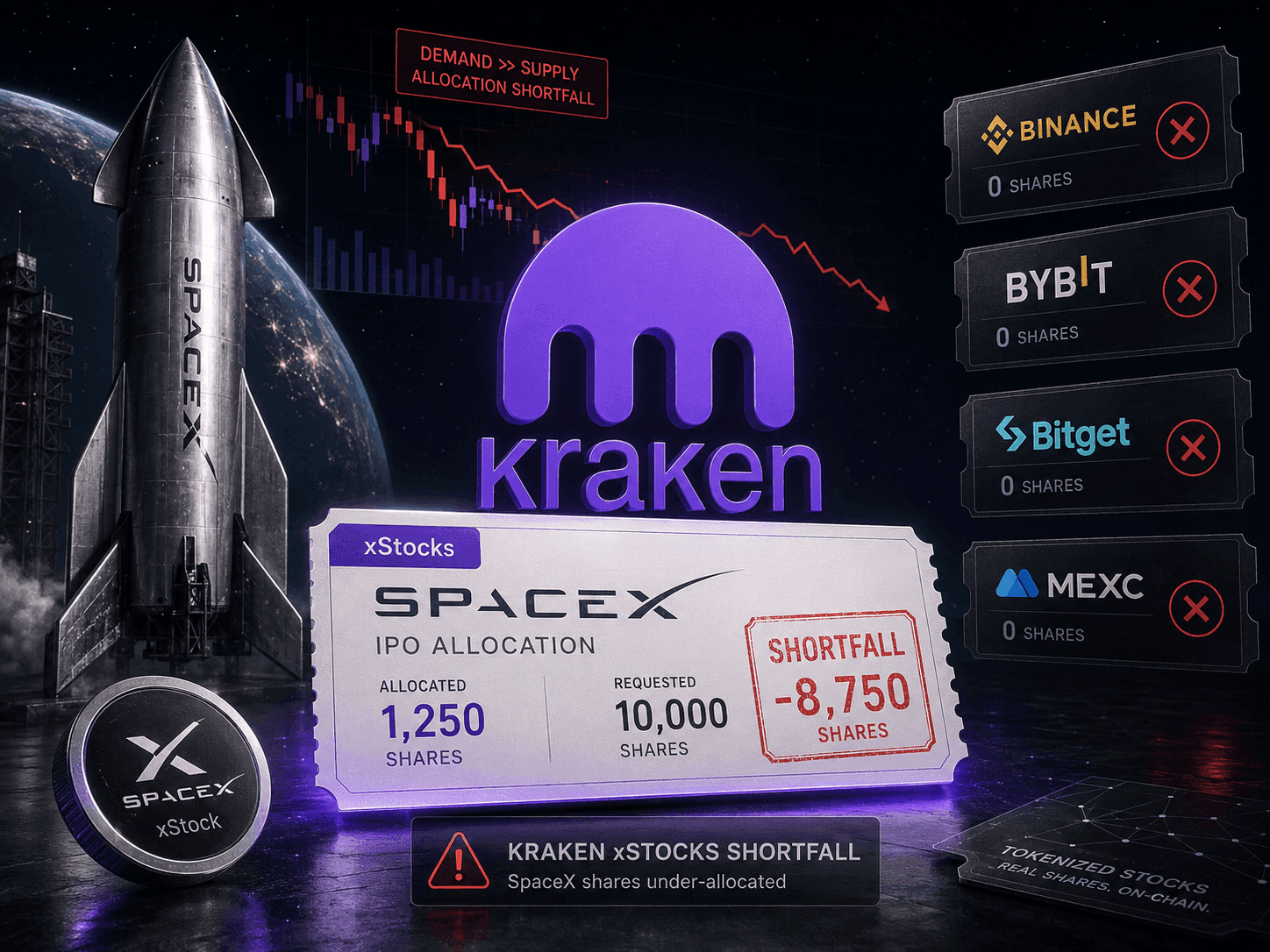
Why Binance, Bybit and Bitget Got Zero SpaceX Shares: Kraken's xStocks Came Up Short
xStocks — Kraken's own tokenized-equity arm — couldn't source SpaceX shares, leaving Binance, Bybit, Bitget and MEXC with zero. Here's why.
May 22, 2025 11:00 PM

You Can Now Trade Tesla and Apple on Kraken... Here's How
Crypto exchange Kraken is launching tokenized stocks for Tesla, Apple, and Nvidia—giving non-U.S. users 24/7 access to some of the world’s biggest companies.
August 6, 2026 1:00 PM

Robinhood Built a Blockchain for Stocks. The Cat Memecoins Took It Over.
$13 million in tokenised equities, memecoins worth ten times that: what Robinhood Chain is, why CASHCAT flooded it, and how investors actually get access.
June 1, 2026 1:17 PM
Binance Launches US Stock Trading with Upcoming bStocks Tokenization on BNB Chain
Binance has introduced zero-commission US stock and ETF trading for non-US users, with plans to launch tokenized on-chain equities via bStocks.
September 9, 2025 11:00 PM
You Can Now Buy US Stocks on Kraken – Here’s How
Kraken brings tokenized US stocks to Europe with xStocks. Trade equities like Nvidia and Google onchain, reshaping the future of crypto and finance.
August 12, 2026 6:24 PM

Tokenized Stocks and Tax in Germany: When the One-Year Holding Period Applies and When the Flat Tax Bites
If you buy a tokenized stock, you often apply the crypto rule: hold for a year, then the gain is tax-free. For these products that assumption usually does not hold, and this article shows from the wording of the law which feature decides the tax regime and how to find it in the issuer documents.
December 21, 2024 12:23 PM

What is MOVE Token and How It Rose to the Top 100 Cryptos
MOVE token is dominating the charts as one of the best-performing cryptocurrencies this month. Learn how it rose to the top 100 cryptos list despite the market's latest corrections.
October 18, 2026 10:34 AM

OKB carries $2.41 billion in market value and $17.9 million of daily turnover: here are the reasons
OKB carries a market capitalisation of $2.41 billion, yet only $17.89 million is traded a day. Our own count of all 33 trading pairs shows where that trading happens and what it means for investors in Europe.

June 13, 2026 10:33 AM

SpaceX IPO Recap: SPCX Closes +19% in a Record Debut, While Tokenized Stocks Stumble
SPCX jumped 19% to a $2T+ valuation on day one — but the tokenized SpaceX trade split in two, and the difference is the real lesson.
October 12, 2026 10:32 PM

Hedera (HBAR): HashPack Switches On Apple and Tesla Tokens, What Matters Now
HashPack switched on trading in tokenised Apple, Nvidia, Tesla and SPY assets on October 8, paid for with HBAR or USDC. HBAR stands at $0.0906, 12 percent below the previous week, while the announcement leaves issuer, fees and country list open.
August 21, 2026 10:16 AM

24-Hour Trading on US Exchanges: What the SEC Roundtable Means for Tokenized Stocks
The US Securities and Exchange Commission takes up the path to round-the-clock trading on American equity markets on September 17, 2026. For tokenized stocks on Kraken and Binance, that puts their most important selling point back on the table.
July 24, 2025 6:00 AM
From Resistance to Adoption: Banks Enter a New Crypto Era
The world’s biggest banks are no longer resisting crypto — they’re embracing it. From JPMorgan to BNY Mellon, a new banking era is unfolding with full-scale crypto adoption and tokenized finance.
October 14, 2026 4:28 AM

Morgan Stanley pushes tokenized equities to 2027: "The client demand really isn't there"
Morgan Stanley will bring tokenized equities to its own trading venue only in the first quarter of 2027, around half a year later than announced. Amy Oldenburg's explanation and the German legal framework show why equity tokens are something different here than there.
October 8, 2026 7:59 PM
Cardano CIP-0113 live: issuers can now freeze and seize regulated tokens, ADA falls 10.3 percent
The Cardano Foundation activated the CIP-0113 standard on the mainnet on October 7, 2026: issuers can write freezing, seizure and KYC rules directly into a token, enforced by the network. ADA itself stays freely transferable and trades at $0.2294, 10.32 percent below the previous day.
September 28, 2026 4:31 PM
Robinhood Chain After September 29: What the End of Free Gas Changes for the Stock Chain
The Robinhood Chain holds $1.02 billion and more trading volume than Polygon, carried by a meme token launchpad. The gas subsidy ends on September 29, fees are already falling, and this is what the ecosystem of Pons, Uniswap and tokenised stocks really rests on.
September 28, 2026 7:24 AM
Base Token: No Date, No Quota, but 6.27 Billion Dollars on the Chain
There is no Base token, only the statement that Coinbase is exploring one. What is measurable instead is 6.27 billion dollars of deposited capital, fees in the hundredths of a cent and an AERO price that has risen 68 percent in thirty days.
September 16, 2026 10:13 AM

USDC on Circle's new Arc chain: what to check before your first transfer
Circle opens the mainnet of its blockchain Arc on September 16, 2026, and on it USDC is the fuel as well. We queried the chain ourselves and show the four points to check before you send USDC there for the first time.
September 13, 2026 7:11 AM
Tokenized Assets on Solana: How to Check Whether Your Token Can Be Frozen or Clawed Back
At Dominion Market, SILV holdings were removed from wallets on September 11 after an exploit. Our query of 32 tokenized assets on Solana shows that every single one carries this permission, and how you can read it up yourself.
August 20, 2026 4:20 AM

Crypto Exchange Delisting: What Happens to Your Tokens When Trading and Withdrawals Close
A delisting runs in four stages, and only one of them is genuinely dangerous: the end of the withdrawal deadline. Using two live OKX dates as the example, we show what happens at each stage and how to tell whether it affects you.
May 2, 2025 4:00 AM
Top 5 Altcoins to Watch in May 2025 After April's Explosive Gains
April 2025 saw major altcoins like SUI, HYPE, and SOL post double-digit gains. With institutional moves and rising on-chain activity driving momentum, here's what to expect from the top-performing altcoins in May 2025.


More from CryptoTicker