
German Crypto Tax Return 2025: What You Should Know Now the July 31 Deadline Has Passed
Recap as of September 27, 2026: the deadline for the 2025 German tax return ended on July 31, 2026 at midnight. This article describes the situation on the day of the deadline: what crypto investors had to report and what happens if the deadline is missed.





Which topics should we dive deeper into?
Select what genuinely interests you. Your picks feed directly into our editorial planning.
Crypto news that's actually worth your time.
Weekly. 60 seconds. Carefully curated by our editors: no hype, no promo flood, no spam.
If you are required to file a German income tax return for 2025 and you are doing it yourself, the clock runs out tonight. Not tomorrow morning, not the first working day of August. The statutory deadline is 31 July 2026 at 24:00, and for crypto investors this particular return carries a few things the previous ones did not.
Here is what still needs to happen in the next few hours.
Why is 31 July the hard deadline this year?
The COVID-era extensions are gone. For the 2025 tax year, the normal rule under § 149 Abs. 2 AO applies again: mandatory filers (Pflichtveranlagung) submit by 31 July of the following year. What counts is the moment your return reaches the Finanzamt, so with ELSTER or tax software it is the successful transmission that matters, not when you started filling it in.
Two exceptions buy you real time:
- Filing through a Steuerberater or a Lohnsteuerhilfeverein. Your deadline moves automatically to 1 March 2027, because 28 February 2027 falls on a weekend.
- Voluntary filing (Antragsveranlagung). If you are not obliged to file and are only submitting because you expect a refund, you have until 31 December 2029 for the 2025 year, with no penalty risk.
Everyone else is on the clock tonight.
Who actually has to report crypto in Germany?
Crypto is not treated like shares here. Coins count as "other assets" under § 23 EStG, which produces the rule that keeps Germany attractive for long-term holders: sell after a holding period of more than twelve months and the gain is tax free, no matter how large it is. The BMF confirmed in its March 2025 letter that staking or lending in the meantime does not extend that period.
Inside the twelve months, it looks different:
- Disposals under one year are taxed at your personal income tax rate, up to 45%.
- The €1,000 Freigrenze covers all private disposals in a calendar year, not just crypto. Note the word: Freigrenze, not Freibetrag. Stay below it and the gain is tax free. Reach it and the whole gain becomes taxable, not just the excess.
- Staking, lending and mining rewards are other income under § 22 Nr. 3 EStG, taxable on receipt at the market rate, with a separate €256 Freigrenze.
- Crypto-to-crypto swaps count as disposals. So do trades on decentralised exchanges. The 2025 BMF letter put DEX activity on the same footing as trades on Binance or Kraken, which means Uniswap and Curve history has to be documented the same way.
- FIFO is the method the German tax office works with, applied per wallet or per exchange.
Most private crypto activity lands in Anlage SO.
What is different about the 2025 return specifically?
Three things, and they all point the same direction.
- Anlage SO now has dedicated crypto lines. From the 2025 tax year onwards, the form has its own section for Kryptowerte rather than a generic "other assets" field. Less room to be vague.
- The grace period on documentation has expired. The BMF letter of 6 March 2025 introduced explicit record-keeping and cooperation duties for crypto, and it came with a Nichtbeanstandungsregelung covering assessment periods up to and including 2024. 2025 is the first year the stricter standard applies without that cushion. Handing over a wallet address is explicitly not enough evidence. The tax office expects transaction overviews or a proper tax report showing type, quantity, acquisition and disposal dates, costs and rates.
- This is the last return you file before the Finanzamt gets the data anyway. DAC8, implemented in Germany as the Kryptowerte-Steuertransparenzgesetz, applies from 1 January 2026. Every crypto service provider registered in the EU now reports user transaction data to the tax authorities automatically. From next year, what you declare gets compared against what your exchange already sent in.
How do you get a filing-ready crypto report in the time you have left?
If your 2025 history is spread across four exchanges, two hardware wallets and a handful of DeFi protocols, reconstructing it manually tonight is not realistic. This is what dedicated tax tooling exists for.
CoinTracking is the option most German filers end up with, for a practical reason: it was built in Germany, in Munich, and has been running since 2012, so the German output is not an afterthought. It generates the Anlage SO as a ready-to-file PDF, and also exports in WISO and SteuerGo formats if you are working inside tax software. FIFO is applied per depot with its Depot Separation setting, which matches how the BMF expects wallet-level calculation to work. Imports cover 400+ exchanges, wallets and blockchains via API, CSV or blockchain address, and the engine tags DeFi swaps, staking rewards and NFT trades automatically rather than making you classify each line by hand.
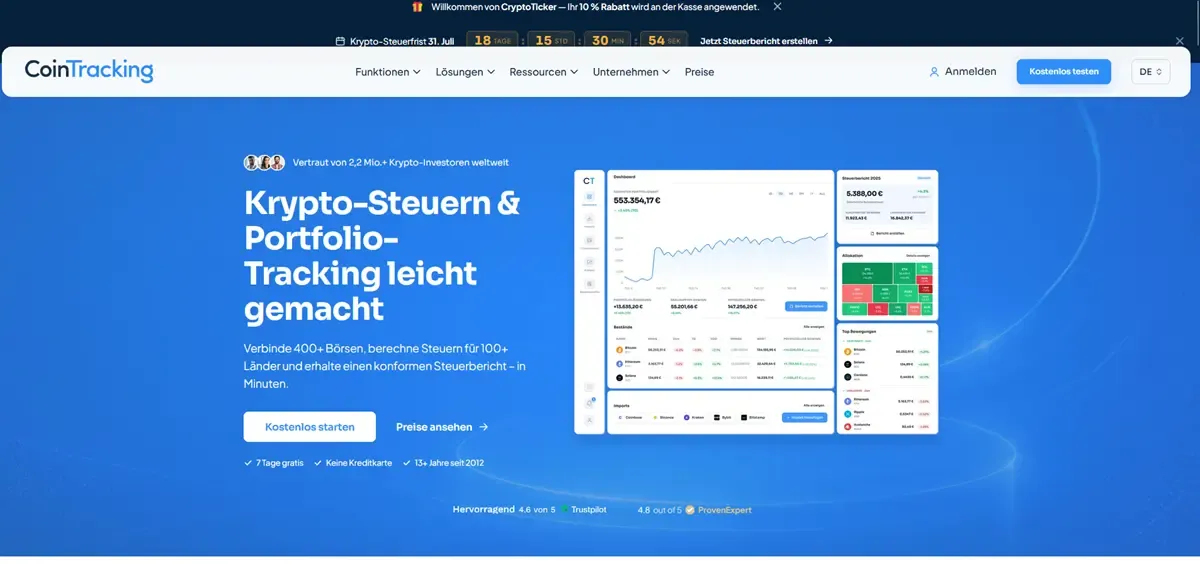
Two practical notes so you are not caught out tonight. New accounts start with a 7-day trial that includes unlimited imports, but the tax report itself sits behind a paid plan, so if you need the Anlage SO today you will be upgrading today. And the import is the fast part: getting your API keys and CSVs in usually takes far less time than reviewing the flagged transactions afterwards.
👉 Import your 2025 history and generate your Anlage SO with CoinTracking
If your history is genuinely messy, the more sensible move may be to accept the second option in the next section instead of rushing a return you cannot substantiate.
What happens if you miss midnight?
From 1 August the Finanzamt is entitled to impose a Verspätungszuschlag where filing was mandatory. It runs at 0.25% of the assessed tax per month, with a minimum of €25 for every month started, and it becomes mandatory rather than discretionary once you are 14 months late. Keep ignoring it and Zwangsgeld and an estimated assessment follow, and an estimate rarely lands in your favour.
You still have two legitimate exits:
- Request an extension. An informal application to your Finanzamt with a real reason (illness, missing documents from an exchange) can be granted. The catch is timing: the request has to arrive before the deadline expires, so that is also a today job.
- Engage a Steuerberater or Lohnsteuerhilfeverein. Doing so moves your 2025 deadline to 1 March 2027 automatically. For anyone with a complicated DeFi or high-frequency year, this is usually the better answer than a rushed self-filing.
One more thing ending tonight: XTB's free Nike share
Separate from the tax calendar, the XTB promotion CryptoTicker readers have been claiming this month also closes today. Open a new account and you get one Nike share (ISIN: US6541061031) credited to your trading account, free.
How it works:
- Open a new XTB account through our link and enter referral code CRYPTOTICKER at the start of the process.
- Complete the account opening and activate your trading account.
- Make any first deposit and accept the promotion terms in the XTB app.
- The Nike share is credited within three business days.
No trades required, no minimum holding period. One timing detail matters if you are starting today: the deposit and the in-app acceptance of the promotion terms must both fall inside the promotion window, which ends today, 31 July 2026. Normally you get seven days after opening. Starting now, that means completing both steps tonight.

👉 Open your XTB account and claim the free Nike share
Investing involves risk. The value of investments can fall as well as rise, and you may get back less than you invested. Promotion terms apply.
 The CryptoTicker newsletter: free, every week
Frequently asked questions about the crypto tax return
Related articles
- Bitcoin and the German Exit Tax: What Applies When You Move Abroad
- Selling bitcoin privately: the tax in Germany and the records you need
- Crypto Taxes 2026 in Germany: Automatic Reporting Under DAC8, What Applies Now
- Crypto Reporting Rules: What Your Exchange Reports to the Tax Office, and Why the Total Is Not Your Profit
- Germany's Crypto Holding Period Faces Abolition: What Petition 201716 and the Draft Bill Mean for Your Tax
Which topics should we dive deeper into?
Select what genuinely interests you. Your picks feed directly into our editorial planning.
Crypto news that's actually worth your time.
Weekly. 60 seconds. Carefully curated by our editors: no hype, no promo flood, no spam.

October 16, 2026 7:25 PM

Crypto holding period for Bitcoin: “That remains to be seen,” says the finance ministry
The federal cabinet did not adopt the draft abolishing the one-year crypto holding period on October 14, 2026; it is still stuck in inter-ministerial consultation. This overview sets out what applies today, which dates follow and why the December 31, 2026 cutoff has no force of law so far.
September 7, 2026 7:22 AM

German Crypto Holding Period Set to Go After All: A Separate Draft Targets Purchases From 2027
Correction of 8 October 2026: The Income Tax Reform Act 2027, adopted by the German federal cabinet on 2 September, does not cover crypto assets. That did not mean the holding period stays. A separate draft bill from the Federal Ministry of Finance, dated 30 September, would abolish it for anything acquired after 31 December 2026. The cabinet is due to decide on 14 October.
September 19, 2026 7:26 AM

Offsetting Crypto Losses Against Share Gains: What Is Really Allowed in Germany
Crypto losses and share gains sit in separate loss buckets in Germany, and there is no offsetting between them. Where the line runs, why crypto derivatives are the exception, and how you can still use losses through carryback and carryforward.
September 27, 2026 10:35 AM

Crypto Exchange Tax Report Wrong: How to Correct It Before the Tax Office Does
Missing acquisition costs, transfers booked as sales, holding periods restarted: your exchange's report is an aid and not proof. How to check it, how to correct it and which deadline is running.
September 8, 2026 1:19 AM

Germany's Crypto Holding Period: What Happens Now Signing for Petition 201716 Closed on September 15
Recap as of September 27, 2026: the signature period for German parliamentary petition 201716, which asks for the one-year crypto holding period to be preserved, closed on September 15, 2026. This article explains what ended that day, how the petitions committee proceeds and why no investor has to sell because of it.

September 27, 2026 1:17 PM

Dogecoin Price: What to Check on Holding Period and Custody Before the Year End
The Dogecoin price stands at $0.0977 on September 27, 2026 and has barely moved in a day. That calm is exactly the moment to work through the holding period, the reporting duty from 2026 and custody without any time pressure.
August 18, 2026 7:13 AM

Bitcoin Tax Reporting in Austria 2026: What Applies
Bitcoin tax reporting in Austria: which data investors can request from crypto exchanges in 2026, and when the report matters for the tax return.
September 9, 2026 1:15 AM

Germany's Crypto Tax: 160 Million Euros for a 555-Billion Budget
The German finance ministry's draft bill puts a figure on the crypto tax for the first time: 160 million euros from 2028. What that number means in the 2027 federal budget, how 11.4 billion became 160 million, and what investors can read from it.
May 16, 2026 11:57 AM

CoinTracking Review 2026 – Crypto Taxes, Portfolio Tracking & Full-Service Support
Manage your crypto taxes effortlessly with our comprehensive guide to CoinTracking. Learn how to track transactions and simplify your tax reporting today!
September 9, 2026 4:22 PM
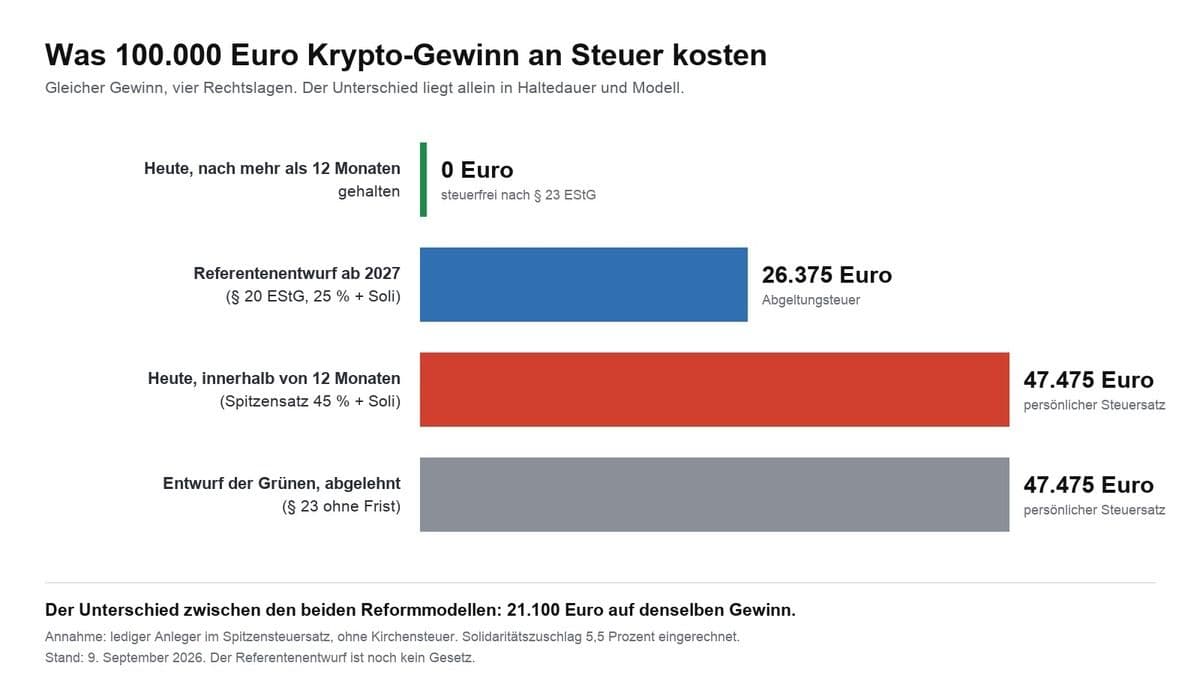
Crypto Tax in Germany: What Applies in 2026 and What Is Set to Change in 2027
Crypto gains are tax-free after twelve months; before that your personal tax rate of up to 45 percent applies. What triggers tax, how the holding period is calculated, what happens with staking and losses, and what the draft bill would change from 2027.

July 1, 2025 2:12 PM

Germany’s Banking Giants Go Crypto: Deutsche Bank and Sparkassen, the 2026 Launch Status
Deutsche Bank plans crypto custody for institutional clients by the end of 2026, the Sparkassen want to offer crypto trading in their app from mid-October. Where both plans stand.
October 12, 2026 7:17 PM

Crypto Futures Tax in Germany: 25 Percent From the First Trade, No One-Year Rule
Crypto futures and perpetuals fall under Section 20 of the German Income Tax Act and therefore a flat 26.375 percent, with no holding period and no 1,000-euro exemption. Since the Annual Tax Act 2024, losses on them can again be offset without limit.
October 8, 2026 4:17 AM

Crypto Holding Period: Without a Purchase Record the Tax Withheld Runs Ten Times Too High
The consultation on Germany's crypto tax bill closed on October 6 and the cabinet is to adopt it on October 14, with tax advisers, banks and the Bitcoin Bundesverband having filed their objections. The sharpest concerns everyone whose purchase data the selling platform does not hold: one adviser calculates a withholding ten times the tax owed.
February 18, 2026 11:00 AM

Top 5 Tax Reporting Tips to Prepare for the 2026 Season
Prepare for the 2026 crypto tax season with our top 5 tips on reporting, tax-loss harvesting, and new IRS rules to avoid penalties.
October 1, 2026 7:36 PM

Crypto tax and withholding at source from 2028: what to check now
The German Federal Ministry of Finance’s draft bill goes to cabinet on October 14, 2026. The underexposed part of it is the deduction of tax from 2028: which providers are to withhold the tax on investment income, why self-custody and foreign platforms stay exempt from it, and what you should document by December 31.
August 31, 2026 10:30 PM

Taxing Crypto Lending: Your Personal Rate Instead of Withholding Tax, and the Right Federal Fiscal Court Case Number
According to the only tax court ruling so far, income from crypto lending falls under Section 22(3) of the German Income Tax Act and therefore under your personal tax rate. The appeal is pending at the Federal Fiscal Court under VIII R 22/25, not under the case number given in many professional articles.
October 18, 2026 7:15 PM

“To effectively combat cross-border tax evasion”: Bundestag opens crypto tax reporting to non-EU states
On 8 October 2026 the Bundestag passed the treaty act on the international reporting framework for crypto-assets, opening the exchange of tax data to states outside the EU. This piece sets out which details flow, from when they flow, and what records a data match requires.
September 8, 2026 10:21 PM

Crypto Holding Period and Grandfathering: Why December 31, 2026 Becomes the Cut-Off in Germany's Draft Bill
A ministerial draft bill from Germany's finance ministry names a cut-off date for the first time: crypto assets acquired after December 31, 2026 are to fall under the flat-rate withholding tax. What that means for legacy holdings, running savings plans and staking income, and why nothing has been decided yet.
October 19, 2026 10:42 PM

Crypto GmbH: 25.6 percent tax from the first sale, nothing privately after a year: what matters now
A crypto GmbH pays 25.6 to 33.3 percent on every gain, from day one. Held privately, the same gain stays tax-free after a year. We work through both routes and show where the GmbH wins regardless.
August 27, 2026 7:21 AM

Crypto Gains 2026: Why the September 10 Advance Tax Payment Decides Your Interest Bill
The third income tax advance payment falls due on September 10, yet for most crypto investors none was ever set. We checked four provisions in full text and show when the interest period for 2026 starts and how you can shrink it yourself.
August 16, 2026 6:14 AM
Crypto Credit Card Tax in Germany: Why Every Payment Is a Disposal
Paying with a crypto credit card means disposing of your coins for tax purposes. What that means for the holding period, the exemption threshold and your record-keeping duties, and which card design keeps the effort small.
September 17, 2026 7:12 PM

Gifting Bitcoin to Children: Allowance, Holding Period and the Tax Office Report
Transferring Bitcoin to your child hands over your holding period and your entry price along with the coins. This guide sets out what really applies in Germany on the allowance, the reporting deadline, representation and custody.
October 15, 2026 4:13 AM

Crypto holding period: the cabinet date passes without a decision, December 31 stays the cut-off
Germany's federal cabinet did not adopt the expected decision of October 14, 2026 to abolish the one-year crypto holding period; the draft is still in interdepartmental consultation. Until new rules arrive, gains stay tax free after one year of holding, and the December 31, 2026 cut-off named in the draft separates old holdings from new ones.
October 6, 2026 10:24 PM

Germany's Crypto Holding Period Before the Petitions Committee on October 12: What Matters Now
The Bundestag's petitions committee debates the crypto holding period on Monday, October 12, 2026, from 12 noon in a public sitting, with federal government representatives on hand for questions. Two days later the cabinet is to decide on the draft bill that removes the one-year period for purchases from 2027.
September 27, 2026 4:40 AM

Crypto Dates in Q4 2026: The Days That Decide Supply, Rates and Tax Duties
From the end of the lock-ups at DoubleZero and Ethena through two rate decisions to the first reporting year under the German Crypto Asset Tax Transparency Act: this calendar lists eighteen dates before New Year's Eve with magnitude and source. You also learn how to tell whether a date will hold at all.
September 24, 2026 1:13 AM

Solana DEX Trades Overtake the NYSE: What to Check on Swaps, Tax and Oversight
Solana's decentralised exchanges settled roughly 208 million trades in a single week and overtook the New York Stock Exchange for the first time. The figure is real, but it measures something other than the comparison suggests, and for German investors it carries tax duties that no provider takes on.
August 24, 2026 10:16 AM

Crypto Tax: Why You Have to Secure Your Transaction History Before the Exchange Closes Your Account
Deadlines run out at several crypto exchanges by early September, after which accounts close and holdings are sold off by force. Anyone who does not export the trading record beforehand faces the tax return with no proof of acquisition date and purchase price.
More from CryptoTicker