
“To effectively combat cross-border tax evasion”: Bundestag opens crypto tax reporting to non-EU states
On 8 October 2026 the Bundestag passed the treaty act on the international reporting framework for crypto-assets, opening the exchange of tax data to states outside the EU. This piece sets out which details flow, from when they flow, and what records a data match requires.





Which topics should we dive deeper into?
Select what genuinely interests you. Your picks feed directly into our editorial planning.
Crypto news that's actually worth your time.
Weekly. 60 seconds. Carefully curated by our editors: no hype, no promo flood, no spam.
The Bundestag decided on October 8, 2026 that German tax authorities may in future exchange data on crypto transactions with countries outside the European Union as well. What passed is a treaty act on an international agreement from 2023 that implements the crypto-asset reporting framework. If you hold coins at an exchange in Singapore, the Cayman Islands or Switzerland, that account no longer sits beyond the reach of the German tax office, as soon as the partner state delivers in return.
This piece sets the vote in context: what exactly gets reported, from when, which countries take part, and where the figures in press coverage diverge. The tax liability itself does not change. What changes is the likelihood that the tax office can cross-check a figure.
What the Bundestag decided on October 8
Parliament adopted the government bill in the version agreed in committee. The full title is the “Act on the Multilateral Agreement of 8 June 2023 between the Competent Authorities on the Automatic Exchange of Information pursuant to the Crypto-Asset Reporting Framework”. It is on file as Bundestag printed paper 21/7195, the finance committee’s recommendation as printed paper 21/8425.
The majority was broad. According to the Bundestag, CDU/CSU, SPD, Bündnis 90/Die Grünen and Die Linke voted in favour, while the AfD group voted against. The federal government justifies the measure with the aim it words as follows: “To effectively combat cross-border tax evasion”.
A treaty act is not new tax law. It grants domestic approval to an agreement under international law that Germany has already signed. Only then may the Federal Republic actually send and receive the data.
CARF: the crypto-asset reporting framework in one sentence
CARF stands for Crypto-Asset Reporting Framework and is the OECD reporting standard that obliges crypto service providers to report user data and transaction totals to their tax authority, which then passes them on to the countries where those users are resident. The model is the Common Reporting Standard, under which banks have been exchanging account data for years. CARF carries that pattern over to exchanges, brokers, custodians and swap services.
We have taken the standard and its relationship to the CRS apart in a separate piece on the OECD reporting standards for crypto-assets. The October vote is the step with which Germany makes that framework usable beyond the EU border.
The data points the bill lists
The bill sets out what is transmitted for every reported user: “name, address, countries of residence, tax identification number and date of birth”. Added to that is the type of each individual crypto-asset. And finally the transaction data: gross transaction amounts, the number of units and the number of reportable transactions.
The term gross transaction amount deserves attention. What is reported is not your profit but your turnover. Move the same 2,000 euros around twenty times in a year and you appear with 40,000 euros in volume, even though the profit can be zero. We have described what that distinction means in practice here: what your exchange reports to the tax office.
Why the gross figure triggers follow-up questions
A tax office that sees a high gross total and finds no corresponding entry in the tax return has a starting point for a query. That is neither suspicion nor an estimate, but first of all a discrepancy between two data sets. It can only be resolved with a breakdown of the individual transactions. Without that breakdown you have to reconstruct it after the fact, and that is laborious at an exchange you left three years ago. A portfolio tracker with tax reporting solves the problem in advance, because it records the transactions as they happen instead of rebuilding them later.

DAC 8 and CARF: two routes, one tax office
Inside the European Union the exchange already exists. The Bundestag points out that for platforms and cryptocurrencies the corresponding European and national reporting obligations under DAC 7 and DAC 8 are already in place. DAC 8 is the EU administrative cooperation directive that brings crypto service providers into the reporting regime; the Bundestag had passed the German implementation back in November 2025.
That makes the division of labour clear: DAC 8 covers the EU, CARF covers the countries outside it. We wrote up what DAC 8 requires in detail when the German implementation was adopted. The October vote closes the gap that had sat between the two worlds until then.
 Find the right crypto tax tool
The timeline: collection in 2026, reporting in 2027
Precision matters here, because several years get mixed up in press coverage. The sequence that follows from the available information looks like this: the service providers subject to reporting collect the transaction data from 2026 onwards. Reporting to the respective tax authority begins in 2027. Under the OECD’s plans, the international exchange between the authorities also starts in 2027.
The Bundestag’s own text names neither a start date for the exchange nor a collection year. If you read a specific month, treat it as the reporting outlet’s figure rather than as something the law fixes. The direction is certain: the current year is already a collection year. Nothing about that can be changed retroactively.
There is also a condition that is easy to miss. An exchange relationship does not come into being through the signature alone. Both states have to bring their rules into force, notify the OECD and name each other as partners. Until that has happened, nothing flows between two signatories.
27, 46 or 55 countries? Why the numbers differ
Three figures circulate for the number of countries involved, and all three can be explained once you tie them to the right question.
For the signing, the Bundestag gives a clear figure: the multilateral agreement was signed in November 2024 by Germany and 26 further countries, so by 27 states. The signing took place in Asunción, Paraguay. Separate from that is the number of states that actually intend to start the exchange from 2027: for that, the OECD names 46 jurisdictions, according to the specialist site Blocktrainer. The third figure, 55, comes from the Bundestag debate itself; the AfD member Jörn König spoke of 55 further states. Blocktrainer considers that figure inaccurate and points to the OECD number.
The middle figure is the most useful one in practice, because it describes where data is meant to flow from 2027. The agreement is also open-ended: further states will join later. The United Arab Emirates and Turkey are named for 2028, the United States has committed to taking part from 2029 and is absent from the first wave.
What a missing country does not mean
A country missing from the first wave does not make gains there tax-free. In Germany, tax liability attaches to your residence, not to where the exchange is based. A missing exchange relationship only lowers the chance that a figure gets matched automatically. The duty to file a complete return applies regardless, and an incomplete return stays incomplete even if nobody checks it.
Exchanges outside the EU: where reporting applies
The reporting duty falls on the providers, not on the users. A provider is caught where it is resident or carries on its business. One simple question follows from that: in which country is the provider holding your balance based, and does that country have an exchange relationship with Germany?
For a platform licensed in the EU, DAC 8 answers that anyway. For a provider in a non-EU state, the partner list decides. And there is a third case that has become very concrete in Germany this year: providers that fail to get their licence and rebuild their business. The marketplace bitcoin.de shows what that looks like after BaFin refused it a MiCAR licence; we set out the situation for balances held there in October. If you move for a reason like that, choose the destination by its licence and not by its fee table; an overview of the trading venues regulated in the EU is in our comparison of regulated crypto exchanges.

Documentation: the records a data match requires
Matching two data sets only works if you have your own. For every position, what counts is the date of acquisition, the acquisition cost, the date of disposal and the disposal proceeds. At a single exchange with a handful of purchases that is manageable. It gets messy with moves between platforms, with coin-to-coin swaps and with transactions at providers that can no longer be reached.
Two points are especially error-prone. First, swapping one coin for another: for tax purposes that is a disposal and an acquisition in one transaction, even though no euro moved. Second, transfers to your own wallet, which are not a sale but can appear as a transaction in a reported data set. Both can only be explained with a breakdown that shows the transaction.
The exemption threshold for private disposals and the one-year holding period under section 23 of the German Income Tax Act continue to apply unchanged. Motions by the Greens and the Left to abolish the holding period found no majority in the Bundestag. Check the amounts that apply for your year before you file, with the tax office or in your tax software, because they have been adjusted several times in recent years.
 Compare MiCA-regulated crypto exchanges
The criticism: data protection in non-EU states and Article 2
The dissent came from the AfD group. According to Blocktrainer’s report, the member Jörn König raised two objections. First, sensitive data should not go to states whose level of data protection falls below the European one. Second, he criticised Article 2 of the act: it allows the federal finance ministry to change the scope of the exchanged data by regulation, without the Bundestag voting again. König called for that article to be deleted. His group also demanded that transfers between a user’s own wallets be excluded and that a de minimis threshold be introduced.
The second objection concerns a mechanism that is notable regardless of the political verdict: after the vote, the scope of reporting is not fixed for good; it can be widened by regulation. To know what will be reported in two years, you therefore have to keep an eye on the regulations, not just on the act.
There is reticence inside the coalition too, though on a different question. On the debate about taxing crypto-assets like shares, the CDU/CSU member Georg Günther was sceptical, according to the same report: “There is no convincing reason for a change of system”, crypto-assets were “not classic securities”, and he summed up: “Tax transparency yes, but no tightening for its own sake.” The distinction in that is useful for context: transparency and the tax rate are two different building sites, and so far only transparency has been decided.
What CARF does not change: the tax liability stays
A reporting framework does not levy tax. It only shifts who knows what. That comes down to three points which remain unchanged after the vote.
The amount of your tax still follows German income tax law, not the law of the state where the exchange is based. The duty to file a complete return rests with you and not with the service provider; a report from the exchange does not replace an entry in your tax return. And the burden of proof for acquisition cost and holding period also stays with you, which is why patchy documentation is a problem even when nothing was reported at all.
That reporting duties are growing beyond exchanges is shown by a development of late summer: wallet manufacturers are now covered in the EU as well. Across all the individual measures the direction is the same: what only you used to know is becoming matchable.
Crypto tax reporting: from 2027 the 2026 data is on file
The vote of 8 October only takes effect in the future, but the collection year is running now. Three steps follow from it.
- Take stock. Note which providers hold balances for you and which country each of them sits in. That shows which positions DAC 8 already captures and which will be added through CARF. Which trading venues are licensed in the EU is shown in our comparison of regulated crypto exchanges.
- Close the gaps in your history. Export the transaction history everywhere you can still retrieve it, and store it off the platform. At a provider that is rebuilding or winding down its business, the export is no longer available later. A tax tool with portfolio reporting handles that part on an ongoing basis.
- Move long-term holdings into your own custody. A transfer to your own wallet is not a sale, but it can appear as a transaction in a reported data set. Note the date and the destination address so the transaction stays explainable later. Which devices are suitable for that is shown in our hardware wallet comparison. If you failed to declare gains for a past year, settle that with tax advice beforehand.
You can read the vote itself: the Bundestag documents it in its text archive for the sitting week, and the DAC 8 implementation from November 2025 is documented there as well.
(As of October 18, 2026. This article is not investment advice. Prices and fee structures change; check the terms with the provider before you buy.)
Frequently asked questions about CARF and the crypto data exchange
Transparency note: This article was produced with the assistance of artificial intelligence and reviewed by our editorial team before publication. All figures and claims were checked against the primary sources linked in the text. The feature image was generated with AI.
Related articles
- Bitcoin Tax Reporting in Austria 2026: What Applies
- Crypto Taxes 2026 in Germany: Automatic Reporting Under DAC8, What Applies Now
- Using Hyperliquid from Germany: What Applies to Your Funds Without a MiCA Licence
- Bitcoin and the German Exit Tax: What Applies When You Move Abroad
- Crypto Reporting Rules: What Your Exchange Reports to the Tax Office, and Why the Total Is Not Your Profit
Which topics should we dive deeper into?
Select what genuinely interests you. Your picks feed directly into our editorial planning.
Crypto news that's actually worth your time.
Weekly. 60 seconds. Carefully curated by our editors: no hype, no promo flood, no spam.

July 31, 2026 10:59 AM

German Crypto Tax Return 2025: What You Should Know Now the July 31 Deadline Has Passed
Recap as of September 27, 2026: the deadline for the 2025 German tax return ended on July 31, 2026 at midnight. This article describes the situation on the day of the deadline: what crypto investors had to report and what happens if the deadline is missed.

September 17, 2026 7:12 PM

Gifting Bitcoin to Children: Allowance, Holding Period and the Tax Office Report
Transferring Bitcoin to your child hands over your holding period and your entry price along with the coins. This guide sets out what really applies in Germany on the allowance, the reporting deadline, representation and custody.
September 24, 2026 1:13 AM

Solana DEX Trades Overtake the NYSE: What to Check on Swaps, Tax and Oversight
Solana's decentralised exchanges settled roughly 208 million trades in a single week and overtook the New York Stock Exchange for the first time. The figure is real, but it measures something other than the comparison suggests, and for German investors it carries tax duties that no provider takes on.
August 20, 2026 10:24 PM

MiCA Review: What the European Commission Could Change About the EU Crypto Rules
The European Commission has reopened MiCA for review after barely two years and is asking 86 questions covering the stablecoin interest ban, staking, lending and DeFi. Brussels is taking responses until September 30, 2026.
August 20, 2026 7:18 AM

Crypto Exchange Self-Certification: No Answer by 1 January 2027 and Trading Stops
The German Crypto Asset Tax Transparency Act obliges crypto providers to obtain a tax self-certification from every existing customer by 1 January 2027. Anyone who ignores the request, the reminder and the formal notice is barred from trading after 60 to 90 days.
October 5, 2026 1:15 AM

Five of nine BaFin warnings cite the Crypto Markets Supervision Act: "This is a case of identity misuse"
Within four days at the end of September, BaFin publicly named nine providers, five of them over unauthorised crypto-asset services. Behind the warnings stands the Crypto Markets Supervision Act, and since the transitional period ran out there is no grey area left for crypto providers in Germany.
September 19, 2026 1:14 AM

Crypto investment fraud: when the tax office taxes phantom gains and what to check now
Between September 11 and 16, 2026, BaFin published thirteen consumer notices, seven of them on crypto-assets. Anyone who has paid into such a platform risks not only the loss but, in some circumstances, a tax demand on gains that never existed.
September 9, 2026 1:15 AM

Germany's Crypto Tax: 160 Million Euros for a 555-Billion Budget
The German finance ministry's draft bill puts a figure on the crypto tax for the first time: 160 million euros from 2028. What that number means in the 2027 federal budget, how 11.4 billion became 160 million, and what investors can read from it.
August 21, 2026 4:27 PM

Wallet App Without BaFin Authorisation: When Holding Crypto-Assets Requires a Licence
On 19 August 2026 BaFin published two consumer notices on wallet offerings. Who controls the means of access decides whether an authorisation is needed.
September 9, 2026 4:22 PM
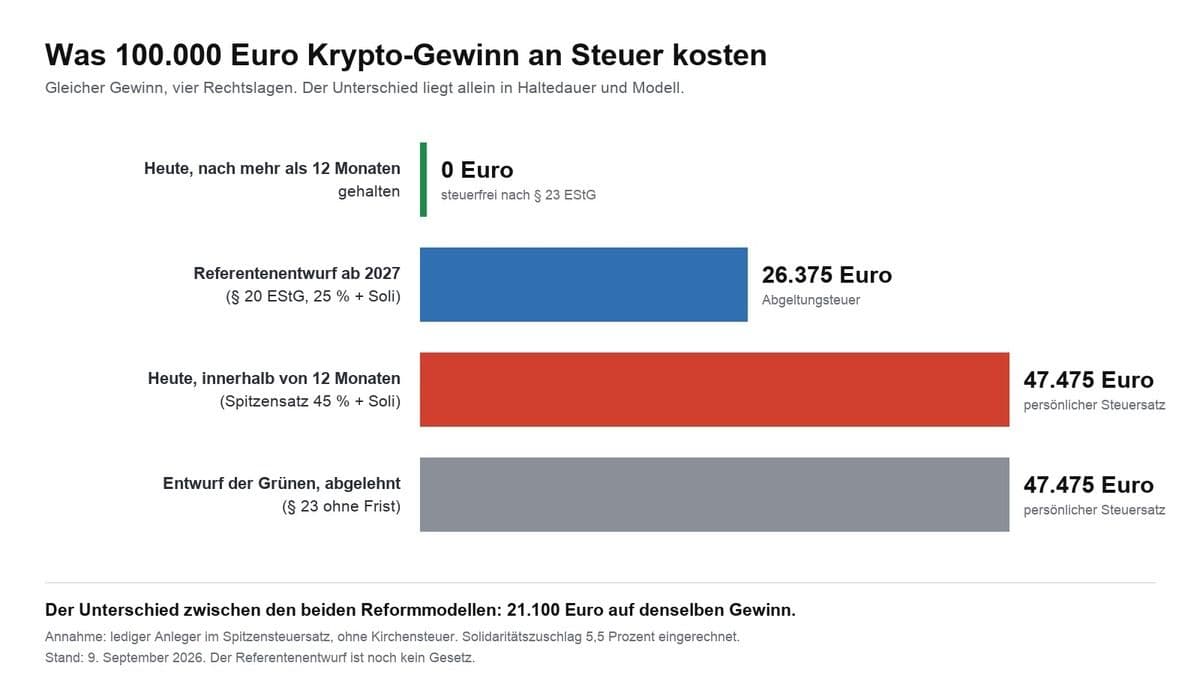
Crypto Tax in Germany: What Applies in 2026 and What Is Set to Change in 2027
Crypto gains are tax-free after twelve months; before that your personal tax rate of up to 45 percent applies. What triggers tax, how the holding period is calculated, what happens with staking and losses, and what the draft bill would change from 2027.
September 26, 2026 1:19 AM

Germany’s Crypto Holding Period Is Wobbling: What to Check Before December 31
A CDU member of the Bundestag makes it plain: the coalition agreement does not guarantee that the one-year holding period for crypto assets will survive. What that means for purchases made before the planned cutoff date of December 31, 2026.
May 16, 2026 11:57 AM

CoinTracking Review 2026 – Crypto Taxes, Portfolio Tracking & Full-Service Support
Manage your crypto taxes effortlessly with our comprehensive guide to CoinTracking. Learn how to track transactions and simplify your tax reporting today!
September 22, 2026 7:23 AM

Gifting Bitcoin to Your Spouse: Allowance, Holding Period and the Report to the Tax Office
Thanks to a 500,000 euro allowance, a gift to a spouse is almost always free of gift tax, and it is not a disposal either. What matters is what travels with it: your purchase date, your purchase price and with them the state of the one-year holding period.
January 14, 2020 12:26 AM

Can Ethereum be Converted to Cash?
Ethereum (ETH) is a prominent crypto-asset. It is a project with high trading volume and thus liquidity. It is traded across almost all exchanges – whether major or minor or centralized or not. All cryptocurrencies have a trading pair against […]
October 12, 2026 7:17 PM

Crypto Futures Tax in Germany: 25 Percent From the First Trade, No One-Year Rule
Crypto futures and perpetuals fall under Section 20 of the German Income Tax Act and therefore a flat 26.375 percent, with no holding period and no 1,000-euro exemption. Since the Annual Tax Act 2024, losses on them can again be offset without limit.
October 8, 2026 4:17 AM

Crypto Holding Period: Without a Purchase Record the Tax Withheld Runs Ten Times Too High
The consultation on Germany's crypto tax bill closed on October 6 and the cabinet is to adopt it on October 14, with tax advisers, banks and the Bitcoin Bundesverband having filed their objections. The sharpest concerns everyone whose purchase data the selling platform does not hold: one adviser calculates a withholding ten times the tax owed.
August 27, 2026 10:16 AM

Bitcoin Tax Return in Austria: When You Must File
Even with a crypto exchange, a tax return can still be necessary in Austria. Foreign platforms, missing capital gains tax withholding and cross-provider losses are the typical triggers.

February 18, 2026 11:00 AM

Top 5 Tax Reporting Tips to Prepare for the 2026 Season
Prepare for the 2026 crypto tax season with our top 5 tips on reporting, tax-loss harvesting, and new IRS rules to avoid penalties.
October 1, 2026 7:36 PM

Crypto tax and withholding at source from 2028: what to check now
The German Federal Ministry of Finance’s draft bill goes to cabinet on October 14, 2026. The underexposed part of it is the deduction of tax from 2028: which providers are to withhold the tax on investment income, why self-custody and foreign platforms stay exempt from it, and what you should document by December 31.
August 31, 2026 10:30 PM

Taxing Crypto Lending: Your Personal Rate Instead of Withholding Tax, and the Right Federal Fiscal Court Case Number
According to the only tax court ruling so far, income from crypto lending falls under Section 22(3) of the German Income Tax Act and therefore under your personal tax rate. The appeal is pending at the Federal Fiscal Court under VIII R 22/25, not under the case number given in many professional articles.
September 8, 2026 10:21 PM

Crypto Holding Period and Grandfathering: Why December 31, 2026 Becomes the Cut-Off in Germany's Draft Bill
A ministerial draft bill from Germany's finance ministry names a cut-off date for the first time: crypto assets acquired after December 31, 2026 are to fall under the flat-rate withholding tax. What that means for legacy holdings, running savings plans and staking income, and why nothing has been decided yet.
September 1, 2026 1:25 PM

Bitcoin Tax Report Wrong: What Austrian Investors Can Do
Errors in a Bitcoin tax report are not unusual. This is the data Austrian investors should check, and how a wrong capital gains tax deduction is put right.
September 5, 2026 10:24 PM

Fake German Finance Ministry Letters: Why Nobody May Demand 19 Percent VAT on Your Crypto Purchase
Since September 1, 2026, Germany's Federal Ministry of Finance has been warning about forged letters that demand 19 percent VAT on cryptocurrency purchases while citing real transactions. That tax does not exist, and this is how to spot the forgery.
July 2, 2026 8:59 PM
Binance Is Out of the EU: How to Move to a MiCA-Regulated Exchange
Binance has left the EU market. Which exchanges hold a MiCA licence, how to verify an authorisation is real, and how to move your holdings across step by step.
September 26, 2026 7:29 PM

Coins Stolen in an Exchange Hack: What the German Tax Office Accepts as a Loss
After the attack on Bitget on September 24, a question the reports leave out arises for those affected in Germany: can a stolen balance be written off against tax? The answer hangs on a single term in the Income Tax Act, and it is decided by your records.
August 21, 2026 1:42 PM

Writing Off a Total Crypto Loss: When the Tax Office Recognises Worthless Coins
A token that has collapsed only reduces your tax once you actually dispose of it. What applies to delisting, exchange insolvency and worthless holdings under Section 23 of the German Income Tax Act, and how you offset losses.
October 9, 2026 1:18 PM

Bitcoin Tax: One Year Past the $126,080 Peak, Losses No Longer Count
Bitcoin trades at $82,558 on Friday morning, 34.5 percent below an all-time high that is now a good year old. Anyone who bought back then loses more than the prospect of a quick recovery when the one-year period expires: the tax value of the loss goes with it.
More from CryptoTicker