
Top 5 Tax Reporting Tips to Prepare for the 2026 Season
Prepare for the 2026 crypto tax season with our top 5 tips on reporting, tax-loss harvesting, and new IRS rules to avoid penalties.





Which topics should we dive deeper into?
Select what genuinely interests you. Your picks feed directly into our editorial planning.
Crypto news that's actually worth your time.
Weekly. 60 seconds. Carefully curated by our editors: no hype, no promo flood, no spam.
Preparing for the crypto tax reporting season can be a daunting task for many investors, especially with the IRS introducing new regulations for 2026. As the tax deadline approaches, staying organized and understanding how your digital asset transactions are treated is crucial to avoid penalties and optimize your returns. Whether you are trading on centralized exchanges or interacting with complex DeFi protocols, a proactive approach to crypto tax prep will save you both time and money.
Essential Checklist for Crypto Tax Readiness
To ensure a smooth filing process, investors should focus on these five key areas:
- Centralize Your Data: Gather transaction histories from all exchanges, wallets, and platforms.
- Identify Taxable Events: Distinguish between capital gains (selling/swapping) and ordinary income (staking/mining).
- Leverage Tax-Loss Harvesting: Sell underperforming assets to offset realized gains.
- Track Cost Basis Accurately: Use the FIFO or Specific Identification method to determine profit.
- Utilize Professional Software: Automate the calculation of complex trades and DeFi activity.

1. Centralize Your Transaction History
The biggest hurdle in crypto tax reporting is the fragmentation of data. Most investors use multiple platforms, and the IRS now requires brokers to report gross proceeds via Form 1099-DA for transactions starting in 2025 (filed in 2026). However, these forms may not always include your correct cost basis if you transferred assets from an external hardware wallet.
You must download CSV files or connect via API to every service you've used. This includes centralized exchanges like Coinbase or Kraken, as well as on-chain activity on $Ethereum, $Solana, or $Bitcoin. Keeping an updated record ensures you aren't paying more than you owe due to "missing" acquisition data.
2. Differentiate Between Capital Gains and Income
In the eyes of the Internal Revenue Service (IRS), not all crypto activity is taxed the same way. Understanding this distinction is vital:
- Capital Gains: Triggered when you sell crypto for fiat, swap one coin for another (e.g., $BTC to $ETH), or use crypto to purchase goods.
- Ordinary Income: Triggered when you receive crypto as a reward. This includes staking rewards, mining proceeds, airdrops, and payments for services.
Failing to report staking rewards as income upon receipt is a common mistake that can lead to audits. Ensure you are recording the fair market value of these tokens in USD at the exact time they entered your "dominion and control."
3. Implement Crypto Tax-Loss Harvesting
If you are sitting on "underwater" positions, you can use them to your advantage. Tax-loss harvesting involves selling assets at a loss to offset your capital gains. In the US, if your losses exceed your gains, you can even use up to $3,000 of those losses to offset your regular income.
Unlike stocks, the "wash sale rule" has historically been more flexible for crypto, though legislation like the CLARITY Act continues to be debated in Congress. Consult a professional or use our comprehensive USA crypto tax guide to see how you can legally minimize your liability.
4. Master Cost Basis Methods
When you sell a portion of your holdings—for example, selling 0.5 Ethereum after buying it at different price points over the year—you must decide which "lot" you are selling.
- FIFO (First-In, First-Out): The first coins you bought are the first ones sold.
- HIFO (Highest-In, First-Out): Selling the most expensive coins first to minimize gains.
Choosing the right method can significantly impact your tax bill. Consistency is key; once you choose a method for a tax year, you should generally stick with it across your entire portfolio to remain compliant.
5. Use Specialized Crypto Tax Software
Manually calculating taxes for hundreds of DeFi transactions or NFT flips is nearly impossible. Professional tools can sync with your wallets and automatically generate the necessary forms, such as Form 8949 and Schedule D.
These platforms also help bridge the gap when an exchange doesn't provide a 1099-DA or when you need to reconcile transfers between different crypto exchanges. Automating this process reduces human error and provides a clear audit trail.
2026 Crypto Tax Deadlines & Forms
| Category | Form | Deadline |
|---|---|---|
| Broker Reporting | 1099-DA | February 17, 2026 |
| Capital Gains/Losses | Form 8949 / Schedule D | April 15, 2026 |
| Staking/Mining Income | Schedule 1 (Form 1040) | April 15, 2026 |
| Foreign Assets (> $50k) | Form 8938 (FATCA) | April 15, 2026 |
Related articles
- Bitcoin Tax Reporting in Austria 2026: What Applies
- CoinTracking Review 2026 – Crypto Taxes, Portfolio Tracking & Full-Service Support
- Bitcoin Tax Report Wrong: What Austrian Investors Can Do
- Bitcoin Losses and Dividends in Austria: How the Tax Offset Works
- Crypto Loss Carryforward in Germany: What Happens to Old Losses Under the 2027 Tax Plan
Which topics should we dive deeper into?
Select what genuinely interests you. Your picks feed directly into our editorial planning.
Crypto news that's actually worth your time.
Weekly. 60 seconds. Carefully curated by our editors: no hype, no promo flood, no spam.

August 22, 2026 4:16 PM

Crypto Stolen or Scammed: What to Do Now and Where to Report It
Wallet drained or fooled by a fake platform? Which steps count in the first hours, where to file a report, when regulators, exchanges and stablecoin issuers can help, and why recovery services that want money upfront are the second trap.

January 1, 2026 3:12 PM

Crypto Taxes 2026 in Germany: Automatic Reporting Under DAC8, What Applies Now
Since 1 January 2026 crypto providers in the EU must record their customers' transactions for the tax authorities. The first report for 2026 follows in 2027. What investors need to know.
September 19, 2026 7:26 AM

Offsetting Crypto Losses Against Share Gains: What Is Really Allowed in Germany
Crypto losses and share gains sit in separate loss buckets in Germany, and there is no offsetting between them. Where the line runs, why crypto derivatives are the exception, and how you can still use losses through carryback and carryforward.
August 27, 2026 10:16 AM

Bitcoin Tax Return in Austria: When You Must File
Even with a crypto exchange, a tax return can still be necessary in Austria. Foreign platforms, missing capital gains tax withholding and cross-provider losses are the typical triggers.
September 17, 2026 10:22 PM

Selling Bitcoin at a Loss and Buying It Straight Back: What That Does to Your Holding Period
Germany has no wash sale rule: the loss stays deductible even if you buy back immediately. The buyback, however, restarts the one-year period for every new unit.
September 2, 2026 1:33 PM

Crypto Tax Software Compared: What CoinTracking, Blockpit, Koinly, Divly and Waltio Cost
On September 2, 2026 we retrieved the pricing pages of five crypto tax software providers and laid their tiers side by side. The entry point sits at €39 to €49 everywhere; above a thousand transactions a year the prices diverge widely.
August 14, 2026 6:18 PM

Bitcoin From a Foreign Exchange to Austria: Which Tax Data You Need
Transferring Bitcoin from a foreign exchange to an Austrian platform: which tax data can be missing for the withholding tax. And what investors need to watch out for.

July 31, 2026 10:59 AM

German Crypto Tax Return 2025: What You Should Know Now the July 31 Deadline Has Passed
Recap as of September 27, 2026: the deadline for the 2025 German tax return ended on July 31, 2026 at midnight. This article describes the situation on the day of the deadline: what crypto investors had to report and what happens if the deadline is missed.

March 7, 2023 12:20 PM

Best Crypto Tax Software 2023
Are you using Cryptocurrencies for trading purposes and worried about paying taxes? Check out the Best Crypto Tax Software options.
September 17, 2026 7:12 PM

Gifting Bitcoin to Children: Allowance, Holding Period and the Tax Office Report
Transferring Bitcoin to your child hands over your holding period and your entry price along with the coins. This guide sets out what really applies in Germany on the allowance, the reporting deadline, representation and custody.
August 25, 2026 10:13 AM

Gifting Bitcoin in Austria: When You Must Report the Gift
Austria levies no general gift tax on bitcoin. Above certain value thresholds, however, a notification to the tax office can be required.
August 29, 2023 6:51 AM

New Crypto Tax Reporting: READ THIS if you’re a US Citizen!
New crypto tax reporting: The Biden Administration has made significant strides to address the ambiguous domain of cryptocurrency taxation.
October 11, 2026 4:50 AM

90 Crypto Kidnappings and Robberies in 7 Months: Why France Is the Most Dangerous Country for Bitcoin Holders
France logged 90 crypto kidnappings, extortions and violent thefts this year, one every 2.5 days. Leaked tax data is to blame. Here is how to protect yourself.
May 15, 2026 9:47 AM

Top 10 Altcoins to Buy in May 2026 as Bitcoin Recovers
Here are the top 10 altcoins to buy in May 2026 as Bitcoin rebounds near $80K and market momentum shifts.

July 9, 2019 1:04 AM

Legally Evade Crypto State Taxes? US Supreme Court Trust Decision
The United States Internal Revenue Service (IRS) considers all Cryptocurrencies as property. This means one thing, taxes on every transaction at both sender and receiver ends. Crypto investors store their currencies in either legal entities such as corporations, partnerships or […]
September 14, 2026 1:27 PM

Bitcoin Lost to a Scam: What Counts as a Tax Loss in Austria
Lost bitcoin to a scam? Why Austria generally does not recognise the damage as a tax loss for privately held assets, and when compensation payments start to matter.
September 3, 2026 10:21 AM

Bitcoin Lost in a Wallet Hack: What Tax Applies in Austria?
Bitcoin lost to hackers? In Austria, the theft of privately held coins generally does not create a capital loss you can use for tax. Only a later payout can change that.
August 21, 2026 1:42 PM

Writing Off a Total Crypto Loss: When the Tax Office Recognises Worthless Coins
A token that has collapsed only reduces your tax once you actually dispose of it. What applies to delisting, exchange insolvency and worthless holdings under Section 23 of the German Income Tax Act, and how you offset losses.
August 20, 2026 4:12 AM

Wrapped Bitcoin in Austria: Is Converting BTC to WBTC Tax-Neutral?
Swapping BTC for Wrapped Bitcoin: when the move to WBTC can be tax-neutral in Austria, and which tax risks investors should know about. Acquisition costs carry over, but the classification of the token decides the outcome.
August 26, 2026 10:25 PM
Selling Bitcoin at a Loss: Loss Offsetting in Austria
Sold Bitcoin at a loss? Austria allows the loss to be offset against certain investment income. When loss offsetting is possible and which limits apply.
October 6, 2026 4:16 AM

13 exchanges list MemeCore, not one euro pair: hold or sell M?
Not one of the 14 markets that list MemeCore trades against the euro: every exit runs through Tether or USDC. What the thin order book, the monthly tranche of 56.1 million M and the holding period mean for your M position.
September 22, 2026 7:23 AM

Gifting Bitcoin to Your Spouse: Allowance, Holding Period and the Report to the Tax Office
Thanks to a 500,000 euro allowance, a gift to a spouse is almost always free of gift tax, and it is not a disposal either. What matters is what travels with it: your purchase date, your purchase price and with them the state of the one-year holding period.
September 9, 2026 4:22 PM
Crypto Tax in Germany: What Applies in 2026 and What Is Set to Change in 2027
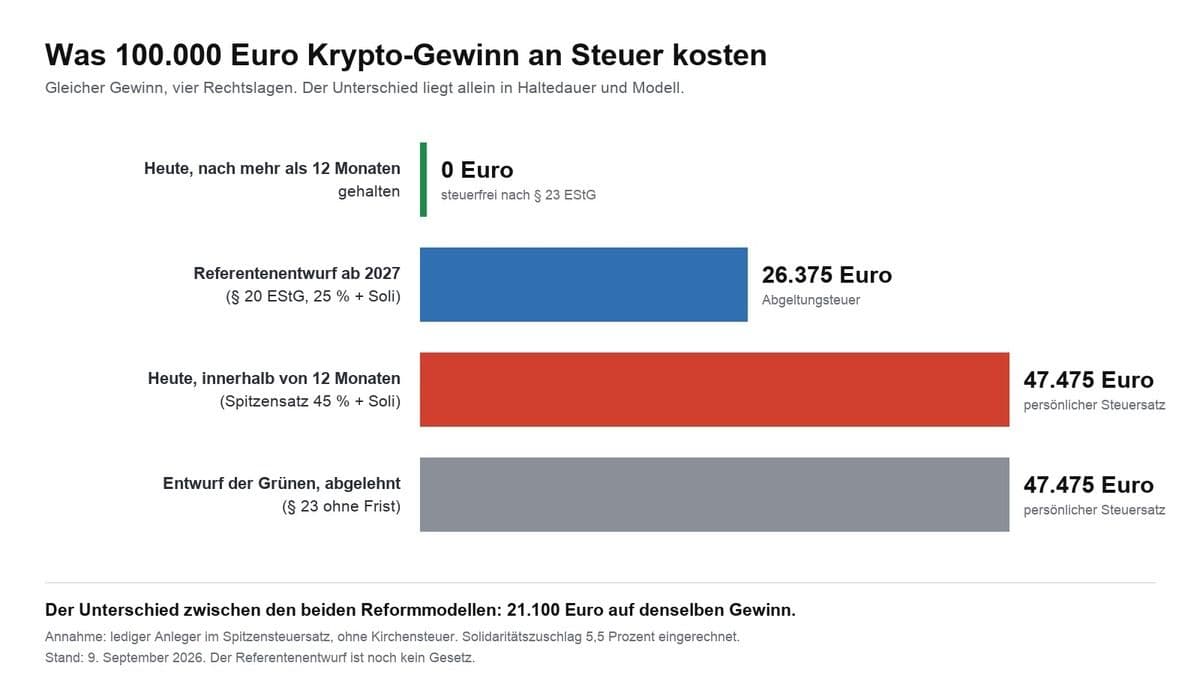
Crypto gains are tax-free after twelve months; before that your personal tax rate of up to 45 percent applies. What triggers tax, how the holding period is calculated, what happens with staking and losses, and what the draft bill would change from 2027.
December 5, 2024 4:00 PM

TRUMP and MUSK push the Crypto Market UP: HOW?
Why is the crypto market up today, how did Bitcoin surpass $100k, and will Ethereum reach a new ATH as well? Find out in this article!
August 16, 2026 9:11 PM

Swapping Bitcoin for Stablecoins: Does Austria Charge Tax?
Anyone swapping bitcoin for USDT or another stablecoin usually pays no tax in Austria yet. When the swap does become taxable after all.
October 1, 2026 7:36 PM

Crypto tax and withholding at source from 2028: what to check now
The German Federal Ministry of Finance’s draft bill goes to cabinet on October 14, 2026. The underexposed part of it is the deduction of tax from 2028: which providers are to withhold the tax on investment income, why self-custody and foreign platforms stay exempt from it, and what you should document by December 31.
More from CryptoTicker