
Cloud mining without your own hardware: $35.60 per petahash a day before fees
Context: Binance is discontinuing Binance Pool, Cloud Mining and the Transaction Accelerator on November 10, 2026, which removes one of the large routes into mining without your own devices. This article works out what bought hash rate currently earns, and separates the documented figures from this newsroom's assessment.




Which topics should we dive deeper into?
Select what genuinely interests you. Your picks feed directly into our editorial planning.
Crypto news that's actually worth your time.
Weekly. 60 seconds. Carefully curated by our editors: no hype, no promo flood, no spam.
The record shows this: Binance is discontinuing Binance Pool together with Pool Savings, Cloud Mining and the Transaction Accelerator on November 10, 2026 at 07:00 UTC; hash rate and shares submitted after that point will no longer be accepted, processed or credited, according to the announcement of October 13, 2026. One of the large routes into mining without your own hardware thus disappears. Our assessment follows further down: a cloud mining contract is a bet on two variables the buyer does not influence, and its return can be calculated before the purchase.
The short answer to the question in the headline: on the arithmetic, bought hash rate currently earns so little that fees and contract term decide between profit and loss, not the Bitcoin price alone. Our older article on Bitcoin mining without your own hardware dates from February 2020, from a time with a quarter of today's network hash rate and four times the block reward. The sum has shifted in both directions since then, and today it comes out stricter.
Binance switches off Pool, Cloud Mining and the Transaction Accelerator on November 10, 2026
The exchange announced the shutdown on October 13, 2026 and described it as part of a product review. Affected are the mining pool itself, the Pool Savings product, the cloud mining offering and the Transaction Accelerator, along with the hash rate notifications and the pool's interface. The stratum addresses go offline on the cut-off date. If you point devices at this pool, aim them at another one beforehand, otherwise the hash rate runs into nothing.
A second point applies to Pool Savings customers: open positions generate no further earnings after the cut-off date, and the exchange does not unwind them automatically. Which deadlines apply in detail and in what order they run out, we set down in our report on the Binance Pool shutdown on November 10. The exchange says it will keep the pool's overview page running for a few days beyond the cut-off date so that settlements remain visible.
A provider that discontinues a product is making a statement about that product. Cloud Mining was one of the smaller-volume offerings at Binance; when a house of that size stops running the business, that is a data point for assessing the entire product category.
What separates cloud mining from pool mining and hosting
Three routes lead into mining, and only one requires no hardware of your own. With pool mining the devices are yours, they sit at your place, and the pool merely bundles your hash rate with that of others so that payouts arrive regularly rather than at random. With hosting, also called colocation, you buy the devices and place them in someone else's data centre, which supplies power, cooling and maintenance and charges rent for it. With cloud mining you buy nothing tangible, but a contract covering a certain amount of hash rate for a certain time.
The difference is considerable in legal and economic terms. On the first two routes you have a device with a residual value that you can sell. On the third you have a claim against a provider, and its worth depends on that provider delivering, settling and paying. Should the provider fail, the contract is worthless, and there is no device you could stand against the wall.
A fourth route avoids mining altogether: to bet on the economics of mining, you can buy shares in mining companies or exchange-traded products on them. A separate section below covers that.
The hash price: what one petahash per second currently earns in a day
The most important figure in cloud mining is the hash price. This value states what one unit of hash rate earns gross per day, and it can be worked out from three public quantities. First the block reward: since the fourth halving it stands at 3.125 Bitcoin per block, and the network finds 144 blocks a day on average, so 450 Bitcoin daily from new issuance. Second the network hash rate, which stood at around 1,034 exahash per second on October 22, 2026, as recorded at mempool.space. Third the price, which stood at about $81,800 that day.
Those three numbers give the sum: 450 Bitcoin times $81,800 comes to roughly $36.8 million that the whole network takes in from new issuance in a day. Spread across 1,034 exahash per second, that leaves around $35,600 per exahash per day. One exahash is a thousand petahash, one petahash is a thousand terahash. So one petahash per second comes to about $35.60 a day, and one terahash to about 3.6 cents. Transaction fees come on top, though in normal operation they account for only a small single-digit percentage.
That figure is the yardstick for every offer. A contract for 100 terahash per second earns roughly $3.56 a day gross, so about $1,300 a year. From that come the provider's maintenance and power fees, usually stated in the contracts per terahash per day. If that fee sits anywhere near 3.6 cents per terahash, nothing is left for the buyer, whatever the advertising promises. So anyone holding a prospectus first sets the fee against the hash price, and only then looks at everything else.

Difficulty and hash rate: why the sum has to be redone every two weeks
The hash price is no constant, and it tends to fall. Mining difficulty sees to that: the Bitcoin network adjusts it every 2,016 blocks, roughly every two weeks, so that a block again takes ten minutes on average. On October 22, 2026 it stood at around 140.58 trillion. As the network hash rate rises, difficulty rises with it, and the share of the whole network held by a fixed amount of bought hash rate shrinks.
The next adjustment was due at the end of October; estimates for it recently ranged between 4.5 percent from our own measurement on October 22 and 6.4 percent according to our report of October 21. Both values are projections from block speed and change up to the cut-off. The direction this year is unambiguous, though: across the recent adjustments, difficulty rose by around six percent several times.
That produces a mechanism many offers do not explain. A cloud mining contract sells a fixed amount of hash rate, not a fixed share of the network. If the network grows by ten percent, the return on the same contract falls by just under ten percent, even with the price unchanged. If the price does not keep pace with the growth in network hash rate, the daily return sinks over the contract term, regardless of the provider and of the quality of the hardware.
Added to that is the second variable with a fixed date: the next halving cuts the block reward from 3.125 to 1.5625 Bitcoin. On October 22, 2026 the block height stood at 972,617, and the halving falls on block 1,050,000, around 77,400 blocks later. At ten minutes per block that is about 537 days, so spring 2028 on this calculation. A contract running beyond that point loses half its gross income on that day, provided price and fees stay unchanged.
 Find the right crypto broker
Contract traps in cloud mining: term, maintenance fee and the shutdown clause
Four clauses decide whether a contract leaves any chance of profit at all. The term sets how long you share in the return; if it runs past a halving, that belongs in your own sum. The maintenance or power fee is deducted per unit of hash rate per day, often in dollars or cents per terahash; it is the one figure that stands directly against the hash price. The shutdown clause allows the provider to end the contract if the return fails to cover the fee over a certain period. And the payout threshold determines the amount from which anything is paid out at all.
The shutdown clause is the most unpleasant, because it bites precisely when the buyer least expects it. If the price falls or difficulty rises sharply, the daily return slips below the fee. The provider then discontinues the contract, and the purchase price paid is spent. The risk therefore sits with the buyer alone, although the buyer has no influence over operations.
A fifth disclosure is missing from many prospectuses entirely: which hardware is used, at what efficiency. Without it there is no way to check whether the stated fee fits the power costs the provider actually has. A contract that names neither device type nor location nor power price therefore cannot be recalculated, and what cannot be recalculated cannot be compared.
Signs of a dubious cloud mining provider
Several signs can be checked independently of the provider and need no specialist knowledge. A fixed return figure in percent per day or month does not fit the business: mining returns depend on price and difficulty and cannot be promised. If company name, registered office and commercial register entry are missing, so is the counterparty against whom a claim would be directed. A referral programme that pays more for recruiting new customers than the mining itself earns shifts the source of income from mining to the inflow of new payers.
Two further points can be checked in minutes. First: does the provider give verifiable data on location, hardware and power tariff, or does it stop at pictures of halls? Second: can the hash rate it claims to run be found again in the distribution of blocks found? The shares of the large pools are publicly visible, and a provider claiming a three-digit number of petahash without appearing there is either running that hash rate through another pool or not at all.
In Germany there is a supervisory question on top. If a mining contract is offered with a fixed promise of return and no decision-making power for the buyer, it may constitute an investment product subject to prospectus and licensing requirements. BaFin publishes warnings about providers without authorisation; a look at those publications belongs before any contract is signed.

Mining shares and ETPs as a route without your own hardware
To share in the economics of mining without buying hash rate, you can acquire stakes in companies that mine. These shares are tradable on German exchanges and accessible through any broker; our crypto broker comparison gives an overview of costs and trading venues. The difference from cloud mining is tangible: a share is a stake in a company with a balance sheet, reporting duties and a market price, while a mining contract is a claim against a provider.
In exchange, a mining share carries risks the Bitcoin price does not explain: debt, power contracts, site risks, dilution through new shares, and the company's decision to hold or sell what it has mined. Mining shares have historically swung harder than Bitcoin itself, in both directions. Alongside them sit exchange-traded products on Bitcoin and on baskets of miners; which of those are accessible in Germany and how they differ is collected in our overview of crypto ETFs in Germany.
The most honest comparison remains the one with buying directly. Buy Bitcoin outright and you pay a trading fee once and then carry the price risk alone. Buy hash rate instead and you carry the price risk as well, plus the risk of rising difficulty, the provider's fees and the counterparty's risk of failure. Three additional risks have to be covered by an advantage, and that advantage sits in the sum further up.
Tax in Germany: mining income, the exemption threshold and the holding period after it
Mining income is taxable in Germany, and taxable at the moment it accrues, valued at the market price on that day. Where someone mines privately on a small scale, the income regularly falls under other income, for which an exemption threshold of 256 euros per calendar year applies. Where the operation is run on a sustained, systematic and profit-seeking basis, the tax authorities classify it as a business, and then trade tax, bookkeeping and the rules for business assets apply. When that threshold is crossed is broken down in detail in our article on crypto mining and tax.
For the later sale of the mined Bitcoin, private holdings fall under the one-year period of section 23 of the Income Tax Act, with an exemption threshold of 1,000 euros per calendar year for all private disposal transactions together. So there are two events: first the accrual, then the sale. Both need their own record with date, quantity and price. With a cloud mining contract this bookkeeping weighs especially heavily, because payouts often arrive daily in small amounts; valuing every credit individually is not feasible without a tool, and for that there is our crypto tax tool comparison.
One note for context: these statements describe the rules as they stand and are no substitute for advice in an individual case. How a contract is treated for tax purposes depends on how it is specifically structured, and a classification as a business changes the sum fundamentally.
 Start a Bitcoin savings plan that suits you
Our assessment: a cloud mining contract is a bet on price and difficulty
From this newsroom's point of view, what argues against the product is above all our own sum further up. At around $35.60 gross per petahash per day, the margin from which the provider's fee and the buyer's profit both have to be paid lies in the range of cents per terahash. Add to that a difficulty that rose by around six percent several times across the recent adjustments, and a halving in spring 2028 that halves gross income per block. That a house the size of Binance is discontinuing this offering as of November 10, 2026 fits the picture, even if the exchange itself speaks only of a product review.
In favour there is a narrow case: someone with access to unusually cheap power who cannot use it themselves, and who finds a contract with a traceable fee, named hardware and a short term, can share in a rising price more strongly that way than by buying directly. That case is rare, and it demands the sum beforehand. Where the sum cannot be drawn up because the prospectus names neither fee nor hardware nor location, there is no contract to recalculate, only a promise.
A total loss is possible with cloud mining, by two routes: through a price fall that pushes the return below the fee and triggers the shutdown clause, and through the provider's failure. None of this is a recommendation to buy or to abstain; the figures above are the basis on which each person decides for themselves.
Cloud mining: without the fee and the hash price in the contract, the sum is missing
- Work out the hash price yourself for the day of your decision: 144 blocks times the block reward times the price, divided by the network hash rate. If the provider's fee sits anywhere near that value, the contract settles itself. If you would rather buy directly, the routes are in the comparison of Bitcoin savings plans.
- Check term, maintenance fee, shutdown clause and payout threshold in the contract text, and note whether the term reaches past the halving in spring 2028. If one of those is missing, the basis for comparison is missing. Trading venues and fees for the simpler route are in the crypto exchange comparison.
- Decide before the first payout where the payments go and how you record them. For custody outside an exchange you need a key only you know; the devices for that are compared in our overview of hardware wallets.
(As of October 22, 2026. This article is not investment advice. Prices and fee structures change; check the terms with the provider before you buy.)
Frequently asked questions about cloud mining
Transparency note: This article was produced with the assistance of artificial intelligence and reviewed by our editorial team before publication. All figures and claims were checked against the primary sources linked in the text. The feature image was generated with AI.
Related articles
- What Is Bitcoin Mining? How It Works and When It Pays Off
- Binance Pool closes on November 10, and the second deadline expires 17 hours later: what you can do now
- Bitcoin Across Multiple Wallets: How Austria Works Out the Acquisition Cost
- Bitcoin With No Cost Basis: How Austria Taxes the Sale
- Bitcoin price prediction: mining difficulty up 6.44 percent on October 29, next target at $83,691
Which topics should we dive deeper into?
Select what genuinely interests you. Your picks feed directly into our editorial planning.
Crypto news that's actually worth your time.
Weekly. 60 seconds. Carefully curated by our editors: no hype, no promo flood, no spam.

October 16, 2026 10:33 AM

Mining difficulty jumps almost 6 percent today: why Bitcoin miners have no cushion this time
Bitcoin network mining difficulty rises by almost 6 percent on Friday afternoon, the steepest step up since June. Because transaction fees carry only 0.65 percent of mining revenue, the cost jump hits miners without any cushion at all.

July 15, 2024 11:02 AM

Bitcoin Price Prediction: BTC Price Surge STARTING or ENDING?
Amid the current market rally, all eyes are on Bitcoin price, especially following the attack on one of its most strategic supporters. With the current BTC price surge, here are the predictions of how high and for how long.
October 13, 2026 10:28 PM

5.5 percent more difficulty from Friday: Bitcoin miners face the year's third-largest step up
On October 16 the Bitcoin network raises mining difficulty by 5.49 percent, the third-largest increase of the year. What that means for miners' costs, for the levels around $81,000 and for your purchase fees.

September 28, 2019 3:17 PM

Bitcoin Hash Rate Doubles Regardless of Price Drop: Why Hash rate Matters?
Bitcoin hasn’t had the best of days. After Sunday, the cryptocurrency has dropped in price by more than 20%. Due to the unexpected movement, investors also tried to figure out possible spurs. BTC price dropped but Bitcoin Hashcrash never happened? […]
October 5, 2026 7:21 PM

Bitcoin price at $85,662 one year after the all-time high: what to watch now
Bitcoin stands at $85,662, which is 32.1 percent below the all-time high whose anniversary falls on October 6. In euros the gap is smaller, and for anyone who bought in October 2025 the one-year tax period is running out at the same time.
October 18, 2026 7:28 PM

Bitcoin price prediction: mining difficulty rises 5.92 percent, what it means for selling pressure
Since October 16 the Bitcoin network has demanded 5.92 percent more computing work per block, while the price slipped to $81,017. The hashprice fell 9.5 percent as a result, and that decides how much miners have to sell this week.

September 19, 2026 4:19 AM

Bitcoin Cash Jumps by Double Digits: What the Grayscale ETF Filing Really Means for You in Germany
Bitcoin Cash gained double digits on September 18 because Grayscale wants to convert its BCH trust into an exchange-traded product. The filing itself, however, states that the basis for it has not been approved at all.
August 4, 2024 6:49 AM

BIG NEWS: Bitcoin Mining Difficulty Hits Record High as BTC Price Drops
Bitcoin mining just got tougher, even as the price of Bitcoin takes a dip. What's going on?

August 24, 2026 10:29 AM

Buying More Bitcoin at $77,000: Savings Plan or Lump Sum
Bitcoin stands at $77,256 after gaining 22.78 percent in a week. This guide shows you how to buy more cleanly at this price and which method fits which starting position.
February 20, 2026 2:36 PM

Crypto News Today: MicroStrategy Buys the Dip as Bitcoin Mining Hits Record Highs
Bitcoin remains the primary focus of institutional interest today, with MicroStrategy adding 2,486 BTC to its reserves, while the network's mining difficulty sees a historic 15% increase.
August 10, 2026 5:15 PM

Bitcoin Lending in Austria: When Tax Falls Due
Lending Bitcoin and earning interest: when lending income is taxed at 27.5 percent in Austria and which exchange rate counts.
September 25, 2026 10:14 PM

Sequans sells its last 314 bitcoin: what to check if you hold a treasury stock
Semiconductor maker Sequans has wound down its bitcoin reserve completely, 15 months after setting a target of one hundred thousand coins. What the case reveals about treasury stocks, and which tax rule applies to the share and to the coin.
September 8, 2026 1:25 PM

Bitcoin Mining in Austria: How Mining Rewards Are Taxed
Bitcoin mining in Austria: when mining rewards are taxed at 27.5 percent, and when a commercial activity brings the progressive income tax rate into play.
September 9, 2026 4:29 PM
Bitcoin and Taxes in Germany: Holding Period, Savings Plan, ETP and Mining
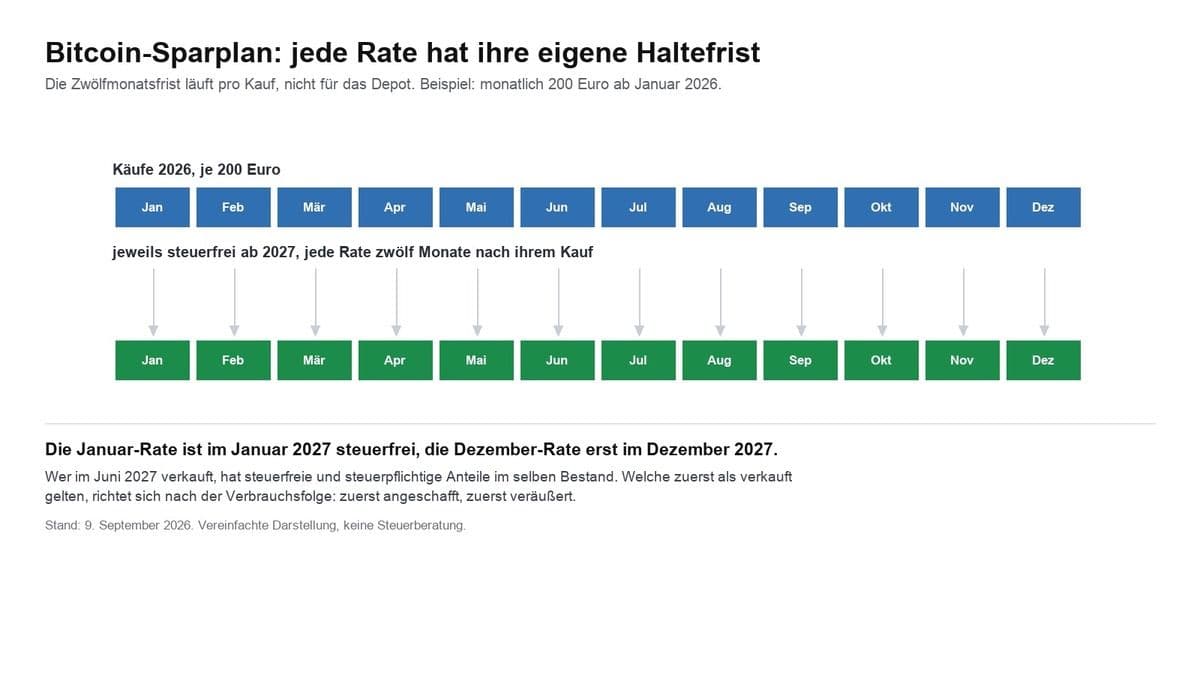
Bitcoin gains are tax-free after twelve months. What that means for a savings plan with twelve deadlines, why ETPs are taxed differently, and what applies to mining, gifts and losses.
August 28, 2026 10:15 AM

Selling Bitcoin Privately: What Tax Applies in Austria
Selling bitcoin directly to another person? In Austria, private sales can still trigger 27.5 percent tax on the realised gain.
July 27, 2024 2:34 PM

Why Is The Crypto Market Up TODAY?
With the Bitcoin 2024 Conference taking place now in Nashville, the crypto market is showing bullish signals, intriguing traders around the future of Bitcoin and Altcoins.
December 5, 2023 12:17 AM

Bitcoin Mining Rig: How to Mine Bitcoin in 2024?
A Bitcoin mining rig, if set up correctly, can generate thousands of dollars. How to mine Bitcoin in 2024? Here's a Bitcoin mining guide.
May 22, 2026 4:52 PM

Mining & Masternodes: Private or Business? Tax Check 2026
Mining and masternodes can be private or commercial. Learn when tax liability arises, which costs are relevant, and why documentation is often important.
October 2, 2024 9:58 AM

Why Bitcoin Price Drops: Middle East Tensions, Mining Struggles Or Massive Liquidations?
September posed significant challenges for Bitcoin, from record-low mining profitability and price drops due to... Will October make it up?
June 30, 2025 10:44 PM

Bitcoin Price USD in June 2025: Musk’s Debt Bill Attack and the Sparkassen Crypto Plan
Snapshot from 30 June 2025: Musk attacked Trump’s $5T debt bill and Germany’s Sparkassen announced crypto trading. What Bitcoin did next, updated September 2026.
September 9, 2026 4:22 PM
Crypto Tax in Germany: What Applies in 2026 and What Is Set to Change in 2027
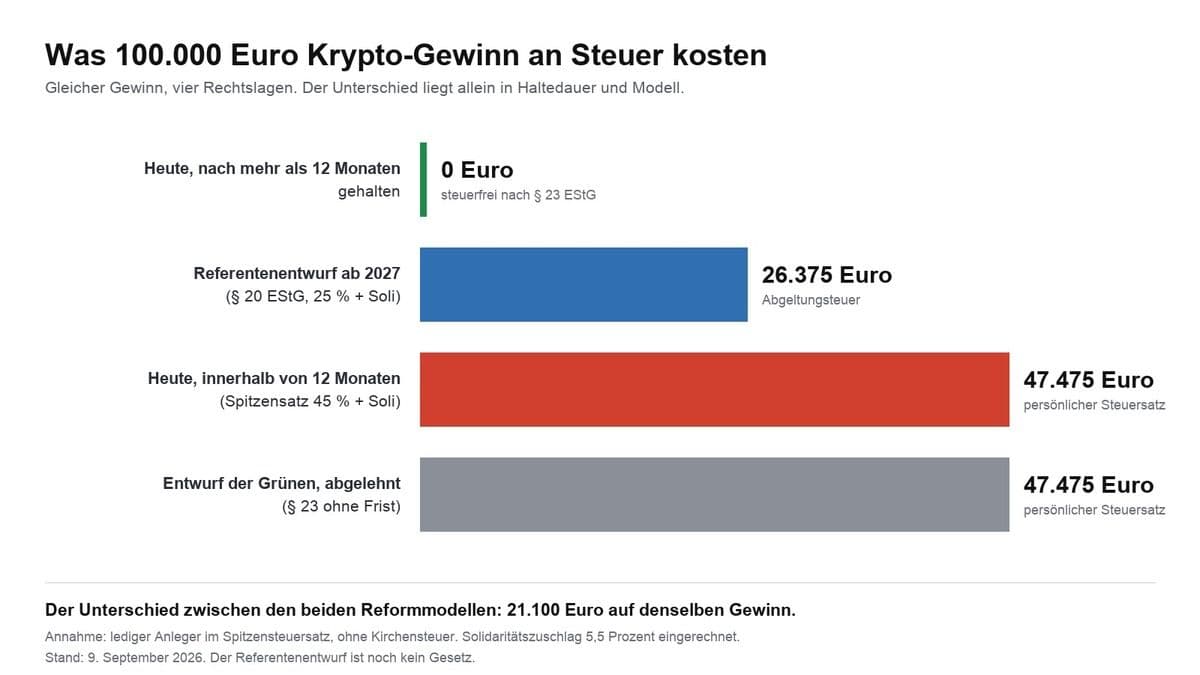
Crypto gains are tax-free after twelve months; before that your personal tax rate of up to 45 percent applies. What triggers tax, how the holding period is calculated, what happens with staking and losses, and what the draft bill would change from 2027.
September 19, 2026 4:26 PM

Crypto Mining and Tax: When the Tax Office Treats Your Mining as a Business
Anyone mining crypto-assets earns taxable income from the very first reward; according to the Federal Ministry of Finance, mining is never private asset management. This guide uses the margin numbers of the Ministry's circular to show when your mining becomes commercial and what you can deduct.
October 9, 2026 1:18 PM

Bitcoin Tax: One Year Past the $126,080 Peak, Losses No Longer Count
Bitcoin trades at $82,558 on Friday morning, 34.5 percent below an all-time high that is now a good year old. Anyone who bought back then loses more than the prospect of a quick recovery when the one-year period expires: the tax value of the loss goes with it.
September 24, 2026 10:11 PM

Bitcoin Price Prediction: What to Check on Levels, Holding Period and Leverage Before the October 28 Rate Decision
Bitcoin is trading at around $83,800, a third below its October 2025 high, while the sentiment index reads greed. Which dates, levels and deadlines over the coming weeks really decide your net gain, and which of them you steer yourself.
August 24, 2026 10:26 AM

Bitcoin Savings Plan in Austria: How the Purchase Price Is Calculated
Bought bitcoin through a savings plan? For multiple purchases Austria applies the moving average price as a matter of principle when working out taxable gains.


More from CryptoTicker