
Bitcoin price prediction: mining difficulty rises 5.92 percent, what it means for selling pressure
Since October 16 the Bitcoin network has demanded 5.92 percent more computing work per block, while the price slipped to $81,017. The hashprice fell 9.5 percent as a result, and that decides how much miners have to sell this week.





Which topics should we dive deeper into?
Select what genuinely interests you. Your picks feed directly into our editorial planning.
Crypto news that's actually worth your time.
Weekly. 60 seconds. Carefully curated by our editors: no hype, no promo flood, no spam.
Bitcoin trades at $81,017 on Sunday evening, and the weekend’s most important number is not in the chart but in the protocol itself: since October 16 the network has demanded 5.92 percent more computing work for the same block. Mining difficulty climbed with block 971,712 to 140.58 trillion, its highest level since March 5. At the same time the price has fallen from $84,506 to $81,017 since the previous adjustment on October 3. More effort, less revenue: for miners that is the squeeze which ultimately decides how much they have to sell.
Difficulty is the Bitcoin network’s automatic adjustment screw. Every 2,016 blocks, roughly every two weeks, the protocol measures how quickly the past blocks were found and resets the difficulty so that a block is produced every ten minutes on average. For the longer-term view of where the price can head over a horizon of months, see our Bitcoin price prediction. For the next two weeks, though, what counts is the miners’ short-term arithmetic, and that shifted noticeably on October 16.
Bitcoin at $81,017: what the price board shows right now
The price stood at $81,017 on Sunday evening, down 0.24 percent within 24 hours (source: CoinGecko, as of October 18). The daily range ran from $80,823 to $82,178, so less than 1.7 percent between high and low. That makes Sunday the weakest day of the week: the seven-day high was $83,115.
Set against the quarter it looks different. The 30-day high stands at $86,597, the low of the past 90 days at $62,773. The price is 35.7 percent away from the all-time high of $126,080 set on October 6, 2025. So the market has been moving for weeks in a band that carries neither panic nor euphoria, and it is precisely in such phases that the miners’ cost side becomes a price factor in its own right.
What has happened since our article of October 17
Yesterday this slot focused on the October 30 options expiry, in which contracts worth $12.2 billion run out. You can read that in our piece on the options expiry of October 30. Since then the price has moved from $81,524 to $81,017, a fall of $507 or 0.62 percent.
More important than the $507 is which line gave way. The average of the past 50 daily closes sits at $81,382, our own calculation from the CoinGecko daily data. Yesterday Bitcoin was still above that line, today it is $365 below it. That is no slump, but it is the week’s first close below a level that short-term traders orient themselves by. What is new is the cost side, on which there was nothing to say yesterday: the October 16 adjustment has only been fully felt in mining operations’ books since the weekend.
How a mining operation does the maths since October 16
The mechanism behind the difficulty jump takes three sentences. A mining operation sells nothing but computing power; its revenue depends on what share it holds of the network’s total computing power and on what a Bitcoin is worth. When difficulty rises, so does the total computing power needed to find a block, and each individual operation’s share of the daily payout falls. The electricity bill stays the same, because the machines keep running.
The network pays out 3.125 Bitcoin per block, so 450 Bitcoin a day at the targeted 144 blocks, transaction fees aside. At the October 3 price that was $38.03 million a day, at Sunday’s price it is $36.46 million. The computing power sharing that money has risen over the same period from around 950 to 1,006 exahash per second, derived from the difficulty.

The hashprice falls to $36.23 per petahash per day
The industry rolls both figures into one metric: the hashprice. It says what one petahash per second of computing power earns per day, and is therefore the revenue per machine deployed. We calculated it ourselves from the difficulty values on mempool.space and the CoinGecko prices, excluding transaction fees and operating costs.
On October 3 the hashprice was $40.03 per petahash per day. On October 18 it is $36.23. That is 9.5 percent less in a little over two weeks, and the decline splits almost exactly in half: 4.1 percent comes from the price, the rest from the higher difficulty. An operator running electricity costs close to the break-even point therefore loses almost a tenth of its income in two weeks without anything changing in its hardware.
That is the figure that matters for the price. Mining operations cover their running costs in euros and dollars, while their income arrives in Bitcoin. When the hashprice falls, a larger share of the mined amount has to be sold immediately instead of moving onto the balance sheet. That selling lands on the same exchanges where the rest of the market trades.
Hashrate has been falling since the jump
That very reaction is already visible in the network data. The 30-day average of computing power sits at 1,019 exahash per second. The daily readings of the past week paint a different picture, however: from 1,084 exahash the figure fell to 943 exahash most recently, a drop of 13.0 percent (source: mempool.space, retrieved October 18).
Part of that is noise, because daily hashrate readings are estimated from the number of blocks found and fluctuate by a few percent even at constant output. The rest is switch-offs: operations whose power price no longer works at a hashprice of $36 are taking machines off the network. That also shows in the current period’s average block time of 9 minutes and 59 seconds, marginally above the target.
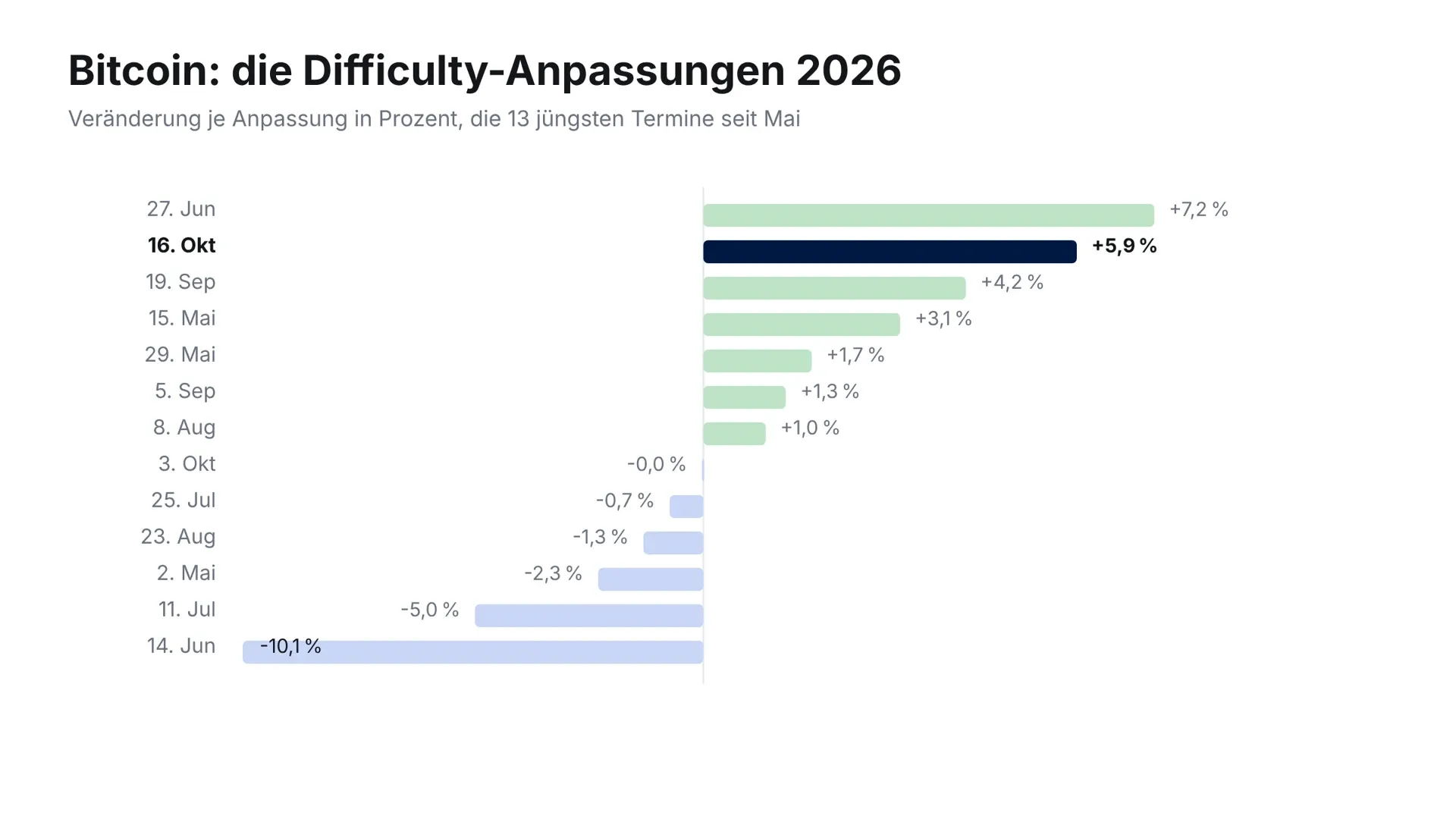
October 16 was the year’s second-largest step up
A look at the 13 most recent adjustments puts the 5.92 percent in context. Only June 27 was bigger in 2026, at 7.15 percent. Then come September 19 with 4.16 percent and May 15 with 3.12 percent (long-run series: blockchain.com). At the other end of the series sits June 14 with minus 10.09 percent, followed by July 11 with minus 5.00 percent.
The immediate predecessor is notable: on October 3 the adjustment came to minus 0.03 percent, practically zero. Within two weeks, then, the network tipped from standstill to the year’s second-largest increase. Such jumps arise when new computing capacity ordered and built over months comes online, and they hit the market regardless of where the price happens to stand.
 Compare exchanges for your Bitcoin purchase
The next adjustment is due on October 30
The coming adjustment falls at block 973,728. At the current block pace some 1,703 blocks are still missing, and the period is a good 15 percent through. As things stand that points to October 30, and the estimate is minus 0.45 percent. The estimate is no promise, because the network recalculates it with every block, and it shifts as soon as operations switch off or back on at scale.
The date is interesting all the same, because it coincides with the options expiry we wrote about yesterday. Two dates that can both cause short-term movement thus fall on the same day. The difficulty adjustment works on the supply side, the expiry on traders’ positioning.

The levels: $81,382 above, $80,823 below
Three levels can be justified for the coming days, and each has an origin rather than being a line on a chart.
$81,382. The average of the past 50 daily closes. The price sits $365 below it. As long as it stays below, every recovery attempt has this line above it as the first resistance. A daily close above turns the relationship around.
$80,823. Sunday’s daily low and therefore the immediate floor. If it breaks, the next reference is the area around $78,000, where the price turned several times in early October.
$83,115. The seven-day high. Only above it does the sideways move become an upward move again, and only then does selling pressure from the mining sector lose weight, because the hashprice rises with the price.
The span between floor and ceiling thus comes to just under 2.9 percent. For a week that is narrow, and narrow ranges tend to resolve in the direction of the first larger sale.
Our assessment: the selling pressure is real but limited
In the editorial team’s view the difficulty jump is a genuine drag for the coming two weeks, but no reason for a new price picture. The numbers support that: a 9.5 percent fall in the hashprice forces operations at the margin of profitability to sell, and the 13 percent less computing power in the daily readings shows that some have already taken that step. The daily payout of 450 Bitcoin amounts to only $36.46 million at $81,017, however, and measured against a market capitalisation of $1.63 trillion that is a small sum.
The mechanics also argue against it: if operations switch off, computing power falls, and the next adjustment comes out correspondingly lower. The estimated minus 0.45 percent for October 30 is exactly that counterbalance in figures. The network corrects its own overheating, and does so within twelve days. Deriving a months-long downward forecast from the difficulty jump overstretches a metric designed for two weeks. Bitcoin remains an asset carrying the risk of total loss, and none of these figures is a buy or sell recommendation.
What hangs on a top-up purchase in Germany
For investors in Germany a sideways phase has a side effect that has nothing to do with the chart. Every additional purchase starts its own one-year holding period for exactly that amount. If you top up today at $81,017, you can only sell that tranche tax-free from October 18, 2027; earlier holdings are unaffected, but the tax authorities generally allocate them on a first in, first out basis. We track the current state of the political debate about the deadline on an ongoing basis at crypto holding period: reform and status.
In practice that means a purchase decision in this phase is also a decision about a cut-off date in October 2027. Buying regularly in fixed instalments creates a corresponding number of deadlines side by side, which makes the bookkeeping more laborious but smooths the entry price. Which providers offer a savings plan on Bitcoin, and at what fees, is in our overview of buying Bitcoin with a savings plan.
The fee side stays cheap for investors
One development argues for moving coins on the blockchain in this situation: network fees are low. As we measured this morning, one satoshi per byte was enough to make it into the next block, which made a withdrawal possible for around 12 cents. The details of that measurement from the morning of October 18 are in our analysis of the network fee and the mempool.
That connection is no coincidence. When demand for block space falls, fees stay low, and precisely then miners lack the revenue source that could cushion the fallen hashprice. For investors who want to move holdings from an exchange into their own custody, that is the favourable side of the same coin.
Bitcoin at $81,017: the $81,382 line decides the week
The difficulty jump of October 16 makes mining 5.92 percent more expensive, the hashprice sits 9.5 percent below its October 3 level, and the price is quoted $365 below the 50-day average. Three steps follow for the coming days:
- Watch the line at $81,382. A daily close above it ends the short-term weakness, a break of $80,823 opens the way towards $78,000. Where you trade and at what fees is shown in our overview of the best crypto exchanges.
- Mark October 30 in the calendar. On that day the next difficulty adjustment and the options expiry coincide. For a staggered entry in fixed instalments until then, the providers in our comparison of Bitcoin savings plans are suitable.
- Document the holding period of every new tranche. Each additional purchase brings its own cut-off date in October 2027. Which programs keep acquisition dates and deadlines cleanly is in our comparison of crypto tax tools.
(As of October 18, 2026. This article is not investment advice. Prices and fee structures change; check the terms with the provider before you buy.)
 Find a tax tool for your holding periods
Frequently asked questions about Bitcoin mining difficulty
Transparency note: This article was produced with the assistance of artificial intelligence and reviewed by our editorial team before publication. All figures and claims were checked against the primary sources linked in the text. The feature image was generated with AI.
More on Bitcoin: All Bitcoin news at a glance
Related articles
- 5.5 percent more difficulty from Friday: Bitcoin miners face the year's third-largest step up
- Bitcoin price prediction: 15.4 percent above the 200-day line, and the next target at $86,600
- Mining difficulty jumps almost 6 percent today: why Bitcoin miners have no cushion this time
- Bitcoin Price Prediction: BTC Price Surge STARTING or ENDING?
- Crypto Market Crash News As BTC Price Crash Back To 56K
Which topics should we dive deeper into?
Select what genuinely interests you. Your picks feed directly into our editorial planning.
Crypto news that's actually worth your time.
Weekly. 60 seconds. Carefully curated by our editors: no hype, no promo flood, no spam.

February 20, 2026 2:36 PM

Crypto News Today: MicroStrategy Buys the Dip as Bitcoin Mining Hits Record Highs
Bitcoin remains the primary focus of institutional interest today, with MicroStrategy adding 2,486 BTC to its reserves, while the network's mining difficulty sees a historic 15% increase.

August 7, 2024 10:29 AM

Bitcoin Price Prediction: Will BTC Price SURGE Past Or DROP Below $57k?
As Bitcoin is hovering around the $57k mark, traders can't help but wonder if it will surge past it or drop back below it. Here is all you need to know...

August 4, 2024 6:49 AM

BIG NEWS: Bitcoin Mining Difficulty Hits Record High as BTC Price Drops
Bitcoin mining just got tougher, even as the price of Bitcoin takes a dip. What's going on?
January 9, 2025 3:30 PM

2025 Bitcoin Price Prediction: What if BTC Price breaks below $90K Support?
The 2025 Bitcoin price prediction hinges on its critical $90,000 support level. Will it hold, or could we see declines to lower levels? Explore key insights shaping the short-term Bitcoin trajectory.
March 15, 2025 5:40 PM

Bitcoin Price Prediction March 2025 with FOMC and TRUMP in Play
Bitcoin price prediction for March 2025 is one to expect, ahead of the upcoming FOMC meeting and Trump's strategic crypto reserve. What to expect for BTC price?
October 14, 2024 12:38 PM

Today's Top Performers: Solana, Bitcoin and Ethereum
Today marks a positive day for most cryptocurrencies, with Solana, Bitcoin, and Ethereum leading the top 10 with impressive surges. But what to expect from each?
December 12, 2024 11:28 AM

Bitcoin Hits $100K Again – But a Crash to $60K Might Be Next
Bitcoin is back at $100K after dropping to $94K, but concerns are growing as BTC faces strong resistance at $104K. Will the bullrun continue, or is a major crash coming in January?
November 24, 2024 9:23 PM

Bitcoin Price Prediction 2025: What to Expect amid TRUMP's Administration?
Bitcoin price is currently among the trendiest topics with Elon Musk's recent post and with the aspiration for 2025 amid Trump's new administration. Here is what to expect!
May 15, 2024 6:05 PM

Bitcoin Price Prediction: 60K CRITICAL LEVEL, What Next?
After a recent crash, the crypto market has shown resilience, with Bitcoin surging over 3% in the past day. What's next for BTC as it hovers around $60,000?
July 7, 2024 6:40 PM

Will BTC Price Crash Again After The Dormant Bitcoin Whale Move?
A decade dormant Bitcoin Whale just moved 140 BTC. Is it a sign of a new BTC price crash or surge soon? What is there to know...
December 16, 2024 5:11 PM

Bitcoin Price Prediction: Can Bitcoin Reach $110,000 After Today's New ATH near $107K?
Bitcoin price has hit a record-breaking ATH of $106,803 fueled by Trump's proposal for a U.S. Bitcoin reserve. This has the crypto market sparking with Bitcoin price predictions.
September 14, 2024 12:01 PM

Bitcoin Surges Past $60K: The Start of a Major Rally or Just Another Bull Trap?
Bitcoin has surged past $60,000, sparking optimism among investors. But with looming market volatility and whale activity, is this the start of a new rally or just another bull trap?
June 24, 2024 10:37 AM

Bitcoin Price Prediction: Can BTC Price Fall Below 50K?
The profitability of Bitcoin futures cash-and-carry trades has plummeted amid a significant crypto market selloff. What are the reasons behind the decline and what can traders expect next?
August 17, 2024 2:55 AM

Bitcoin Price Prediction: How Will BTC Price Move Following Gold's Surge?
Will Bitcoin break through resistance and rally, or are there further declines on the horizon, for the second half of August? This is the latest analysis of Bitcoin’s price...
April 13, 2025 11:22 AM

Bitcoin Dollar Price Jumps: Is the Bitcoin Price Rally Just Starting?
After dropping to $75,000 during Trump’s tariff war, Bitcoin has bounced back significantly. With the current Bitcoin dollar price at $84,800, the $100K milestone is once again in sight. What’s next?
February 21, 2026 4:00 PM

Bitcoin Price Prediction: Can BTC Break the $70,000 Resistance This Week?
Bitcoin tests key resistance levels as bulls eye a return to $70,000. Analyze the technical triggers and market sentiment driving the next BTC move.
December 10, 2024 12:30 AM

Bitcoin Price Drops Below $100K – Is a Bigger Crash Coming?
Bitcoin has fallen below $100K, triggering a broader market correction of over 8% in the last 24 hours. With profit-taking and large sell-offs hitting the market, could Bitcoin drop to $90K or lower?
April 22, 2026 9:11 AM

Bitcoin Price Hits $78,000 as Ceasefire Extension Ignites Bullish Momentum
Bitcoin breaches $78,000 following the US-Iran ceasefire extension and a $2.5 billion MSTR purchase. Here is the weekly BTC chart for key 2026 price targets.
April 29, 2025 7:00 PM

Bitcoin Price Prediction 2025: BTC Surges 10% but Caution Persists on THIS Chart
Bitcoin surges 10% with a bullish breakout—can it hit $109,356? Analysts highlight opportunities and risks. Here's what you need to know.
February 16, 2025 5:31 PM

Bitcoin News: BTC Price Faces Uncertainty Amid Network Decline, and Institutional Developments
Bitcoin price remains uncertain as network activity declines, institutional involvement increases, and bold predictions suggest a potential $2 million valuation. What to expect for BTC price?
February 15, 2025 11:34 AM

Bitcoin Price Surges Amid International Governmental Adoption - Can It Break $100K?
Bitcoin price is on the rise, fueled by massive international adoption and growing interest in crypto custody services. Will these developments push Bitcoin past the elusive $100K mark?
June 26, 2024 5:00 PM

Bitcoin Price Prediction: The Tenfold Surge SOON?
After the Fall, the Surge? Bitcoin's tenfold potential predicted by experts: Could Bitcoin surpass $100K?
November 15, 2025 10:47 AM

Bitcoin Crash: Analysts Warn of Deeper Downside as Oversold Levels Hit Extremes
Bitcoin is deeply oversold and at risk of further losses. Analysts warn the crash could extend if key support levels fail.
June 22, 2026 2:21 PM

Bitcoin Price Prediction: Saylor Buys More BTC as Market Tests $65K
Strategy added 520 BTC as Bitcoin trades near $65K. Is Saylor calling the bottom, or is BTC still facing rejection risk?
January 26, 2026 10:50 AM

Bitcoin Price Prediction: BTC Breaches $88K Support and Faces Potential Downside
Bitcoin has dropped below the critical $88,000 support level on January 26, 2026. Market indicators suggest a risk of further declines amid global macro uncertainty.


More from CryptoTicker