
Bitcoin miners earn 14.2 percent less per exahash as difficulty hits a record
Analysis: Since September 19, the Bitcoin network has demanded 11.8 percent more computing work per block, while the price has fallen over the same period. What this gap means for the coming weeks, and which level below the price actually holds.


Which topics should we dive deeper into?
Select what genuinely interests you. Your picks feed directly into our editorial planning.
Crypto news that's actually worth your time.
Weekly. 60 seconds. Carefully curated by our editors: no hype, no promo flood, no spam.
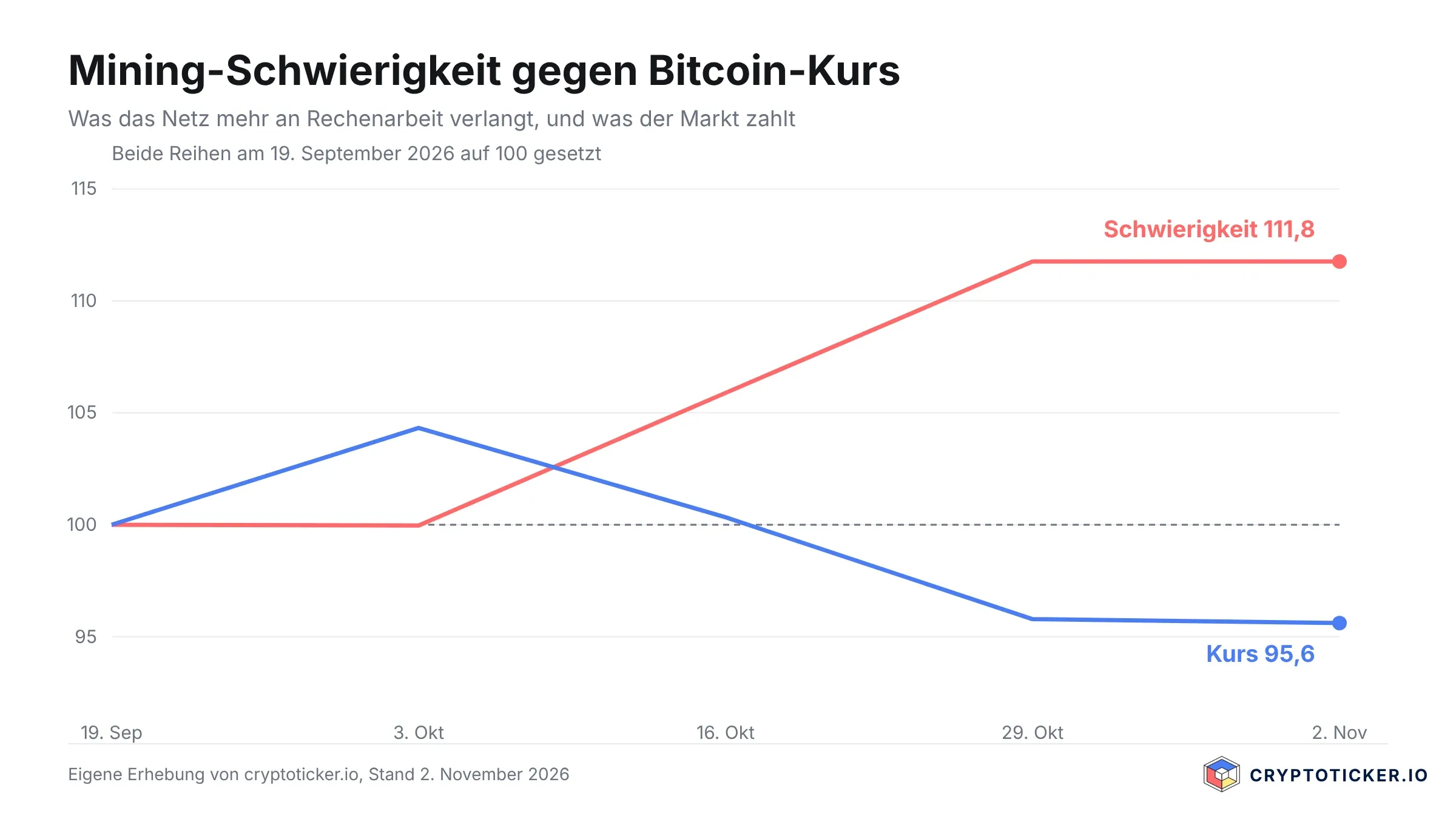
What is established: mining difficulty on the Bitcoin network has stood at 148.4 trillion since October 29, the highest on record. Over three adjustments since September 19 it has risen 11.8 percent, while bitcoin traded at $77,657 on Monday afternoon, 4.4 percent below its level on September 19. Our assessment follows further down: the miners' higher costs are no floor under the price, but they are a reason for continued selling pressure from this group.
Anyone looking at the chart today sees a quiet week: $77,511 as the daily low, $78,740 as the daily high, down 0.7 percent from Monday's close. Behind this calm sits a mechanism that rarely features in market commentary and that matters right now. Where the price could head over a horizon of months is covered in our bitcoin price prediction. This piece looks at the part the chart does not show: the miners' economics.
Bitcoin mining difficulty rises for the third time in a row
Every 2,016 blocks, roughly every two weeks, the Bitcoin network resets its difficulty. On October 16 it went up 5.92 percent, and on October 29 by a further 5.54 percent. Before that, on October 3, there was a flat adjustment of minus 0.03 percent. Taken together, the three steps add up to 11.8 percent, and the figure of 148.4 trillion is the highest the network has ever carried.
Difficulty is neither a fee nor a price that anyone sets. It determines how many hashing attempts are needed on average before a valid block is found. If it rises 5.5 percent, the same machine needs 5.5 percent more time, and therefore 5.5 percent more electricity, for the same share of the block reward.
What a mining difficulty adjustment sets in motion
The mechanism behind it is a feedback loop, and it explains why the number is rising now of all times. The network targets one block every ten minutes. When operators add hashing power, blocks arrive faster, and the next adjustment pushes difficulty up until the ten-minute rhythm is restored. When they switch machines off, it falls.
That is exactly what has happened in recent weeks. The network's hashrate averaged 1,069 exahashes per second over the seven days to November 2, against 984 at the start of October. One exahash is a quintillion hashing attempts per second. The network has therefore gained 8.7 percent more capacity, even though the price fell over the same period. Data centres ordered months ago are coming online now, regardless of what the price is doing.
For investors, this means the miners' cost side responds to the price with a delay, not immediately. Quarters pass between the decision to build a facility and the day its machines start hashing.

 Compare exchanges for your bitcoin purchase
Hashprice: $33,095 instead of $38,552 per exahash
To measure the gap between effort and return, we calculated the network's daily revenue per exahash of hashing power. The inputs are the block reward of 3.125 bitcoin, the 144 blocks produced on an average day, daily closing prices on the Kraken exchange and the network's seven-day average hashrate. cryptoticker.io compiled this analysis itself on November 2, 2026.
The result: in the week to November 2, one exahash of hashing power earned $33,095 in daily revenue. In the week to October 9 it was $38,552. That is a decline of 14.2 percent. It has two components pulling in the same direction: 8.7 percent more hashrate cuts the same cake into more slices, and a price 6.7 percent lower makes the cake smaller.
The block reward has been 3.125 bitcoin since the halving in April 2024. The next halving is not due until 2028. Until then, only the price or transaction fees can improve the miners' economics, and fees currently contribute only a small share.
Why miners sell in this situation
A miner has two kinds of cost. The machines are paid for before the first block is found; that is sunk capital. Electricity, by contrast, is incurred every day and has to be paid every month. If revenue per exahash falls while the power bill stays the same, there are exactly three options: sell their own bitcoin, take on debt or switch machines off.
All three show up in the market. Sales from this group hit an order book that is already thin. If you buy or sell yourself, pay attention to the fees and market depth of your exchange; our crypto exchange comparison shows where the spread between bid and ask stays narrow on larger orders.
The 200-day moving average at $73,161 as the lower level
On Sunday the futures curve was the focus here; today it is the levels on the chart. We calculated both lines that matter at present ourselves, from the daily closing prices of the past 200 trading days.
On the downside, the 200-day average sits at $73,161. The price is 6.2 percent above it. This line has held as a support zone several times this year, and it is still rising, if slowly. Closer to hand is the 30-day low of $77,204 from October 31, only 0.6 percent below the current price. If that level gives way, the chart shows no fresh price history between it and the 200-day line.
The 50-day moving average at $81,932 caps the upside
On the upside, the 50-day average stands at $81,932, 5.2 percent above the price. As long as bitcoin stays below it, the medium-term trend points down. The 30-day high was $86,510 on October 3; the price is now 10.2 percent away from it.
Between $73,161 and $81,932 lies the corridor in which the coming weeks will probably be decided. It is just under twelve percent wide, and the price currently sits in its lower third.
 Find a tax tool to track your holding periods
The next difficulty adjustment on November 13 points lower
The current difficulty period is a little more than a quarter complete, with 1,487 blocks still to go. Extrapolated from the pace so far, the next adjustment on November 13 would be 1.45 percent lower. That would be the first meaningful cut since August 23, when difficulty eased 1.31 percent; the flat adjustment of minus 0.03 percent on October 3 was noise.
This estimate is no promise, however. The projection rests on the pace of the first 500 or so blocks and could reverse before the adjustment date, particularly as hashrate has picked up again over the past three days. A cut would nonetheless be a signal: it would mean operators are actually taking machines off the network because running them no longer pays at these prices.
What has changed since Sunday's futures market analysis
On November 1 we described the missing premium in the futures market here; the price stood at $77,370 at the time. Little has changed in the picture since then: at $77,657 the price is 0.4 percent higher, the $77,204 level has held again, and the daily high of $78,740 did not get past the weekend's zone.
What is new is the cost side. The futures curve says something about traders' expectations; revenue per exahash says something about the constraints on a group that receives 450 new bitcoin every day and has to sell part of them. Taken together, the two give a fuller picture than either metric on its own.
Our view: mining costs are no price floor
In the newsroom's view, the miners' economics are regularly misread. The idea that the price cannot fall below production costs sounds plausible and has not held historically: in the 2022 downturn, bitcoin traded for months below the electricity costs then estimated for many operators, and the network kept running. The mechanism itself explains why. When the price falls, the most expensive operators switch off, difficulty drops, and the remaining operators produce more cheaply. The system finds a new equilibrium; it does not support any particular price.
What the figures do offer, in our view, is something else: an indication of the supply side over the coming weeks. 14.2 percent less revenue per exahash with an unchanged power bill raises the pressure to sell ongoing production. Against that, many listed operators have hedged their electricity costs over the long term and have credit lines available. The pressure can therefore be shown as a tendency, not as a number.
Holding period and tax: what a sale costs in Germany
For investors in Germany, this situation comes with a concrete calculation that has nothing to do with the chart. Under current law, anyone who holds bitcoin for more than a year sells the gain tax-free; within the year, your personal income tax rate applies once total gains from private sales exceed €1,000 in the calendar year. So if you are thinking about selling today, check the purchase date first, not the price.
What happens to the holding period is politically open; we track the latest state of play on our page on the crypto holding period. If you bought at several different times, you also need a clean allocation using the first in, first out method. Which tools do this automatically and produce the annual summary for the tax office is covered in our crypto tax software comparison.
How to calculate revenue per exahash yourself
The calculation takes three numbers and a minute. Current hashrate and difficulty are publicly available on the mempool.space mining dashboard, and any exchange will give you the price. Multiply 450 bitcoin by the price in dollars, divide the result by the hashrate in exahashes per second, and you have the daily revenue per exahash.
If you want the trend rather than the daily figure, mempool.space shows difficulty and hashrate in a combined chart. Because daily hashrate readings fluctuate widely, between 867 and 1,228 exahashes in October alone, it makes sense to work with a seven-day average rather than a single day.
Mining costs and the bitcoin price: below $77,204 it gets serious
Three points from this piece to work with:
- Note the levels. $77,204 as the 30-day low, $73,161 as the 200-day line below it, $81,932 as the 50-day line above. If you want to buy, place your order at one of these levels rather than somewhere in between; our exchange comparison shows which platform charges the lowest fees for it.
- Mark November 13 in your calendar. If difficulty does fall then, part of the hashing power has given up. Historically, that tends to be a late signal rather than an early one.
- Check the purchase date before the price. In Germany, a sale before the one-year period ends costs income tax; a sale after it does not. The tools in our tax tool comparison handle the allocation.
(As of November 2, 2026. This article is not investment advice. Prices and fee structures change; check the terms with the provider before you buy. Trading crypto assets carries the risk of total loss.)
Frequently asked questions about mining difficulty and the bitcoin price
Partner links: some links on this page are partner links. If you become a customer through one of them, we may earn a commission at no extra cost to you. Selection, ratings and ranking are decided independently by our editorial team. Ethics and Independence · Ownership and Funding
Transparency note: This article was produced with the assistance of artificial intelligence. Figures and claims are based on the primary sources linked in the text. The feature image was generated with AI.
For later? Save this article and find it again in your profile.
More on Bitcoin: All Bitcoin news at a glance
Related articles
- Bitcoin price analysis: BTC breaks the July low, is $50,000 next?
- Bitcoin price back to $100,000 by New Year's Eve? The odds are brutal
- Bitcoin price prediction: Fed minutes leave room for 'more than 25 basis points', BTC falls to $62,700
- Bitcoin price prediction: Mayer Multiple drops to 0.88, 11 percent below the 200-day line
- Crypto Crash Prediction: Where Will 3 Major Coins Bottom Out?
Which topics should we dive deeper into?
Select what genuinely interests you. Your picks feed directly into our editorial planning.
Crypto news that's actually worth your time.
Weekly. 60 seconds. Carefully curated by our editors: no hype, no promo flood, no spam.

November 14, 2026 9:21 PM

Bitcoin price prediction: fear index at 13, and what 12 earlier panics show for BTC
Analysis: the Fear and Greed Index fell to 13 on Saturday, with bitcoin trading at around $65,500 in the evening. We examined the twelve earlier phases with a reading of 13 or lower since 2018, with a clear result for the weeks ahead.

November 13, 2026 7:19 PM

Ethereum price prediction: Foundation wallet sells for a fourth time, ETF outflows 87 times larger
Analysis: a wallet attributed to the Ethereum Foundation sold another 2,000 ETH on November 13. Set against the outflows from US ether ETFs that is a footnote, and with the price below $2,000 other levels matter more.
November 12, 2026 9:22 AM

Bitcoin price prediction: mining gets 7.5 percent easier, what changes for the price
Analysis: fewer machines on the network, a hashprice close to its low for the year and, on Friday evening, the steepest cut in mining difficulty since June. What that means for the bitcoin price prediction and where the key levels lie.
November 10, 2026 9:24 PM

Bitcoin price prediction: lowest level since August, will the $72,000 zone hold?
Analysis: bitcoin falls to its lowest level since August 20 after the US inflation data and tests the 200-day average at $73,150. What ETF outflows, the options market and the Fed mean for the zone between $72,000 and $75,000.

November 9, 2026 11:17 AM

Bitcoin slips below Strategy's $75,451 cost basis as Saylor's 849,327 BTC go underwater
Analysis: Bitcoin trades at around $74,030 on Monday, below the $75,451 average price at which Strategy bought its 849,327 BTC. What the SEC filing reveals about the purchases, which levels matter now and how Bitcoin and Strategy shares are taxed in Germany.

November 8, 2026 9:21 AM

Bitcoin Price Prediction 2030: Targets From $500,000 to $2.4 Million Put to the Test
Bitcoin (BTC) is supposed to rise to between $500,000 and $2.4 million by 2030. How realistic is that? We compared every price target with the price on the day it was stated, calculated the annual return required from today and set it against past cycles.
November 7, 2026 11:12 AM

Bitcoin Price Prediction: BTC Sits on the $75,700 Cost Basis of Recent Buyers
Analysis: Bitcoin trades at around $75,900 on Saturday, almost exactly at the cost basis of investors who bought in the past 155 days. Which levels count until the end of November, and what this means for purchases made since June.
November 7, 2026 5:12 AM

Extreme Fear at $75,800: What Matters Now for the Bitcoin Price
Analysis: Bitcoin enters Saturday at around $75,800, while the Fear and Greed Index drops to 25 and signals extreme fear for the first time since August 6. What a look back at 182 fear days shows, which levels count and why a deadline ends today for purchases from November 2025.
November 5, 2026 11:19 PM

Shiba Inu at Its Lowest Since August: SHIB Price Prediction as the Token Tracks Bitcoin
Analysis: Shiba Inu fell to $0.00000437 on Thursday evening, its lowest level since August 19. What is established is that SHIB fell almost exactly as much as Bitcoin; we assess which levels count below and above.
November 5, 2026 8:07 AM

Bitcoin Price Prediction: 24,912 Calls Against 8,223 Puts, What Friday's Expiry Decides
On Friday, Bitcoin options worth about $2.65 billion expire at Deribit, with three times as many calls as puts. The price sits just above max pain. Which levels count now and what range the options market is pricing in.
November 3, 2026 8:28 AM

Why Is Crypto Down Today? The 5 Reasons Behind the November 3 Sell-Off
Why is crypto down today? Bitcoin sits near $76,000 after the Binance hack, a hawkish Fed and a Nasdaq slide. The five drivers, explained.
November 3, 2026 5:15 AM

Bitcoin price at $76,887: BTC slips to its 100-day line on US election day
Bitcoin falls to its 100-day average of around $76,540 on the morning of the US election and briefly trades below it for the first time since August. For German buyers from November 2025, the one-year holding period ends at the same time, with consequences for offsetting losses.
October 31, 2026 10:52 AM

XRP Price Crash Continues: XRP Loses $1.30 Support, Here Is the Next Target
XRP price crashes below $1.30 after weeks of defending the level. We analyze the chart and reveal the next short-term target for XRP as selling continues.
October 31, 2026 9:46 AM

Bitcoin Price Crash Continues: BTC Slips Below $78,000, Here Is the Next Target
Bitcoin price crashes below the key $78,000 area as selling pressure builds. We analyze the chart and reveal the next short-term target for BTC.
October 30, 2026 8:02 AM

Bitcoin Price After Binance Hack: Only 2% Down. What Comes Next?
Bitcoin fell only 2% after the biggest crypto hack ever drained $2.8 billion from Binance. Here are the higher and lower Bitcoin price targets now.
October 27, 2026 12:31 PM

XRP Price Crashes Below $1.30: What Caused It and What Comes Next
XRP price has dropped below $1.30 after weeks of selling. Here are the factors behind the XRP crash and the next high and low price targets.
October 25, 2026 12:18 PM

Bitcoin price prediction: difficulty climbs 5 percent on Thursday
Computing power in the Bitcoin network sits 16 percent above its level of 30 days ago, the price 4.9 percent below it. On Thursday mining difficulty follows, and that shifts the economics for mining operations.
October 23, 2026 4:30 PM
Cloud mining without your own hardware: $35.60 per petahash a day before fees
Context: Binance is discontinuing Binance Pool, Cloud Mining and the Transaction Accelerator on November 10, 2026, which removes one of the large routes into mining without your own devices. This article works out what bought hash rate currently earns, and separates the documented figures from this newsroom's assessment.
October 21, 2026 4:15 PM

Bitcoin price prediction: mining difficulty up 6.44 percent on October 29, next target at $83,691
Analysis: the computation on the Bitcoin network gets 6.44 percent harder on October 29, after 5.92 percent on October 16. What the two jumps mean for miners' costs, for the October 30 expiry and for the levels at $81,574 and $83,691.
October 18, 2026 7:28 PM

Bitcoin price prediction: mining difficulty rises 5.92 percent, what it means for selling pressure
Since October 16 the Bitcoin network has demanded 5.92 percent more computing work per block, while the price slipped to $81,017. The hashprice fell 9.5 percent as a result, and that decides how much miners have to sell this week.
October 16, 2026 10:33 AM

Mining difficulty jumps almost 6 percent today: why Bitcoin miners have no cushion this time
Bitcoin network mining difficulty rises by almost 6 percent on Friday afternoon, the steepest step up since June. Because transaction fees carry only 0.65 percent of mining revenue, the cost jump hits miners without any cushion at all.
October 13, 2026 10:28 PM

5.5 percent more difficulty from Friday: Bitcoin miners face the year's third-largest step up
On October 16 the Bitcoin network raises mining difficulty by 5.49 percent, the third-largest increase of the year. What that means for miners' costs, for the levels around $81,000 and for your purchase fees.
October 11, 2026 4:44 PM

Bitcoin price prediction: 15.4 percent above the 200-day line, and the next target at $86,600
Bitcoin stands at $83,063, which is 15.4 percent above the 200-day line but 34 percent below the all-time high. The difficulty adjustment on October 16 and the chart midpoint both point to a zone 4.3 percent away.
September 29, 2026 10:38 AM

Bitcoin Falls Toward $83,000 as Trump Rejects Iran Ceasefire Deal
Bitcoin slipped toward $83,000 after Trump rejected Iran's Hormuz proposal, sending oil above $100 and wiping out $478 million in crypto liquidations.
September 11, 2026 8:32 AM

Bitcoin Price Drops 4% in a Week, and the Chart Just Got Interesting
Bitcoin price fell 4% this week and lost the $78,000 shelf. Here is what the chart says about the next support, resistance and price targets.

More from CryptoTicker