
Shiba Inu: $3.0 billion market cap against $46,453 on Shibarium
The Shiba Inu project's own blockchain holds $46,453 on October 23, while the token itself is valued at $2.998 billion. What the figures mean for holders in Germany, and what happens for tax when SHIB is swapped for BONE.




Which topics should we dive deeper into?
Select what genuinely interests you. Your picks feed directly into our editorial planning.
Crypto news that's actually worth your time.
Weekly. 60 seconds. Carefully curated by our editors: no hype, no promo flood, no spam.
Shiba Inu is valued at $2.998 billion on Friday evening. On Shibarium, the project's own blockchain, $46,453 sits at the same hour. The token's market capitalisation is therefore roughly 64,500 times the value working on the blockchain it is meant to fund.
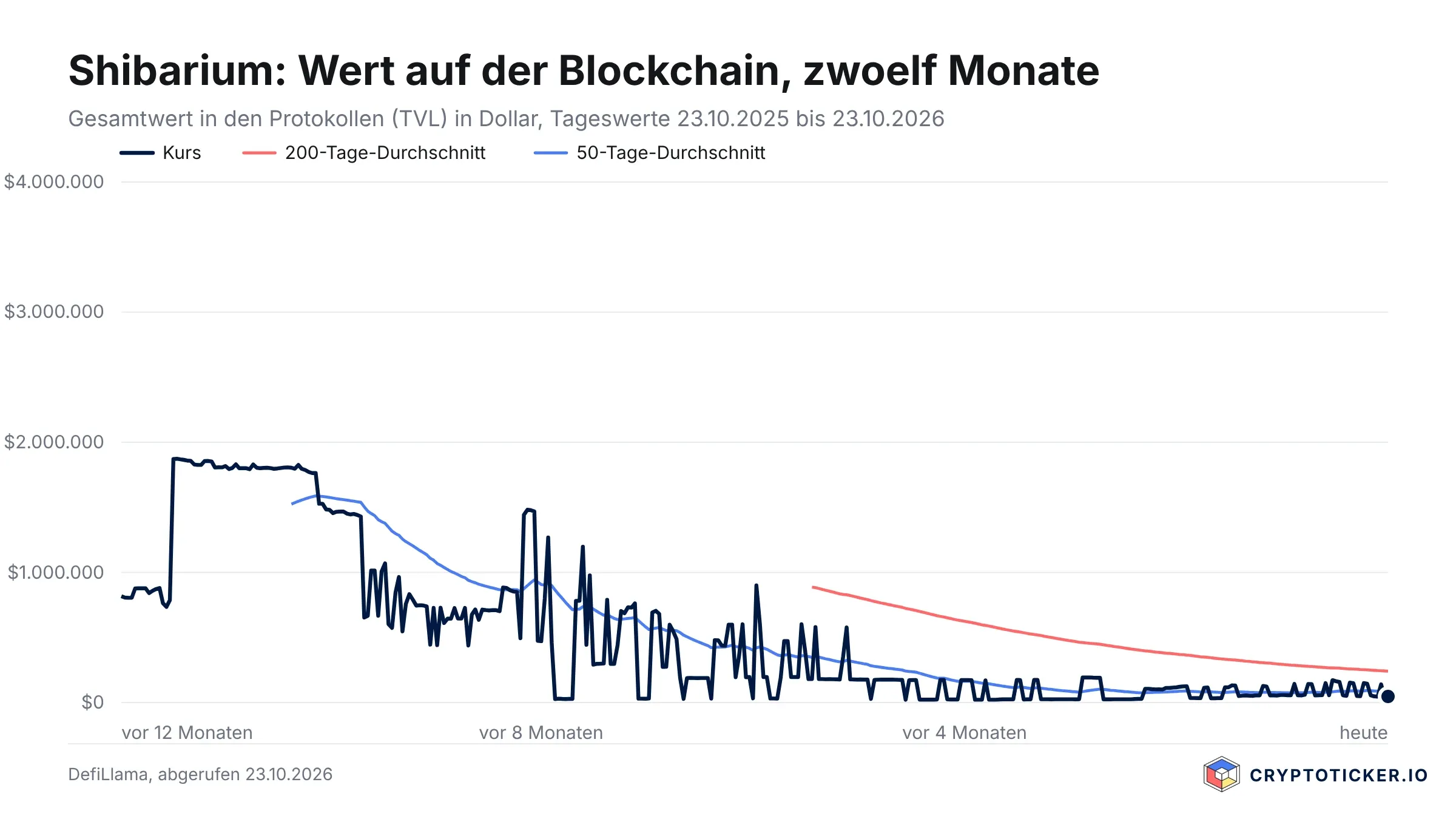
Here is the evidence: DefiLlama reports $46,453 in the protocols on Shibarium for October 23; a year ago the figure was $816,615. Our own assessment follows further down in a section of its own, with the figures that argue for and against.
Shibarium: where the project's own blockchain stands
Shiba Inu trades at $0.00000509 on Friday evening, or €0.00000454, and is 2.9 percent above Thursday evening's level. The day's high was $0.00000513, the low $0.00000491. Over 30 days the token is down 9.6 percent, over twelve months down 50.1 percent. It remains 94.1 percent below its record of October 27, 2021, when it reached $0.00008616. A market capitalisation of $2.998 billion is good for 35th place, and daily turnover stands at $64.96 million. All figures date from October 23 at around 18:40 UTC.
Shibarium is a layer-2 blockchain. A layer 2 is a separate blockchain that hands its results to a larger blockchain at regular intervals, in Shibarium's case to Ethereum, and can therefore offer cheaper fees than that larger chain. Shibarium went live on August 28, 2023, and it was supposed to give the project a use beyond simply holding the token. Payments on it are made in BONE, the project's second token, not in SHIB.
Total value locked, or TVL, measures how much money users have deposited into a blockchain's applications, for instance into a trading venue or a lending market. It is not a price and not a valuation but a quantity: the higher it stands, the more capital trusts that blockchain's applications. On August 29, 2023, the first day DefiLlama records, the figure was $1,272,456. Today it is $46,453, or 3.7 percent of that starting value.
The $46,453 measured against the token's figures
The value on Shibarium equals 0.0016 percent of SHIB's market capitalisation. Set against trading, the contrast is sharper still: SHIB turns over $64.96 million a day, roughly 1,400 times the sum sitting on its own blockchain. Anyone buying SHIB moves a multiple of what the project's blockchain holds in total, in a single day.
BONE, Shibarium's gas token, costs $0.055032 and carries a market capitalisation of $13.75 million. SHIB's market capitalisation is 218 times as high. Daily turnover in BONE is $280,743. That figure matters more in practice than the price: paying for transactions on Shibarium requires BONE, and a market with barely $281,000 of daily turnover will not absorb a larger order without moving the price.

676 transactions a day: the real volume on Shibarium
The blockchain's public explorer, Shibariumscan, counted 676 transactions on October 22, the last full day. Across the month from September 22 to October 22 the total comes to 62,193 transactions, an average of 2,006 a day and a median of 1,323. The weakest day was October 17 with 650, the strongest October 19 with 7,296.
That range tells more than the average does. A factor of eleven between the weakest and the strongest day inside a single month means individual events carry the numbers, not steady operation. The blockchain has produced 11,713,585 blocks so far, one block every 5.02 seconds on average. On the arithmetic of recent weeks, that leaves fewer than 0.04 transactions per block.
 Compare hardware wallets for your SHIB
How the value shrank from $6.44 million to $46,453
The record stood at $6,437,163 on December 8, 2024. From there to today, 99.3 percent has disappeared. The decline was not even: a year ago, on October 23, 2025, $816,615 was still sitting in the protocols. The twelve-month low came in the summer, at $24,695 on July 25, 2026. The value has almost doubled since then, yet over 30 days it is down 19.7 percent again.
The largest single position sits at an exchange, not in a protocol
DefiLlama lists 21 protocols active on Shibarium. Only a few of them carry the value. The largest position among the protocols is ShibaSwap V1, the project's own trading venue, with $22,662, close to half the blockchain's total. WoofSwap follows with $8,227, PunkSwap with $1,243, ShibaSwap V2 with $1,177 and LeetSwap with $223.
Separately, DefiLlama reports $85,418 held on Shibarium by the exchange Gate. That sum does not enter the blockchain's total, because exchange balances are counted apart from it. The position is still striking: a single exchange holds almost twice as much on this blockchain as all of its applications manage together.
What has changed since the burn figures of October 22
Our article of October 22 calculated how long the current burn pace would need to take one percent of the supply out of circulation: 714 years, at 673 million tokens burned in 30 days. The price stood at $0.00000495 then and at $0.00000509 today, a gain of 2.8 percent in two days. Circulating supply is unchanged at 589.24 trillion tokens.
The burn and Shibarium are connected, and that is rarely spelled out: under the project's design, part of the fees accruing on Shibarium goes towards burning SHIB. The amount burned therefore depends on how much the blockchain is used. At 676 transactions a day that source produces practically nothing, and that explains the 714 years from Wednesday's calculation better than any look at the burn pace on its own.
BONE and SHIB: why two tokens hang on the same blockchain
For investors in Germany, the split between the two tokens is the point that matters most in practice. SHIB is the token traded on exchanges and held in almost every wallet. BONE pays for transactions on Shibarium. Move SHIB from Ethereum to Shibarium and you then need BONE to do anything there at all, and BONE has to be bought somewhere first. With daily turnover of $280,743, that route is narrow.
The second point concerns liquidity on the way out. On October 19 we measured that only 1.59 percent of SHIB trading runs in euros. On Shibarium itself, the $46,453 is a sum that a mid-sized order would already move. Selling there means meeting a thin order book; the depth sits at the large exchanges, not on the project's own blockchain. Which exchanges trade SHIB in euros, and at what fees, is set out further down.
 Find an exchange with depth in the SHIB order book
Shibarium or Ethereum: how to find out where your SHIB sits
In most cases, SHIB that has been bought sits on Ethereum, because that is the blockchain the token was issued on in 2020 and the one every large exchange pays out to. Three details give you certainty. First, the network shown in your wallet: if it says Ethereum or ERC-20, the tokens are on Ethereum and Shibarium plays no part. Second, the gas: fees billed in ETH mean Ethereum, fees in BONE mean Shibarium. Third, the exchange's withdrawal screen: where it offers a choice of networks, Shibarium appears as an entry of its own.
The distinction has a concrete reason. A bridge between two blockchains is a program in its own right, one that locks tokens on one side and issues them on the other. If that program is lost, access is gone, even though both blockchains keep running. Anyone holding SHIB for the long term has the broader infrastructure and the deeper liquidity on Ethereum. How custody without third-party access works, and which devices handle it, is set out in our hardware wallet comparison.
Tax and the holding period: what switching blockchain triggers in Germany
Under the German Federal Ministry of Finance circular of March 6, 2025 on crypto assets, a sale of privately held crypto assets is tax-free after a holding period of one year; inside that year an exemption threshold of €1,000 per year applies. What counts as a sale is the decisive question.
Transferring your own SHIB from one address to another, including from Ethereum across a bridge to Shibarium, is not a sale and does not reset the holding period, as long as the tokens stay the same and stay in your possession. Swapping SHIB for BONE, by contrast, is a sale of SHIB and a purchase of BONE: a new one-year period starts for BONE, and a gain on the SHIB side is taxable inside the year. That hits precisely the holder who wants to become active on Shibarium and buys gas to do it. Documenting both transactions with date, quantity and price therefore matters. In an individual case, your own tax adviser decides.
Our assessment of the situation at Shibarium
In this newsroom's view, Shibarium three years after launch is not an argument for the SHIB price but a position that has to be explained. The evidence: $46,453 in the protocols against $6,437,163 in December 2024, 676 transactions on October 22, a $13.75 million market capitalisation for BONE. Against that, the value has risen again since the July low of $24,695 and the blockchain runs unchanged in technical terms, with a block every 5.02 seconds and no outage in the recorded data. What follows from it: the SHIB price responds to the state of the market and to trading data, not to usage of Shibarium. Anyone holding SHIB for the sake of its own blockchain is currently holding it for an expectation rather than for an operation. None of this is a recommendation to buy or sell; with crypto assets, total loss is possible.
Shibarium: without usage, BONE stays at $13.8 million
- Check in your wallet or in your exchange's withdrawal screen which network your SHIB sits on, and make a note of it. If they are on Ethereum, nothing needs to change. How to hold them from there without third-party access is covered in the hardware wallet comparison.
- If you are planning a sale, check the depth of the order book in your pair first, in euros above all. The exchange comparison lists the venues with their fees and euro pairs.
- If you have swapped SHIB for BONE, or plan to, record the date, quantity and price on both sides. Tax software reads these transactions out of the blockchain data and builds the statement for your tax return from them.
(As of October 23, 2026. This article is not investment advice. Prices and fee structures change; check the terms with the provider before you buy.)
Frequently asked questions about Shibarium
Transparency note: This article was produced with the assistance of artificial intelligence and reviewed by our editorial team before publication. All figures and claims were checked against the primary sources linked in the text. The feature image was generated with AI.
Related articles
- Shiba Inu price prediction: 1,005 Shibarium transactions today, targets up to $0.0000399
- Shiba Inu price up 4.4 percent: outperforms the market, but 88 trillion SHIB sit on exchanges
- Shiba Inu Price Prediction: What to Check on SHIB Before the December 31 Deadline
- Shiba Inu Price at $0.00000538, Down 8.6 Percent in a Day: Hold or Sell?
- Shiba Inu price prediction: Shibarium's locked capital falls 68 percent, and one pool accounts for it
Which topics should we dive deeper into?
Select what genuinely interests you. Your picks feed directly into our editorial planning.
Crypto news that's actually worth your time.
Weekly. 60 seconds. Carefully curated by our editors: no hype, no promo flood, no spam.

September 28, 2026 1:26 PM
Shiba Inu Price Below Six Millionths of a Dollar: 477 Million Burned Tokens Are 0.000081 Percent of Supply
The Shiba Inu price stands at $0.0000056 on September 28, 2026 and has lost a good 6 percent in 24 hours, although 476.96 million SHIB were destroyed over the past 30 days. The arithmetic behind it explains why the burn does not carry the price, and what counts for holders in Germany on tax before the year turns.

October 8, 2026 10:34 PM

Shiba Inu prediction: Zama's Q2 2026 target window has passed, Shibarium holds $159,561
The price targets for SHIB rest on an upgrade whose target window passed in June. Shibarium today carries $159,561 and 1,323 transactions a day, and that is exactly what the forecast can be checked against.
October 1, 2026 7:25 PM

Shiba Inu price prediction before the October 4 triangle apex: which levels decide now
Shiba Inu is quoted at 5.73 millionths of a dollar on Thursday afternoon, and the triangle of rising lows and falling highs runs out on October 4 according to an analysis by Blockchain.News. Which levels follow from that, what October seasonality really offers, and which deadline German SHIB holders should still meet before the turn of the year.
October 1, 2026 1:37 AM

Shiba Inu Forecast: 589 Trillion Tokens and What Matters Now for the Price Target
One cent per SHIB would equal 5.89 trillion dollars in market value, three and a half times Bitcoin. What the circulating supply says about realistic price targets, and which tax deadline is now running for investors in Germany.
October 3, 2026 10:33 AM

Shiba Inu 93.4 Percent Below Its Record: 31 December 2026 Splits Old and New SHIB
Shiba Inu trades at $0.00000568 on 3 October, 93.4 percent below its record. More important than the day is the German draft bill on crypto tax: it splits your SHIB into grandfathered and new holdings on 31 December 2026.

September 26, 2024 2:31 PM

Shiba Inu Ecosystem Explosive Growth: Shibarium Fees Surge and SHIB Price Breaks Out
Shiba Inu ecosystem explosive growth: 2,190% jump in Shibarium fees and a 203% surge in trading volumes. Why this renewed interest in SHIB?
October 17, 2026 10:16 PM
Shiba Inu ten days before its record turns five: what matters now is the holding period
On October 27 the all-time high of Shiba Inu turns five years old, and the price stands 94.2 percent below it. For holders in Germany nothing about that date hinges on the price; it hinges on the one-year deadline in section 23 of the Income Tax Act.
October 11, 2026 4:15 PM

Shiba Inu: 65 billion tokens to exchanges are $349,700: What to watch now
CryptoQuant reports a net inflow of 65 billion tokens to exchanges for Shiba Inu. At the price on October 11 that is $349,700, and 0.75 percent of daily turnover.
October 18, 2026 10:14 PM

Shiba Inu has 99.96 percent of its supply in circulation, XRP only 63.1 percent
Of every Shiba Inu token that can exist, 99.96 percent is in circulation. At XRP it is only 63.1 percent, at Chainlink 76.7. What that difference means for the SHIB price.
September 9, 2026 4:22 PM
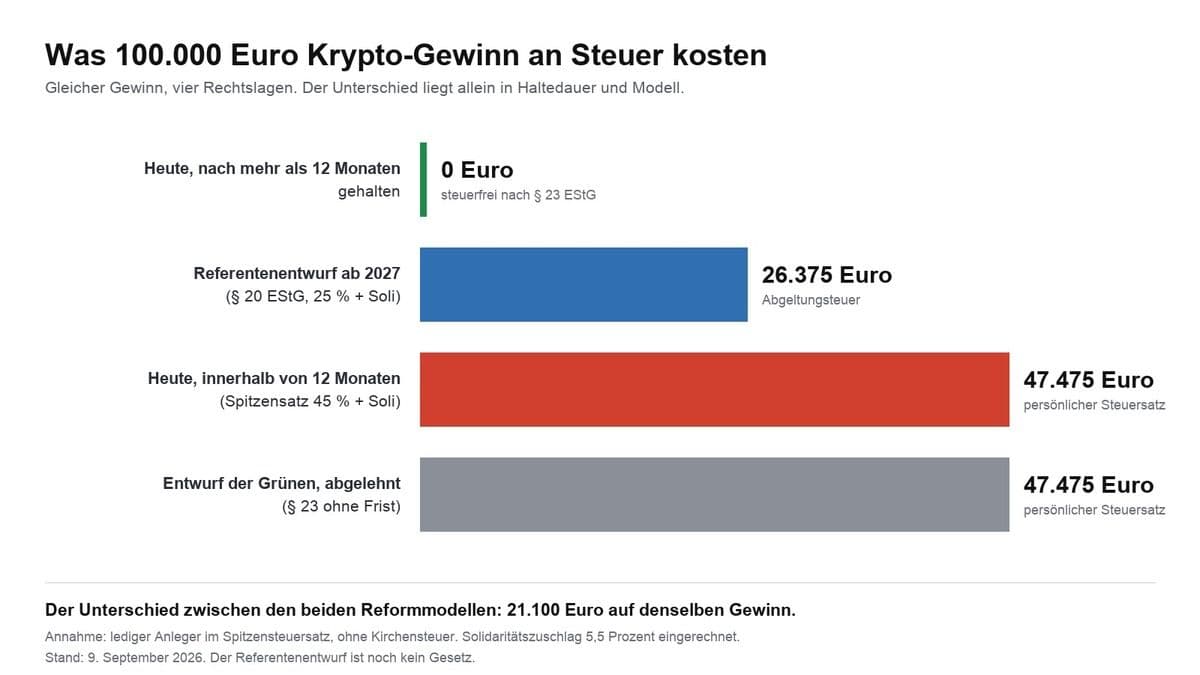
Crypto Tax in Germany: What Applies in 2026 and What Is Set to Change in 2027
Crypto gains are tax-free after twelve months; before that your personal tax rate of up to 45 percent applies. What triggers tax, how the holding period is calculated, what happens with staking and losses, and what the draft bill would change from 2027.
September 8, 2026 10:21 PM
Crypto Holding Period and Grandfathering: Why December 31, 2026 Becomes the Cut-Off in Germany's Draft Bill
A ministerial draft bill from Germany's finance ministry names a cut-off date for the first time: crypto assets acquired after December 31, 2026 are to fall under the flat-rate withholding tax. What that means for legacy holdings, running savings plans and staking income, and why nothing has been decided yet.
October 7, 2026 10:24 AM

4.79 percent down with a turnover ratio of 2.53 percent: the level that decides the Shiba Inu price prediction
Shiba Inu stands at $0.00000557 and loses 4.79 percent in 24 hours, more than any other of the six large coins. Dogecoin gives up 3.66 percent while being traded three times as intensively relative to its size, which makes an exit from SHIB the dearer one.
September 26, 2026 1:19 AM
Germany’s Crypto Holding Period Is Wobbling: What to Check Before December 31
A CDU member of the Bundestag makes it plain: the coalition agreement does not guarantee that the one-year holding period for crypto assets will survive. What that means for purchases made before the planned cutoff date of December 31, 2026.
October 14, 2026 1:13 AM

Shiba Inu today: lowest daily level since September 18
Shiba Inu trades at $0.00000521 and its daily reading of $0.00000516 is the lowest since September 18. Over 30 days the coin is nonetheless almost unchanged, and the turnover ratio explains why SHIB falls harder than Dogecoin.

September 27, 2026 1:17 PM
Dogecoin Price: What to Check on Holding Period and Custody Before the Year End
The Dogecoin price stands at $0.0977 on September 27, 2026 and has barely moved in a day. That calm is exactly the moment to work through the holding period, the reporting duty from 2026 and custody without any time pressure.
October 20, 2026 1:33 PM
60.6 percent down in twelve months and only 12th by market value: what to check before your purchase anniversary
Dogecoin has lost 60.6 percent over twelve months, more than twice as much as Bitcoin, and now ranks only 12th by market value. For investors in Germany the calendar matters more than the next price level: the anniversary of the purchase decides whether a gain stays tax free and whether a loss still counts at all.
October 16, 2026 7:25 PM

Crypto holding period for Bitcoin: “That remains to be seen,” says the finance ministry
The federal cabinet did not adopt the draft abolishing the one-year crypto holding period on October 14, 2026; it is still stuck in inter-ministerial consultation. This overview sets out what applies today, which dates follow and why the December 31, 2026 cutoff has no force of law so far.
October 15, 2026 4:13 AM

Crypto holding period: the cabinet date passes without a decision, December 31 stays the cut-off
Germany's federal cabinet did not adopt the expected decision of October 14, 2026 to abolish the one-year crypto holding period; the draft is still in interdepartmental consultation. Until new rules arrive, gains stay tax free after one year of holding, and the December 31, 2026 cut-off named in the draft separates old holdings from new ones.
February 10, 2026 4:30 PM

Shiba Inu Price Prediction: Is SHIB Still a Good Investment in 2026?
Shiba Inu faces a critical juncture in 2026. In this Shiba Inu price prediction, we share ecosystem updates and a technical analysis to see if SHIB is still a buy.
September 24, 2026 10:12 AM
XRP Falls 9.7 Percent: What to Check on Holding Period and Buying Route
XRP is down around 9.7 percent on the morning of September 24, twice as much as the typical large crypto asset. Our count of 18 coins shows who the pullback hits and which three things hold true regardless of the price.
September 14, 2026 10:23 AM

Take Ethereum Profits or Wait Out the Holding Period? What the Price Jump Means for Your Tax Bill
Ether reached its highest level since the end of January on September 11, 2026, and many are asking whether to sell now. In Germany the answer hangs on the purchase date first: we work out which tranches are tax free and which of them are showing a gain at all.
September 9, 2026 4:13 PM

Bitcoin 29 Percent Below Last Year: Which Crypto Losses You Can Still Use Before the One-Year Holding Period Expires
Nine out of ten major crypto assets trade lower today than exactly twelve months ago, Bitcoin alone by 29.2 percent. We measured the price series ourselves and show why the purchase date alone decides the tax value of your loss.
September 8, 2026 1:19 AM

Germany's Crypto Holding Period: What Happens Now Signing for Petition 201716 Closed on September 15
Recap as of September 27, 2026: the signature period for German parliamentary petition 201716, which asks for the one-year crypto holding period to be preserved, closed on September 15, 2026. This article explains what ended that day, how the petitions committee proceeds and why no investor has to sell because of it.
January 17, 2026 1:35 PM
Shiba Inu Price Prediction: Will SHIB Delete a Zero in 2026?
SHIB trades near $0.0000059 in September 2026, down from $0.0000085 in January. What it would take to delete a zero before year-end, and what has changed since.
September 26, 2024 11:14 AM

SHI Stablecoin Launch Is Soon, What Will Happen To SHIB?
The SHIB team reveals the upcoming launch of SHI stablecoin. Will SHI boost or compete with SHIB in the Shiba Inu ecosystem?
September 9, 2026 1:15 AM

Germany's Crypto Tax: 160 Million Euros for a 555-Billion Budget
The German finance ministry's draft bill puts a figure on the crypto tax for the first time: 160 million euros from 2028. What that number means in the 2027 federal budget, how 11.4 billion became 160 million, and what investors can read from it.
October 2, 2026 1:33 PM

Crypto tax before the cabinet on October 14: “Comments are only possible until October 6”
Germany's Federal Ministry of Finance sent the draft bill on crypto taxation to the associations on September 30, 2026, and the cabinet is to decide on October 14. For your holdings one date counts above all: December 31, 2026.
More from CryptoTicker