
Shiba Inu: 673 million tokens burned in 30 days, one percent of supply would take 714 years
Analysis: 589,876 SHIB were burned in 24 hours, worth roughly three dollars. What that means for circulating supply, and why percentage figures on the burn rate mislead.





Which topics should we dive deeper into?
Select what genuinely interests you. Your picks feed directly into our editorial planning.
Crypto news that's actually worth your time.
Weekly. 60 seconds. Carefully curated by our editors: no hype, no promo flood, no spam.
The record shows this: over the past 24 hours, 589,876 Shiba Inu were transferred to the project's public burn addresses, worth roughly three dollars. Our assessment follows further below: that pace is not enough to shrink the circulating supply noticeably any time soon, which means the burn currently carries no weight as an argument for a rising price.
The price stood at $0.00000492 on Thursday evening, 5.6 percent below the previous day. That is the lowest daily reading of the past 30 days. The $0.0000050 level we wrote about yesterday gave way in the course of the day.
Three dollars in 24 hours: what the burn actually achieves
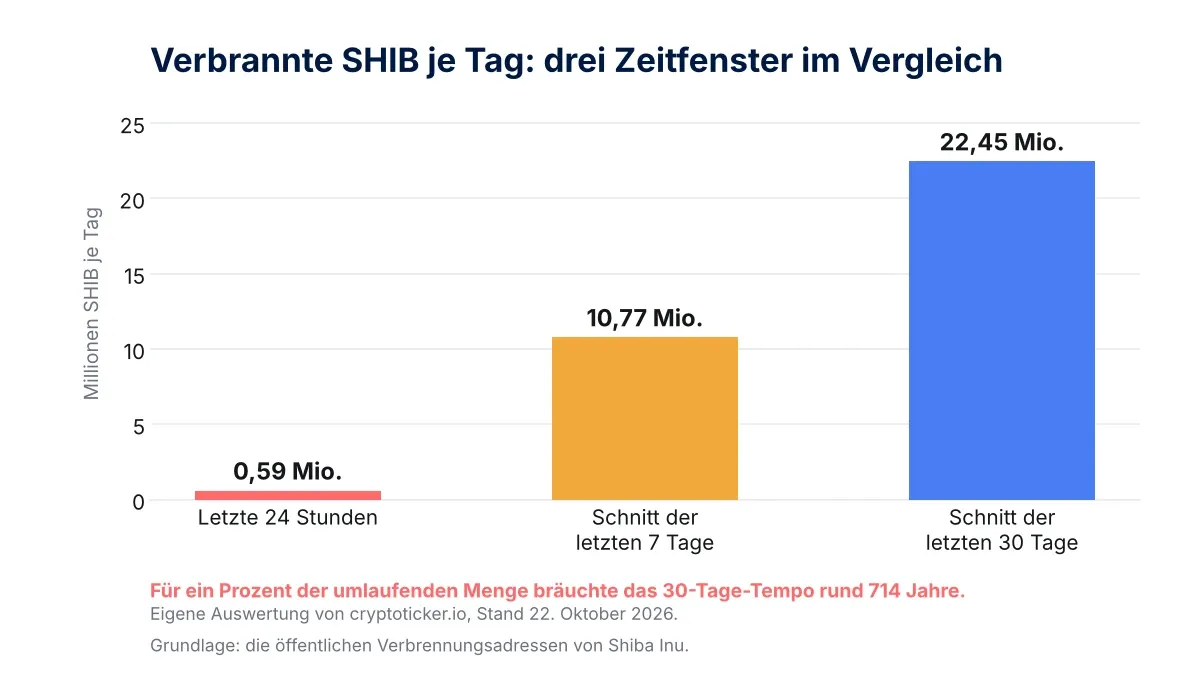
Shiba Inu's burn addresses are public, and every transfer to them can be counted one by one. Over the past 24 hours, 589,876 SHIB landed there. At Thursday evening's price that is about three dollars. Over seven days the figure was 75,364,167 SHIB, over 30 days 673,543,431 SHIB.
Those three numbers look large until somebody puts them in proportion. Circulating supply stands between 585.49 and 589.24 trillion SHIB, depending on how you count. The difference between the two figures arises because some data services still include tokens on the burn addresses and others do not. Measured against that order of magnitude, 673 million tokens in a month amount to a share of about 0.000115 percent.
In total, 410.85 trillion SHIB have been burned so far, spread across 21,916 individual transfers. That equals 41.08 percent of the quadrillion tokens originally issued. By far the largest part goes back to a single event in 2021, not to ongoing operations.
Token burns explained: how a blockchain puts a balance out of reach
A token burn is a transfer to an address nobody holds the private key for. Technically nothing disappears; the tokens remain on the blockchain. They can never be moved again, though, because the signature that would authorise a transfer does not exist. Economically the effect is the same as destruction.
Shiba Inu has several fixed addresses for this. Anyone can send tokens there, and many holders do. The appeal rests on a simple calculation: if supply shrinks and demand stays the same, the price per token rises. That calculation holds in theory. In practice it depends on how large the burned share is relative to the remaining supply.
714 years for one percent: the calculation in detail
For this article we retrieved the burn figures for the 24-hour, seven-day and 30-day windows on October 22, 2026 and derived the daily pace from them. This analysis was compiled by cryptoticker.io itself on October 22, 2026.
Over 30 days, 673,543,431 burned SHIB work out to a pace of 22,451,448 tokens a day. One percent of circulating supply is roughly 5.85 trillion SHIB. Divide the one by the other and 260,780 days come out. That is about 714 years. Using the higher supply figure of 589.24 trillion, it becomes 719 years.
Over the past seven days the result is starker still. The pace there was 10,766,310 tokens a day, and the same one percent would take roughly 1,489 years. The burn has therefore slowed in recent days rather than sped up.
Burn rate up 7,700 percent: why such headlines say nothing
Crypto media have carried headlines such as "burn rate jumps 7,700 percent" for years. Numbers like that are not wrong, they are simply meaningless. A burn rate compares one day with the day before. If 1,000 tokens were burned yesterday and 78,000 today, that reads as a gain of 7,700 percent, even though both cases involved sums worth cents or a few euros.
Exactly that effect is visible in the current figures. From the 30-day average to the latest day, the pace has fallen by 97.4 percent. Tomorrow a single larger transfer can turn that number into a four-digit gain without anything measurable changing in circulating supply. To judge the situation, read the absolute token count and its value, never the percentage.
 Find an exchange for your SHIB
The burn addresses: 21,916 transfers and 410.85 trillion tokens
The total of burned tokens comes from very unequal sources. The large burn of 2021 did the lion's share; what remained afterwards is a steady trickle of many small transfers, 21,916 of them in all. Spread across the life of the project, that is a handful of transfers a day.
That leads to a sober reading of the supply. Of the original quadrillion tokens, 58.92 percent remain, just under 589 trillion. That remaining supply is almost entirely in circulation; we reported on the release schedule on October 18, when 99.96 percent of the tokens had already been issued. No new tokens are being added, then, but barely any are disappearing either.
For anyone starting out, one point stands above the rest: the supply side is practically static, so the price hangs almost entirely on demand. Buyers of SHIB are therefore better served watching fees and spreads than the burn headline of the day. Which providers are licensed in Germany under MiCA and what trading costs there is set out in our crypto exchange comparison.
SHIB price at $0.00000492: the 30-day low in focus
One SHIB cost $0.00000492 on Thursday evening. During the day the high was $0.00000521 and the low around $0.00000492. The market value of all tokens therefore stands at about $2.90 billion, which puts SHIB in 37th place in the market.
The decline is no special case for Shiba Inu. Bitcoin lost 4.1 percent on the same day, Ethereum 4.6 percent, XRP 6.7 percent and Chainlink 6.4 percent. At 5.6 percent, SHIB sits in the middle of that move. No specific trigger for the fall is visible in the day's data.
Over seven days the token is down 3.4 percent. The all-time high of $0.00008616, set on October 27, 2021, is roughly 94.3 percent above the current price. The fifth anniversary of that record falls on Tuesday.

Levels below and above: $0.00000418 and $0.00000610
On the downside, the next documented level is the low of the past 90 days. It dates from July 25, 2026 and stood at $0.00000418. Roughly 15 percent separate the current price from that point. In between there is no area where the price turned more than once over the past three months.
On the upside, the first hurdle is the band between $0.00000498 and $0.00000516. Daily closes from October 18 to 22 sat there before the price dropped below. The second hurdle is the high of the past 90 days at $0.00000610, from September 23, 2026, roughly 24 percent above the current level.
These levels come from the daily closes of the past 90 days, not from a model. They say where trading last took place, not where the price is heading.
Since yesterday's article: the $0.0000050 level has given way
On Wednesday we wrote that 87.16 trillion SHIB sit on exchanges and that the round $0.0000050 level was being tested. That test ended on Thursday: the price closed below it.
Two things have changed since. First, at $0.00000492 the price is 4.1 percent below Wednesday's close. Second, the pace of burning has fallen further over the same period, from a 30-day average of 22.45 million tokens a day to 0.59 million on the latest day. Both moves point the same way: less activity, less demand.
 Compare hardware wallets for your tokens
How to check the burn figures yourself
The numbers this article rests on can be retraced in a few minutes. The public counter at shibburn.com lists every transfer to the burn addresses with a timestamp and an amount. The totals for 24 hours, seven days and 30 days are there too.
Three points matter when you do the maths
First the absolute number: how many tokens is it, and what are they worth in euros or dollars? A burn worth three dollars is not news, whatever percentage sits next to it.
Then the proportion: set the amount against circulating supply. With Shiba Inu you divide the burned amount by roughly 585 trillion. If the result is a number with four zeros after the decimal point, the event carries no weight for the price.
Finally the window: a daily figure swings wildly. The 30-day average says more about whether anything lasting has changed.
Our assessment: the burn is no price driver at present
In the editorial team's view, the numbers argue against the burn as a price case. The evidence: 673,543,431 tokens burned in 30 days against a circulating supply of roughly 585 trillion, a share of 0.000115 percent, and a pace that would need 714 years for one percent. For comparison, the 87.16 trillion tokens sitting on exchanges are about 129,000 times the monthly burn and can be moved in a single trading day.
One point argues the other way, and we will not play it down: the burn depends on how much the ecosystem is used. If usage picks up, the volume of burned tokens rises with it. Were the pace to stay above several billion tokens a month, the calculation would look different. The current level is far from that, and we are not forecasting it.
For investors in Germany that means: the supply side offers no argument right now. Holders of SHIB base that decision on demand, on liquidity at the exchanges and on their own time horizon. On the one-year holding period and on recording your own purchases we keep a separate overview, linked below.
SHIB burn: 22.45 million tokens a day do not move the price
1. Take the absolute number rather than the percentage. Before reacting to a burn headline, work out what it is worth. Where you can trade SHIB and at what fees is shown in our crypto exchange comparison.
2. Settle custody before the next drop arrives. Tokens on an exchange sit on somebody else's keys. Which devices are available for self-custody and what they cost is set out in the hardware wallet comparison.
3. Keep a clean record of your purchases. The one-year holding period counts from the purchase date of each position, and without records that cannot be proven later. Suitable tools are listed under tax software and portfolio trackers.
(As of October 22, 2026. This article is not investment advice. Prices and fee structures change; check the terms with the provider before you buy.)
Frequently asked questions about the Shiba Inu burn
Transparency note: This article was produced with the assistance of artificial intelligence and reviewed by our editorial team before publication. All figures and claims were checked against the primary sources linked in the text. The feature image was generated with AI.
Related articles
- Shiba Inu Price Below Six Millionths of a Dollar: 477 Million Burned Tokens Are 0.000081 Percent of Supply
- Shiba Inu price prediction before the October 4 triangle apex: which levels decide now
- Shiba Inu Forecast: 589 Trillion Tokens and What Matters Now for the Price Target
- Shiba Inu price up 4.4 percent: outperforms the market, but 88 trillion SHIB sit on exchanges
- When Does the Shiba Inu Rocket Launch? We Did the Math on What Burning Really Achieves
Which topics should we dive deeper into?
Select what genuinely interests you. Your picks feed directly into our editorial planning.
Crypto news that's actually worth your time.
Weekly. 60 seconds. Carefully curated by our editors: no hype, no promo flood, no spam.

March 7, 2026 7:00 PM
Shiba Inu Analysis: SHIB Inflows Spike—Is a 53,000% Burn Rate Enough?
SHIB faces fresh selling pressure as 157 billion tokens hit exchanges. Can a skyrocketing burn rate save Shiba Inu from the $0.0000050 zone?

October 3, 2026 10:51 PM

Shiba Inu price prediction: “Yours truly”, the developer answers when asked who pays for Shibarium
On October 2 a Shiba Inu developer answered in two words who pays for running Shibarium: he does. What that means for the Shiba Inu price prediction is shown by a calculation from the burn rate, the circulating supply and the network data.

September 28, 2026 4:38 PM
Shiba Inu Price Prediction: What Matters Now That Shibarium Handles 1,680 Transactions a Day
Shiba Inu trades at $0.0000056 on September 28, 2026, and its own layer-2 chain Shibarium processes around 1,680 transactions a day after the reorg fix, against 4.69 million in August 2025. This piece sets out which figures actually carry a SHIB forecast today and what follows from them for buying, custody and tax in Germany.
January 17, 2026 1:35 PM
Shiba Inu Price Prediction: Will SHIB Delete a Zero in 2026?
SHIB trades near $0.0000059 in September 2026, down from $0.0000085 in January. What it would take to delete a zero before year-end, and what has changed since.
February 10, 2026 4:30 PM
Shiba Inu Price Prediction: Is SHIB Still a Good Investment in 2026?
Shiba Inu faces a critical juncture in 2026. In this Shiba Inu price prediction, we share ecosystem updates and a technical analysis to see if SHIB is still a buy.
October 5, 2026 10:17 PM
Shiba Inu price prediction: 384 million SHIB burned in 30 days, 585 trillion still in circulation
The burn figures for Shiba Inu diverge widely depending on which counter you read. What the verified monthly balance means for the circulating supply, why the new Solana route has been the bigger lever since October 4, and which levels are capping the price now.
November 26, 2024 6:01 PM
Shiba Inu Price Prediction: New Rewards & Token Burns vs Market Crash
With news about new rewards unveiling, token burns, and an optimistic 200% Shiba Inu price prediction, could it be enough for the SHIB price to recover?
October 18, 2026 10:14 PM

Shiba Inu has 99.96 percent of its supply in circulation, XRP only 63.1 percent
Of every Shiba Inu token that can exist, 99.96 percent is in circulation. At XRP it is only 63.1 percent, at Chainlink 76.7. What that difference means for the SHIB price.
September 29, 2026 10:36 PM
Shiba Inu Price Prediction: 500 Billion SHIB Hit Exchanges in 24 Hours, Next Target 6.2 Millionths of a Dollar
500.12 billion SHIB flowed to trading venues in 24 hours, yet on balance more SHIB left the exchanges than arrived. What the burn figures really show and which levels count to the upside and the downside.
October 9, 2026 10:16 AM
Shiba Inu: 707.5 million tokens burned in 30 days, and what that is worth in money: How to check the figure yourself
Shibburn lists 707,506,927 Shiba Inu tokens burned over 30 days, 1,945,872 of them in the past 24 hours. Measured against the circulating supply that is 0.000121 percent and roughly $3,820, and two arithmetic steps let you place any such report yourself.

October 2, 2026 1:16 PM

Shiba Inu price up 3.1 percent with 17,271 tokens burned: the consequences for fees and holding period
Shiba Inu stands at 5.93 millionths of a dollar on October 2 and 3.13 percent up, yet only 17,271 tokens worth 10 cents were burned in 24 hours. What really carries the daily gain, and what follows from it for holding period, fees and order size.
February 3, 2023 7:50 PM

Can Shiba Inu Reach $1? Our 2023 Prediction Checked in 2026
In February 2023 we asked whether Shiba Inu could reach $1. It could not, and it still cannot: at $0.00000583, SHIB would need a market cap of about $589 trillion. Here is what happened since.

January 30, 2024 3:03 PM
Shiba Inu Burn Rate Surges by HUGE 1300%: What’s Next for SHIB Price?
It's a burning spree that's set the crypto community on fire with excitement. Will the SHIB price increase?
March 4, 2025 7:01 AM

Shiba Inu Price Prediction for March 2025 Amid Community Warnings
Shiba Inu (SHIB) is set for a major price move, with AI predicting a 97% surge by March 2025. But is it the right time to invest amid rising scams?
September 18, 2024 7:57 PM
FACT: Will Shiba Inu Coin reach $1 during the next Bullrun?
Will Shiba Inu coin reach $1 during the next bullrun? Let's analyze in this Shiba Inu coin price prediction.
June 29, 2024 4:49 PM

Shiba Inu Price Prediction: Will Shiba Inu Coin CRASH Soon?
Shib coin news: With Bitcoin hovering around $60,000 and Shiba Inu striving to reach the significant $0.000020 mark, what does the future hold for SHIB price?
September 21, 2024 12:21 PM
SHIBA INU Price Moonshot to $1? Unleashing the SHIB price Analysis
It is essential to consider the factors that could potentially propel SHIB. Let's take a look at this SHIB price article in more detail.
September 26, 2024 2:31 PM

Shiba Inu Ecosystem Explosive Growth: Shibarium Fees Surge and SHIB Price Breaks Out
Shiba Inu ecosystem explosive growth: 2,190% jump in Shibarium fees and a 203% surge in trading volumes. Why this renewed interest in SHIB?
September 27, 2024 9:34 AM
Shiba Inu Leads As Meme Coins Dominate The Market: Why Did SHIB Price Surge?
Shiba Inu has taken the crypto world by storm with its explosive SHIB price surge. What’s driving this rally, and could SHIB price erase another zero?
July 5, 2025 4:27 PM
Is Shiba Inu Ready for a 20% Rally?
Traders are watching a tight price range and critical support levels that could decide whether SHIB surges 20% higher or drops to new lows.
June 22, 2025 1:49 PM

Is This the Best Time to Buy SHIB in 2025?
Shiba Inu (SHIB) is testing key support levels after weeks of decline. With RSI screaming “oversold,” is a bounce finally coming?
March 29, 2025 2:32 PM
Shiba Inu Price Prediction: Can SHIB Crash to $0 in This Bearish Market?
Shiba Inu (SHIB) is under pressure as a bearish sentiment dominates the crypto market. Could SHIB crash to $0.000001, or is a reversal still in play? Here’s what to expect as volatility rises.
October 8, 2025 3:23 PM
Shiba Inu Price Prediction: SHIB Coin Drops 5% as Bitcoin Price Adjusts
Shiba Inu’s market rank slips to 22 after a 5% drop in 24 hours, as Bitcoin corrects from $126K to $122.5K. Can $SHIB rebound if BTC rises again?
October 11, 2026 4:15 PM

Shiba Inu: 65 billion tokens to exchanges are $349,700: What to watch now
CryptoQuant reports a net inflow of 65 billion tokens to exchanges for Shiba Inu. At the price on October 11 that is $349,700, and 0.75 percent of daily turnover.
September 29, 2026 7:30 PM
Shiba Inu Holds 5.50 Millionths of a Dollar: Stronger Than Dogecoin Over 30 Days
Shiba Inu stands at 5.742 millionths of a dollar on Tuesday evening. What decides matters, though, is the depth of the euro order book: it carried only 28 percent of the dollar turnover, and at the best ask price it held around 10 euros.
September 26, 2026 4:24 PM
Shiba Inu Price: Which Marks and Which Spread to Check Before Your Next Order
Shiba Inu is quoted at $0.00000589 on September 26, 2026, 7.54 percent higher than seven days earlier. Which three marks count now, why the same purchase costs thirty times the spread depending on the exchange, and what to check on custody and the one-year period.
October 6, 2026 10:13 PM

Shiba Inu Price at $0.00000578 and €0.00000514, Seven Days Down in Dollars and Up in Euros: Which Levels Decide Now
The Shiba Inu price stands at around $0.00000578 and €0.00000514 on Tuesday evening. Read the same week in euros and the sign flips — and the levels that count next hang on exactly that.
More from CryptoTicker