
40 percent price gain on flat capital: Immutable now markets AI tools for 800 games
Around $11.2 million has been sitting unchanged on Immutable's blockchain since January, while the IMX price gained 40.5 percent in thirty days. What the chain delivers today, why players pay no network fees, and where you can get IMX against the euro in Germany.




Which topics should we dive deeper into?
Select what genuinely interests you. Your picks feed directly into our editorial planning.
Crypto news that's actually worth your time.
Weekly. 60 seconds. Carefully curated by our editors: no hype, no promo flood, no spam.
Anyone opening Immutable's home page today finds no game characters and no NFT collection, but a marketing platform for game studios: 800 games, 35 billion data points, a tool for analysing Steam images. The blockchain the company became known for appears only as one product box among several. According to our own assessment, around $11.2 million sits on it, practically the same amount as in January.
The IMX token has nonetheless had a good month: a gain of 40.5 percent in thirty days, measured in euro. This piece sorts out both sides. It works through the blockchain, the token, the applications, the access route and the trading venues available in Germany. The figures on locked capital were gathered by cryptoticker.io itself on October 13, 2026 from DefiLlama's public data.
What Immutable is today: from NFT platform to toolkit for Steam studios
Immutable started out as a technology provider for games with blockchain items. The best known of them is the collectible card game Gods Unchained, in which cards exist as tradable tokens. That period is also the source of its reputation as the address for Web3 gaming.
Its own home page tells a different story today and advertises marketing and data tools for games companies: an audience analysis, a tool for measuring performance, an AI assistant for growth, plus a free analysis service for Steam thumbnails which, by its own account, has evaluated more than 25,000 such images. As the basis for this, the page cites 35 billion data points from more than 800 games across PC, Steam, consoles and mobile devices.
The customer examples given there are conventional games companies. Ubisoft is named with a title said to have reached 2.8 times the purchase rate on launch day, and a studio called 1047 Games with more than 300,000 Steam wishlist entries in under two months. Blockchain does not feature in those examples. The Passport and Chain products are still on the list, but without a single figure beside them.
That is the most important observation for anyone holding IMX: the company increasingly earns its money from tools for games without a blockchain. What that means for the token is set out further below. We attempted an assessment of the wider sector in our overview of the four companies in Web3 gaming.
Immutable zkEVM: the technology behind chain ID 13371
In the provider's technical documentation the blockchain is called Immutable zkEVM and described there as the blockchain for games built on Ethereum. The main network carries chain ID 13371, the test network 13473. The access point for programs is rpc.immutable.com, capped at 25 requests per second on the free tier.
zkEVM stands for a network that executes Ethereum contracts and secures its work with cryptographic proofs. For developers that means anyone working on Ethereum brings their tools and contracts with them. The connection to Ethereum runs through bridge contracts, which the documentation describes as audited and monitored.
What is missing from that documentation is notable. Immutable X, the company's older network, no longer appears there. Anyone reading the current papers finds only one blockchain. So anyone still holding items or tokens from the old environment should check where they now sit rather than rely on old instructions.
Sponsored network fees through Passport: why players pay no gas
The network's native currency is IMX, or tIMX on the test network. Players notice little of it, and that is deliberate. Immutable offers to take on the network fees: the documentation puts it as players never paying fees thanks to gas sponsoring. This is made possible by Passport, the in-house login and wallet solution, which creates an account without the usual recovery phrase.
For onboarding new players that is the obvious answer, because nothing keeps casual players away as reliably as being told to buy cryptocurrency first. For demand for IMX the same decision has a flip side: if the studio covers the fees, the player does not need the token. Use of the blockchain therefore grows independently of how many people hold IMX.
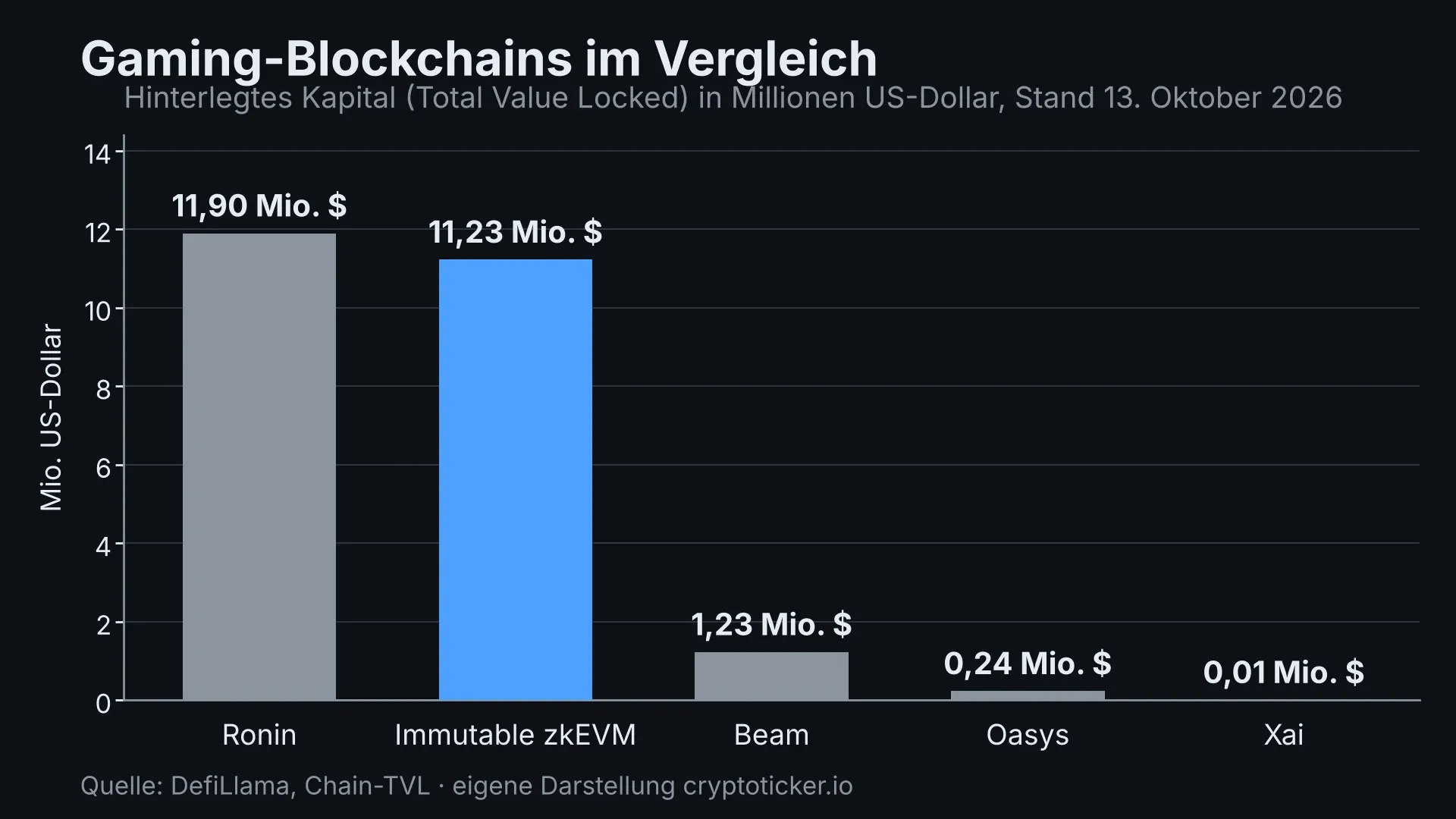
$11 million since January: the capital on the blockchain is standing still
Total value locked, or TVL, measures the capital deposited in a blockchain's applications. For Immutable zkEVM we assessed the trajectory from DefiLlama's public data, with three verified readings.
On January 1, 2026 it held $11.57 million. On April 1 it was $11.16 million, on July 1 $10.94 million, on October 1 $11.22 million, and on October 12 $11.22 million. Over more than nine months, then, the figure has moved by less than four percent. The highest level ever measured stands at $21.23 million in July 2025.
Such a trajectory is unusual. Most blockchains swing with the market, often by multiples. Here almost nothing moves, and that suggests the capital is held by a few fixed positions rather than by investors coming and going. In the ranking of blockchains by locked capital, Immutable zkEVM sits in 78th place.
Among the networks built for games that is still second place. Ronin comes to $11.90 million, Immutable zkEVM to $11.23 million, Beam to $1.23 million, Oasys to $0.24 million and Xai to $0.01 million. How that looks in detail at Ronin is broken down in our ecosystem piece on Ronin. The position of the whole category can be summed up in one sentence: gaming blockchains together move less capital than a mid-sized protocol on Ethereum.
 Find an EU-authorised exchange for IMX
Quickswap V3 and KAIO: the two applications with capital worth mentioning
Behind the $11.2 million there are essentially two applications, according to the DefiLlama data. The decentralised exchange Quickswap V3 holds $11.23 million, and KAIO, a provider in the field of tokenised real-world assets, $6.27 million. The fact that both figures together exceed the value of the blockchain is a counting effect: capital working in several protocols at once is counted only once for the value of a blockchain.
What follows from that is a thin layer of provision. As a DEX, meaning a decentralised exchange, there is effectively one available. A lending market with capital worth mentioning is absent, as is a launchpad of its own for new tokens. What does exist is what the blockchain was built for: trading in game items that exist as tokens. Marketplaces for them run on the in-house order book technology that studios build into their games.
For investors that is the most important limitation. Anyone looking for DeFi in the usual sense, meaning loans, interest or derivatives, finds little on Immutable zkEVM. Where NFT trading still takes place at all is written up in our overview of the NFT marketplaces in 2026.
IMX: 98 percent below the 2021 high and 40 percent up on the month
The token figures, gathered on October 13, 2026 from CoinGecko: IMX stands at €0.15. Market capitalisation is around €140 million, which means 214th place among all cryptocurrencies. There are 904,472,049 tokens in circulation out of a maximum of 2 billion, or 45.2 percent. Valuing the entire supply at today's price gives around €309 million.
The trajectory points both ways. Over thirty days there is a gain of 40.5 percent, over seven days a loss of 8.8 percent, over one year a loss of 69.7 percent. The price is 98.2 percent away from its peak of €8.49, reached on November 25, 2021. Around €7.8 million was traded within one day most recently.
Those 98.2 percent are not evidence of failure; they are a reminder of the starting point. The peak fell at the height of NFT enthusiasm, when collectibles dominated the news. More telling is the distance between market value and usage. Around €140 million of market capitalisation stands against $11.2 million of locked capital.
More than half of the tokens are, in addition, not yet in the market. When and how those roughly 1.1 billion IMX enter circulation will help decide whether a rising price holds.

Gods Unchained and the 800 games: what Immutable puts in the window
Gods Unchained is still running and can be reached through its own site. The collectible card game remains the best-known title built on Immutable, and it is also the oldest. The figure of 800 that the company advertises today, by contrast, refers to the data base of the marketing platform covering games of every kind, including those without a blockchain.
That distinction is decisive and often gets lost in summaries. A studio using Immutable's audience analysis tools never touches the blockchain. A number that mixes the two says little about the network. Anyone wanting to check the state of it is therefore better off looking at locked capital and at activity in the explorer.
A comparison over time shows the direction. Two years ago Immutable was synonymous with games on the blockchain, and Illuvium was among the most frequently named titles. What became of that generation is traced in our review of Web3 gaming. Today the blockchain comes last in Immutable's product list.
Bridge, explorer and network data: the route onto Immutable zkEVM
To do anything on the blockchain you enter the network with chain ID 13371 and the access point rpc.immutable.com in your wallet. Anyone playing via Passport can skip this step, because the login creates the account itself. For the standalone route, any wallet that permits custom networks will do.
Balances come across from Ethereum through the bridge contracts. explorer.immutable.com serves as the public register of all transactions and contracts. There you can check whether a transfer has arrived and which address sits behind a game item before you grant it an approval.
One peculiarity applies to game items: technically they belong to you, but they hang on the game that issues them. If a studio shuts down operations, the token stays in the wallet and loses its purpose all the same. That holds for such items generally and is not down to this blockchain.
 Compare NFT marketplaces and fees
IMX against the euro: which authorised exchanges run the trade
For investors in Germany what counts is whether a token can be bought against the euro and at a provider with European authorisation. cryptoticker.io checked this question itself on October 13, 2026 by querying the public trading registers of several exchanges.
The result is better than for many smaller tokens: Kraken lists IMX against the euro and against the US dollar, and Bitvavo lists the euro pair as well. At Coinbase, IMX is available only against the US dollar and against the stablecoin USDT; a euro pair is missing there. Anyone wanting to buy without a conversion step therefore has two authorised addresses to choose from. Which of them suits you and what the order costs in each case is shown in our exchange comparison.
A note on game items: they are bought in the game itself or on a marketplace, not on an exchange. Which marketplaces are worth considering for that today is set out in our marketplace comparison.
What argues against IMX: supply, dependency and a market without growth
Four points belong on the other side. First, supply: more than a billion IMX are not yet in circulation, and every release meets a market with around €7.8 million of daily turnover. Second, the dependency on a handful of applications, since the locked capital effectively hangs on a single exchange on the blockchain. Third, the gas sponsoring, which decouples usage from demand for the token. Fourth, the direction of the company, whose visible business today consists of marketing tools for games without a blockchain.
For tax purposes, German law treats IMX like other crypto assets as an other asset. Gains from a sale within one year of purchase fall under the private disposals of the Income Tax Act and are taxable above the exemption limit; after one year has passed the gain remains tax free. The same basic pattern applies to game items that exist as tokens, though valuation is harder there because no continuous price exists. Individual cases are a matter for tax advice.
And the fundamental point stands: a total loss is possible. A token whose network has been sitting at the same level of capital for nine months needs more than one good month to sustain higher prices.
Our assessment: the blockchain no longer carries the company on its own
Immutable has made a decision, and it stands openly on its own home page: growth is to come from data and marketing tools for game studios, not from game items on the blockchain. In business terms that is understandable, because 800 games as a data base is a larger market than the second-largest gaming blockchain with $11.2 million of locked capital.
For IMX the same decision cuts both ways. In favour: a company with a viable business can run its blockchain for longer than one without. Against: none of the advertised tools needs the token, and players' network fees are sponsored anyway. The 40.5 percent jump in thirty days changes none of that as long as locked capital stays at eleven million dollars. The direction can be checked against precisely that figure. This is expressly not a recommendation to buy or sell.
Immutable: $11 million in capital, 800 games in the window
Three steps if you want to look at IMX more closely:
- Choose a venue with a euro pair. Two authorised exchanges list IMX directly against the euro; at a third you need the detour via the dollar or a stablecoin. The terms are in the exchange comparison.
- Keep custody separate from the game login. A Passport account is meant for the game, a wallet of your own for your holdings. Which one is suitable is shown by the software wallet comparison.
- Record purchases and game items. With tokens from games in particular, the one-year period later becomes an arithmetic problem if the records are missing. Suitable programs are listed in the comparison of tax tools.
(As of October 13, 2026. This article is not investment advice. Prices and fee structures change; check the terms with the provider before you buy.)
Frequently asked questions about Immutable (IMX)
Transparency note: This article was produced with the assistance of artificial intelligence and reviewed by our editorial team before publication. All figures and claims were checked against the primary sources linked in the text. The feature image was generated with AI.
Related articles
Which topics should we dive deeper into?
Select what genuinely interests you. Your picks feed directly into our editorial planning.
Crypto news that's actually worth your time.
Weekly. 60 seconds. Carefully curated by our editors: no hype, no promo flood, no spam.

October 27, 2024 4:04 PM
What is KLAUS Token: The Meme Coin Making Waves in the Crypto Community
KLAUS Token is making waves in the crypto market and getting noticed among the meme coins. But what is this KLAUS token about?
May 20, 2024 10:19 AM
Will Dogwifhat (WIF) Price Still Go Up To Reach $5?
Dogwifhat (WIF), a meme coin based on a viral Shiba Inu meme, is making headlines with its skyrocketing value. What price to expect and what are the support levels now?

October 26, 2021 10:58 AM
You Think You Know What Immutable X Is? Your Step by Step Guide to IMX Token
NFT's are creating a storm currently. This post is all about Immutable X marketplace and Immutable X token, layer-2 scaling solution.

October 12, 2021 7:33 PM

Why Traders Should Buy The Wojak Token
The Wojak token recently made a 2500% jump in the market. Find out in this article if you can still buy the token despite the jump.
October 21, 2024 12:57 PM
MEW Price Prediction After Reaching A New ATH
MEW Token (Cat in a Dogs World) reached a new all-time high today, driven by recent price spikes and strong technical indicators. Could it break through resistance and set another new ATH?
January 22, 2025 7:31 PM
Tornado Cash OFAC Sanctions Overturned: A Huge Win for Crypto Privacy and a 150% TORN Price Surge
The U.S. court’s reversal of Tornado Cash OFAC sanctions marks a pivotal moment for blockchain privacy, sparking a dramatic surge in the TORN price.
January 20, 2025 1:50 PM
Ethereum Price Prediction with Vitalik Buterin New Leadership after ETH Price Struggles in Bitcoin's Shadow
ETH price struggles with Bitcoin’s dominance, Trump’s crypto moves, and the Solana blockchain surge. As Vitalik Buterin announces leadership changes to reshape Ethereum’s future, what to expect for Ethereum price and blockchain?
June 21, 2024 5:06 PM
Shiba Inu (SHIB) Price Prediction: Promising Developments In The Near Future?
Shiba Inu (SHIB) future looks promising with the latest developments, including major token burns, strategic Web3 sponsorships, and optimistic price predictions.
August 28, 2024 10:33 PM
How to Migrate from MATIC to POL: Full Guide
How to update and migrate Polygon Tokens from MATIC to POL, when and why? Here is all you need to know...
March 17, 2025 6:00 AM
MANTRA OM Price Prediction for March 2025: Will OM Price Reach $50?
MANTRA OM price surges despite the downtrends, making OM token rank as the top-performing crypto of 2025. But what about the MANTRA OM price prediction for March 2025? Will this momentum continue for OM price to reach $50?

April 13, 2026 6:10 PM
RAVE Token Surges 4,000%: What is RaveDAO and How to Trade It?
RAVE token skyrocketed over 4,000% in 7 days. Learn what RaveDAO is and follow our guide to trade RAVE on Bitget today.
February 15, 2025 10:13 PM

ARKA Launch on Solana: How Prediction Markets and High-Profile Tokens Are Shaping SOL's Future in 2025
Solana's blockchain dominance continues in 2025 with the launch of ARKA, a prediction market platform. With these developments, experts predict the potential for SOL price to surge to $750.
November 12, 2024 1:58 PM
Crypto Market Rally News: EGO and CRO Tokens Lead The Bullish Surge
The global crypto market is on fire, with a 4.25% surge in the last 24 hours. EGO and CRO tokens are among the top performers today. Find out why they are capturing attention in this bullish rally!
February 18, 2024 11:00 PM
Bitget Token: How High Will the BGB Price Go?
This article is all about the BGB price analysis and What is BGB token. Let's take a look at this in more detail.
November 14, 2024 6:10 PM
Peanut the Squirrel (PNUT): TOP Performer of The Week
From an all-time low to an all-time high in just 10 days, ranking among the top 5 trending tokens and taking over this week's best performer, here is Peanut the Squirrel (PNUT).
September 1, 2024 10:00 PM
Ripple Unlocks 1 Billion XRP Tokens: What's Next For XRP Price?
As Ripple unlocks 1 Billion XRP Tokens, eyes are now on the XRP price, will it surge or crash next?
February 16, 2026 4:00 PM
CC Canton Token Surges Into Top 20 — Can It Break Into the Top 10 Next?
CC Canton token enters the Top 20 after overtaking major altcoins. Can it reach the Top 10 next? Here’s the full market analysis.
December 19, 2024 2:31 PM
XRP Crash: What Happened and What's Next for the Last Days of 2024?
XRP recent crash has left investors on edge as the crypto faces significant market turbulence. But what are the reasons behind the drop?
December 13, 2024 11:00 AM
Why is AVAX Price UP while the Market is DOWN?
With the Avalanche9000 launch set to transform the Avalanche blockchain and expert AVAX price predictions signaling bullish momentum, what's next for AVAX?
October 8, 2024 10:46 AM

This Memecoin Made 100% in 1 Month...Meet MOG Token
MOG crypto has seen a significant price increase over the past month, attracting attention from traders and investors.

October 3, 2026 4:13 AM

OKB at $120, X Layer 10 Percent Below Its Capital Peak: Why One Lending Market Holds 68 Percent
OKB trades at $120.25 after an unusually quiet week. X Layer holds $168.3 million in deposits according to our own survey, and 68 percent of that sits in a single lending market.
September 21, 2026 4:24 PM

Jupiter Rises: Money Is Rotating Back Into Solana DeFi
Solana gains 7.6 percent, the trading aggregator Jupiter 13 percent. When applications rise faster than the chain, capital is looking for leverage inside the ecosystem. What sits behind it and where the risk lies.
September 21, 2026 4:19 PM

Arbitrum Up 150 Percent In A Month: Is Robinhood Carrying The Price?
ARB is the strongest performer of the past four weeks. Behind the advance sit Robinhood's own chain and trading in tokenised assets. Two dates decide whether the rally holds.

September 19, 2026 4:20 PM
Is Ondo a Good Buy at the Current Price?
Ondo trades above both moving averages and far below its twelve-month high. We examine the chart position, trading volume and supply mechanics, and set out what argues for and against buying the ONDO token.
August 29, 2026 4:26 PM
Is Aster a Good Buy at Current Prices?
Aster sits above both moving averages and at the same time far below its high since listing. We assess whether the token is a good buy at the current price and why the supply still to be released remains the weightiest objection.

More from CryptoTicker