
Three NFT marketplaces fewer: what matters when buying now
Binance has ended NFT trading, Nifty Gateway is closed and Magic Eden trades only on Solana. Which NFT marketplaces are open in 2026, what a purchase costs and why MiCA does not protect you there.


Which topics should we dive deeper into?
Select what genuinely interests you. Your picks feed directly into our editorial planning.
Crypto news that's actually worth your time.
Weekly. 60 seconds. Carefully curated by our editors: no hype, no promo flood, no spam.
Update, November 16, 2026: As announced, Blur closed its website blur.io on November 12, 2026. Until November 12, 2027, the site only keeps a page online where users withdraw ETH from the Blur Pool and close out open Blend loans.
Update, November 3, 2026: The October 11 version still listed Blur among the open marketplaces. A day later Blur announced on X that its website blur.io would be shut down on November 12, 2026; the protocol keeps running on Ethereum, and the lending service Blend issues no new loans from that date. We have also added Foundation, which has been offline since April 2026. What the shutdown means for Blur users is set out in our article on the Blur shutdown and Blend loans; which marketplaces still trade is shown in our current comparison of NFT marketplaces.
Buying an NFT in 2026 means facing fewer doors than a year ago. An NFT marketplace is the venue where digital collectibles are offered, auctioned and sold. Three large providers wound this business down wholly or in part over the course of the year: Binance's NFT trading, the art platform Nifty Gateway and Magic Eden's non-Solana markets. Add to that the digital art platform Foundation, offline since April 2026, and Blur, which closed its website on November 12, 2026. Still open are OpenSea, Tensor, Rarible and SuperRare. Since those closures, which marketplace comes into question for you is decided above all by one question: which blockchain your desired NFT sits on.
What an NFT marketplace is and where it differs from a crypto exchange
An NFT marketplace is a trading platform for non-fungible tokens, meaning tokens that cannot be swapped against one another like coins, because each of them designates its own unique piece. A crypto exchange matches buy and sell orders for mutually interchangeable cryptocurrencies; a marketplace for NFTs works more like an auction house with a shop window.
The practical difference lies in custody. At an exchange your coins generally sit in an account held by the provider. On an NFT marketplace you connect your own crypto wallet, and the NFT stays there the whole time. The marketplace only displays what is in your wallet and settles the trade through smart contracts, meaning programs that run on the blockchain itself and automatically execute the swap of tokens for payment.
That is precisely why a closure is less dramatic for collectors than it sounds. If the marketplace disappears, the shop window disappears, not the ownership.
Binance: NFT trading ended on July 3, 2026
Binance shut down the NFT section of its central trading platform as of July 3, 2026. The announcement is dated June 3, 2026, giving users a month. Transferable NFTs had to be moved into the in-house wallet or another compatible external wallet by 23:59 UTC on the cut-off date.
The handling of the non-transferable pieces is notable. Certificates from the in-house learning platform, for example, could not technically be moved out at all; they became inaccessible after the cut-off date, and the credentials were supplied as PDFs instead. A standalone NFT marketplace at Binance had in any case already closed in 2023, and the 2026 step concerned the remainder.
For German users this was above all a question of deadlines. Those who missed the notification and moved no balance lost nothing on transferable pieces, but had to go through customer service afterwards.
Nifty Gateway has been closed since April 23, 2026
Nifty Gateway was one of the oldest venues for digital art and one of the few where artworks could be bought with a credit card instead of with cryptocurrencies. Its own site today carries the notice that the platform was officially closed on April 23, 2026 and that the deadline for moving holdings expired that day.
Two commitments still stand there: by its own account the operator helps customers move their NFTs into a wallet of their choice even after the cut-off date, and it intends to keep metadata and images on its own servers permanently. For larger collections there is a tool that withdraws many pieces at once.
Anyone with something still sitting there should get in touch rather than write the matter off. The notice on the home page sets out the route via sign-in.
Foundation has been offline since April 2026
Foundation was one of the best-known platforms for digital art on Ethereum. Co-founder Kayvon Tehranian announced the end on April 15, 2026 in a letter to the community, after a planned sale of the platform had fallen through, as Cointelegraph reported. Since April 27, 2026 the home page has carried only the notice that Foundation will stay offline for good.
The NFTs remain in collectors' wallets, because Foundation never held them in custody. Anyone who had listed a piece there, however, has to retrieve it from the escrow contract; community tools do this without the Foundation interface. According to the letter, Foundation will keep pinning media and metadata for one more year, so collectors should secure their files themselves within that window.
Magic Eden trades only on Solana now
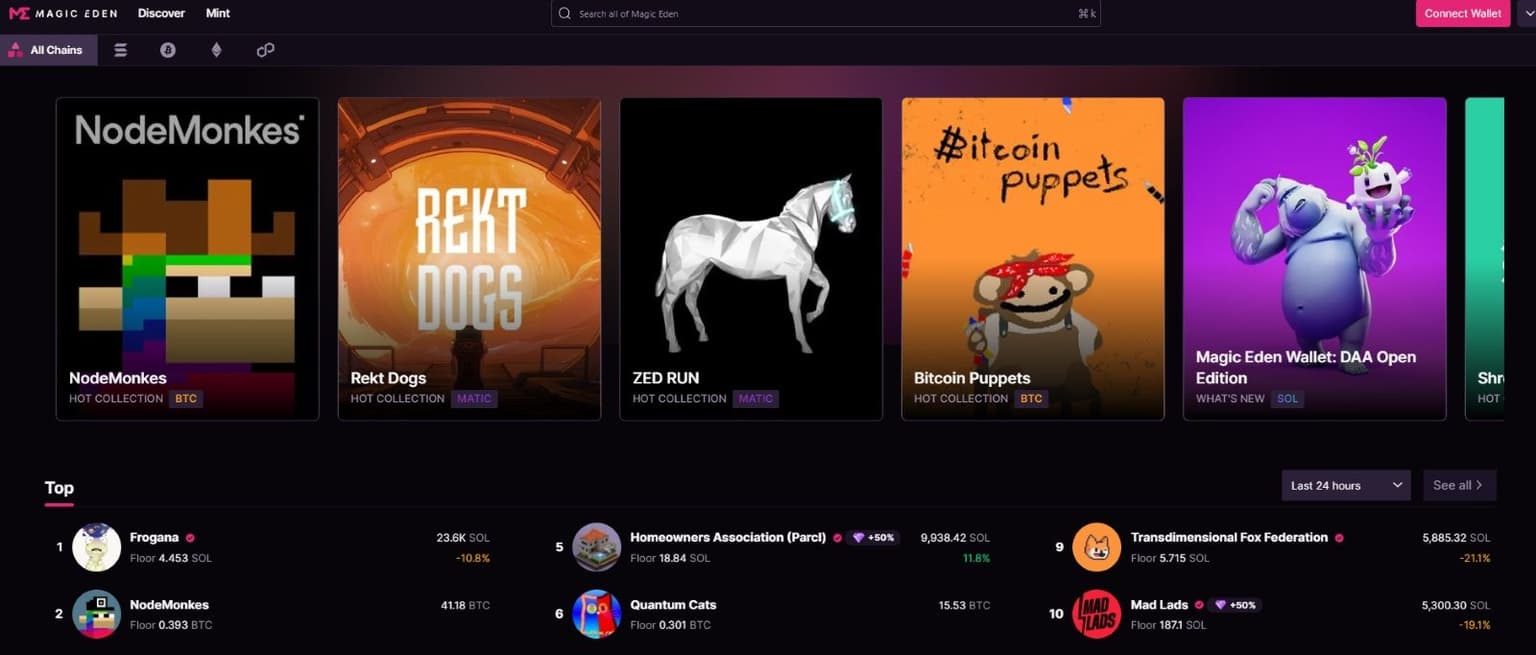
Magic Eden announced at the end of February 2026 that it would close its markets for Bitcoin-based pieces and for EVM chains. EVM stands for the Ethereum Virtual Machine, Ethereum's execution environment; EVM chains are therefore networks that use the same technology, Polygon and Avalanche among them. According to the industry outlet Decrypt, trading there ended barely two weeks after the announcement, and support for the company's own multi-chain wallet ran out at the start of April.
What remains is the Solana market, and there Magic Eden is still a first address. Co-founder and chief executive Jack Lu justified the pivot with what he called the large opportunity in the gambling business; with Dicey the company runs a betting and casino platform of its own. How the retreat unfolded in detail is set out in our analysis of the discontinuation of the Magic Eden services.

What $576 million against $121,000 reveals about the retreat
Behind the closures sits a calculation that rarely becomes this publicly clear. Citing an analysis by the data service Dune, Decrypt reported that in the month before the announcement Magic Eden generated around $576 million of trading volume in digital collectibles, by far the greater part of it on Solana. Of that, roughly $121,000 fell to Bitcoin-based pieces.
The ratio explains the mechanism better than any statement of intent. Every additional blockchain served costs a marketplace its own indexing, its own smart contracts, its own customer service and its own security audits, and those costs arise regardless of whether much or little is traded on the chain. Once a branch's volume falls below the threshold at which it carries itself, it is switched off, and that hits the smaller chains first.
The implication: the narrower the market for a collection, the greater the danger that the venue for it will eventually disappear. Ownership stays, liquidity does not.
 Compare NFT marketplaces and fees
OpenSea and Tensor: where trading still happens today
OpenSea remains the broadest venue and, with the second version of its interface, reaches a whole series of networks, Ethereum, Polygon and Solana among them. For newcomers it is usually the obvious starting point, because its supply, collections and payment routes demand the least prior knowledge.
Tensor is aimed at high-frequency traders on Solana. The interface shows bids and fixed prices side by side and lets you buy many pieces in one go, which looks rather cluttered to collectors holding individual pieces. It is built for speed and volume, not for browsing.
Both require your own wallet and a matching cryptocurrency. Without ether on Ethereum or SOL on Solana no purchase comes about, and you obtain both beforehand on a regulated crypto exchange. How the prices of the two network tokens have developed lately is set out in our Ethereum price prediction and in the Solana price prediction.
Blur: website closed since November 12, 2026
Blur grew big as a venue for high-frequency traders on Ethereum, with bids and fixed prices for several collections side by side and bundled orders. On October 12, 2026 the team announced that the website blur.io would be shut down on November 12, 2026, and it has since done so. Since then, blur.io only shows a withdrawal page, which according to Blur stays online until November 12, 2027. According to Blur, only the frontend is affected: the marketplace protocol keeps running on Ethereum, and holders of the BLUR token continue to control its fee switch.
For collectors, ownership does not change, because Blur does not hold NFTs in custody either. The lending service Blend is a different matter: it has issued no new loans since November 12. According to Blur, an open loan has no due date; it ends when the borrower repays or the lender calls it, and if the borrower then fails to repay within about 30 hours, the pledged NFT goes to the lender. Open loans can be closed out through the withdrawal page until November 12, 2027. Anyone who had NFTs listed on Blur should revoke the approvals granted in their wallet. Blur has not given a reason for the shutdown. According to DefiLlama data reported by CoinDesk, monthly trading volume had fallen from around $1.43 billion in March 2023 to under $7 million in March 2026.
Rarible after the brand sale to IMPOSSIBLE
Rarible has remained a multi-chain marketplace and shows collections on Ethereum, Solana and further chains. By its own account the company IMPOSSIBLE has taken over the Rarible brand and substantial parts of the platform technology, the RaribleX infrastructure business among them, and intends to continue along the course set.
Excluded from the sale is the governance token RARI, which remains with the associated foundation. For users of the marketplace the change of owner alters little day to day at first; those trading there should follow the new owner's announcements all the same, because closures in this market have recently come with short notice.
SuperRare and curated art in the niche market
SuperRare pursues the opposite approach to the mass market: artists are selected, the number of works stays small, and every artwork exists as a single piece. This part of the market lives less on trading volume than on collectors looking for a particular work.
For the choice of marketplace that is a category of its own. Collectors of digital art find a different offering on a curated venue than on an open platform where anyone can list their collection. Both routes have their justification, they simply serve different buyers.
Which wallet you need for which marketplace
The wallet decides which marketplaces are open to you at all. For Ethereum and the EVM chains you need a wallet that supports these networks; for Solana one that handles the Solana format. A multi-chain wallet covers both, a wallet limited to one chain does not.
Two points matter more here than the choice of provider. First, the recovery phrase never belongs in a photo, a notes app or a cloud. Second, before every connection you check whether the address called up is really the marketplace's, because faked interfaces are among the most common attacks in this market. How quickly real value drains away in the process was shown by the exploit around granted approvals at Magic Eden: old permissions there were enough to move other people's holdings. Granted approvals can be revoked, and that is exactly what belongs on the list after every change of marketplace. Which devices come into question for it is shown by our comparison of hardware wallets.
Fees in NFT trading: marketplace fee, royalty and network costs
The cost of a purchase is made up of three parts that are rarely shown together on the listing side. The marketplace fee is deducted from the sale proceeds by the venue. The licence fee, often called a royalty, goes to the artist or the project and is collected by the smart contract or by the marketplace; whether it is enforced is handled differently from platform to platform. Added to that are the blockchain's network costs, which on Ethereum fluctuate noticeably with load and on Solana are usually small.
Never reckon with the displayed price alone, therefore. In practice the difference between two venues lies less often in the marketplace fee than in the chain on which trading happens, and with it in the network costs.

What is left of a closed marketplace: metadata, images and the smart contract
For most collections, what sits on the blockchain is not the image but a reference to it. The metadata, meaning name, attributes and the path to the image file, often sit on the project's servers or in a distributed file system. The token itself stays in your wallet as long as the chain runs.
That is what creates the real risk of a closure. If a project switches off its servers, your NFT may show nothing but an empty surface although the entry on the blockchain is unchanged. That Nifty Gateway explicitly promises to keep hosting metadata and images is therefore more than a courtesy. Foundation, by contrast, has promised only one more year after its closure.
This can be checked before buying: if the collection shows where its files sit, and if they are stored in a distributed file system, the dependence on a single provider is smaller.
 Buy ether and SOL safely
MiCA and NFTs: the regulation's protection does not apply here
German investors have grown used to the European MiCA regulation at crypto exchanges, which requires providers to be licensed. For NFTs it generally does not apply: article 2 paragraph 3 of the regulation excludes unique and non-fungible crypto-assets from its scope. A pure NFT marketplace therefore usually needs no authorisation from BaFin, and the duties on information sheets, complaints procedures and segregation of client assets do not bite there.
The exemption is narrower than it sounds, though. Recital 11 of the regulation expressly brings pieces from large series and collections back in, because their uniqueness is doubtful. Fractions of an NFT also fall under the rules. Whether a specific piece is exempt remains a case-by-case question, and the classification is made not by the marketplace but by the supervisor.
In practice that means buying an NFT leaves you legally worse off than buying bitcoin or ether from a licensed provider. There is no deposit protection, no regulatory minimum capital and, in a dispute, no route of complaint to the supervisor.
Tax in Germany: the one-year holding period
Under practice so far, German tax law treats NFTs like other assets held privately. Sell at a profit within a year of buying and that is a private disposal under section 23 of the Income Tax Act. After a year has passed the gain remains tax-free. An exemption threshold of 1,000 euros applies to the sum of all private disposals in a calendar year; once it is reached, the entire gain is taxable, not merely the excess.
Documentation matters, and from the outset. Time of purchase, purchase price in euros, fees and the wallet address belong on the record, because a closed marketplace will issue you no statement afterwards. What the European reporting duties mean for Ethereum-based collectibles is something we have written up in our article on NFT taxes and DAC8.
The editorial view: the chain decides the marketplace
Our assessment: choosing the venue is no longer a matter of taste in 2026 but follows the blockchain. The figures from the Magic Eden retreat argue for that, where a monthly volume of around $576 million on the strong chain stood against roughly $121,000 on the weak one, along with the closures at Binance, Nifty Gateway and Foundation inside half a year and the end of the website of Blur, once the largest NFT marketplace on Ethereum. Against it stands the point that with OpenSea and Rarible two providers continue to serve several chains, so the market is not falling apart completely. Buyers today should nonetheless reckon with the marketplace for their piece being a different one in two years. A total loss of the money committed is possible at any time with NFTs, because for many collections simply no buyer comes forward any more.
NFT marketplaces: without MiCA protection only your own wallet counts
Three large closures in one year, plus the end of Foundation and the shutdown of Blur's website, have made the market easier to survey, but have also shown how quickly a shop window shuts. Your ownership hangs on the wallet and on the chain, not on the provider. Here is the order to work in:
- Determine the chain first. Establish which blockchain the collection that interests you sits on, and choose the venue accordingly. An overview of the open platforms is given by our comparison of NFT marketplaces.
- Obtain the cryptocurrency beforehand. Buy ether or SOL on a licensed platform and then transfer them into your own wallet; the terms are set out in our comparison of crypto exchanges.
- Put custody and approvals in order. Place valuable pieces on a device that keeps the keys offline, and revoke old permissions after every change of marketplace; suitable devices are shown by the hardware wallet comparison.
(As of October 11, 2026, updated November 3, 2026. This article is not investment advice. Prices and fee structures change; check the terms with the provider before you buy.)
Frequently asked questions about NFT marketplaces
Partner links: some links on this page are partner links. If you become a customer through one of them, we may earn a commission at no extra cost to you. Selection, ratings and ranking are decided independently by our editorial team. Ethics and Independence · Ownership and Funding
Transparency note: This article was produced with the assistance of artificial intelligence. Figures and claims are based on the primary sources linked in the text. The feature image was generated with AI.
For later? Save this article and find it again in your profile.
Related articles
- How to buy Bitcoin Cash: fees on €500 range from €1.25 to €7.45
- Buying an NFT with euros: paying by card can cost you 4.6 percent
- Chainlink lands at Charles Schwab: LINK carries a 0.75 percent fee, but investors in Germany are left out
- Canton Coin and the SEC: no-action letter classifies CC as a digital commodity, with limits
- How to Buy USDT in the EU: 7 Platforms Checked, What Still Works
Which topics should we dive deeper into?
Select what genuinely interests you. Your picks feed directly into our editorial planning.
Crypto news that's actually worth your time.
Weekly. 60 seconds. Carefully curated by our editors: no hype, no promo flood, no spam.

October 29, 2026 4:18 PM

Tokenized silver: what matters at the MiCA cut-off on October 30
Pax Gold will be converted compulsorily in the EEA on October 30, Bitpanda's metal tokens will not. The reason is a classification in the small print – and it decides trading, liability and tax.
October 27, 2026 3:47 PM
Buy Chainlink in Germany: five licensed exchanges, fees that differ tenfold
Across the three order books measured, 100 euros bought around 9.82 LINK at Tuesday midday, with prices three cents apart. What decides it is the route: a fee of 0.15 to 1.875 percent.
October 27, 2026 3:28 PM
Buy Litecoin: seven euro exchanges and the fee that decides the cost
At Tuesday midday, 100 euros bought 1.9816 LTC at Bitvavo and 1.9810 at Coinbase. The bigger difference is the fee: 25 cents in the order book, 1.88 euros on a simple buy.
October 23, 2026 1:35 PM
What is Tether (USDT)? The stablecoin explained: 182 billion tokens without EU authorisation
With 182.8 billion tokens in circulation, Tether is the largest stablecoin in the world and settles two out of every three crypto dollars traded. In the EU it lacks authorisation as an e-money token, and from January 8, 2027 authorised providers may no longer offer services around it.

October 23, 2026 1:23 PM
$1.81 billion on a single exchange: Monero open interest figures differ sixfold
Monero is down 6.2 percent at $606.80 over 24 hours, after reaching $653.71 within the same range. An own count of 52 futures contracts shows why reported open interest differs sixfold depending on the data source, and which figure matters for your position size.
October 23, 2026 1:22 PM
Dogecoin: 96 percent of trading runs on Tether, 0.13 percent on the euro
Of the 100 highest-volume Dogecoin pairs, 96.00 percent run through Tether and 0.13 percent through the euro, measured on October 23, 2026. That exact trading pair loses its basis in the EU by January 8, 2027, and that shifts the question of where you buy DOGE next.
October 22, 2026 4:42 PM

USDT or USDC: the key points before the October 30 deadline
Analysis: in the European Economic Area, Coinbase converts remaining balances in USDT, DAI and PYUSD into USDC on October 30, 2026, and from November 12 the EBA supervises the USDC issuer directly. This piece sets out what that means for the choice between the two largest dollar stablecoins, and separates the documented deadlines from the newsroom's assessment.
October 21, 2026 4:14 AM

Pump.fun launches perpetual futures with 40x leverage: what to watch now
Pump.fun has traded perpetual futures on Bitcoin and Ethereum since October 16, 2026, with leverage of up to 40 times and Hyperliquid as the technical operator. At that leverage a 2.5 percent price move is enough for liquidation, and a MiCA licence for the EU market is missing.
October 20, 2026 10:18 AM
Coinbase converts USDT and DAI into USDC on October 30: the swap restarts the one-year holding period
On October 30 Coinbase will convert the remaining USDT, DAI and PYUSD balances in the European Economic Area into USDC. The swap counts as a disposal under section 23 of the German Income Tax Act, and the one-year clock starts again for the new balance.
October 20, 2026 4:17 AM

Stablecoin interest: MiCA article 50 bans it, and lending yield is taxable from 256 euros
No issuer in Europe pays interest on the token itself, and article 50 of MiCA expressly forbids it. Where a quoted yield actually comes from and how the tax office treats it.

October 16, 2026 4:25 AM
“Not just for stablecoins, but for every form of money”: Mastercard opens stablecoin payouts to bank accounts
Mastercard and BVNK launched the Global Money Platform on 15 October: fiat and stablecoin accounts, real-time exchange, cards and payouts to local bank accounts through one interface. For German users two questions hang on it that the announcement does not answer: the fees and MiCA authorisation.
October 15, 2026 10:13 PM
NEAR up 9 percent, and longs pay in 74 of 86 perp markets: What it means for your coins
NEAR trades at around $5.26 on October 15, 2026 and gains 9.25 percent, while Bitcoin adds only 0.96 percent. Our own survey of 86 perpetual markets shows the buy side paying for its position in 74 of them.
October 15, 2026 4:32 AM
Which cryptocurrency to buy? Five criteria that matter before the coin
22,260 cryptocurrencies are on sale across 1,504 trading venues, and most guides start with the name. We reverse the order and set out the five criteria, from market capitalisation to the holding period, that come before the coin.
October 13, 2026 4:45 PM

NFT prices in October 2026: Bored Apes 97 percent below record, CryptoPunks hold up best
A Bored Ape costs less than it has in years, Pudgy Penguins lost almost three quarters in a year, and Blur is closing. The prices of the eight best-known NFT collections compared, the reasons for the decline, and what matters when buying at a low price.
October 13, 2026 4:37 PM

Blur closes on November 12: what matters now for NFT holders
The once largest NFT marketplace on Ethereum switches off its website on November 12, 2026, and the Blend lending product will then arrange no new loans. Outstanding loans, open bids and old approvals all need a decision before that.
October 11, 2026 10:39 PM
Buying Dogecoin: instant buy at one percent or the order book at 0.8?
Seven cents per €100 separated the best asks of three authorised exchanges on Sunday evening. Between instant buy and order book at the same provider lie 75 cents.
October 6, 2026 4:32 AM
Bitcoin for a gift card: what paying with crypto means for your holding period
Paying for a gift card with Bitcoin is a sale for tax purposes. What counts as the disposal proceeds, when the twelve-month holding period bites, and the four records the tax office expects.
September 25, 2026 1:47 PM
Magic Eden and Limit Break exploit: 530 WETH and thousands of NFTs drained, how to revoke your approvals
A bug in Limit Break's Payment Processor, the protocol behind Magic Eden's former Ethereum marketplace, has been draining NFTs and WETH since Thursday. Our blockchain analysis shows 911 affected wallets. What happened, why hardware wallets do not protect you and which two approvals to revoke now.
September 24, 2026 1:13 AM
Solana DEX Trades Overtake the NYSE: What to Check on Swaps, Tax and Oversight
Solana's decentralised exchanges settled roughly 208 million trades in a single week and overtook the New York Stock Exchange for the first time. The figure is real, but it measures something other than the comparison suggests, and for German investors it carries tax duties that no provider takes on.
September 23, 2026 7:15 AM
SoFi Settles Card Payments in Stablecoin: What Cardholders Should Check
Since September 22, 2026, the US bank SoFi has run its entire card business through its own stablecoin, SoFiUSD, on the Mastercard network. What sets the model apart from a crypto credit card, and which rules would apply if a European provider followed suit.
September 22, 2026 10:25 PM
Binance Buys Into Circle: What the USDC Deal Means for Your Balance
Binance is taking a $100 million stake in Circle and extending the USDC agreement by five years. For investors in Germany, the sum matters less than the question of who earns money from stablecoins left sitting idle.
September 22, 2026 4:12 PM
Nearly $1 Billion Into Bitcoin ETFs: What to Check on ETNs, Portfolio and Holding Period
US spot bitcoin ETFs took in a net $999 million on September 21, the third consecutive day of inflows. German investors cannot reach these funds: what ETNs, the holding period and your buying route mean for you.
September 22, 2026 1:15 AM
Memecoin Rally: Why Memecoins Are Rising and What to Check Before You Buy
The memecoin sector stands 9.01 percent higher, the overall market only 2.90 percent. The arithmetic behind it shows that two tokens carry three quarters of the move and that the sector has no occasion of its own.
September 21, 2026 4:13 AM
How to Buy XRP in Germany: Exchange, Destination Tag and Tax
Buying XRP works through a crypto exchange with MiCA authorisation, through a broker, or through an ETP in your securities account. This guide shows what matters on fees, the destination tag, custody and the German holding period.
September 19, 2026 10:28 AM
Claiming the LAPTOP Airdrop at Bitvavo: Who Is Eligible and What to Do by October 10
Bitvavo is letting customers with TRUMP losses above 1,000 euros request around 200 $LAPTOP until October 10, 2026. This guide shows who meets the conditions, how the exchange calculates the loss and what to expect on tax.
More from CryptoTicker