
Magic Eden and Limit Break exploit: 530 WETH and thousands of NFTs drained, how to revoke your approvals
A bug in Limit Break's Payment Processor, the protocol behind Magic Eden's former Ethereum marketplace, has been draining NFTs and WETH since Thursday. Our blockchain analysis shows 911 affected wallets. What happened, why hardware wallets do not protect you and which two approvals to revoke now.




Which topics should we dive deeper into?
Select what genuinely interests you. Your picks feed directly into our editorial planning.
Crypto news that's actually worth your time.
Weekly. 60 seconds. Carefully curated by our editors: no hype, no promo flood, no spam.
If you listed an NFT, placed an offer or accepted one on Magic Eden's former Ethereum marketplace in 2024, you need to act now. A bug in Limit Break's Payment Processor, the trading protocol behind that marketplace, has been used since Thursday to pull NFTs and Wrapped Ether (WETH) out of other people's wallets. On ApeChain, Wrapped ApeCoin (WAPE) was hit. Our own analysis of the blockchain shows 530.7 WETH gone from 911 wallets, plus thousands of NFTs, and at our last check at 12:40 UTC the drain was still running.
Protecting yourself takes minutes: you revoke the approvals for two contracts. Cancelling a listing is not enough. And a hardware wallet does not protect you here. We explain why in detail below, because it is being misrepresented in many replies on X right now.
Update, September 29, 2026, 08:48 UTC: More than two in five rescued NFTs are now back with their owners. According to the counter on the claim site nftsaresafu.xyz, 12,781 of 29,787 rescued NFTs had been reclaimed by Tuesday morning, up from 3,132 of 26,448 at midday on Sunday. The total has grown because new holdings were added, among them the NFTs secured by the whitehat Jiri123_eth, claimable since Sunday, 809 ApuStajas and, since last night, 134 Quirkies which, according to 0xQuit, can be reclaimed directly from an attacker's wallet. The site now also lists every asset still waiting to be claimed. It is worth telling people who do not follow X: according to 0xQuit, many of those affected may not know that something is waiting for them.
On Monday evening 0xQuit published the first detailed account of the attack: Payment Processor V2 trusted a sender address passed on by an approved forwarding contract (a forwarder in the style of ERC-2771), and that address could be forged. This let the attacker create a zero-price offer for someone else's NFT and make the contract believe the owner had accepted it. Cancelling listings would therefore not have helped; all that mattered was the outstanding approval. 0xQuit also says he is in contact with several parties involved in the exploit about returning assets.
The drain continues, but far more slowly. Our count on Ethereum shows 121,595 NFT transfers at zero price from 14,835 wallets since the start, about 6,200 more than at midday on Sunday; between Saturday and Sunday midday the increase had been more than 32,000. All of the growth went to addresses other than those of the two whitehats, although the address holding the most NFTs (31,984) has received nothing since Sunday midday. WETH losses rose by just over 4 WETH to 541.9 WETH from 970 wallets, with the latest drain at 06:42 UTC today. As long as an approval remains open, the wallet stays exposed; the steps to revoke it are below.
Update, September 27, 2026, 11:06 UTC: Rescued NFTs can now be reclaimed. 0xQuit opened the claim site nftsaresafu.xyz on September 26 at 02:47 UTC. You first have to revoke your Payment Processor approval; the claim costs only gas, and a donation is optional. According to the site's counter, 3,132 of 26,448 rescued assets had been reclaimed by 10:58 UTC today. MetaMask shows a warning on the site; according to 0xQuit, you can ignore it as long as you have verified you are on the real site. Open it only via his post, never via links in replies or direct messages. For collections with transfer restrictions (ERC721C, ERC1155C), claims only work once the collection owner enables them. The whitehat Jiri123_eth secured further NFTs; our count shows 1,771 in his address 0x1234248d4b9525F42434e20D46Abbff2686f56B3, and they are being added to the same claim site.
Limit Break issued a statement on X on September 26 at 03:17 UTC: Payment Processor V2 is an immutable contract that nobody can fix, so users should not wait for a remedy but revoke their V2 and V3 approvals now. V3 has been paused and the investigation is ongoing. Correction to yesterday's update: the claim site was already live at that point, and Limit Break had already made its statement. We missed both.
The drain continues. Our count on Ethereum up to block 26,068,341 (10:57 UTC) shows 115,404 NFT transfers at zero price from 14,196 wallets since the start, more than 32,000 above yesterday's midday figure. 17,461 went to 0xQuit's rescue address. A single address, 0x22657b3eb4b984f0137c58e0713ae125d752b4f4, has now received 31,984 NFTs; yesterday at midday it was not among the four largest recipients, and its operator is unknown. WETH losses barely moved: 537.5 WETH from 949 wallets, with the latest drain at 09:20 UTC.
Update, September 26, 2026, 12:10 UTC: The attack is still running on day two. Our follow-up check on Ethereum up to block 26,061,512 (12:05 UTC) shows 82,794 NFT transfers at zero price from 11,784 wallets since the start. 16,652 of them went to 0xQuit's rescue address, 66,142 to 344 other addresses whose operators are unknown. A single one of them, 0x28bc445b674940c53c227b45d4405c34e60027ad, pulled 15,512 NFTs from 2,573 wallets overnight. On WETH we now count 534.7 WETH from 936 wallets; the latest drain was at 12:04 UTC. Revoke.cash puts the total damage at at least $2.8 million across Ethereum, Polygon, Base, Arbitrum and ApeChain. Payment Processor V2 can be neither paused nor fixed. Limit Break has paused V3 on every chain except ApeChain, where it remains usable until November 30, 2026, according to Revoke.cash. So check Arbitrum as well and revoke on ApeChain right away. According to 0xQuit, you can reclaim rescued NFTs once your approvals are revoked; no date has been set yet. We have not found a statement from Limit Break itself so far.
Magic Eden and Limit Break: the two approvals you need to revoke now
Two contracts are affected. Quit, VP of Blockchain at Yuga Labs, named them publicly on Friday morning:
- Payment Processor V2 on Ethereum: 0x9A1D00bEd7CD04BCDA516d721A596eb22Aac6834
- Payment Processor V3 on ApeChain: 0x9a1D00000000fC540e2000560054812452eB5366
Magic Eden also names Polygon and Base, because the marketplace used Payment Processor V2 there as well. Check your wallet on all four networks. In your wallet the contract usually shows up as "Limit Break: Payment Processor". That is the name you saw in the signature window back then, when you placed or accepted an offer.
What happened in the Limit Break exploit: the timeline
We built the timeline from three sources: posts by the people involved on X, the incident page on Revoke.cash and our own analysis of the events that the Payment Processor leaves on the blockchain. All times are UTC.
- Thursday, September 24, 13:08: The first attack. A single address pulls 305 NFTs out of a single wallet in three transactions, each as a "sale" at a price of zero. Quit lists 10 Meebits, 50 Otherdeeds, 10 World of Women and 235 Desperate ApeWives, exactly 305. Nobody notices for twelve hours.
- Friday, September 25, around 01:00: Quit comes across the incident and realises that a large number of other wallets can be reached through the same bug. He contacts Limit Break, which pauses Payment Processor V3. V2 on Ethereum cannot be paused.
- 05:46: The rescue begins. Quit and helpers pull at-risk NFTs out through the bug themselves and park them at 0x71cF3f5724bD2B72Ef6464992aCd26216De7fe33.
- 06:31: NFT trader Cirrus raises the alarm because one address is "buying" thousands of NFTs for 0 ETH. At 06:47 Quit confirms that it is his rescue.
- 07:06: The rescue starts on ApeChain as well.
- 08:09: Quit publicly calls on users to revoke their approvals.
- 08:25: The WETH drain begins. The first transaction alone takes 281.66 WETH from 25 wallets. By 09:00, 522.5 WETH are gone.
- 08:51 and 09:10: Other tokens are hit too: 8,380 USDC from 62 wallets and around 549,000 WILD from eleven wallets.
- 09:11: Revoke.cash publishes a dedicated checker page for the incident.
- 09:54: On ApeChain, 7,680 WAPE disappear from 19 wallets in a single transaction.
- 10:11: The last transfer to the rescue address. At 10:19 all activity on the ApeChain contract stops.
- From 09:27 until at least 12:22: Other addresses keep pulling NFTs at zero price, 7,870 transfers from 1,786 wallets in total. The latest WETH drain in our data is at 12:19.
- 12:22 to 12:40: Our follow-up check shows another 2,292 NFT transfers at zero price and another 0.55 WETH from five purchases. The attack is not over.
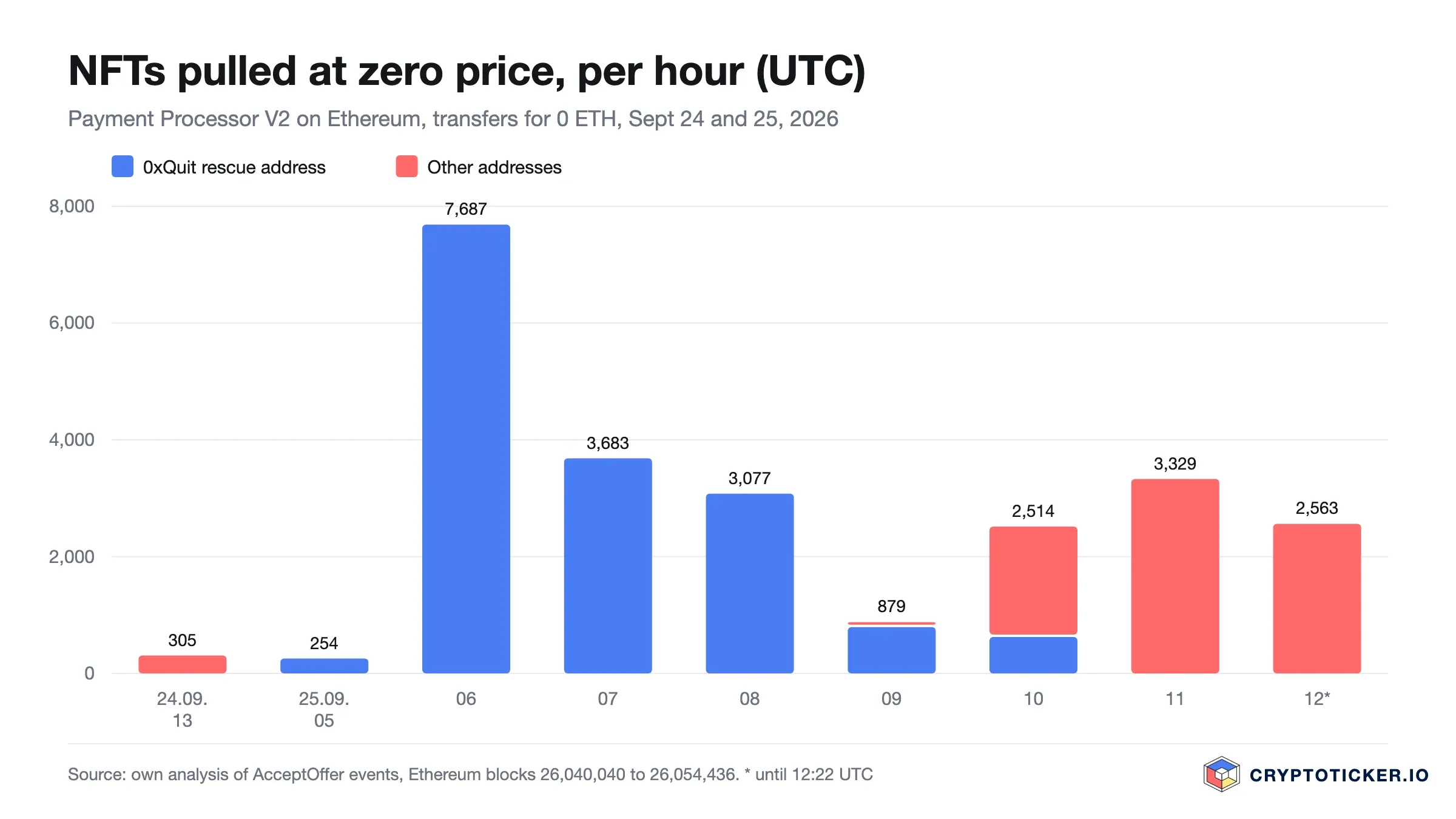
The chart shows the turning point. Until late morning almost every transfer comes from the rescue address. After that, others take over. Who is behind those addresses cannot be read from the blockchain. They could be further helpers or copycats who rebuilt the exploit. For you it makes no difference: as long as the approval stands, anyone can use it.
Quit puts the night's result at 23,155 rescued NFTs worth more than $5.7 million. Our data shows 16,117 transfers to the rescue address on Ethereum and 9,795 on ApeChain. The figures do not match one to one, because one event is not always exactly one NFT; multi-edition tokens can carry several copies. The order of magnitude is right.
 Hardware wallets compared
Why WETH and WAPE were drained
Many people are asking this, and the answer explains the whole attack. No contract can pull plain Ether out of your wallet. A contract can only move tokens you have given it permission for, an approval in crypto jargon. NFT marketplaces use two kinds.
The NFT approval. Listing an NFT lets the marketplace contract transfer it on sale, usually for the whole collection ("approved for all"). The zero-price NFT transfers went out through this approval.
The token approval. An offer on an NFT is not paid in Ether but in wrapped Ethereum, WETH. It is a token pegged one to one to Ether that can be approved like any other token. So that an offer can be settled automatically later, you allow the Payment Processor to spend your WETH, as a rule in unlimited amounts and with no expiry. On ApeChain it works the same way with WAPE, the wrapped form of ApeCoin.
That is why these two tokens were hit. The USDC, WILD and APE drains in our data show, however, that any token you ever approved for the Payment Processor is exposed.
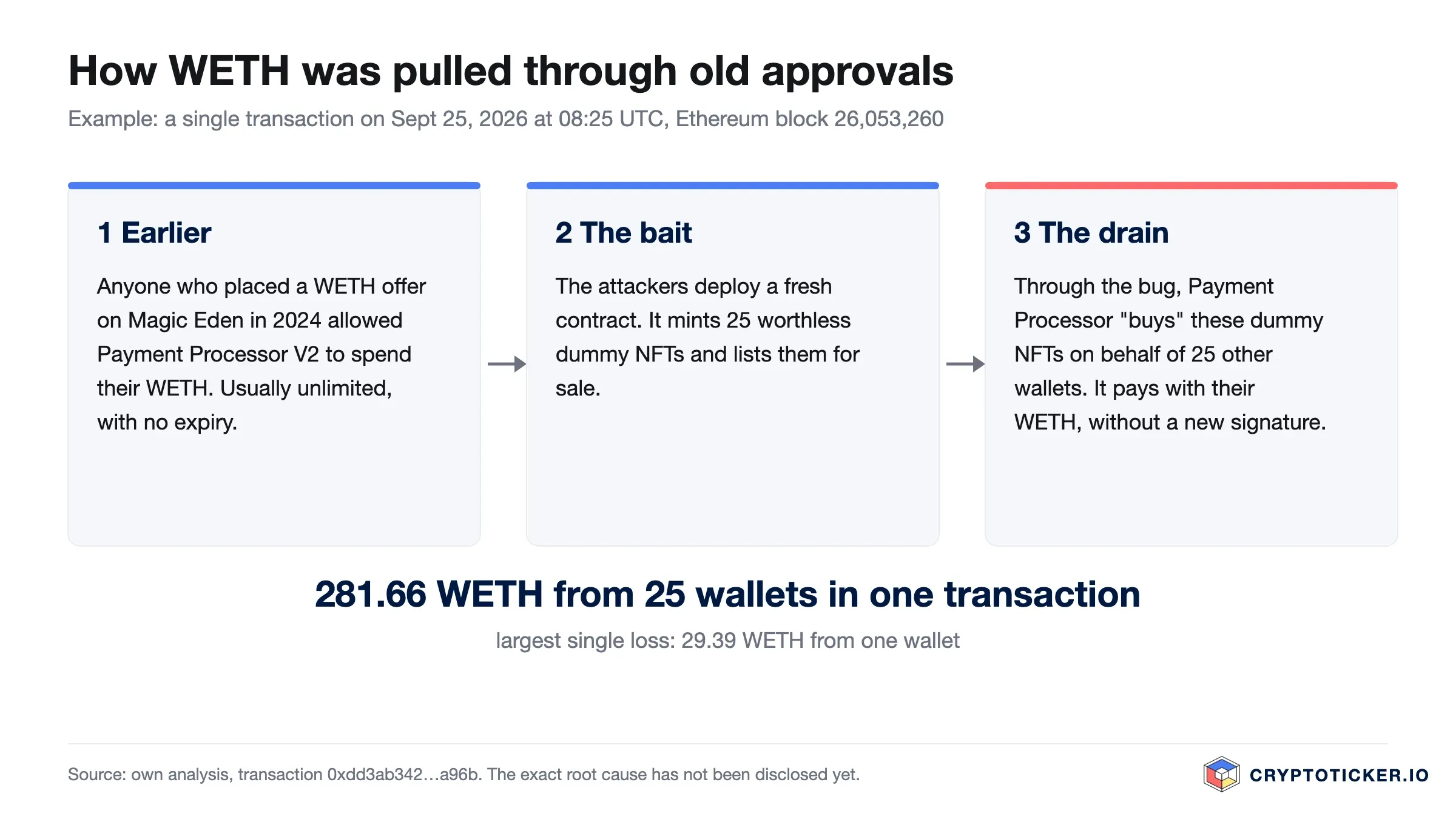
A single transaction shows the trick step by step. The attackers deploy a fresh contract that mints 25 worthless dummy NFTs and lists them for sale. They then have the Payment Processor "buy" these dummy NFTs on behalf of 25 other wallets. Payment comes out of the victims' WETH, via the old approval, without any of them signing anything. The largest single item in this transaction: 29.39 WETH from one wallet. How exactly the contract is made to act on someone else's behalf has not been disclosed by Limit Break or Quit so far.
Important if you still hold or swap WETH: the approval covers every WETH that lands in your wallet, including future balances. If you wrap Ether into WETH or receive WETH in a swap while the approval stands, you put it straight within the attackers' reach. Revoke first, then swap.
"But I had a hardware wallet": why a Ledger does not protect you
Under the warnings on X, some are mocking victims: anyone using a hardware wallet is safe, they say. That is not true here, and many of those affected had one. An acquaintance of our newsroom lost 5.94 WETH despite using a Ledger.
The reason lies in where an approval is stored. A hardware wallet protects your private key. It ensures that nobody can sign in your name without the device. But you already signed the approval, back then, perhaps two years ago, with that very device. Since then it has sat in the token contract on the blockchain: "The Payment Processor may move WETH from this address." When the Payment Processor now pulls WETH, nobody asks your device. The Ledger stays in the drawer, and the money leaves anyway.
A hardware wallet protects against stolen keys, not against rights you granted yourself. Keeping the two apart helps you focus on what actually works in incidents like this. For an overview of devices, see our hardware wallet comparison; you still have to manage your approvals yourself.
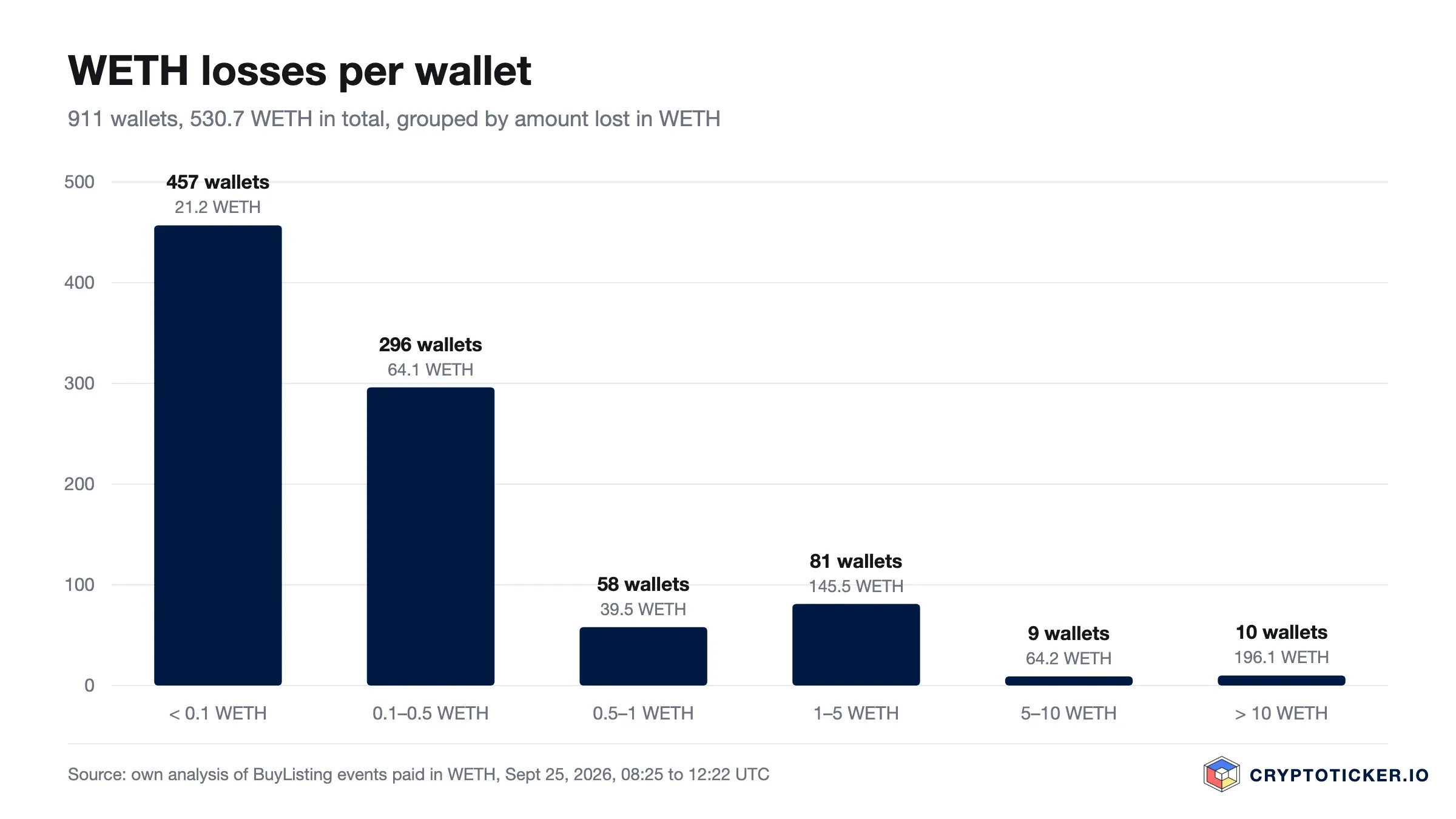
How big is the damage from the Magic Eden exploit?
Our count on Ethereum comes to 530.7 WETH from 911 wallets. At an Ether price of $2,702.88 (CoinGecko, September 25, 2026) that is about $1.43 million. Most victims lost small amounts: half the wallets lost less than 0.1 WETH. Ten wallets, by contrast, each lost more than 10 WETH, 196 WETH between them.
Quit speaks of 660 WETH he could no longer rescue, about $1.7 million. The gap to our figure is probably explained by the fact that we only analysed Ethereum; Polygon and Base are missing. On top of that, our data shows 8,380 USDC, about 549,000 WILD (roughly $7,200), 12.9 APE on Ethereum and 7,680 WAPE on ApeChain.
The NFT picture is harder to add up. What sits at the rescue address is due to be returned. What has gone to other addresses since late morning, 7,870 transfers from 1,786 wallets, remains an open question for now.
Quit wrote on Friday morning that he had worked through the night to save around $6 million worth of NFTs, and that all he could think about was the $1.7 million in WETH he was not fast enough for. Since then, victims who lost WETH have been replying under his posts, some of them by their own account having revoked an hour too late.
Who is 0xQuit, the overnight rescuer?
Quit is VP of Blockchain at Yuga Labs, the company behind Bored Ape Yacht Club, CryptoPunks and Otherside. On X he describes himself as a Solidity developer and auditor, and he founded the NFT tool oSnipe. He regularly warns about vulnerabilities on X and, when in doubt, steps in himself before others can exploit them.
It is not his first rescue this year. In June, during a bug in Flooring Protocol, he pulled 68 NFTs worth more than $500,000 out of vulnerable pools, including 29 Bored Apes and two CryptoPunks, and held them for their owners. The approach was the same both times: whoever knows the bug pulls the assets out first, before someone with bad intentions does, and returns them once the danger has passed.
What Magic Eden and Limit Break say
Magic Eden stresses the distinction: the marketplace itself was not attacked. Co-founder and CEO Jack Lu wrote on X that the incident concerns Limit Break's trading protocol and contracts, which Magic Eden stopped using two years ago. According to Magic Eden, it used Payment Processor V2 from February to October 2024 and shut down its EVM marketplace entirely in the first quarter of 2026. Current listings are not affected, and the company says it is talking to Limit Break about further steps.
Limit Break itself had not issued a statement of its own by our deadline. All that is known is what Quit reports: that the team quickly paused V3 on ApeChain. Several NFT projects on ApeChain acted on their own. The team behind Dengs, for example, says it temporarily froze all Deng NFTs, and ApeDroidz reported that some of its collection is among the rescued assets.
If you want to review the marketplaces where NFTs trade today, you will find the comparison below. More on Magic Eden's retreat from the Ethereum business is in our analysis of the Magic Eden shutdown.
 NFT marketplaces compared
Revoke approvals: how to protect your wallet step by step
- Open Revoke.cash and enter your address or connect your wallet. Revoke.cash lists the incident on its own checker page, where you can test your address directly.
- Go through network by network: Ethereum, ApeChain, Polygon, Base and Arbitrum.
- Revoke every approval for the Payment Processor, that is 0x9A1D00bEd7CD04BCDA516d721A596eb22Aac6834 on Ethereum, Polygon and Base and 0x9a1D00000000fC540e2000560054812452eB5366 on ApeChain. This covers NFT approvals ("approved for all") as well as token approvals for WETH, WAPE, USDC or APE.
- Each revoke transaction costs a small fee and has to be signed with your wallet, on the device itself if you use a hardware wallet.
- Only then touch WETH again. No swap into WETH and no wrapping of Ether while the approval stands.
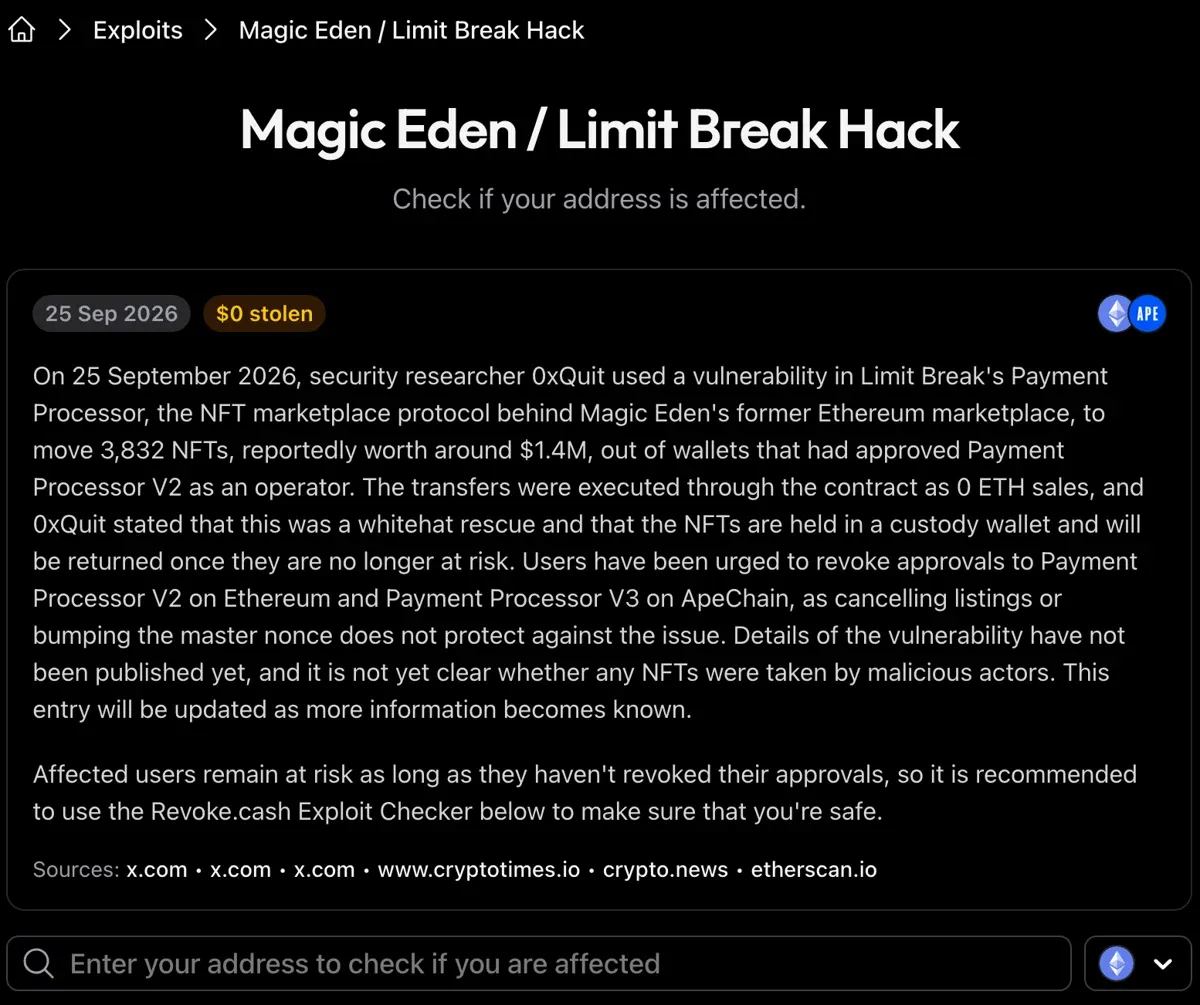
What does not help: cancelling listings or bumping the so-called master nonce. Revoke.cash explicitly points out that neither does anything against this bug. And revoking does not bring back what has already gone. It only stops more from leaving.
According to Quit, you will only get rescued NFTs back once your approval has been revoked, otherwise the NFT would be exposed again straight away. There is no official return process yet. Expect scammers to exploit exactly this situation over the coming days: direct messages offering "recovery", fake return pages, requests to sign a message. Do not sign anything someone sends you, and wait for announcements from the known accounts.
What the exploit means for the NFT market
The real lesson of the day is an uncomfortable one: approvals do not expire. Magic Eden stopped using Payment Processor V2 almost two years ago and closed the marketplace this spring. The rights that thousands of users had granted to that contract stayed in place regardless, and the contract itself kept running, with no emergency brake. A platform can close; its contracts on the blockchain do not close with it.
Add to that the industry habit of granting unlimited approvals, so that users do not have to pay for a second transaction with every offer. It saves a few cents and turns every forgotten approval into an open account.
The incident falls in a striking week. On Thursday evening Bitget reported an outflow of about $352 million from hot wallets, the largest hack of the year; what Bitget customers should check now is in our report. The same evening, Quit also counted an attack on Payy worth $1.8 million. The tools are getting better on both sides. Research published this year shows that AI agents can now find and exploit smart contract vulnerabilities at scale, particularly in old contracts that nobody maintains any more. Whether AI played a role in this attack is not known. What is clear: searching for forgotten bugs is getting cheaper, and this night's rescue hinged on one person who happened to be awake.
How we analysed the blockchain data on the Limit Break exploit
We read every trade event that Payment Processor V2 emitted on Ethereum between September 23, 2026, 12:00 UTC and September 25, 2026, blocks 26,040,040 to 26,054,436. That comes to 25,299 events of the AcceptOffer and BuyListing types. The positive control: for the same block range, three independent nodes returned the same count. On ApeChain we read Payment Processor V3 from September 24 in the same way, 10,041 events.
We count a sale at a price below 0.001 tokens as an NFT drain. A token drain is a purchase in which the victim's wallet pays as the buyer. We checked the mechanism against individual transactions, such as the one with the 281.66 WETH. One cross-check with an outside source: our count for the first attack on September 24 comes to 305 NFTs, the same figure Quit gives.
What the figures cannot do: Polygon and Base are not included. Who is behind the individual addresses, helper or attacker, cannot be read from the data. And one event is not always exactly one NFT. Dollar values are based on prices as of September 25, 2026.
Magic Eden, WETH and old approvals: key takeaways
If you traded on Magic Eden, Otherside or an ApeChain marketplace in 2024, revoke the approvals for the Payment Processor today, on Ethereum, ApeChain, Polygon and Base. Do not wrap Ether into WETH while the approval stands. A hardware wallet protects your key, not rights you have already granted. And beyond today: go through your approvals regularly, say once a quarter, and revoke them immediately when a platform shuts down. Keep valuable assets in a wallet you do not trade from and never approve anything with.
(As of September 29, 2026, 08:48 UTC. This article is not investment advice. The situation is still developing; check official statements from Limit Break and Magic Eden before you act.)
Transparency note: This article was produced with the assistance of artificial intelligence and reviewed by our editorial team before publication. All figures and claims were checked against the primary sources linked in the text. The feature image was generated with AI.
Related articles
- Revoke Token Approvals on Ethereum: A Revocation Now Costs 0.52 Cents
- Magic Eden Shutting Down? Why the Platform Is Sunsetting Services
- ApeCoin and ApeChain in 2026: What Is Left of the Ecosystem, Three Weeks Before ApeFest
- Trezor Hack Scare: That STM32 Entropy Email Is a Phishing Attack
- Ledger Closes a Gap in the Ethereum App: When the Display Shows Something Other Than What You Sign
Which topics should we dive deeper into?
Select what genuinely interests you. Your picks feed directly into our editorial planning.
Crypto news that's actually worth your time.
Weekly. 60 seconds. Carefully curated by our editors: no hype, no promo flood, no spam.

August 4, 2026 1:21 PM

Coldcard Losses Near $114 Million as a Fourth Sweep Hits: Why Is Bitcoin Rising Anyway?
A fourth wave of Coldcard sweeps took another 449 BTC on Monday, yet Bitcoin climbed back toward $64,000. Here is what changed and who is still exposed.
December 6, 2024 5:10 PM

Magic Eden Airdrop Guide: How to Claim Magic Eden Token
The Magic Eden $ME airdrop checker is now live! Here's everything you need to know about checking your allocation, claiming your rewards, and understanding the value of $ME tokens.

October 9, 2026 5:36 PM
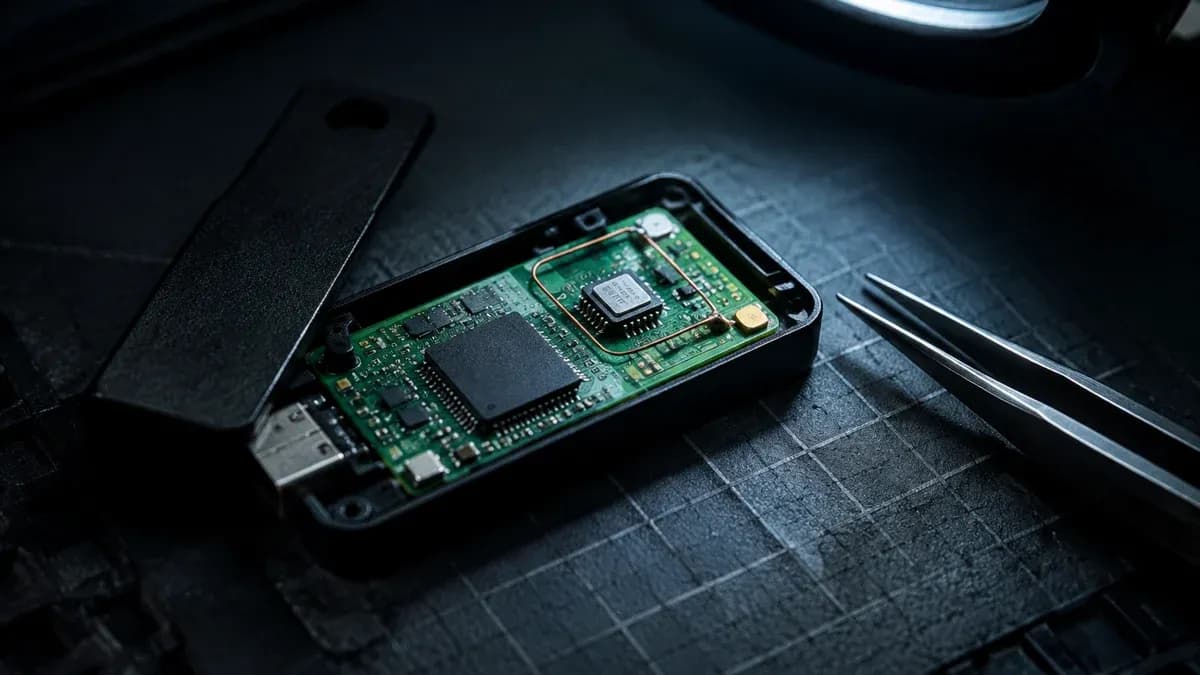
Ledger Hack? $86 Million Drained: What Is Behind the Tampered Wallets From Southeast Asia
Since Friday, Ledger users in Southeast Asia have been reporting empty wallets, and analysts count more than $86 million. Ledger has halted the reseller CryptoBilis. An implant inside the device reportedly reads the seed phrase. What is known, what CZ advises and what you should do now.
August 20, 2026 1:45 AM
Wallet Drainers: What You Really Approve When You Confirm, and How to Take It Back
Most emptied wallets were never hacked. Their owners confirmed it themselves, granting an approval that is unlimited and never expires. What sits behind "Approve" and a signature request, and how to get rid of old approvals.
October 12, 2026 1:32 AM

Three NFT marketplaces fewer: what matters when buying now
Binance has ended NFT trading, Nifty Gateway is closed and Magic Eden trades only on Solana. Which NFT marketplaces are open in 2026, what a purchase costs and why MiCA does not protect you there.
September 17, 2026 4:14 PM
D'CENT App Wallet: How to Tell If Your Recovery Phrase Has to Move Now
Manufacturer IoTrust reports suspicious asset transfers in the D'CENT app wallet and asks users to move their holdings. One question decides the matter: has your recovery phrase ever been entered into the app?
October 2, 2026 7:16 AM

$1.26 Billion in Three Months: Crypto Hacks Hit Their 2026 High
The security firm CertiK counts around $1.26 billion in damage from 247 incidents for the third quarter of 2026. September was the worst month of the year with 99 cases, and this is the background and what it means for your custody.
October 2, 2026 4:32 AM
NEAR Intents halts withdrawals after a $3.8 million exploit: here are the reasons
NEAR Intents confirms an exploit of more than $3.8 million and holds deposits and withdrawals on eleven networks. Reimbursement is promised, a date for it is not.
September 25, 2026 4:11 AM
Bitget Pauses Withdrawals: Where Existing Customers in Europe Stand
Bitget reports unauthorised outflows of around $351.6 million (later revised to $387.5 million) and has suspended withdrawals. For existing customers in Europe, that closes the one route MiCA had left them.
September 7, 2026 7:26 PM
Stolen Keys Beat Code Flaws: Why the Private Key Is the Way In for 2026 Crypto Hacks
Compromised private keys overtook smart contract code flaws as the most common attack route for the first time in 2026. What sits behind the shift, and how to check your own setup for its single point of failure.
August 31, 2026 10:12 AM
Fake AML Checks for Crypto Wallets: How to Spot the Scam Sites
Fraudulent websites pose as money-laundering screening services for crypto addresses and ask you to connect your wallet. A genuine check needs only the public address, and three of the domains named by Malwarebytes still respond twelve days later.
October 12, 2026 10:40 PM
Shiba Inu and the Fake Airdrop of October 12: “no such airdrop. this is a drainer”
An account on X advertised a supposed SHIB airdrop on October 12. An adviser to the project calls the page a wallet drainer. What is behind it and how to check and revoke your token approvals.
October 5, 2026 1:29 AM

Chainalysis attributes $387 million from the Bitget hack to North Korea: what matters now for investors in Germany
The analytics firm Chainalysis attributes the theft of around $387 million at Bitget to actors with ties to the DPRK and puts the annual total above one billion dollars. What that means for custody, choice of exchange and record-keeping in Germany.
September 30, 2026 1:23 PM
NEAR Intents Blocks $50 Million From the Bitget Hack: Why THORChain Let the Swaps Through
A cross-chain protocol says it stopped more than $50 million in transfers from the Bitget attack and froze $503,000. The case shows who can halt funds in transit and what that means for your custody.
September 13, 2026 4:13 AM

Symbiosis Hack: How to Check Whether Your Bridged Bitcoin Can Still Get Out
An attacker minted billions of unbacked syBTC on the cross-chain bridge Symbiosis and pulled out roughly $336,000. We checked for ourselves on September 12 which routes are still running: the way into the bridge is suspended, the way out is open.
September 10, 2026 1:28 AM
End Blind Signing: What to Check on Your Hardware Wallet After the Trezor Update
Since September 7, Trezor has shown contract data in plain text on the device instead of a hexadecimal string alone. Our own count shows which share of Ethereum capital that reaches and where you keep signing blind.
August 21, 2026 7:26 PM

Restoring a Seed on Another Manufacturer's Wallet: What BIP39 Guarantees and What It Does Not
Your seed is yours; the device belongs to a company. This article explains what the open BIP39 standard actually guarantees, why a wrong derivation path makes a full wallet look empty, and the test that settles both in twenty minutes.
August 13, 2026 4:59 PM

Trezor Data Breach: First 13,689 Customers, Then Roughly 67,000 More Exposed
A breach at Trezor shipping partner ShipMonk exposed names, phone numbers and home addresses of 13,689 customers in August; in September Trezor reported roughly 67,000 more in the US. Devices are safe, phishing risk is not.
August 5, 2026 10:33 PM
$130 Million Gone Because the Randomness Was Predictable: Which Hardware Wallet You Can Still Buy
The Coldcard flaw proved the most respected wallet is not the safest. Which vendor has which track record – and why now is the wrong moment to pause your savings plan.
July 31, 2026 3:54 PM
594 BTC Gone in 25 Minutes: The Coldcard Flaw That Made Seed Phrases Guessable
A firmware bug from March 2021 let an attacker drain $38 million from around 500 Bitcoin wallets. Here is what broke, who is exposed and what to do now.
April 21, 2026 11:15 AM

Breaking: Arbitrum Security Council Freezes $71M in ETH Linked to KelpDAO Exploit
The Arbitrum Security Council has frozen 30,766 ETH tied to the KelpDAO hack, sparking a fierce debate over decentralization and emergency powers in DeFi.

October 17, 2023 3:47 AM

Guide to the Best NFT Marketplaces for 2023
Discover the top 5 NFT marketplaces for 2023. Dive into detailed insights on Blur, LooksRare, OpenSea, Magic Eden, and Rarible. Your ultimate guide to the NFT world this year.
December 26, 2025 1:50 PM
Breaking: Trust Wallet Chrome Extension Hack Drains $7M, Full Reimbursements Promised
A supply-chain attack hit Trust Wallet’s Chrome extension, draining $7M from users. Binance’s CZ says all victims will be reimbursed.
October 14, 2026 1:30 PM
What is a hardware wallet? How the device protects your keys
A hardware wallet stores no coins, only the private key, and it never releases it. How signing works inside the device, what the 12 or 24 words mean, and which attacks the design cannot stop.
October 13, 2026 1:16 AM

Ledger Confirms Implant in a Hardware Wallet as Reports Reach Europe: What Is Behind It
Ledger confirms an unauthorised additional circuit board in a tampered device and traces the confirmed cases to a reseller in South-East Asia. One report from European retail is still open, which makes the purchase route of your own device the criterion.

More from CryptoTicker