
Shiba Inu price prediction: is $34.6 million in daily volume enough?
Analysis: Shiba Inu changes hands for $34.6 million in a single day, which comes to 1.25 percent of its own market value. Which levels this thin order book still carries, and what the choice of exchange currently costs, is set out by our editorial team further down.





Which topics should we dive deeper into?
Select what genuinely interests you. Your picks feed directly into our editorial planning.
Crypto news that's actually worth your time.
Weekly. 60 seconds. Carefully curated by our editors: no hype, no promo flood, no spam.
What is documented: Shiba Inu is trading at $0.0000047 on Sunday midday, and in the preceding 24 hours only $34.58 million was turned over in Shiba Inu, according to CoinGecko data. Our assessment follows further down: for the price action of the coming days, that turnover weighs more heavily than any chart level.
The reason this figure stands out at all this weekend lies with the industry's largest trading platform. After the attack of October 29, Binance began reopening withdrawals on Sunday morning, initially for 15 blockchains. SHIB is on none of the release lists published so far. What that means for trading can be read off the turnover of the individual venues, and the picture there has shifted within a few days.
$34.6 million in daily volume against a $2.77 billion market value
SHIB's market capitalisation stands at $2.770 billion according to CoinGecko data from November 1, 2026, 10:42 UTC. That is enough for rank 37 among all cryptocurrencies. Against it sits $34.58 million in daily turnover. In relative terms, 1.25 percent of the entire holding changes hands in a single day.
To put that metric in context: turnover frequency, that is daily volume divided by market capitalisation, measures how easily a position can be unwound without moving the price. For Bitcoin that figure stood at 3.2 percent on the same reference date, for Ethereum at 1.6 percent. SHIB sits below both, and it does so on a holding of 589.24 trillion circulating tokens.
Little of this is visible in the price itself at first. Over 24 hours it is down 0.13 percent, over seven days 2.95 percent. Over 30 days it is 21.18 percent, over twelve months 53.51 percent. From the all-time high of $0.00008616, set on October 27, 2021, it is 94.54 percent short.
Binance reopens withdrawals in stages, SHIB is on no list
Binance had halted withdrawals after the attack on its hot wallets. On November 1 the exchange reopened them, by its own account between 06:00 and 09:00 UTC and staggered across 15 blockchains. Named in the process were Bitcoin on the Bitcoin blockchain, ETH, USDT and USDC on Ethereum, BNB, USDT and USDC on the BNB Smart Chain, TRX and USDT on Tron, SOL, USDT and USDC on Solana, as well as the respective main currencies on XRP, Zcash, Dogecoin and Sui.
Richard Teng, chief executive of Binance, said on the matter: "We've now replenished approximately 95% of the impacted assets." The exchange says it has deposited more than $6.34 billion from corporate funds to cover customer balances, and has frozen or located around $3 billion of the funds that flowed out. It has announced a detailed report on the incident.
For SHIB, the decisive part of that notice is a different one. Binance writes that every combination of asset and blockchain goes through its own security review before it is released. The exchange gives no timetable for the remaining tokens. SHIB is an ERC-20 token, so it lives on the Ethereum blockchain, yet the release there so far covers ETH, USDT and USDC according to the published list. Whether an individual account can already withdraw SHIB is shown reliably only by the withdrawal screen in your own Binance account.
How a withdrawal freeze shifts turnover to other venues
The mechanism behind it is unspectacular and works powerfully all the same. Anyone who cannot move their tokens off an exchange shifts new business to where they can get out again. Market makers, the traders who post both buy and sell offers and make their living balancing their holdings between venues, cannot do exactly that while withdrawals are blocked. Those traders then commit less capital and widen their prices, because every position stays at risk for longer.
The numbers show precisely this pattern. On November 1, Binance ranks eighth in SHIB trading with $1.08 million in daily turnover and thus carries 3.14 percent of total turnover. At the top sit KuCoin with $4.65 million and BitDelta with $4.43 million, which together account for 26.3 percent of the day's turnover. Behind them follow Poloniex with $2.76 million and Upbit with $2.07 million.
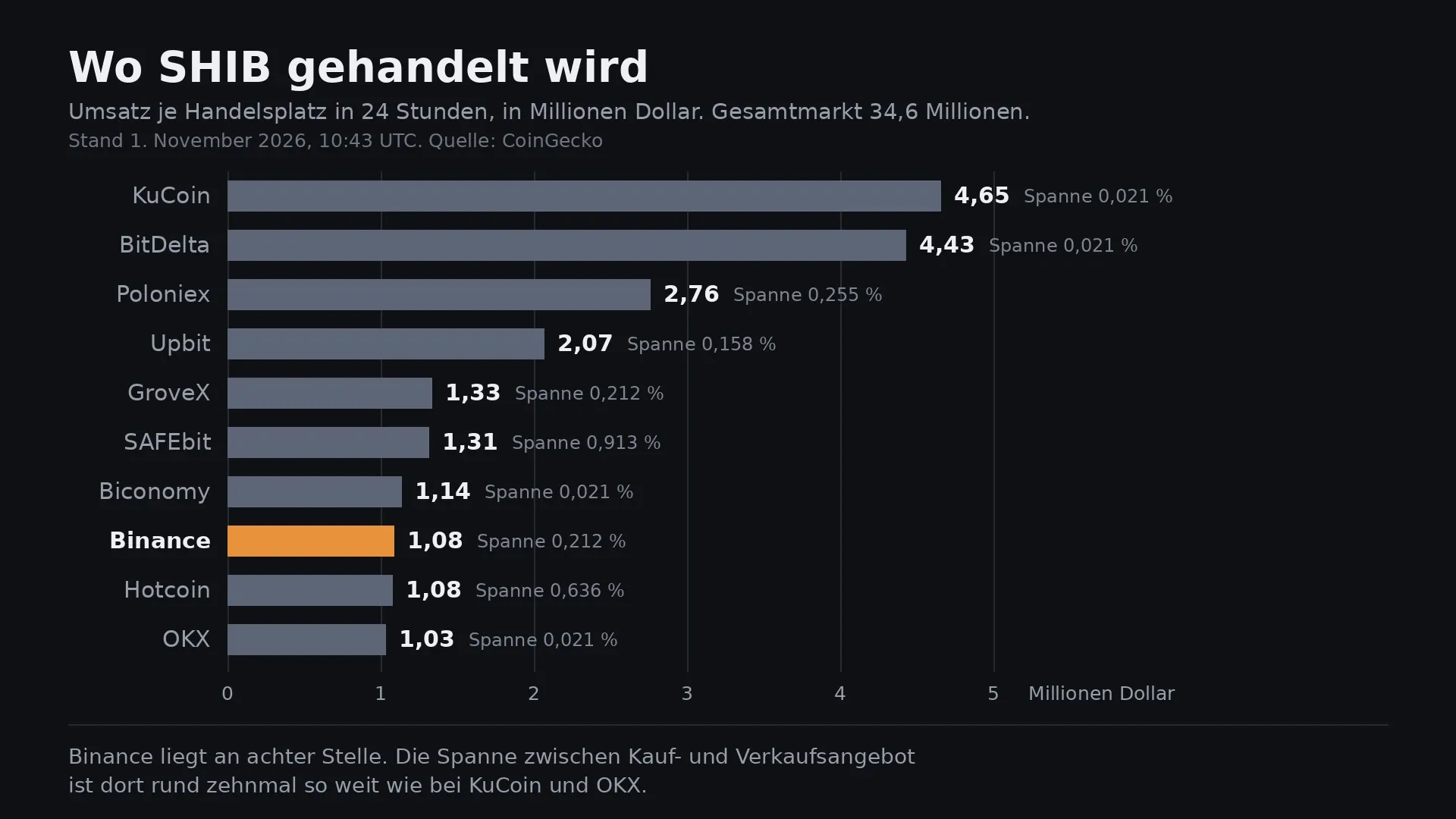
The spread: 0.021 percent at KuCoin, 0.913 percent at SAFEbit
The spread is the gap between the best buy offer and the best sell offer in the order book. That gap is the price of immediate execution, and it appears on no fee statement.
At SHIB these spreads diverge widely on November 1. KuCoin, OKX and Biconomy quote the SHIB/USDT pair at 0.021 percent, as does BitDelta. Binance comes in at 0.212 percent, roughly ten times as much. Upbit sits at 0.158 percent, Poloniex at 0.255 percent, Hotcoin at 0.636 percent and SAFEbit at 0.913 percent. Between the cheapest and the most expensive of the ten highest-turnover venues there is therefore a factor of 43.
 Compare the exchanges for your SHIB
What a wide spread costs on a 1,000 euro stake
The arithmetic is short. Anyone who buys SHIB for 1,000 euros and later sells the position again pays the spread once in full in effect, because they buy at the ask and sell at the bid. At 0.021 percent that is 21 cents. At 0.913 percent it is 9.13 euros.
The difference of just under 9 euros per 1,000 euros staked sounds manageable. At a price of $0.0000047, however, that amount matches what SHIB has delivered in price movement at all over the past 24 hours. Anyone who builds a position on one day and unwinds it the next can hand the entire move to the spread at an expensive venue, even though the direction was right.
Two things soften this. A limit order, where a maximum price is set instead of executing at the next best price, places itself into a thin order book rather than clearing it out. And splitting helps: an order of 1,000 euros spread across several partial orders meets tighter prices on average than a single large order, because a thin book opens deeper price steps even at small amounts. Which venues are licensed under MiCA in Germany and what fees they charge alongside that is set out in our overview of the best crypto exchanges.
From $0.00000468 to $0.0000047: the state of play since the October close
On October 31 our editorial team recorded SHIB's October close at $0.00000468 at this spot and looked at the one-year deadline for last year's buyers. Since then little has happened to the price: from $0.00000468 to $0.0000047 is 0.43 percent to the upside.
What has changed instead is the environment. The withdrawal freeze at the largest exchange has been partly lifted since Sunday morning, and turnover has switched venues without growing in the process. The levels are therefore holding not because many buyers are defending them, but because hardly anyone is trading.

0.00000466 and 0.00000473: the levels of the first day of November
The daily low on November 1 is $0.00000466, the daily high $0.00000473. Between the two lie 1.5 percent, and the price has moved within that range all day.
To the downside, the next level is grounded in our own data from October 30, when SHIB marked a daily low at $0.00000448. Today's low sits 4.0 percent away from it. To the upside stands the round level of $0.0000050, which the price was still fighting over at the end of October and which now lies 6.0 percent above the current reading.
At a daily turnover of $34.6 million, both levels have a different quality than they would in a liquid market. In a thin order book a single larger sale is enough to clear several price steps, and the same order moves the price further on a low-turnover weekend than on a Tuesday afternoon. That applies in both directions.
Dogecoin may leave Binance, SHIB not yet
The comparison with the larger meme token makes the situation tangible. Dogecoin is on the published release list, because Binance explicitly names the Dogecoin blockchain among the 15 networks reopened. DOGE is trading at $0.075757 on November 1 and is down 22.0 percent over 30 days, so almost level with SHIB.
The difference lies in the construction. DOGE runs on its own blockchain and is therefore released as its own network. SHIB is a token on the Ethereum blockchain and thus hangs on a release that has so far been granted for only three assets of that blockchain. Holders therefore have to reckon with the familiar trading depth returning later for SHIB than for DOGE, without any disadvantage of the project itself being responsible for it.
 Find a broker with tight spreads
Holding period and tax: what the trading venue has to do with the one-year deadline
For German investors the question of the trading venue has a second side. Under the law as it stands, gains from the sale of cryptocurrencies are tax free after a holding period of more than one year; within the year the exemption threshold of 1,000 euros per calendar year applies. What counts is the point of acquisition, not the place of custody.
Switching trading venue, where SHIB is merely transferred from one exchange to another or into your own wallet, is not a sale and does not restart the one-year deadline. Anyone who does sell on one exchange and buy again on another to avoid the wide spread, however, triggers a disposal and starts the deadline for the new holding from scratch. Which reform proposals for this rule are currently on the table is tracked by our editorial team in the running status on the crypto holding period.
One practical point comes on top where several venues are involved: the acquisition dates have to be cleanly documented across all exchanges, otherwise the one-year deadline cannot be evidenced in case of doubt.
Our assessment: the spread currently costs more than the forecast
From the editorial team's point of view, the daily turnover of $34.58 million is the more important figure of this Sunday, not the price level of $0.0000047. The arithmetic above supports it: between the cheapest and the most expensive of the ten highest-turnover venues there is a difference of 8.92 euros on a stake of 1,000 euros, and the entire price movement of the past 24 hours came to 0.13 percent. Execution costs are therefore currently larger than the movement they are meant to capture.
Against it stands the fact that this condition is likely to be a transition. Binance has replaced 95 percent of the affected funds, the release continues in stages, and with the return of the largest platform to SHIB trading the spreads should converge again. The exchange has named no date for that, and precisely for that reason the assessment stays limited to what is documented: as long as SHIB is on no release list, trading stays dispersed and execution more expensive than usual.
What follows from this is no statement about the direction of the price. It is a statement about the costs at which a decision is implemented this week. Our editorial team names no price target, because none can be derived from a thin order book.
SHIB trading: the choice of venue costs more than one percent
- Pick the venue by spread and licence. The gap between buy and sell offers at SHIB swings between 0.021 and 0.913 percent on November 1. Which providers are licensed under MiCA in Germany is shown by our overview of the best regulated crypto exchanges.
- Read the withdrawal status in your own account instead of inferring it from announcements. The release runs separately per asset and blockchain. Anyone who wants to move SHIB sees the actual state in the withdrawal screen of their account. Anyone working through derivatives or leveraged products instead will find the terms in our comparison of the best crypto brokers.
- Record acquisition dates across all exchanges. The one-year deadline decides whether a gain is tax free, and it runs per acquisition. Tools for this are in our comparison of crypto tax tools and portfolio trackers.
The market data in this article comes from CoinGecko, the details on the resumption of withdrawals from the reporting by crypto.news.
(As of November 1, 2026. This article is not investment advice. Prices and fee structures change; check the terms with the provider before you buy.)
Frequently asked questions about Shiba Inu
Transparency note: This article was produced with the assistance of artificial intelligence and reviewed by our editorial team before publication. All figures and claims were checked against the primary sources linked in the text. The feature image was generated with AI.
Related articles
- Shiba Inu News: Is a Big Jump to 10 Cents Coming?
- FACT: Will Shiba Inu Coin reach $1 during the next Bullrun?
- Shiba Inu Price Prediction: Will Shiba Inu Coin CRASH Soon?
- Shiba Inu Price Prediction 2025: How High Will SHIB Price Go After the 2024 Halving
- Shiba Inu Price Prediction as BONE listed on a Big Exchange!
Which topics should we dive deeper into?
Select what genuinely interests you. Your picks feed directly into our editorial planning.
Crypto news that's actually worth your time.
Weekly. 60 seconds. Carefully curated by our editors: no hype, no promo flood, no spam.

October 30, 2022 2:59 PM

BIGGEST Shiba Inu Prediction: How High can SHiB reach before 2023?
What is a Shiba Inu prediction for the end of 2022? In this article, we deal with a possible Shiba Inu price increase for the next few weeks.
May 28, 2021 12:42 PM

Shiba Inu Price Prediction – is this Coin still Worth it?
Today, Shiba Inu's price is around its lowest since the pump. Is Shiba Inu crypto still worth buying? Should you Buy SHIB?
February 3, 2023 7:50 PM

Can Shiba Inu Reach $1? Our 2023 Prediction Checked in 2026
In February 2023 we asked whether Shiba Inu could reach $1. It could not, and it still cannot: at $0.00000583, SHIB would need a market cap of about $589 trillion. Here is what happened since.
September 26, 2024 2:31 PM

Shiba Inu Ecosystem Explosive Growth: Shibarium Fees Surge and SHIB Price Breaks Out
Shiba Inu ecosystem explosive growth: 2,190% jump in Shibarium fees and a 203% surge in trading volumes. Why this renewed interest in SHIB?

September 28, 2026 4:38 PM
Shiba Inu Price Prediction: What Matters Now That Shibarium Handles 1,680 Transactions a Day
Shiba Inu trades at $0.0000056 on September 28, 2026, and its own layer-2 chain Shibarium processes around 1,680 transactions a day after the reorg fix, against 4.69 million in August 2025. This piece sets out which figures actually carry a SHIB forecast today and what follows from them for buying, custody and tax in Germany.

January 27, 2024 8:01 AM

Shiba Inu Coin Price: Will Shibdentity Drive SHIB’s Price to $1?
The ultimate objective is to simplify token transactions. Let's take a look a this Shiba Inu coin price article in more detail.
November 29, 2022 9:40 AM
Shiba Inu Price Prediction – How Far Will the SHIB Go?
What is the Shiba Inu price prediction for the end of 2022 after consolidation? Let's take a look at it in more detail.
June 16, 2022 8:07 AM

Shiba Inu Price Prediction – Is SHIB dead?
Is SHIB dead? In this Shiba Inu price prediction, we’re going to technically study the SHIB token. Let's take a look.
September 24, 2023 8:56 PM

Shiba Inu Price Prediction: How High Can Shiba Inu reach Short-Term?
What's next for SHIB? Will its prices touch the much-anticipated $0.000010 mark? Let's analyze in this Shiba Inu price prediction.
October 8, 2025 3:23 PM
Shiba Inu Price Prediction: SHIB Coin Drops 5% as Bitcoin Price Adjusts
Shiba Inu’s market rank slips to 22 after a 5% drop in 24 hours, as Bitcoin corrects from $126K to $122.5K. Can $SHIB rebound if BTC rises again?
May 20, 2024 10:19 AM

Will Dogwifhat (WIF) Price Still Go Up To Reach $5?
Dogwifhat (WIF), a meme coin based on a viral Shiba Inu meme, is making headlines with its skyrocketing value. What price to expect and what are the support levels now?
September 27, 2024 9:34 AM
Shiba Inu Leads As Meme Coins Dominate The Market: Why Did SHIB Price Surge?
Shiba Inu has taken the crypto world by storm with its explosive SHIB price surge. What’s driving this rally, and could SHIB price erase another zero?
August 22, 2023 9:28 AM

Danger: Shiba Inu Crashed -20%! Is it the END of Shiba Inu?
Will Shiba Inu soar to $0.000011 or is a downfall to $0.0000050 more likely? Let's analyze in this Shiba inu price prediction article.
August 5, 2023 7:27 AM
Shiba Inu price prediction: When will Shiba Inu reach 1 cent?
When will Shiba Inu reach one cent? Let's take a look at this Shiba Inu price prediction article in more detail.
June 25, 2022 8:32 AM

Shiba Inu Price Prediction – Shib Price is Up, Will it Continue to Climb?
In this article, we look closely at Shiba Inu price prediction and evaluate whether it’s a good sentiment to buy or should we wait.
December 29, 2022 7:51 AM
Shiba Inu to Reach 1$ soon? This New Upcoming Development Proves it Right
What is the Shiba Inu price prediction, and is the SHIBA Inu on track to reach $1 soon? Let's go over it in more detail.
March 7, 2026 7:00 PM
Shiba Inu Analysis: SHIB Inflows Spike—Is a 53,000% Burn Rate Enough?
SHIB faces fresh selling pressure as 157 billion tokens hit exchanges. Can a skyrocketing burn rate save Shiba Inu from the $0.0000050 zone?
May 5, 2025 8:00 AM

Meme Coins Defy Market Downturn: May 2025 Outlook and Q2 Forecast
Find out which meme coins are defying the crypto downturn in May 2025, with fresh momentum, political hype, and what price predictions are shaping their Q2 forecasts.

October 8, 2026 4:20 PM

Shiba Inu Price at $0.00000537, 86 Percent of Trading in USDT: What It Means for Your Next Order
Of $73.89 million in daily turnover, 85.6 percent runs through USDT and only 1.49 percent through the euro. Between the narrowest and the widest euro venue the spread differs by a factor of 30, which on a 1,000-euro order means 21 cents against 6.24 euros.
March 13, 2024 5:02 AM

SHIB Price Prediction: Will the Shiba Inu price 500x in the Next 7 Days?
SHIB, has recently surged. Will SHIB Price 500x in the next seven days? Let's take a look at this SHIB price prediction article.

January 20, 2024 9:13 AM
How High can Shiba Inu go this 2024?
Explore Shiba Inu's 2024 price prediction: Analyzing factors influencing SHIB's volatile journey in the dynamic cryptocurrency market.
September 14, 2023 7:21 AM
How High Will Shiba Inu Price Go Before Christmas 2023?: SHIB Price Boom Is Closer Than You Think! READ THIS…
Using the provided data, we can glean some insights into the potential trajectory of Shiba Inu Price. Let's take a look at this.
July 30, 2022 12:17 PM

Shiba Inu Price Prediction: UPTREND Confirmed! BUY SHIB NOW?
Will SHIB go up in 2022? Will we finally see a renewed uptrend for SHIB? Let's analyze in this Shiba Inu price prediction article.
February 10, 2026 4:30 PM

Shiba Inu Price Prediction: Is SHIB Still a Good Investment in 2026?
Shiba Inu faces a critical juncture in 2026. In this Shiba Inu price prediction, we share ecosystem updates and a technical analysis to see if SHIB is still a buy.
January 17, 2026 1:35 PM
Shiba Inu Price Prediction: Will SHIB Delete a Zero in 2026?
SHIB trades near $0.0000059 in September 2026, down from $0.0000085 in January. What it would take to delete a zero before year-end, and what has changed since.


More from CryptoTicker