
Is Internet Computer a Good Buy at Current Prices?
As of 17 November 2026: Internet Computer is moving sideways below two falling averages that have now crossed, but is holding above its August low. We check with our own price data what that means for buying at current prices.


Which topics should we dive deeper into?
Select what genuinely interests you. Your picks feed directly into our editorial planning.
Crypto news that's actually worth your time.
Weekly. 60 seconds. Carefully curated by our editors: no hype, no promo flood, no spam.
As of 17 November 2026: Internet Computer with updated figures
Internet Computer closed at $2.49 on 16 November 2026, 5.2 percent below the $2.63 on which the analysis below, dated 27 October 2026, is based. The figures in this section are daily closing prices from CoinGecko; cryptoticker.io calculated the moving averages and the RSI from them.
| Metric | 16 November 2026 |
|---|---|
| Closing price | $2.49 |
| 50-day average | $2.64 |
| 200-day average | $2.66 |
| RSI (14 days) | 48.1 |
| Change over 30 days | −15.0% |
| Change over 90 days | +13.5% |
| Twelve-month high | $5.50 (17 November 2025) |
| Twelve-month low | $2.02 (1 August 2026) |
| Daily trading volume (30-day average) | $42 million |
That puts ICP 5.7 percent below its 50-day average and 6.3 percent below its 200-day average. The 14-day relative strength index stands at 48.1, in neutral territory between 30 and 70. Trading volume averaged around $42 million a day over the past 30 days, below the 90-day average of around $59 million.
The short-term assumption of the analysis of 27 October, a sideways range between $2.20 and $2.75, has essentially held. It would have been refuted by ICP reclaiming the 50-day average at $2.90; the price has not reached that level on any day since, and the highest daily close was $2.65 on 28 October. On the downside, the price closed below the range only once, at $2.17 on 14 November, and stayed above the August low of $2.02, the level at which the long-term assumption fails. Both averages have kept falling since. By our own calculation from the daily closes, the 50-day average slipped below the 200-day average on 15 November, the death cross towards which the analysis saw the setup heading. Both lines now run close together above the price; only a close above $2.66 would lift ICP back over both.
The sections below reflect the situation as of 27 October 2026.
Internet Computer trades at 2.63 dollars, which leaves it 71 percent below the twelve-month high of 8.97 dollars set in November 2025. At the same time the price stands 30 percent above the twelve-month low of 2.02 dollars, marked in early August 2026. Between those two marks sits the question readers keep putting to us: is ICP a good buy at current prices, or is this a falling knife?
cryptoticker.io compiled the price data and every average in this article on 27 October 2026, from the daily closing prices of the past 365 days published by CoinMarketCap. Readers who want the longer horizon will find it in our Internet Computer price prediction.
Advertisement: Crypto futures trading: Bitget offers leverage of up to 100x. Leverage can lead to high losses. Our exchange comparison shows more platforms.
Internet Computer price analysis: where the ICP price stands today
The ICP price is 2.63 dollars. The 200-day moving average runs at 2.75 dollars, the 50-day moving average at 2.90 dollars. Both lines sit above the price, and both are falling. For a buyer hoping to catch a floor, that is the least comfortable arrangement available: the market trades below its own mean, and the mean is coming down to meet it.
Three marks matter for the coming weeks. On the downside, support lies at 2.02 dollars, the twelve-month low of 2 August 2026. That zone held, and from there the price has gained 24.1 percent over 90 days. The current zone between 2.60 and 2.70 dollars is where the market has settled after the retreat of the past four weeks. On the upside, the 200-day mark at 2.75 dollars is the first genuine hurdle, followed by the 50-day average at 2.90 dollars.
Market capitalisation stands at 1.47 billion dollars, which is rank 53 in the overall market. A year ago ICP traded at 3.29 dollars, so the twelve-month balance is a loss of 20.1 percent. That reads as moderate, and it hides the range: between the high and the low of the past twelve months lies a factor of more than four.
The Internet Computer downtrend: broken or merely interrupted
The third quarter argues for a broken downtrend. From the low at 2.02 dollars the price climbed for 90 days, 24.1 percent in total, and the August low has not been tested since. A market that declines to revisit its low has at the very least lost sellers.
Almost everything else argues against a reversal. Over 30 days the balance is a loss of 17.6 percent, over seven days a loss of 7.4 percent. The price crossed the 200-day average at 2.75 dollars from above during October, and the 50-day average at 2.90 dollars still runs above the 200-day line, though it is falling faster. Should it cross from above, chart readers get the signal they call a death cross. The arrangement is not there yet, and it is moving in that direction.
Our reading is explicitly an assumption rather than a finding: the downtrend is interrupted, not broken. Since August the price has built a higher floor, but it has not produced a higher high, and that is precisely the condition for a change of trend. As long as ICP stays below 2.90 dollars, the picture remains a downtrend with a pause in it.
What RSI and moving averages mean for an ICP entry
The daily RSI reads 36.2. It is the most instructive figure in the whole dataset, because it sits in the lower third while remaining above the level of 30 at which a market counts as oversold. For an entry that says two things. First, selling pressure is real without being panicked: there is no capitulation of the kind that historically delivers the best entry prices. Second, there is still room below before technical buyers take any interest at all.
The moving averages supply the counterpart. A price 4.3 percent under the 200-day line and 9.4 percent under the 50-day line does not qualify as an exceptional situation; in severe sell-offs, gaps of 30 or 40 percent are routine. Anyone buying here is buying a weak patch rather than a washout.
In practice that argues for staggering an entry instead of placing a single one: a first tranche at 2.63 dollars, a second around 2.20 dollars, a third only once the August low of 2.02 dollars has held again. Anyone waiting for confirmation takes the day ICP reclaims 2.90 dollars as the signal and pays roughly 10 percent more for it.
 Find an exchange for your ICP purchase
What trading volume reveals about demand for Internet Computer
In 24 hours, ICP worth roughly 51 million dollars changes hands. Measured against a market capitalisation of 1.47 billion dollars that is 3.5 percent, and the real information sits in that ratio: high enough to move larger quantities without a noticeable price concession, too low for a wave of fresh demand.
What matters is how the figure relates to the direction of the price. A loss of 17.6 percent over 30 days on ordinary volume describes a market in which buyers are absent, not one in which sellers are pressing. For someone considering an entry, that is the better of the two conditions: absent buyers come back once there is a reason.
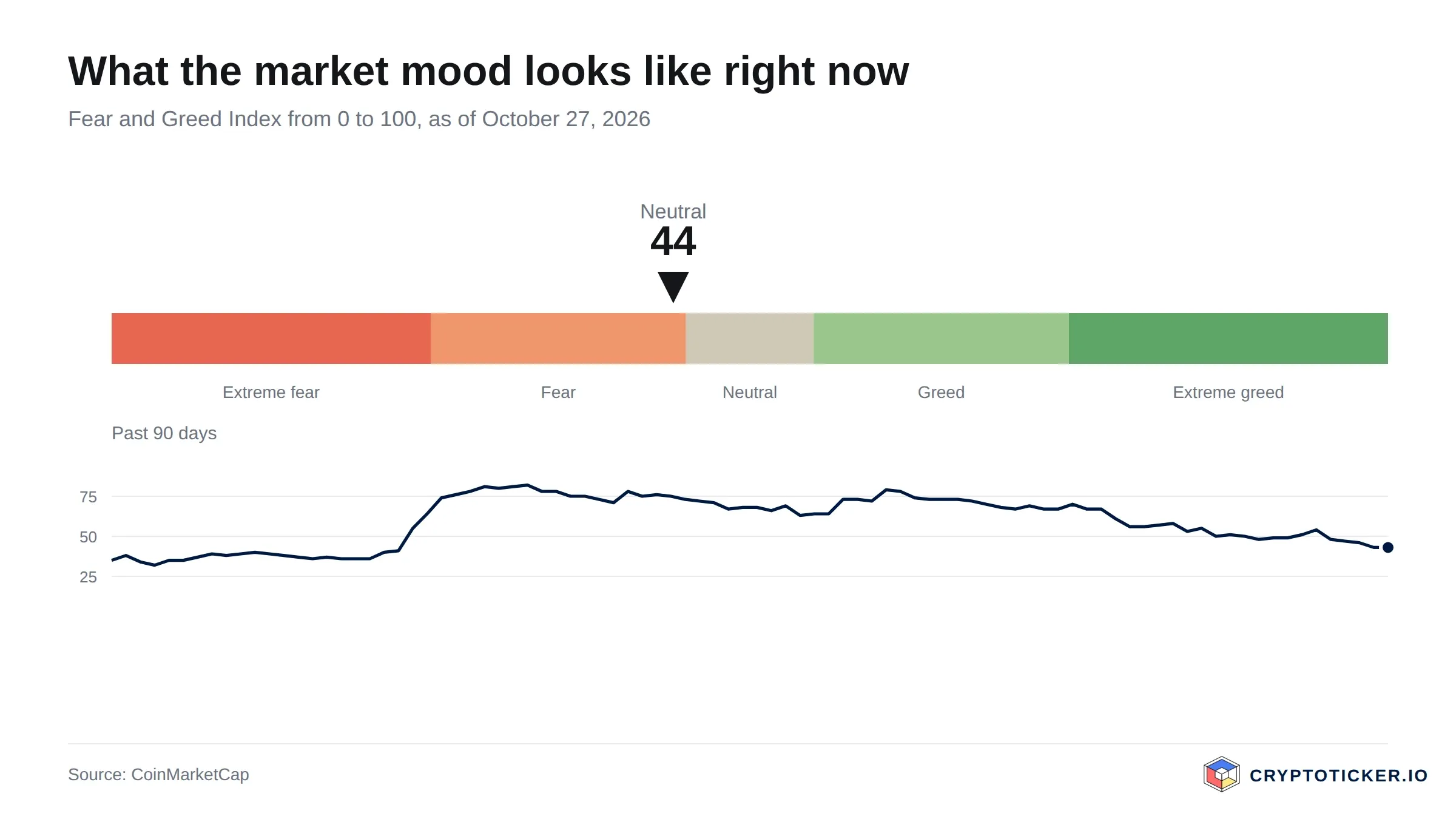
The wider frame comes from the market as a whole. The Fear and Greed Index reads 44 and therefore sits in neutral territory: no setting in which fear is pushing prices down, and none in which euphoria is carrying them up. ICP is falling considerably harder than the average in that market, and that points to reasons inside the project.
Structural factors that speak for Internet Computer
Supply is the most unusual point about ICP, and it is misread in both directions. There are 558.2 million tokens in circulation, and that is also the entire supply. There is no fixed ceiling: new tokens are created as rewards for node operators and for votes in the network, while others disappear for good when developers convert them into computing power. That burning pays for the infrastructure; it is not a marketing device. How the two sides currently stand against each other is published continuously in the network's circulation statistics.
From that follows the actual investment case. ICP is one of the few assets whose supply shrinks when the blockchain is genuinely used. On most projects the user pays the fee; here the developer pays in advance. The network built by the DFINITY Foundation runs applications entirely inside its own nodes, interface and data storage included, which makes it the counter-design to a blockchain that only stores entries in a ledger.
The third factor is the yield paid through network governance. Lock ICP for a fixed term and you receive voting rights and running rewards, and the longer the lock, the larger both become. Locked tokens are withdrawn from the market, and the lock is real: before the term expires you cannot reach your tokens.
Three points in favour of buying Internet Computer at current prices
First, the valuation against its own history. At 2.63 dollars ICP trades 71 percent below the twelve-month high of 8.97 dollars. Anyone assuming a return to the zone around 5 dollars is not talking about a new record, but about half the distance the price has given up since November 2025.
Second, the floor that held. The low of 2.02 dollars held in August, and the price stands 30 percent above it. That gives a clearly nameable mark at which the assumption fails. It is more than most assets in this size class have to offer.
Third, supply against rising usage. If the number of applications on the blockchain grows, demand for computing power rises with it, and tokens are destroyed for good to pay for it. An asset whose supply shrinks as usage climbs has a lever that a pure payment network does not. That lever only works, however, if usage actually increases.
 Compare staking offers for your coins
Three points against buying Internet Computer at current prices
First, the position on the chart. The price sits below both important averages, at 2.75 and 2.90 dollars, and both are falling. An RSI of 36.2 shows weakness without reaching the extreme from which recoveries tend to start. Anyone buying here is buying against the trend and needs patience measured in months.
Second, supply without a ceiling. The missing ceiling is an advantage only for as long as more tokens burn into computing power than are newly created. If usage stays weak, the rewards for node operators and voters outweigh the burn, and supply grows. For an asset already under pressure, that is additional headwind.
Third, the gap to the wider market. ICP has lost 17.6 percent over 30 days in an overall market whose Fear and Greed Index reads 44. When an asset falls harder than its surroundings without any market panic, the cause lies closer to the project. From rank 53 the way back leads only through new user numbers.
Buying and storing Internet Computer: costs, exchanges and wallets
ICP is listed on every large European trading venue. For investors in Europe the first question is whether the provider operates under European supervision, because segregation of client assets, the complaints route and tax records all depend on it. Our overview sits in the comparison of the best regulated crypto exchanges; how one of the largest platforms works in practice is set out in our Kraken reviews.
Two items drive the cost. The trading fee at most providers runs between 0.1 and 1.5 percent per purchase, depending on whether you go through a trading interface or an instant-buy window. On top of that comes the spread between the buying and the selling price, more noticeable at 3.5 percent daily turnover against market capitalisation than it is with Bitcoin. On small amounts it often costs more than the fee itself.
Storage comes in two forms. Investors who only want to hold move the tokens to a wallet of their own; which devices qualify is shown in our hardware wallet comparison. Investors who want the network reward lock the tokens for a chosen term. That lock is the price of the reward.
Is Internet Computer a good buy at current prices: short term and long term
Update of 17 November 2026: this assessment reflects the situation as of 27 October 2026. The short-term assumption has held so far: ICP has not closed above $2.90 on any day since, and the lowest close, $2.17 on 14 November, stayed above the August low of $2.02. By our own calculation, the 50-day average now runs below the 200-day average. The current assessment is in the section “As of 17 November 2026” at the top of the article.
In the short term, over weeks to three months, the data argue against a purchase. The price sits below both averages, momentum points down with a loss of 7.4 percent over seven days, and an RSI of 36.2 leaves room before any excess. The likely path is a sideways range between 2.20 and 2.75 dollars. That assumption is refuted as soon as ICP reclaims the 50-day average at 2.90 dollars and holds there for more than a week.
In the long term, over two to three years, everything hangs on one measurable quantity: does the blockchain burn more tokens through genuine usage than it hands out in rewards? If the answer turns positive and stays there, today's price is what an asset with shrinking supply and a market capitalisation of 1.47 billion dollars costs. If usage fails to arrive, the technology will not help, and the 71 percent gap to the twelve-month high of 8.97 dollars describes a valuation correction rather than an opportunity. This assumption counts as refuted if supply grows across several quarters while the price falls below 2.02 dollars.
On balance ICP at current prices is neither a bargain nor a trap, but a bet on usage with a named threshold. Both scenarios can be checked against figures the network publishes itself.
Buying Internet Computer: The key points for your decision
- Set the threshold before you buy. 2.90 dollars on the upside and 2.02 dollars on the downside decide whether your assumption holds. The longer horizons are set out in our Internet Computer price prediction.
- Choose the venue on supervision and cost. With a spread of this width, fees bite harder than they do on large coins. One European regulated provider is examined in our Bitpanda reviews.
- Decide storage and locking separately. Settle first whether you want to hold or to take the network reward, then set the split. For the held portion, our wallet comparison sets out the options.
Disclosure: Some of the providers mentioned in this article work with us through partner programmes. This has no influence on the price analysis or on our assessment of the chart; the price data come from a public market data source and can be verified there.
(As of 17 November 2026; analysis as of 27 October 2026. This article is not investment advice. Prices, fees and terms change; check them with the provider before every purchase. Crypto assets are subject to severe price swings, and a total loss is possible.)
Frequently asked questions about Internet Computer
Partner links: some links on this page are partner links. If you become a customer through one of them, we may earn a commission at no extra cost to you. Selection, ratings and ranking are decided independently by our editorial team. Ethics and Independence · Ownership and Funding
Transparency note: This article was produced with the assistance of artificial intelligence. Figures and claims are based on the primary sources linked in the text. The feature image was generated with AI.
For later? Save this article and find it again in your profile.
Related articles
- Whales Are Buying the Ethereum Dip While ETFs Dump $400 Million: Who Is Right?
- Is Midnight a Good Buy at Current Prices?
- Is Jupiter a Good Buy at Current Prices?
- Bitcoin after the crash: falling knife or buying opportunity? What 13 years of price data show
- Ethereum price prediction: can buyers hold $2,000 as ETF outflows shrink 99 percent?
Which topics should we dive deeper into?
Select what genuinely interests you. Your picks feed directly into our editorial planning.
Crypto news that's actually worth your time.
Weekly. 60 seconds. Carefully curated by our editors: no hype, no promo flood, no spam.

November 9, 2026 7:25 AM
XRP price prediction: Korea drives 17 percent of Upbit trading, and $1.08 is the level that decides
Analysis: XRP is the most traded coin on the Korean exchange Upbit, yet buyers there pay no premium over the global market price. Together with empty ETF books, that argues against a quick recovery and puts the $1.08 level at the centre.

November 7, 2026 10:59 PM

Will Bitcoin Go Back Up? Three Scenarios to Year-End: $70,000, $80,000 or $100,000
Bitcoin (BTC) is 40% below its record, ETFs are bleeding cash and the Fed may hike. What happened since early November, which levels decide between $70,000, $80,000 and $100,000, and what price history says about the 53 days to New Year's Eve.

November 6, 2026 11:24 AM

Shiba Inu Price Prediction: OKX Long-Short Ratio Slides to 2.2 Before Jobs Data
Analysis: on OKX, there are now only 2.2 long accounts for every short account in SHIB, down from 2.8 three days earlier. What the long unwind, the US jobs report at 14:30 German time and the levels between $0.00000412 and $0.00000515 mean for the days ahead.
November 5, 2026 2:09 PM

XRP Price Prediction: Down 7 Percent Against Bitcoin, Why the Ratio Says More Than the Price
XRP sits exactly on its 20-day average, but against Bitcoin the coin has lost more than 7 percent in 30 days. Why the ratio to Bitcoin says more than the dollar price right now and which levels count for the XRP price prediction.
November 5, 2026 1:09 PM

Cardano Price Prediction: Down 26.5 Percent in 30 Days, the Levels ADA Must Hold Now
Cardano lost 26.5 percent in 30 days, four times as much as Bitcoin. Now the 20-day and 200-day averages sit almost at the same price right above the market. Why this zone decides and which scenarios follow for ADA.

November 3, 2026 9:29 AM

Solana Price Below $95: Record ETF Outflows and Whale Selling Push SOL to a 7-Month Low
Solana price drops under $95 after a record $71 million ETF outflow and whale dumping. SOL is 19% down in a month. Is $78 the next stop?
November 3, 2026 8:59 AM

Ethereum Price Below $2,300: Is $2,000 Next or Is This the Bottom?
Ethereum price slips toward $2,250 as $3 billion leaves DeFi. Whales are buying the dip. Does ETH hold $2,200 or test $2,000 next?
October 30, 2026 11:28 PM

Is Polygon a Good Buy at Current Prices?
Polygon sits roughly half below its twelve-month high and keeps running into both moving averages. What the chart structure, the RSI and the trading volume say about buying POL at the current price.
October 28, 2026 6:40 AM
Is Morpho a Good Buy at Current Prices?
Morpho trades around a quarter below its twelve-month high while still holding above its long-term average. What argues for and against buying into the DeFi lending token at this level.
October 27, 2026 11:25 PM

Is Arbitrum a Good Buy at Current Prices?
As of 18 November 2026: Arbitrum has slipped below its 200-day average on a weekly close, the condition under which our October analysis called the short-term case wrong. We check with our own price data what that means for buyers.
October 27, 2026 9:27 PM

XRP below $1.30: what matters before Wednesday's Fed decision
XRP fell to $1.28 overnight into October 27 and was back at $1.32 by the afternoon. Three dates now sit in the calendar: Wednesday's rate decision, the escrow release on November 1 and the delayed XRPL upgrade.
October 26, 2026 11:22 PM

Is Sky a Good Buy at Current Prices?
As of 17 November 2026: Sky has fallen below its 200-day average and below the summer zone around $0.06, and the October recovery counts as refuted. We check with our own price data what that means for buying at current prices.
October 21, 2026 12:33 AM
Is Worldcoin a Good Buy at Current Prices?
As of November 11, 2026: Worldcoin has fallen below both moving averages and the marks of the October analysis, while the twelve-month low holds. What chart, supply and World ID now mean for buying WLD.
October 13, 2026 10:47 AM

Solana price at $108.21 as a $201 million buyback hangs on the $100 level: what to check now
SkyAI is selling Solana to buy back its own shares for up to $201 million, and ties the offer to a SOL price above $100. What the condition means for levels, order choice and tax.
October 9, 2026 1:06 PM

Ethereum Price Under $2,500: Is ETH a Good Buy Right Now?
Ethereum has slipped below $2,500 and the question in every chat group is the same: buy the dip, or stay out? Here is what is driving the price, what the near-term levels are, and what the long-term forecasts actually assume.
October 7, 2026 1:50 PM

Cardano gives back the Leios rally: ADA falls twice as hard as the altcoin index
Cardano loses 7.97 percent within 24 hours to $0.2546, giving back the rally of October 5 and 6. The trigger came from outside: positions worth more than $547 million were closed by force market-wide.
October 5, 2026 1:26 PM

XRP Price Prediction: Three XRPL Updates in 17 Hours from October 8, and What Matters Now
Three protocol changes go live on the XRP Ledger within 17 hours on October 8 and 9, read straight from the chain's ledger. What that means for maintenance windows, self-custody and the German holding period.
October 3, 2026 1:41 PM

Dogecoin Price Prediction: $0.10 as the Ceiling, and What to Watch at a 2.5 Percent ETP Fee
Dogecoin trades at $0.0927 on October 3 and therefore sits on its 200-day average. More important than the mark at $0.10 is the route question for German investors: a 2.50 percent fee in the Xetra ETP against the one-year holding period on a direct purchase.
October 1, 2026 4:30 AM

228 Million CRO Up for Burning: the Cronos Vote Ends on Saturday
Until early Saturday, CRO stakers are voting on two proposals: a burn of 228 million CRO and a commitment to put all revenue from two products into buybacks. The quorum is reached and there are no votes against. What the figures mean relative to supply, and what investors in Germany should check.
October 1, 2026 4:13 AM
Pump.fun (PUMP): A Sixth of All Tokens Burned, Price Up 50 Percent in a Week
Pump.fun has now destroyed almost 17 percent of its maximum supply, and the PUMP price rose by half in seven days. On top of that came a clarification from the US Securities and Exchange Commission on buyback programs that frees up less than many headlines claim. Here are the week's figures, the levels and what investors in Germany should check.
September 29, 2026 4:13 PM
Dogecoin Price Prediction: 81 Percent of ETF Money Now Sits With One Issuer
The American Dogecoin funds took in a net $2.89 million in the week to September 25, more than ever before. Around 81 percent of the assets now sit with a single provider, while Bitwise winds down its fund on October 14.
September 21, 2026 10:19 PM

Solana at a Three-Month High: What Is Holding the SOL Price Up as ETF Inflows Dry Up
Solana trades above every hourly price of the past 90 days and leads the five largest coins over one month. ETF inflows have shrunk to a fraction since the end of August. What is moving the price instead, where the levels sit, and what to check before you buy or stake.
September 20, 2026 7:15 PM

When Does the Shiba Inu Rocket Launch? We Did the Math on What Burning Really Achieves
For years the SHIB community has hoped that enough tokens would be burned to lift the price. We measured the past 30 days against the circulating supply. The result is sobering, but it finally explains why the rocket never launches.
September 16, 2026 7:30 PM

Is World Liberty Financial a Good Buy at the Current Price?
As of November 11, 2026: WLFI has fallen below September’s twelve-month low and trades far below its 200-day average. What the chart, RSI and outstanding supply now mean for buying at current prices.

More from CryptoTicker