
Dogecoin Price Prediction: $0.10 as the Ceiling, and What to Watch at a 2.5 Percent ETP Fee
Dogecoin trades at $0.0927 on October 3 and therefore sits on its 200-day average. More important than the mark at $0.10 is the route question for German investors: a 2.50 percent fee in the Xetra ETP against the one-year holding period on a direct purchase.




Which topics should we dive deeper into?
Select what genuinely interests you. Your picks feed directly into our editorial planning.
Crypto news that's actually worth your time.
Weekly. 60 seconds. Carefully curated by our editors: no hype, no promo flood, no spam.
Anyone wanting to buy Dogecoin today has two routes in Germany, and they cost very different amounts. One route is the exchange-traded security, an ETP on Xetra that eats 2.50 percent a year in fees. The other is buying the coin directly through a trading platform, where a fee arises once and nothing after that. On top of this comes the point that moves the most money in Germany: after a holding period of one year, the gain from a direct purchase is tax free. Whether the same applies to the ETP hangs on a single clause in the prospectus. This piece works both routes through, places the price situation and names the dates that fall in October.
Dogecoin Price on October 3: $0.0927 and 87 Percent Below the Record
Dogecoin trades at $0.0927 on Saturday morning, around €0.0823 converted. Within 24 hours that is 4.3 percent less. Market capitalisation stands at $14.5 billion, a single day's trading turnover at $877 million. The figures come from CoinGecko.
For context: the all-time high stands at $0.7316 and dates from May 7, 2021. From today's price that is a factor of 7.9. Put differently, Dogecoin stands 87.3 percent below its record, and has done so for four and a half years. Anyone counting on a return there is counting on an eightfold rise. That is no argument against the coin, but it is an argument for taking the running costs of a position seriously. On a stake that is meant to sit for years, an annual fee bites far harder than it does on a three-week trade.
The trading turnover of $877 million in a day equals around six percent of market capitalisation. Dogecoin therefore remains one of the most liquid cryptocurrencies of all, and that is why the spread on a direct purchase at a large platform usually stays tiny. Liquidity here simply describes how much is traded without the price swinging.
The 200-Day Average at $0.093 and the Ceiling at $0.10
The moving 200-day average is the mean of the closing prices of the past 200 trading days; many market participants read it as the dividing line between an upward and a downward phase. The technical analysis from Blockchain.News places this average at about $0.093 at the moment and the nearest resistance at $0.10. The current price therefore sits practically on the line.
Two sober distances follow from that. The round mark of $0.10 is 7.9 percent away. The lower edge of the October range, which forecasting services see at $0.0871, is 6.0 percent away to the downside. The range is narrow, then, and that is exactly what makes it interesting for the cost question: an annual fee of 2.50 percent eats a third of the way to the $0.10 mark before any gain even arises.
The difference between resistance and forecast matters. A resistance is an observed price mark at which selling set in previously. A forecast is an expectation. The $0.10 is one thing, the range up to $0.106 another, and neither figure is a promise.

Bitwise Is Closing Its Dogecoin Fund BWOW: Last Trading Day on October 14
On September 10 the provider Bitwise told the US regulator, the SEC, that it would wind up its Dogecoin fund BWOW. The last trading day on NYSE Arca is Wednesday, October 14, 2026. After that the value of the remaining shares is determined on the valuation date of October 21, with the cash payout scheduled for October 22. The fund most recently managed around $722,000, roughly five hundred-thousandths of Dogecoin's market capitalisation.
For investors in Germany this fund is not directly relevant, because a US ETF without a European key information document cannot be bought through a German broker in any case. What is relevant is the lesson. Access alone creates no demand. Three of the US spot products on Dogecoin hold $16.55 million between them, which is 0.11 percent of market capitalisation. The product launched by 21Shares in January 2026, listed on the Nasdaq under the ticker TDOG, is one of them. The exchange wrapper has therefore brought Dogecoin no institutional capital of any notable size.
Anyone who has lived through a closure like this knows the uncomfortable part: the payout comes in cash and at the valuation-date price, not in coins. For tax purposes that is a sale, even though you did not trigger it. With a directly held position that cannot happen to you, because there is no provider who could discontinue the product.
 Compare crypto exchanges and fees
ETP, ETN and ETF: Three Wrappers Investors Often Confuse
An ETF is a segregated fund. If the provider goes bankrupt, investors' assets stay untouched, because they sit apart in law. In return, European fund law demands diversification, and a fund holding only a single cryptocurrency does not meet that requirement. That is why there is no Dogecoin ETF in the literal sense in the EU.
An ETN is a debt security, meaning a promise from the issuer to pay out the value of the underlying. ETP is the umbrella term for exchange-traded products of this kind. The products on cryptocurrencies that are tradable in Germany are in practice all ETNs, even where the name says ETP. This is no quibble over words: an ETN carries an issuer risk and an ETF does not.
The reputable providers defuse this risk by backing the product physically. Physically backed means that for every share issued, the corresponding quantity of the coin sits with a custodian. With the 21Shares product this custody runs through Coinbase Custody. An overview of the whole field of exchange-traded crypto products in Germany is in our guide to crypto ETFs and ETPs for German investors.
21Shares Dogecoin ETP on Xetra: 2.50 Percent Total Expense Ratio a Year
The product carries the ISIN CH1431521033 and the German securities number A4A5WJ, trades on Xetra under the ticker DOGE and was launched on April 8, 2025. The issuer is 21Shares, based in Switzerland, and fund assets stand at around €10 million. Trading hours on Xetra are 9am to 5:30pm on weekdays; at weekends and on public holidays trading rests, while the spot market runs on. The data is in the profile at Deutsche Börse.
The total expense ratio comes to 2.50 percent a year. This ratio is not debited. It is taken daily, pro rata, out of the backing holding. Each share therefore holds slightly less Dogecoin with every day that passes. That does not show up in the portfolio statement, because the price of the security simply rises a little more slowly than the price of the coin.
What this means over time can be worked out. On a stake of €10,000 and an unchanged price, you lose €250 after one year, €731 after three years and €1,189 after five years. Cumulatively that is 2.50, 7.31 and 11.89 percent. These figures arise whether Dogecoin rises or falls.
| Holding period | Cumulative cost | on €10,000 |
|---|---|---|
| 1 year | 2.50 percent | €250 |
| 2 years | 4.94 percent | €494 |
| 3 years | 7.31 percent | €731 |
| 5 years | 11.89 percent | €1,189 |
Set against this is a genuine advantage. The security sits in an ordinary securities account, runs through brokers such as Trade Republic or Scalable Capital, can be bought through a savings plan and requires no key management of your own. Anyone who already keeps a securities account and does not want to set up a wallet pays the fee for convenience. An overview of the providers is in our comparison of the best crypto brokers.
ETP or Direct Purchase: Costs, Custody and Tax Compared
What Arises on a Direct Purchase
Buying through a trading platform, you pay a trading fee of roughly 0.1 to 1.5 percent of the amount depending on the provider, plus the spread, meaning the difference between the buying and selling price. After that no running fee arises as long as the coins sit on the platform. Withdraw them to a wallet of your own and a network fee is added, which at Dogecoin is traditionally very low.
What Arises on the ETP
Here you pay your broker's order fee, the exchange spread and then 2.50 percent a year. In return all custody work falls away, and the holding appears in the same portfolio overview as shares and bonds.
Where the Routes Really Part
The cost question is the smaller one. The larger one is tax, and the next section turns to it. For now just this much: on a gain of €3,000 the difference between the full flat-rate withholding tax and tax exemption is €791. That is more than three years of the ETP fee on €10,000.

DogeOS Opens Its Public Testnet: EVM Applications on a Second Layer
On October 1 the team behind the MyDoge wallet opened the public testnet of DogeOS. DogeOS is an application layer that sits on top of Dogecoin without changing the base layer. EVM-compatible means that developers can use the same tools and contract languages as on Ethereum. Fees are paid in DOGE. CoinDesk names lending, perpetual contracts, stablecoins and prediction markets as the planned use cases.
A testnet is a practice environment with worthless test coins. It proves that code runs, and nothing else. No date for the mainnet has been set. Anyone deriving a price driver from this is taking an announcement for a fact. Dismissing the matter entirely would be just as wrong, though: Dogecoin has had no smart contract layer until now, and if that layer arrives, the usage profile of the coin changes.
For the route question this carries real weight. Fees on DogeOS are paid in DOGE, and an ETP share is not DOGE. Anyone who ever wants to use such a layer needs the coin itself and not the paper on it.
 Compare crypto tax software
Holding Period Under Section 23 EStG: One Year, a €1,000 Exemption Limit and the Delivery Claim
Directly held cryptocurrencies count as other economic assets in Germany. The sale falls under the private disposal transaction set out in Section 23 (1) sentence 1 no. 2 of the German Income Tax Act (EStG). Two rules follow from that, and every investor should know them.
First the holding period: if more than twelve months lie between purchase and sale, the gain is tax free, whatever its size. Second the exemption limit of €1,000 in the calendar year, raised for the 2024 tax year by the Growth Opportunities Act. An exemption limit means this: stay below it with all private disposal gains of a year and you pay nothing; exceed it and the entire gain becomes taxable, not merely the part above. The tax administration's view on this is in the German Federal Ministry of Finance circular of May 10, 2022 and in the update of March 6, 2025.
Why the Delivery Claim Decides Everything on the ETP
For exchange-traded crypto products the position is inconsistent, and this is exactly where it turns expensive or cheap for you. The widespread reading, which leans on the case law on Xetra-Gold, runs as follows: where the product is physically backed and grants a claim to delivery of the deposited coins, it is treated like a direct investment. Section 23 EStG then applies, including the one-year period. Where that delivery claim is missing, or the product is replicated synthetically, it counts as a capital investment under Section 20 EStG, and the gain is subject to the flat-rate withholding tax of 25 percent plus the solidarity surcharge, together 26.375 percent, plus church tax where applicable.
This reading is not settled. The specialist literature discusses expressly whether income from crypto ETPs is to be classified as income from capital assets or as other income. No ruling of the German Federal Fiscal Court specifically on crypto ETPs exists. On top of that comes the practical catch: German custodian banks frequently withhold capital gains tax on a foreign bearer security to begin with. Reclaiming it is possible only through the tax return, and for that you need a justification the tax office accepts.
A very concrete action follows from this. If the key information document or the prospectus of your product states a delivery claim in tradable denominations, you have an argument. If it does not state one, reckon with the flat-rate withholding tax. On a gain of €3,000 that is a difference of €791. Specialist lawyers and tax advisers recommend a binding ruling from the tax office for larger amounts, before the purchase takes place.
On a direct purchase the position is clear by contrast. Hold for a year, and the gain is tax free. The price for that consists of documentation: you have to be able to evidence the purchase date, quantity and acquisition cost of each entry, because otherwise the tax office cannot check that the period was observed.
MiCA Authorisation: The BaFin Register and the Buying Route in Germany
The EU's MiCA regulation has applied in full since December 30, 2024. Anyone offering crypto services in the EU, meaning trading, exchange or custody, needs authorisation as a crypto-asset service provider. BaFin keeps a register of the authorised firms for Germany, and ESMA keeps an EU-wide directory. An authorisation granted in another member state applies here too via the EU passport.
For you this is no formality. It is the difference between a supervised provider and one where nobody is responsible in the event of a dispute. An authorised platform has to segregate client funds, maintain routes of complaint and meet information duties. Whether a provider is authorised is shown to you by a look into the BaFin register or the ESMA directory, before you transfer money.
One more point that often slips by: the spot market runs around the clock, at weekends and on public holidays as well. Xetra does not. Anyone positioned exclusively through the ETP cannot react to a move on a Saturday evening. With a coin that loses 4.3 percent within a day, that is a real difference.
Dogecoin Price Prediction for October 2026: The Range From $0.0871 to $0.106
Commercial forecasting sites name a range between $0.0871 and $0.106 for October 2026, with a mean around $0.0966. Measured against the price of October 3, that is 6.0 percent to the downside and 14.4 percent to the upside. These are the expected values of individual providers and not a consensus forecast.
The case to the upside rests on three points: the 200-day average, which is holding so far, the high liquidity, and the prospect of an application layer through DogeOS. The case to the downside rests on three as well: the continuing outflows from the US products, up to the closure of BWOW, the absent supply cap of Dogecoin, and the fact that the coin has traded 87 percent below its record for four and a half years.
None of these expectations serves as a reason to buy. What can be determined reliably today, by contrast, are the costs of the route and the tax treatment. You know both before buying, while the price in twelve months is known to nobody. That is why the route question deserves more careful handling than the price question. Anyone planning to hold a position for longer than a year makes, in the choice between paper and coin, a decision worth several hundred to several thousand euros, and does so regardless of how the price develops.
Dogecoin Price Prediction: What to Take Away
- Plan the holding period before you choose the route. Under twelve months the ETP fee barely weighs, and the tax question arises similarly on both routes. Beyond twelve months the picture turns around: 2.50 percent a year then costs noticeably, and the one-year period of the direct purchase becomes the biggest lever. Which trading venues in Germany are supervised and what they charge per order is in our comparison of the best regulated crypto exchanges.
- Document every entry from the first purchase onwards. The purchase date, quantity and acquisition cost of each position decide whether you can evidence the one-year period to the tax office. A portfolio tracker handles that automatically and exports the statement; the providers are in our comparison of crypto tax tools.
- Settle custody before the amount grows. On a direct purchase the holding sits with the platform at first. Above a sum whose loss would hurt, it belongs in a wallet of your own, and the backup of the recovery words belongs on paper or metal, never in the cloud. Which devices come into question is shown by our hardware wallet comparison.
(As of October 3, 2026. This article is not investment advice and not tax advice. Prices, fee structures and the tax treatment change; check the terms with the provider before you buy and settle tax questions with a tax professional.)
Frequently asked questions about Dogecoin
Transparency note: This article was produced with the assistance of artificial intelligence and reviewed by our editorial team before publication. All figures and claims were checked against the primary sources linked in the text. The feature image was generated with AI.
Related articles
- XRP price prediction after the release of 1 billion tokens: what to watch now
- Ethereum Price Prediction: What to Check on ETH Before the Quarter Turns
- Shiba Inu price prediction before the October 4 triangle apex: which levels decide now
- Shiba Inu Price Prediction: What to Check on SHIB Before the December 31 Deadline
- Bitcoin Price Prediction: What to Check on Levels, Holding Period and Leverage Before the October 28 Rate Decision
Which topics should we dive deeper into?
Select what genuinely interests you. Your picks feed directly into our editorial planning.
Crypto news that's actually worth your time.
Weekly. 60 seconds. Carefully curated by our editors: no hype, no promo flood, no spam.

September 27, 2026 10:16 PM

Dogecoin Price Prediction: Which Levels Decide the Fourth Quarter
Dogecoin trades at $0.0973 on September 27 and has gained 12.2 percent in seven days. Which three measured levels frame the fourth quarter, how accurate the circulating price targets proved in September, and which four checks are due before the quarter turns.

October 20, 2026 1:33 PM

60.6 percent down in twelve months and only 12th by market value: what to check before your purchase anniversary
Dogecoin has lost 60.6 percent over twelve months, more than twice as much as Bitcoin, and now ranks only 12th by market value. For investors in Germany the calendar matters more than the next price level: the anniversary of the purchase decides whether a gain stays tax free and whether a loss still counts at all.
September 26, 2026 4:48 PM
Dogecoin Forecast: Daily New Issuance Exceeds the ETF Inflows
Dogecoin pays out 13.53 million new DOGE every day, around $1.32 million, and that is above the strongest daily ETF inflow of this month. What it means for price targets, marks and your holding period.
October 10, 2026 10:33 AM

Dogecoin at $0.0862 and Bitwise Winds Down Its DOGE ETF on 14 October: Why That Barely Moves the Price
Bitwise is winding down its Dogecoin ETF BWOW: trading ends on 14 October and the money flows on 22 October. The holding amounts to 0.14 percent of one trading day. What that means for the price and why the German route runs through an ETP costing 2.50 percent a year.
October 4, 2026 10:14 AM

Dogecoin price at $0.0929: why the 200-day line sits at $0.0878 and not at $0.093
Dogecoin trades at $0.0929 on Sunday morning. Market reports put the 200-day line at around $0.093; recalculated from 366 daily closes it sits at $0.0878. Two October dates that matter for investors in Germany run alongside it.
October 1, 2026 11:19 AM

Dogecoin at $0.0946: the level that decides before the ETF closes on October 14
Dogecoin stands at $0.0946 on October 1 and fails once again at the zone around $0.098. At the same time a deadline is running: the US ETF BWOW stops trading on October 14. For investors in Germany, though, it is not the fund that decides but the buying route between a direct purchase and a Xetra ETP.

October 5, 2026 2:14 PM
Top 5 Altcoins to Buy in October 2026: These Coins Could Rally Next
October 2026 could be the month altcoins finally wake up. These are the top 5 altcoins to buy now, with current prices and the catalysts behind them.
October 20, 2026 10:28 AM
XRP price prediction: a 13-week inflow streak breaks as $2.47 million leaves a single fund: what you can do now
The US spot ETFs on XRP gave up more money than they took in last Friday, for the first time in 13 weeks. The amount is small, the signal is not, and for investors in Germany a decision between an ETN and a direct purchase hangs on it.

October 7, 2026 4:16 PM

XRP Price Prediction, $1.4445 and a Delayed XRPN Market Debut: What to Watch Now
XRP stands at $1.4445 on October 7, 4.4 percent below the previous day. Three dates shape the week: the XRPN market debut on October 12, the holding-period hearing on the same day and the cabinet session on October 14.
September 24, 2026 10:36 PM
Ethereum Price Prediction: What to Check on Staking, Leverage and Where You Buy After Three Attempts at $2,800
Ether stands at $2,700 and has bounced off the zone around $2,800 three times in thirty days, without a single daily close above it. What our own count shows, and the three things to settle before the next attempt.
September 9, 2026 4:22 PM
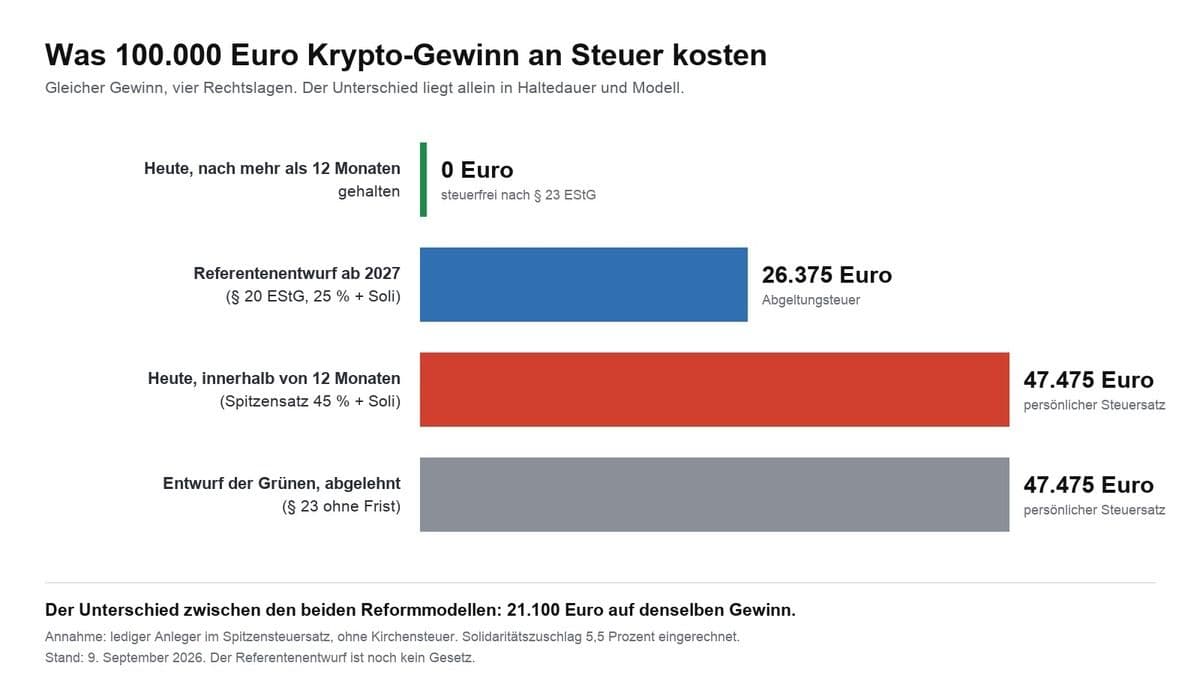
Crypto Tax in Germany: What Applies in 2026 and What Is Set to Change in 2027
Crypto gains are tax-free after twelve months; before that your personal tax rate of up to 45 percent applies. What triggers tax, how the holding period is calculated, what happens with staking and losses, and what the draft bill would change from 2027.
October 21, 2026 10:21 PM
XRP price prediction: whale outflows from Binance fall to $49.7 million: twice as strong as Bitcoin
Analysis: XRP whale outflows at Binance have dropped to their lowest level since October 2021, and the price is rising twice as strongly as Bitcoin on Wednesday evening. The number is documented, the interpretation is open. What a drying-up outflow means for holders in Germany comes further down.
October 16, 2026 4:32 PM
XRP forecast: Evernorth lists 473 million XRP on the Nasdaq, the price has not moved since Monday
Since Monday, Evernorth has been the largest listed XRP treasury on the Nasdaq, holding 473 million tokens. The price stands at $1.34 all the same. Why that is, and what investors in Germany need to watch on tax.
October 12, 2026 4:28 PM

XRP price prediction: $160 million behind Solana, 13 weeks of inflows against a 9 percent weekly loss
The XRP funds are only $160 million behind the Solana funds and have been taking in fresh money for 13 weeks. Why the price is falling anyway at $1.38, and what that means for the $2.80 year-end target.
October 6, 2026 1:34 AM

93.56 million dollars out of the Zcash ETF in one week: what changes for ZEC holders in Europe
The Grayscale Zcash ETF lost money for the first time since launch in the week to October 5, 2026, a net $93.56 million. What the figure says about demand and what it means for ZEC holders in Europe.
October 5, 2026 4:26 PM

Shiba Inu price up 4.4 percent: outperforms the market, but 88 trillion SHIB sit on exchanges
Shiba Inu adds 4.4 percent on Monday, making it the strongest of the six big names. At the same time 88.08 trillion SHIB worth $525 million sit on trading venues, almost five times a single day of turnover.
September 25, 2026 1:12 PM
XRP Jumps to $1.56: What Holders Should Check on Buying Route, Holding Period and Leverage
XRP trades at $1.56 on September 25, 2026, up 6.85 percent on the day and 16.64 percent on the week. What the on-chain data and the US ETF inflows actually show, and what investors in Germany should check now on buying route, holding period, leverage and custody.
October 16, 2026 7:25 PM

Crypto holding period for Bitcoin: “That remains to be seen,” says the finance ministry
The federal cabinet did not adopt the draft abolishing the one-year crypto holding period on October 14, 2026; it is still stuck in inter-ministerial consultation. This overview sets out what applies today, which dates follow and why the December 31, 2026 cutoff has no force of law so far.
October 15, 2026 1:27 PM
Dogecoin loses 8.6 percent in seven days, Bitcoin only 2: why DOGE falls more than four times as hard
Dogecoin falls to $0.0801 on Thursday and loses 8.6 percent over the week, while Bitcoin gives up only 2.0 percent. What decides is the zone around $0.0789, where the price already stopped on 16 September.
October 4, 2026 4:32 PM

14.11 million dollars in the ETF channel, 854 million in a single session: does that move the Dogecoin price?
The American Dogecoin funds hold a good 14 million dollars between them, while 854 million dollars change hands on a single trading day. This prediction works out what weight the ETF channel really carries in the formation of the price, and which levers are left to you in Germany.
March 26, 2025 7:01 PM
Can Dogecoin Price Hit $1 and Be the Surprise Winner of 2025?
DOGE price is climbing fast—could Dogecoin hit $1 in 2025? Here are the latest price analyses, bullish signals, and the key role of Elon Musk and X Payments in DOGE’s next moonshot.
August 11, 2026 9:13 PM

Germany's Crypto Holding Period Faces Abolition: What Petition 201716 and the Draft Bill Mean for Your Tax
Petition 201716 calls for the one-year holding period for crypto assets to be kept and will be heard in public by the Bundestag's Petitions Committee on 12 October 2026. Correction of 8 October: the reform was not decided by the cabinet in July. A draft bill of 30 September would end the holding period for crypto acquired after 31 December 2026, and the cabinet is due to take it up on 14 October.
April 24, 2026 6:33 PM
Top 5 Cryptos to Buy in April 2026: Strong Recoveries After Ceasefire?
Discover the best cryptocurrencies to buy in April 2026 as markets prepare for a relief rally following Middle East tensions and significant price corrections.
February 16, 2026 11:00 AM
Solana Price Prediction: Can SOL Reclaim $100 before March 2026?
Solana tests key support near $80. Discover if the Firedancer upgrade and $1.66B RWA growth can trigger a SOL price recovery in 2026.
September 27, 2026 1:17 PM
Dogecoin Price: What to Check on Holding Period and Custody Before the Year End
The Dogecoin price stands at $0.0977 on September 27, 2026 and has barely moved in a day. That calm is exactly the moment to work through the holding period, the reporting duty from 2026 and custody without any time pressure.
September 24, 2026 10:12 AM
XRP Falls 9.7 Percent: What to Check on Holding Period and Buying Route
XRP is down around 9.7 percent on the morning of September 24, twice as much as the typical large crypto asset. Our count of 18 coins shows who the pullback hits and which three things hold true regardless of the price.
September 22, 2026 7:20 PM
ETH Price Prediction: What to Check at the $2,800 Mark Now
Ether stands at $2,735.96 on September 22, 2026, right below the zone at which it has failed repeatedly. Instead of a target number, you get four checks that count before your next order: holding period, buying route, the staking line and the distance to liquidation.
More from CryptoTicker