
Dogecoin mining: merged mining with Litecoin earns €6.94 a day
Today Dogecoin is mined almost exclusively through merged mining with Litecoin on Scrypt ASICs. We calculate what an Antminer L9 earns in Germany and at which electricity price mining pays off.


Which topics should we dive deeper into?
Select what genuinely interests you. Your picks feed directly into our editorial planning.
Crypto news that's actually worth your time.
Weekly. 60 seconds. Carefully curated by our editors: no hype, no promo flood, no spam.
In 2026, Dogecoin mining in practice works only as merged mining with Litecoin on a specialised Scrypt miner. At network values of November 3, 2026, an Antminer L9 with 16 gigahash per second simultaneously mines around 90 Dogecoin and 0.02 Litecoin a day. Together that is worth €6.94. To do so, the device draws 80.6 kilowatt hours from the grid. It only makes a profit as long as a kilowatt hour costs less than 8.61 cents. On German household electricity, the miner loses a good €22 every day.
If you simply want to own Dogecoin, you will therefore almost always get the coins more cheaply by buying them on a regulated crypto exchange with a MiCA licence. For one day's electricity costs you get around 440 DOGE there, almost five times as many as the L9 mines in the same period. This guide explains how merged mining works technically, calculates the yield step by step and shows when Dogecoin mining can pay off in Germany at all.
Dogecoin mining in November 2026: the key figures
- A Dogecoin block pays a fixed 10,000 DOGE and is produced on average every minute. There is no supply cap; around 5.26 billion DOGE are added each year.
- A Litecoin block pays 6.25 LTC plus fees and is produced every two and a half minutes. The next halving of the reward is due at block 3,360,000, at today's pace in summer 2027.
- On November 3, difficulty stood at 35.6 million (Dogecoin) and 98.6 million (Litecoin).
- Around 86 percent of a Scrypt miner's daily yield now comes from Dogecoin and only 14 percent from Litecoin.
- The Antminer L9 breaks even at 8.61 cents per kilowatt hour. According to Eurostat, household electricity in Germany costs 36.18 cents.
- On its own, without a pool, an L9 would statistically find a Dogecoin block only every 111 days.
Our Bitcoin mining calculator for Germany shows what the calculation looks like for the big brother, using the same formula. The basics, from proof of work to pools, are explained in our guide What is Bitcoin mining?.
What is merged mining? How Dogecoin and Litecoin share the computing work
Merged mining means that a miner uses the same computing work to search for blocks on two blockchains at once. Technically the procedure is called AuxPoW, short for auxiliary proof of work. The miner builds a Litecoin block and embeds a reference to a Dogecoin block in it. If it finds a hash that meets Dogecoin's lower difficulty, the Dogecoin network accepts this proof as valid work. If the hash also meets Litecoin's stricter difficulty, a Litecoin block is created as well. The electricity is consumed only once, but the reward comes twice.
Dogecoin introduced the procedure on September 11, 2014 with block 371,337. On the same day, the Litecoin pool litecoinpool.org announced that Dogecoin could now be mined together with Litecoin. The idea had been proposed by Litecoin founder Charlie Lee. The reason at the time was security: as the price fell, fewer and fewer miners were mining Dogecoin, and a thin hashrate leaves a network exposed to attacks in which someone controls more than half of the computing power. Since the coupling, the entire Scrypt hashrate of the Litecoin camp has also protected Dogecoin.
Scrypt is the hash algorithm used by Litecoin and Dogecoin. It requires more memory than SHA-256, the algorithm used by Bitcoin. That is why a Bitcoin miner is no good for Dogecoin, and vice versa. Scrypt was originally meant to keep mining on ordinary computers. Since around 2014, however, there have been specialised chips, so-called ASICs, that compute Scrypt orders of magnitude faster than any processor.
For you as a miner this has a practical consequence: you do not have to choose between Dogecoin and Litecoin. Every larger Scrypt pool mines both networks at once and credits you with your share of both rewards. Our analysis of the Dogecoin and Litecoin mining budget gives an overview of how strongly the Dogecoin share grew in October.
Scrypt miners for Dogecoin: why graphics cards and processors are no longer enough
The total hashrate of the Litecoin network stood at around 2.8 petahash per second at the start of November, which is 2.8 million gigahash. The Dogecoin network reaches about 2.5 petahash. With 16 gigahash, an Antminer L9 contributes a little more than one two-hundred-thousandth of that. Graphics cards and processors only reach megahash values on Scrypt, i.e. thousandths of a gigahash. At today's values, a single gigahash brings in around 43 cents a day. A graphics card therefore mines fractions of a cent while consuming many times that in electricity.
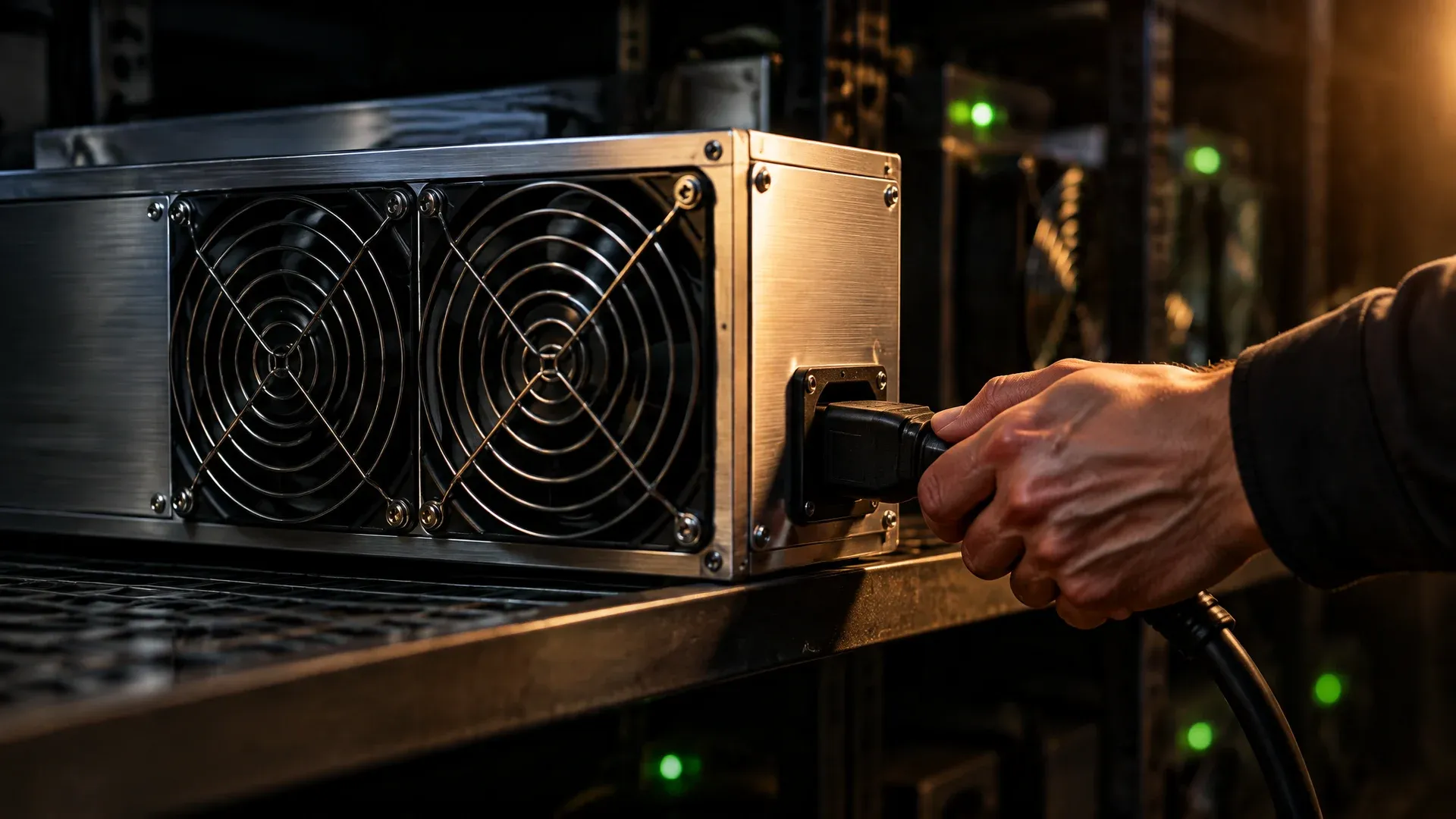
Serious Dogecoin mining therefore only runs on Scrypt ASICs. The best-known device is Bitmain's Antminer L9. Depending on the retailer's specification, it delivers 16 gigahash at 3,260 to 3,360 watts. For the calculation below we use the higher consumption so that the result does not look too favourable. Retail prices range from around $6,500 to $9,750, roughly €5,800 to €8,700. Customs, shipping and import VAT come on top if the device is delivered from outside the EU.
 Choose a regulated exchange and buy Dogecoin
Dogecoin mining calculator: the Antminer L9's yield on November 3
A miner's yield follows from three numbers: its hashrate, the network's difficulty and the reward per block. Difficulty is the level the network adjusts every few blocks so that blocks are produced at the target interval. The formula for Scrypt is the same as for Bitcoin: hashrate in hashes per second times 86,400 seconds, divided by difficulty times 2 to the power of 32. The result is the expected number of blocks per day. With merged mining you do this twice, once with Litecoin's difficulty and once with Dogecoin's, and add the two yields together.
| Calculation step, Antminer L9 | Litecoin | Dogecoin |
|---|---|---|
| Hashrate | 16 GH/s | 16 GH/s (the same work) |
| Difficulty on November 3, 2026 | 98.6 million | 35.6 million |
| Expected blocks per day | 0.00326 | 0.00903 |
| Reward per block | 6.25 LTC plus fees | 10,000 DOGE |
| Yield per day in coins | 0.0204 LTC | 90.3 DOGE |
| Price on November 3 | €48.04 | €0.0660 |
| Yield per day in euros | €0.98 | €5.96 |
| Total per day | €6.94 | |
| Power per day (3.36 kW times 24 hours) | 80.6 kWh | |
| Break-even (€6.94 divided by 80.6 kWh) | 8.61 cents per kWh | |
The yield is an expected value before pool fees. It holds on average over many blocks; on individual days it fluctuates with the pool's luck. The pool fee is usually a few percent of the payout and lowers the break-even point accordingly. The shift between the two coins is striking: although the miner nominally computes for Litecoin, 86 percent of its yield comes from the Dogecoin reward. If the Dogecoin price rises, the calculation improves quickly. If it falls, hardly anything is left of the yield, because Litecoin alone cannot carry the miner at any German electricity price.
The power price decides: Dogecoin mining on household, business and solar power
Dogecoin mining on grid power does not pay off in Germany, either for households or for typical businesses. The table shows the Antminer L9 over 30 days at three electricity prices. For households we use the 36.18 cents from Eurostat statistics for the first half of 2026, and for businesses the 23.66 cents net that Eurostat reports for annual consumption of 20 to 499 megawatt hours. For your own solar power, we set the price at what you forgo: the feed-in tariff of 7.70 cents that the Federal Network Agency (Bundesnetzagentur) cites for small rooftop systems commissioned from August 2026. The three values come from our mining calculator of November 3.
| Antminer L9, 30 days | Household power | Business power (net) | Own solar power |
|---|---|---|---|
| Price per kWh | 36.18 ct | 23.66 ct | 7.70 ct |
| Yield (2,709 DOGE and 0.61 LTC) | €208.21 | €208.21 | €208.21 |
| Power (2,419 kWh) | €875.27 | €572.38 | €186.28 |
| Result | −€667.06 | −€364.17 | +€21.93 |
Even with solar power the surplus stays small. At 73 cents profit a day, it takes more than two decades for an L9 costing €5,800 to recoup its purchase price, and only if price and difficulty stay the same. Then there is the daily problem: the miner needs 80.6 kilowatt hours around the clock. A solar system on a family home only supplies that during the bright hours of a summer day, and at night the device runs on grid power. The full 3.36 kilowatts of output turns into heat. In winter the miner heats a room; in summer the heat has to be moved out of the house.
Mining pool instead of solo mining: alone, an L9 waits 111 days for a Dogecoin block
A mining pool is a group of many miners who combine their computing power and share the rewards according to the work they contribute. For small miners it is indispensable. A single L9 would statistically find a Dogecoin block only every 111 days and a Litecoin block only every 306 days. In between come months without any yield, while the electricity bill arrives every month. In a pool, by contrast, the yields flow daily and almost evenly.
Pools settle in two ways. Under PPS, short for pay per share, the pool pays a fixed amount for every partial proof submitted, regardless of whether the pool is currently lucky. Under PPLNS, pay per last N shares, the payout depends on how many blocks the pool actually finds. PPS is more predictable, but the fee is usually higher. Some pools pay out the Dogecoin share directly in DOGE, while others fold it into the Litecoin payout. Check which variant your pool uses before you sign up, because it determines which coins you will later have to tax and store.
Cloud mining and mining apps for Dogecoin: where the payout really comes from
Besides your own hardware, providers advertise Dogecoin cloud mining or mining apps for smartphones. With cloud mining you rent computing power in someone else's data centre and are credited with the yield. The calculation above applies there just the same: at today's values, a gigahash earns around 43 cents a day before electricity and fees. A contract that promises more has to pay the difference from a source other than mining.
A smartphone can practically not compute Scrypt. Its performance is far below that of a graphics card. Apps that display daily DOGE payouts generally distribute advertising or bonus credits, not genuine mining income. Before you put money into a contract, use the formula in this article to check whether the promised hashrate can deliver the yield at all.
 Track your mining income with a tax tool
Dogecoin mining and tax in Germany: business income or other income
In Germany, mined Dogecoin are taxable income from the moment they are credited. What counts is the market value in euros on the day the coins arrive in your wallet or pool account. In its circular on crypto assets of March 6, 2025, the Federal Ministry of Finance classifies mining by scale, technology and profit motive. Anyone who mines systematically and with significant capital is therefore usually running a business.
In a business, the mined coins form part of business assets. The one-year holding period that private investors know does not then apply: every later sale is taxable. In return, you can deduct electricity, hardware and pool fees as business expenses. When a hobby becomes a business and what that means for trade tax and bookkeeping is explained in our guide to crypto mining tax for commercial mining. To record every single inflow at the day's price, a crypto tax tool that captures mining income is worthwhile. With daily credits from a pool, more than 365 individual entries accumulate over a year.
Buying Dogecoin instead of mining it: what a day's electricity buys on an exchange
In the end, every calculation comes down to the same comparison. On household power, the Antminer L9 uses €29.18 worth of electricity a day and mines coins worth €6.94 in return. For €29.18 you could buy around 442 DOGE on an exchange on November 3, while the miner manages 90 DOGE and 0.02 LTC. If you want to hold DOGE for the long term, buying is therefore clearly the better option, as long as you do not have electricity below the break-even price.
Since the MiCA transition periods ended, crypto exchanges serving customers in Germany need a licence under the EU regulation on markets in crypto-assets. You can check whether a provider has one in the register of the European Securities and Markets Authority (ESMA). Purchased Dogecoin held as private assets are subject to the holding period: after one year, the gain is tax-free. That is an advantage that commercially mined coins do not have.
Whether bought or mined: for larger holdings, the coins do not belong in a pool account or on an exchange but in a wallet whose keys only you know. A pool that is hacked or shuts down will otherwise take the balance with it.
Dogecoin mining: the numbers only work below 8.61 cents of electricity
- Check your power price: take your electricity bill and compare the unit price with the break-even of 8.61 cents. If it is higher, you can buy Dogecoin more cheaply on a regulated crypto exchange from our comparison.
- Record your inflows: if you mine anyway, record every credit at the day's price. A tax tool with mining import saves you from keeping the spreadsheet by hand.
- Secure your coins: regularly withdraw mined and purchased DOGE from the pool or exchange and store them in a hardware wallet from our comparison.
(As of November 3, 2026. This article is not investment advice. Prices and fee structures change; check the terms with the provider before you buy.)
Frequently asked questions about Dogecoin mining
Transparency note: This article was produced with the assistance of artificial intelligence and reviewed by our editorial team before publication. All figures and claims were checked against the primary sources linked in the text. The feature image was generated with AI.
Related articles
- Bitcoin mining calculator 2026: why a miner in Germany loses money on grid power
- Bitcoin Mining Rig: How to Mine Bitcoin in 2024?
- Dogecoin Carries 83.5 Percent of the Mining Budget It Shares With Litecoin: How to Check What Miners Earn per Day
- Dogecoin is 84 blocks short a day: why fewer DOGE arrive than planned
- 159,000 Blocks to the Next Litecoin Halving: Reward Drops to 3.125 LTC
Which topics should we dive deeper into?
Select what genuinely interests you. Your picks feed directly into our editorial planning.
Crypto news that's actually worth your time.
Weekly. 60 seconds. Carefully curated by our editors: no hype, no promo flood, no spam.

October 26, 2026 12:48 PM

Dogecoin: 22,538 transfers a day, barely a seventh of Litecoin
For context: the Dogecoin network produced 1,379 blocks in 24 hours and moved 22,538 transfers in them, a good 16 per block. Litecoin, served by the same scrypt miners, came to 253 per block. What that means for fees and for moving into your own wallet.

October 22, 2026 12:31 AM
What Is Bitcoin Mining? How It Works and When It Pays Off
Miners secure the Bitcoin network and earn 3.125 BTC per block. How proof of work functions, what an ASIC costs in electricity in Germany and at what power price mining breaks even.

September 19, 2024 11:16 AM
How to Become a Cryptocurrency Millionaire by 2025 in 3 Easy Steps!
In this article, we discuss 3 steps you could follow, and with a lot of investment and luck, you can become a cryptocurrency millionaire.

March 26, 2025 7:01 PM
Can Dogecoin Price Hit $1 and Be the Surprise Winner of 2025?
DOGE price is climbing fast—could Dogecoin hit $1 in 2025? Here are the latest price analyses, bullish signals, and the key role of Elon Musk and X Payments in DOGE’s next moonshot.
March 30, 2025 6:54 AM
Dogecoin Mining vs. Bitcoin Mining: Which Is More Profitable in 2025?
Thinking about mining crypto? Dogecoin and Bitcoin both offer big opportunities—but which one is better in 2025?
November 23, 2024 6:00 PM
Dogecoin Rises 20% in 24 Hours – $0.50 Price Mark Within Reach
Dogecoin is on a rally, gaining over 20% in the past 24 hours and reaching a current price of $0.47. With strong investor momentum, $0.50 is just around the corner.
November 4, 2026 12:00 AM

Trump, Iran and the MOAB: What Moves the Oil Price and Gold Price After the Midterms
Trump's pause on Iran ended with the vote. What is on record about the mother of all bombs, why gold has fallen on most big oil days, and where oil and gold can be traded.
May 17, 2025 11:04 AM
Best Yield Stablecoins 2025: Where to Earn Safely and Profitably
Stablecoins offer high yields with low risk. How to earn passive income and start growing your crypto portfolio? Here's all you need to know.
January 22, 2025 11:31 AM
How to Identify Fake TRUMP tokens: A Guide to Staying Safe in the Crypto World
The rise of fake TRUMP and MELANIA tokens is alarming crypto enthusiasts. Learn how to distinguish the official tokens from scams and protect your investments with this essential guide.
October 2, 2024 9:58 AM

Why Bitcoin Price Drops: Middle East Tensions, Mining Struggles Or Massive Liquidations?
September posed significant challenges for Bitcoin, from record-low mining profitability and price drops due to... Will October make it up?
February 16, 2025 8:23 PM

Dogecoin Price Prediction: Is a New ATH Coming Soon for DOGE Price?
Dogecoin seems to be on track for a significant price surge, with analysts forecasting a potential new ATH. But what are the key factors influencing DOGE's bullish momentum and the potential path to $1.35?
September 8, 2026 1:25 PM
Bitcoin Mining in Austria: How Mining Rewards Are Taxed
Bitcoin mining in Austria: when mining rewards are taxed at 27.5 percent, and when a commercial activity brings the progressive income tax rate into play.
April 9, 2025 4:00 AM
What Happened to Dogecoin and Cardano Today?
After the recent crypto market crash, uncertainty looms over the top 10 cryptos. With Dogecoin (DOGE) and Cardano (ADA) already flipped in rankings, could Solana (SOL) be next?
August 28, 2024 10:33 PM
How to Migrate from MATIC to POL: Full Guide
How to update and migrate Polygon Tokens from MATIC to POL, when and why? Here is all you need to know...

October 18, 2026 1:15 PM
Dogecoin: 13.82 Million New DOGE in a Day and a 0.05 Percent Fee Share: How the Network Pays Its Miners
The Dogecoin network paid out 13.82 million new DOGE in the 24 hours to Sunday midday and took in about $581 in user fees. That puts 0.05 percent of miner revenue on the users and 99.95 percent on an issuance that Dogecoin never halves.

October 15, 2026 1:27 PM
Dogecoin loses 8.6 percent in seven days, Bitcoin only 2: why DOGE falls more than four times as hard
Dogecoin falls to $0.0801 on Thursday and loses 8.6 percent over the week, while Bitcoin gives up only 2.0 percent. What decides is the zone around $0.0789, where the price already stopped on 16 September.
September 16, 2023 8:24 PM
Can you STILL Mine Bitcoin Today? Here’s the Answer!
Many wonder if Bitcoin mining remains doable for the average Joe. Can you still mine Bitcoin? Is Bitcoin mining profitable today?
October 22, 2024 7:30 AM

How to Set Up ApeChain Mainnet on MetaMask
Here's how to easily connect to ApeChain Mainnet on MetaMask. With the native token $CURTIS making headlines, ApeChain ecosystem should boom soon.
October 13, 2026 10:28 PM
5.5 percent more difficulty from Friday: Bitcoin miners face the year's third-largest step up
On October 16 the Bitcoin network raises mining difficulty by 5.49 percent, the third-largest increase of the year. What that means for miners' costs, for the levels around $81,000 and for your purchase fees.
August 22, 2026 4:16 PM
Crypto Stolen or Scammed: What to Do Now and Where to Report It
Wallet drained or fooled by a fake platform? Which steps count in the first hours, where to file a report, when regulators, exchanges and stablecoin issuers can help, and why recovery services that want money upfront are the second trap.
June 27, 2026 4:15 PM
Coinbase Advanced 2026: A Beginner's Guide to Trading, Order Types, and Getting Started
Coinbase Advanced is a pro trading platform built into your account. Here's what it is, what you can trade, and how to get started in minutes.
June 8, 2026 8:37 AM
Will SpaceX have the largest IPO in history?
SpaceX could break all IPO records with its planned public offering. Here's why investors are looking at Elon Musk's space company.
February 11, 2026 7:05 AM
5 Things to Look for BEFORE Buying Bitcoin
Thinking about entering the crypto market? Discover the 5 essential factors to check before you buy Bitcoin to secure your investment and strategy.
October 29, 2024 1:07 PM
Can You Guess The TOP 5 Meme Coins To Watch This Week
With the current bullish trend, and the hype around meme coins, here are the top 5 meme coins to watch this week!
August 20, 2023 3:22 PM
Is it Profitable to Mine Bitcoin in Lebanon? Latest Findings Revealed…
The profitability of Bitcoin mining hinges significantly on regional electricity costs. Is it Profitable to Mine Bitcoin in Lebanon?
November 3, 2026 10:36 PM

Anthropic Stock: How to Buy, IPO Date and Pre-IPO via XTB
Anthropic plans to list on Nasdaq under the ticker ANT. When you can buy the stock, what the pre-IPO CFD at XTB is, how the offers in Europe and the UK work and what the prospectus says.
November 2, 2026 9:43 PM
How to store crypto safely: protect yourself from hacks like the one at Binance
After the $6.3 billion hack at Binance: how to store your cryptocurrencies safely. Hardware wallets compared, wallet scanners such as MetaMask Security Alerts, the key settings on your exchange account and a seven-step checklist.
More from CryptoTicker