
Dogecoin: 13.82 Million New DOGE in a Day and a 0.05 Percent Fee Share: How the Network Pays Its Miners
The Dogecoin network paid out 13.82 million new DOGE in the 24 hours to Sunday midday and took in about $581 in user fees. That puts 0.05 percent of miner revenue on the users and 99.95 percent on an issuance that Dogecoin never halves.

Which topics should we dive deeper into?
Select what genuinely interests you. Your picks feed directly into our editorial planning.
Crypto news that's actually worth your time.
Weekly. 60 seconds. Carefully curated by our editors: no hype, no promo flood, no spam.
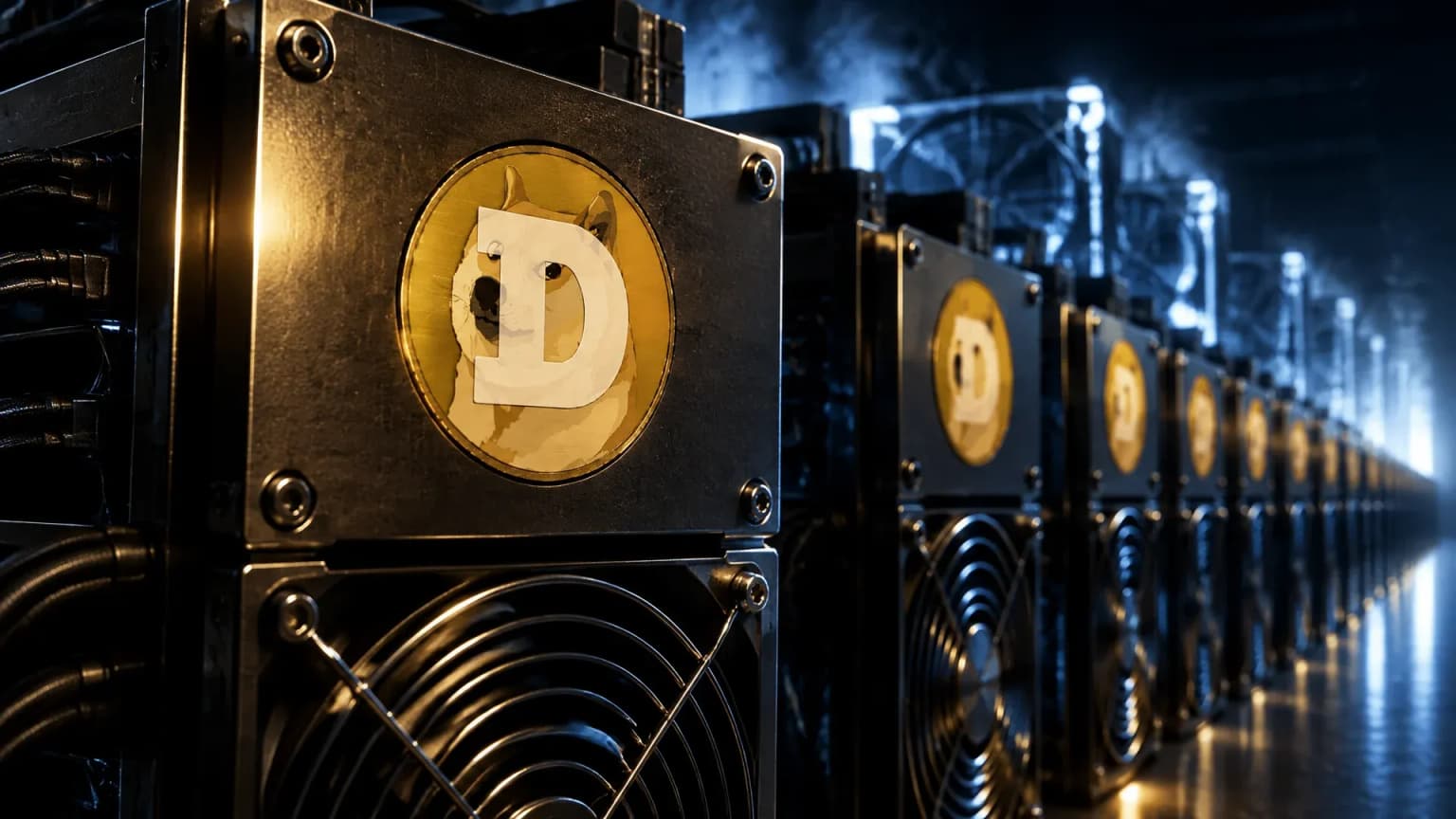
The Dogecoin network paid its miners 13.82 million new DOGE in the 24 hours to Sunday midday, worth about $1.10 million at the Sunday midday price. Users of the blockchain sent roughly $581 in transaction fees over the same period. That puts the fee share of miner revenue at 0.05 percent, with the remaining 99.95 percent coming out of freshly issued coins. Anyone holding Dogecoin pays for the security of the blockchain through that issuance rather than at the moment of a transfer, and the issuance thins their own share of the supply by a good three percent every year.
Network data from the service Blockchair shows 1,382 blocks found in that period, 58 short of the 1,440 that a one-minute target block time implies. The most recent block carried height 6,420,206. DOGE traded at $0.079357, or €0.070631, at Sunday midday, after about $0.0804 on Saturday. Over a week it is down 6.96 percent, over a year 57.71 percent.
Block Reward and Transaction Fees: What Makes Up Miner Revenue
Miners in a proof-of-work network earn from two pots. The first pot is the block reward: a set amount of new coins that the protocol creates with every block found and credits to whoever found it. The second pot is the transaction fees that users attach to their transfers so a miner includes them in the next block. Both pots together are the security budget of a blockchain. That budget decides how much computing power is worth deploying and how expensive an attack on the ordering of blocks would be.
At Dogecoin the balance between the two is extreme. 1,382 blocks times 10,000 DOGE gives the 13.82 million new coins of the day. Against that stand 22,766 transactions at an average fee of $0.0255, the $581 mentioned above. Annualised, that is roughly $212,000 from fees against roughly $417 million from issuance.
10,000 DOGE per Block: Dogecoin Has No Halving
The decisive difference from Bitcoin lies in how long the reward lasts, not in its size. Bitcoin halves its block reward roughly every four years until it runs towards zero. Dogecoin dropped that mechanism in 2014 and wrote the reward into the protocol at 10,000 DOGE per block, permanently and with no end date. The project describes this issuance on its own project page as a deliberate choice for a means of payment that replaces lost coins and keeps fees low.
On the arithmetic, the fixed reward means 1,440 blocks a day and therefore 5.256 billion new DOGE a year. Against a supply of 156.37 billion DOGE that is 3.36 percent a year. Because the network ran slightly slower over the 24 hours measured, it came out at an annualised 5.04 billion and thus 3.23 percent. The range between 3.23 and 3.36 percent is the pace at which new coins appear, whether the price rises or falls.
Why the Block Count Varies
Dogecoin adjusts its difficulty after every block, where Bitcoin waits two weeks. If computing power drops away, the network takes longer than a minute per block for a short while, until the adjustment takes hold. Difficulty stood at 38,720,114 on Sunday and the hash rate averaged 2.68 petahash per second over the day. That is where the gap of 58 blocks comes from: about 580,000 fewer DOGE were created that day than the nominal figure.

The Fee Share on the Network: 0.05 Percent at Dogecoin, 0.489 Percent at Bitcoin
The comparison with Bitcoin puts the number in context, and it does not flatter Dogecoin. Bitcoin came to 141 blocks in the 24 hours to Sunday midday, 440.625 new BTC worth about $36.17 million, and 678,525 transactions at an average fee of $0.2618. That works out at roughly $177,700 in fees and a fee share of 0.489 percent of miner revenue, about nine times the Dogecoin figure.
Both figures are low, and both networks currently live off their issuance. The difference is the direction of travel. At Bitcoin the reward falls with every halving, so the fee share has to rise or the budget shrinks. At Dogecoin the reward stays where it is, and the fee share can stay small without the network noticing. For investors, that means the low fees at Dogecoin are a consequence of permanent issuance, not a mark of efficiency.
 Find an exchange for your DOGE
Merged Mining With Litecoin: Where the 2.68 Petahash per Second Come From
A security budget that is 99.95 percent new coins sounds like an acute problem. That it is not comes down to a feature many accounts skip over: Dogecoin has been merge mined with Litecoin since 2014. Both networks use the Scrypt hashing algorithm, and a miner can work on Litecoin blocks and Dogecoin blocks at once with the same effort. Merged mining means the computing power is supplied once and rewarded twice.
In Sunday's numbers: Litecoin averaged 2.47 petahash per second over the day, Dogecoin 2.68. Litecoin paid out rewards worth about $219,000 on the same day, Dogecoin five times that at $1.10 million. A large part of the security of Dogecoin therefore arises as a by-product of another blockchain, and Dogecoin is by now the larger payer of the two. The fee share at Litecoin itself, 0.213 percent, sits between Bitcoin and Dogecoin.
The Point for Holders
The computing power behind Dogecoin rests on a calculation a miner makes across both networks together. If the price of either coin slumps, the shared work becomes less attractive, and that hits both. There is a second angle alongside the chart: the robustness of the network turns on demand for DOGE and on what Litecoin is worth in the market.
3.36 Percent Dilution a Year: The Share of the Supply Shrinks on Its Own
For a holder the issuance is a figure in their own portfolio, not an abstract protocol number. A holding of 10,000 DOGE comes to $793.81, or €706.31, on Sunday. It accounts for 0.0000064 percent of the supply. If 5.256 billion DOGE are added over a year and the holding itself does not change, that share falls by 3.25 percent. The holding stays the same size; the cake grows.
This calculation says nothing about the price. It says something about the load the price has to carry: for a holding to keep the same value in euros, demand has to grow each year by the amount the new coins represent, so at today's $417 million a year by a good $1.1 million a day. Bitcoin needs 0.80 percent a year for that, Dogecoin four times as much.
Our assessment: the issuance is the most predictable item in the Dogecoin calculation, and the one mentioned least often in day-to-day coverage. The evidence is the block count of 1,382 on Sunday, the fixed 10,000 DOGE per block and the supply of 156.37 billion, which together give the 3.23 to 3.36 percent. Against it stands the argument that fixed issuance can make good sense for a means of payment, because it keeps fees low and replaces lost coins. None of this is a buy recommendation in either direction; it is the number that belongs in a holding plan running over several years.

Median Fee of 0.0707 DOGE: What a Transfer on the Network Really Costs
The low fee side has a practical flip side for holders, and it can be put in euros. The median fee on a Dogecoin transfer stood at 0.0707 DOGE on Sunday, about half a cent. The mempool, the queue of unconfirmed transfers, held 39 transactions and 10,739 bytes, so there was effectively no backlog that would have called for a higher fee. On-chain volume that day was 11.28 billion DOGE, around $895 million, while exchanges turned over $425 million.
What an exchange charges for a withdrawal has nothing to do with that half cent. The withdrawal fee is a price set by the provider, not a network fee, and at DOGE it is usually several times higher. On small amounts that difference is the bigger cost block, so it pays to look at the fee schedule of your own provider before withdrawing, and to bundle several planned withdrawals into one. Which providers in Germany charge what is set out in the overview of the best crypto exchanges. The network side can be checked at any time, for instance through the fee and block charts at BitInfoCharts.
Compare MiCA-regulated crypto exchangesHolding for a Year: Holding Period, Loss Offsetting and the Tax Threshold
For investors in Germany the dilution leads to a question that tax law answers. DOGE counts as another asset within the meaning of section 23 of the German Income Tax Act. Sell within a year of buying and the gain is taxable as a private disposal, at your personal income tax rate. Once a year has passed the gain is tax free. For 2026 the threshold for all private disposals together is 1,000 euros; once it is exceeded the entire gain is taxable, not only the part above it.
In practical terms, with a 57.71 percent loss over the year: anyone selling DOGE at a loss inside the one-year window can offset that loss against gains from other private disposals in the same year, from other coins or from gold, for instance. Anyone who waits the window out loses that option, because after the deadline a loss counts for tax as little as a gain. The decision on when to sell is therefore also a tax decision, and it assumes that the acquisition dates of the individual holdings are documented.
What Has Changed Since the Last Dogecoin Article
On Friday this slot covered the wind-down of the Dogecoin fund run by Bitwise, which pays its holders out in cash on October 22. That date is now four days away and unchanged. The price has moved: from about $0.0804 at Saturday midday to $0.079357 at Sunday midday, down 1.23 percent. The day's low was $0.077662 and the high $0.080484. That leaves the record of $0.731578 from May 7, 2021 some 89.15 percent away. New since Friday is the number this article is about: the fund wind-down takes about $707,000 of demand out of the network, while the issuance of new coins puts $1.10 million of new supply in front of it in a single day.
The network also counted 8,483,425 addresses with a balance and 493 reachable nodes on Sunday. Bitcoin came to 216 reachable nodes the same day, at a hash rate of 986.6 exahash per second.
Dogecoin Miner Pay: Users Cover 0.05 Percent, Issuance 99.95
Three concrete steps follow from Sunday's numbers:
- Work out your own share. Divide your DOGE holding by 156.37 billion, then by 161.63 billion. The difference of 3.25 percent is the share that one year of issuance costs you while you do nothing. That number belongs next to the purchase price, not in its place. Tools that keep the holding and the acquisition date together are set out in the overview of crypto tax software.
- Compare the withdrawal fee of your provider with the half cent the network charges. If it is several times higher, bundle withdrawals instead of taking coins out one at a time. The terms offered by providers available in Germany are set out in the comparison of the best crypto exchanges.
- Fix the acquisition date of every holding before you decide on a sale. Inside the one-year window a loss can be offset and a gain is taxable; after it neither applies. If you hold the coins yourself, the documentation stays your job; the devices for it are in the hardware wallet comparison.
(As of October 18, 2026. This article is not investment advice. Prices and fee structures change; check the terms with the provider before you buy.)
Frequently asked questions about Dogecoin miner pay
Partner links: some links on this page are partner links. If you become a customer through one of them, we may earn a commission at no extra cost to you. Selection, ratings and ranking are decided independently by our editorial team. Ethics and Independence · Ownership and Funding
Transparency note: This article was produced with the assistance of artificial intelligence. Figures and claims are based on the primary sources linked in the text. The feature image was generated with AI.
For later? Save this article and find it again in your profile.
Related articles
- Dogecoin price at $0.055: the zone that preceded rallies in 2022 and 2023
- Dogecoin price slips below $0.0577 as OKX funding rate turns negative
- Dogecoin price: 91 satoshis, weakest against bitcoin since January 2021
- Dogecoin news: DOGE futures market shrinks by a quarter since early November as funding turns negative
- Dogecoin sinks below 6 cents, its lowest level since June 2023
Which topics should we dive deeper into?
Select what genuinely interests you. Your picks feed directly into our editorial planning.
Crypto news that's actually worth your time.
Weekly. 60 seconds. Carefully curated by our editors: no hype, no promo flood, no spam.

November 14, 2026 1:29 PM

US Dogecoin ETFs go a month without a single inflow as the DOGE price slips to $0.063
Analysis: Dogecoin falls to $0.0620 on Saturday, and the US spot ETFs from Grayscale and 21Shares have not reported a single dollar of inflows or outflows since October 14. What the standstill means for the price, and how the Xetra ETP and a direct purchase compare on costs.

November 13, 2026 11:17 AM

Dogecoin price hits lowest level since October 2023 as longs lose $7.7 million
Analysis: Dogecoin fell to $0.063 on Friday, its lowest level since October 2023, as leveraged longs worth $7.7 million were liquidated. Which levels matter now, what the futures market shows and what MyDoge users and November 2025 buyers should keep in mind.
November 12, 2026 11:20 PM

What is Dogecoin? With no supply cap, 5 billion new DOGE arrive every year
Dogecoin started in 2013 as a joke and is now a coin with its own blockchain, ranked 12th by market value. This profile explains the technology, merged mining and inflation without a cap, and what matters when buying and storing DOGE.
November 12, 2026 3:20 PM
Dogecoin price slips to $0.065 as DogeOS nears launch: what it means for DOGE holders
Analysis: Dogecoin has slipped below its previous low for the year of $0.0666, while DogeOS chief Jordan Jefferson says the launch of the DeFi layer is very close. What the new layer means for custody and the buying route, and which price levels matter now.
November 11, 2026 1:16 PM
Dogecoin whales sell 750 million DOGE as the price clings to $0.068
Analysis: Dogecoin is holding just above its 2026 low of $0.0666, while large wallets have sold around 750 million DOGE since November 3. What the futures market shows, which levels matter and how a direct purchase compares with the Xetra ETP.
November 10, 2026 5:24 PM
Dogecoin price at $0.067: DOGE falls to its lowest level since November 2023
Analysis: Dogecoin drops to $0.0667 after the US inflation data, its lowest price in three years. What the derivatives market shows, which levels from 2023 now count and how to use losses for tax purposes.
November 9, 2026 5:14 PM

Dogecoin price at its August low: why DOGE is falling twice as hard as bitcoin
Analysis: Dogecoin slides to $0.0679 on Monday and reaches its August low. Why DOGE is falling twice as hard as bitcoin, what the derivatives market shows and which levels now matter.
November 9, 2026 1:30 AM
Bitcoin halving explained: at block 1,050,000 the reward drops to 1.5625 BTC
The Bitcoin halving cuts the miners' reward every 210,000 blocks, most recently in April 2024 to 3.125 BTC. This explainer works through issuance per epoch up to just under 21 million and shows when the next halving at block 1,050,000 is due.
November 7, 2026 3:29 PM
Dogecoin Price Slips to $0.0726 as Monero Overtakes DOGE by Market Cap
Analysis: Dogecoin falls to $0.0726 on Friday and drops behind Monero to 13th place by market capitalisation. For buyers from November 2025, the holding period is expiring at the same time, and with it the chance to use the loss with the German tax office.
November 7, 2026 9:13 AM
Dogecoin Price at $0.072 in a Death Cross: When Will DOGE Rise Again?
Since October 29, Dogecoin's 50-day moving average has been below its 200-day line. Our analysis shows why the signal comes late, which levels at $0.0760 and $0.0690 matter, and what November 2025 buyers in Germany should know before their holding period ends.
November 6, 2026 11:11 PM
Dogecoin news: 21Shares ends House of Doge's service contract for the TDOG ETF
Analysis: on November 5, 21Shares terminated its services agreement with House of Doge for its US Dogecoin ETF TDOG with immediate effect. The fund is too small to matter for Dogecoin, but for holders of the Xetra ETP the licence question remains open.
November 5, 2026 9:28 PM

Dogecoin Price Hits Lowest Since August as OKX Traders Pile Into Longs
Analysis: Dogecoin fell with Bitcoin and chip stocks to as low as $0.0710, its lowest since August. On OKX, the ratio of long to short accounts rose to 5.41 in the process. What the positioning shows, which levels count and where leveraged positions tip over.
November 4, 2026 5:29 PM

Dogecoin price against Bitcoin: one DOGE now costs just 96 satoshi
Analysis: against Bitcoin (BTC), Dogecoin (DOGE) is now worth just 96 satoshi, down from 160 a year ago. Why the post-election recovery does not change that, which levels around $0.0775 matter and what swapping into Bitcoin means for tax.
November 3, 2026 11:28 PM
Dogecoin mining: merged mining with Litecoin earns €6.94 a day
Today Dogecoin is mined almost exclusively through merged mining with Litecoin on Scrypt ASICs. We calculate what an Antminer L9 earns in Germany and at which electricity price mining pays off.
November 3, 2026 9:46 PM

Dogecoin on US midterm night: just under 16 percent of the 2024 election rally is left
Context: on the evening of the US midterms, Dogecoin trades at $0.0752, 84 percent below the peak DOGE reached five weeks after the 2024 presidential election. What the 2022 and 2024 elections did to the coin, and which German tax deadline expires on Wednesday for buyers from November 2025.
November 3, 2026 1:18 PM
House of Doge loses its Nasdaq listing: why the Dogecoin price barely moves at $0.075
Analysis: Nasdaq suspended House of Doge shares on November 3. Why the Dogecoin price is barely affected, what it means for the Xetra ETP and which levels count at $0.0751.
November 2, 2026 9:11 PM
Dogecoin price at $0.0737: large wallets have shed 120 million DOGE since Thursday
Analysis: the Dogecoin price has seen its 50-day line drop below the 200-day line, and addresses holding 10 to 100 million DOGE have sold around 120 million tokens since Thursday. What the signal meant last time, where the key levels sit and what to settle on tax and leverage now.
November 1, 2026 3:45 PM
Dogecoin is 84 blocks short a day: why fewer DOGE arrive than planned
Analysis: the Dogecoin network produced 1,356 blocks in 24 hours instead of the intended 1,440. Over 30 days, 2,176 blocks are missing, and with them fewer new Dogecoin are created than the standard calculation assumes.

October 30, 2026 6:16 PM
Dogecoin price breaks $0.0750: the level that decides now
Dogecoin trades at $0.0757 at midday on Friday and has lost the $0.0750 level that had served as a test since October 24. The day's low was $0.0727, and the next line with a reason behind it sits at $0.0695.
October 25, 2026 3:15 PM
Dogecoin trademark deal ends: does the 21Shares ETP keep the name?
The exclusive trademark agreement between the Dogecoin Foundation and House of Doge has been over since October 19. Three 21Shares products may keep the name, among them the ETP that trades in euros on Xetra. An exit payment of $400,000 is still outstanding.
October 24, 2026 10:14 PM
159,000 Blocks to the Next Litecoin Halving: Reward Drops to 3.125 LTC
The next Litecoin halving cuts the block reward from 6.25 to 3.125 LTC. It is triggered by block 3,360,000, and on October 24, 2026 roughly 159,000 blocks were still missing.
October 19, 2026 1:25 PM

Dogecoin: large addresses buy 600 million DOGE while daily turnover halves: why the price is still falling
Between October 12 and October 16, around 600 million DOGE moved onto large addresses according to Santiment data, while the price lost 8.6 percent in seven days. Daily turnover collapsed by almost half at the same time, and that is what decides whether buying on this scale moves anything at all.
October 11, 2026 10:39 PM
Buying Dogecoin: instant buy at one percent or the order book at 0.8?
Seven cents per €100 separated the best asks of three authorised exchanges on Sunday evening. Between instant buy and order book at the same provider lie 75 cents.
October 11, 2026 10:14 AM
Dogecoin today: one transfer moved $48.6 million, six transactions sat in the mempool
A single transfer carried 5.12 percent of Dogecoin's daily volume, while six transactions sat in the mempool. What the chain data reveal about fees, order book depth and the holding period.
October 8, 2026 4:52 PM
Dogecoin Price at $0.087: 13.55 Million New DOGE Enter Circulation Every Day
Dogecoin trades at $0.087 and has lost 8.1 percent in seven days. Every day 13.55 million new coins come into existence, and unlike with Ethereum there is no compensation for holders.
September 30, 2026 4:36 PM

Dogecoin Price Prediction: 28 Billion DOGE Make $0.098 the Level That Decides
Dogecoin trades at around $0.0973 on Wednesday midday and keeps failing at the zone at $0.098, where roughly 28 billion DOGE changed hands. At the same time $1.50 billion sits in open leveraged positions, and the tax authority's one-year period runs separately for every purchase.
September 28, 2026 10:13 AM
Dogecoin Price Prediction: 5 Billion New DOGE Would Fall to 500 Million, What Matters Now
A proposal in the official Dogecoin repository would lower the block reward from 10,000 to 1,000 DOGE, pushing annual issuance from around 5.3 billion down to around 526 million coins. What that means for the supply side, for the levels between $0.0800 and $0.1004, and for your holding period ending December 31.
More from CryptoTicker