
What is Dogecoin? With no supply cap, 5 billion new DOGE arrive every year
Dogecoin started in 2013 as a joke and is now a coin with its own blockchain, ranked 12th by market value. This profile explains the technology, merged mining and inflation without a cap, and what matters when buying and storing DOGE.

Which topics should we dive deeper into?
Select what genuinely interests you. Your picks feed directly into our editorial planning.
Crypto news that's actually worth your time.
Weekly. 60 seconds. Carefully curated by our editors: no hype, no promo flood, no spam.
Dogecoin is a cryptocurrency with its own blockchain that launched at the end of 2013 as a joke about an internet meme and today ranks among the largest coins in the world. Its ticker is DOGE. Unlike Bitcoin, there is no supply cap: every new block brings a fixed 10,000 DOGE, which adds around 5 billion coins a year. On November 12 one Dogecoin costs about €0.06, its market value is a little over €9.3 billion, and DOGE ranks 12th according to CoinGecko.
This profile explains how the network works technically, who secures it, why the money supply grows without limit and what that means for investors when buying and storing the coin. Our own calculation shows how sharply Dogecoin's inflation has fallen since 2015 and why the gap to Bitcoin is widening anyway.
Dogecoin explained simply: a payment coin on its own blockchain
A cryptocurrency is digital money whose bookkeeping is not held by a bank but in a public register maintained jointly by many computers. That register is called a blockchain: a sequence of data blocks in which every transfer is recorded permanently and visible to everyone. Dogecoin has run such a blockchain itself since December 2013, which makes it a coin in its own right rather than a token on someone else's network.
From the start DOGE was meant as money to spend, not to hoard. Fees are low: in the 24 hours to November 12 the median transfer cost around $0.002, according to the block explorer Blockchair. On the same day just under 29,300 transactions ran through the network. For comparison, Bitcoin processes many times that, at considerably higher fees.
In the crypto world Dogecoin is regarded as the first meme coin, a cryptocurrency whose fame comes from an internet joke. An overview of this category, its opportunities and its risks is on our meme coin topic page. DOGE differs from most younger meme coins in one important respect, though: it has its own blockchain with its own miners that has been running for almost 13 years.
History of Dogecoin: from the Doge meme to internet tipping
Dogecoin was created by programmer Billy Markus and marketer Jackson Palmer. Both found the crypto scene of 2013 too dogged and wanted a currency that was fun. Palmer built the website, and Markus, under the name "Shibetoshi Nakamoto", wrote the code for the first four versions. The official Dogecoin history gives December 6, 2013 as the launch date, while other sources cite December 8.
The name comes from the Doge meme: a photo of the Japanese Shiba Inu dog Kabosu, framed by colourful Comic Sans phrases. The coin struck a chord. Two weeks after launch, according to the Dogecoin project, more transactions ran through DOGE in a single day than through Bitcoin. On Reddit, Dogecoin became the tip for a good post.
In 2014 the community raised 26.5 million DOGE, then about $30,000, to send the Jamaican bobsleigh team to the Winter Games in Sochi. The same year more than 40 million DOGE were collected for wells in Kenya. Both founders stepped back from development in 2014. Palmer left the crypto scene entirely in 2015 and has been critical of it since. A core team of volunteer developers has maintained the code ever since.

Dogecoin technology: Scrypt, proof of work and one block per minute
Technically, Dogecoin descends from Luckycoin and thus indirectly from Litecoin. The network runs on proof of work: computers known as miners solve a computational puzzle, and whoever first finds a valid solution may add the next block to the blockchain and receives the block reward. The puzzle follows the Scrypt algorithm. Scrypt is a hashing method that requires a lot of memory as well as computing power, so machines built for Bitcoin's SHA-256 algorithm cannot use it.
The target is one block per minute, or 1,440 blocks a day. In practice only 1,356 blocks were produced in the 24 hours to November 12, one every 64 seconds on average. We had already measured this shortfall at the end of October in our own analysis of block data over 7 and 30 days. A transfer is therefore usually confirmed for the first time after one to two minutes.
Important for investors: because Dogecoin relies on proof of work, there is no native staking. Anyone offered "Dogecoin staking" with a fixed interest rate is in fact lending their coins to a provider and bearing that provider's default risk.
 Find the right crypto exchange
Merged mining with Litecoin: who secures the Dogecoin blockchain
Since 2014 Dogecoin has been mined together with Litecoin in what is called merged mining. Merged mining means that a miner finds blocks for two blockchains at once with the same computational work, without using twice the electricity. Dogecoin thus shares the computing power of the much larger Litecoin miners. That makes a small blockchain harder to attack, because an attacker would need to muster the majority of this combined computing power.
For miners, Dogecoin has become the more important part. In our calculation from November 3, around 86 percent of a Scrypt miner's daily revenue came from DOGE and only 14 percent from Litecoin. Whether it pays off in Germany is worked out in our guide to Dogecoin mining. In short: at German household electricity prices, a typical machine loses money every day.
Who controls the network? No one alone. Anyone can run a node, a computer that holds a full copy of the blockchain and checks new blocks. Blockchair counted a little over 450 reachable nodes on November 12. Changes to the rules require the consent of miners and node operators.
Dogecoin inflation: 10,000 DOGE per block and no cap
For cryptocurrencies, inflation means how fast the number of coins grows each year relative to the amount already in circulation. For Dogecoin the answer is unusually simple. Since block 600,000 in February 2015, every block has brought a fixed 10,000 DOGE. By then around 98.4 billion DOGE had been created. According to CoinGecko, there are around 156.7 billion on November 12.
At the planned rate of one block per minute, 5.26 billion DOGE would be added every year. Because blocks arrive somewhat more slowly, the average since 2015 has been just under 5 billion. Measured against today's supply, that is an issuance rate of a little over 3 percent a year.
The Dogecoin project openly defends this design. A fixed amount per year pays miners permanently and keeps the network secure, it writes in its answers on Dogecoin inflation. A cap would make the blockchain vulnerable in the long run, because at some point the reward for miners would disappear. Dogecoin, it says, should be spent and not hoarded.
Dogecoin vs Bitcoin: why the DOGE issuance rate falls more slowly
The difference from Bitcoin lies in the mechanism. Bitcoin halves its block reward roughly every four years and ends at 21 million coins. Dogecoin issues the same absolute amount every year. Because the circulating supply grows, the percentage still falls, only slowly and without jumps.
Our own calculation based on the protocol rules shows the consequence. In 2015 Dogecoin's issuance rate was just under 5 percent, in 2020 around 4 percent, and today a little over 3 percent. In 2030 it would still be about 2.8 percent, in 2040 around 2.2 percent. Bitcoin was far above that in 2015 at a good 9 percent, but since the April 2024 halving it has reached around 0.8 percent and will fall to about 0.4 percent after the next halving, expected in 2028.
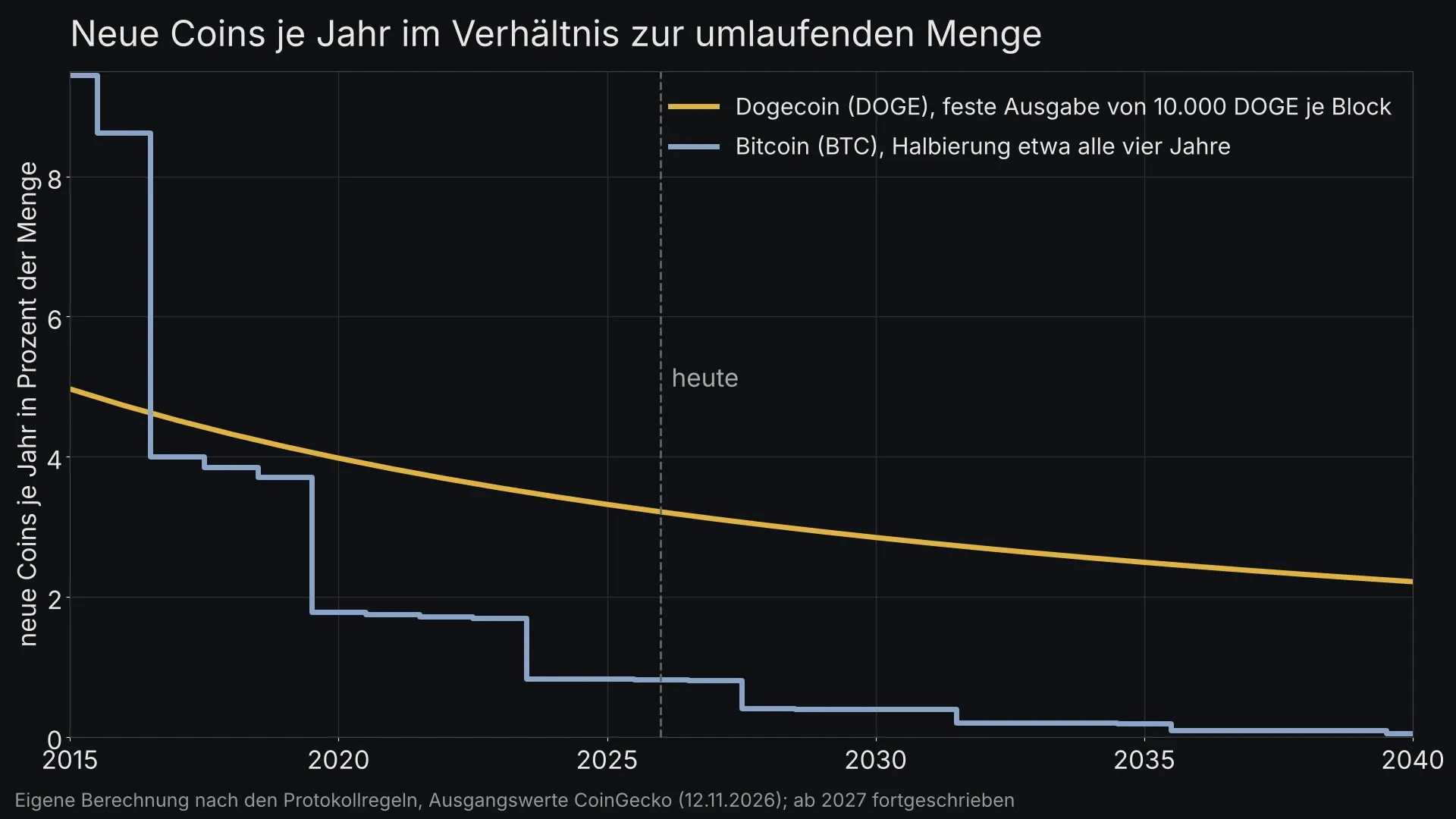
For holders this means in concrete terms: even if demand stays the same, DOGE needs new money every year of roughly 3 percent of its market value so that the price does not suffer from the extra supply. At today's market value that is roughly €280 million a year that miners can bring to market. Bitcoin gets by with a fraction of that.
Elon Musk and the Dogecoin price: record high in 2021, steep fall afterwards
Outside the crypto world, Dogecoin became known above all through Elon Musk. In late 2020 and early 2021 the Tesla chief repeatedly wrote publicly about DOGE, and the price rose from a few cents to many times that. Dogecoin reached its record high of $0.73 on May 7, 2021, according to CoinGecko, one day before Musk's appearance on the US comedy show "Saturday Night Live". The price then fell sharply.
On November 12 DOGE trades at around $0.066, a good 90 percent below that high and around 61 percent below its level a year ago. That shows how strongly the price depends on sentiment and individual voices. The network itself has no new business models or revenues that could justify a value.
Find a crypto exchange with EU authorisationDogecoin Foundation, House of Doge and DogeOS: who drives the project today
There is no company that owns Dogecoin. The Dogecoin Foundation is a non-profit organisation founded in 2014 and revived in 2021. By its own description it supports development and adoption, protects the brand from misuse and is working on a roadmap for the project. Volunteer developers continue to maintain the code.
A commercial ecosystem has grown up alongside it. The company House of Doge called itself the Foundation's official corporate arm until October. On November 5 the fund provider 21Shares terminated its services agreement for its US Dogecoin ETF with the ticker TDOG, as we reported on November 6. 21Shares gave no reasons.
Technically, the project generating the most movement at present is DogeOS, an additional layer on which DOGE is to be used in applications such as exchanges or lending protocols. Founder Jordan Jefferson told the trade outlet The Block that the first version has been developed and audited and that the mainnet launch is "very, very close". He gave no date.
Buying and storing DOGE: an exchange with MiCA authorisation or your own wallet
In Europe, Dogecoin is almost always bought through a crypto exchange or a broker. Since the EU's MiCA regulation took effect, crypto service providers need authorisation to do this. Which providers list DOGE and what they charge is shown in our comparison of crypto exchanges. A step-by-step guide covering payment methods is in our guide to buying Dogecoin. How gains on DOGE are taxed depends on where you live, and crypto tax software keeps the purchase date and price of every position on record.
When it comes to storage you have two options. If the coins stay on the exchange, the provider holds them for you. If you move them to your own wallet, you hold the private key yourself, and the recovery phrase of 12 or 24 words is then your only way in. Many common hardware wallets support DOGE, and there is also the Dogecoin Core software, which downloads a full copy of the blockchain.
One figure often looks alarming: individual addresses hold a large share of all DOGE. According to the Dogecoin project, however, many of the largest addresses belong to exchanges and brokers that pool the coins of hundreds of thousands of customers in them. If you hold your own coins, you are independent of such pooled addresses.
Dogecoin risks: sentiment, dilution and total loss
Dogecoin has a long track record and a large community, but it is a speculative asset. Three points shape the risk in particular. First, the price depends heavily on sentiment and celebrities, as its path since May 2021 shows. Second, ongoing issuance of a little over 3 percent a year dilutes every existing holding. Third, there are no revenues and no issuer standing behind a value.
A total loss is possible. Only put money into DOGE that you can afford to lose, and do not concentrate your crypto holdings in a single coin.
Dogecoin in your portfolio: a payment coin with just over 3 percent issuance a year
Dogecoin is an original among cryptocurrencies: its own blockchain since 2013, secured through merged mining with Litecoin, with cheap transfers and no supply cap. Anyone buying DOGE is betting on demand and community, not on scarcity. Two steps help with putting that into practice:
- Choose a provider: Only buy DOGE from an authorised provider. Which exchanges hold a MiCA licence is shown in our comparison of regulated crypto exchanges.
- Sort out storage: Larger holdings belong in your own wallet. Suitable devices are listed in our hardware wallet comparison.
(As of November 12, 2026. This article is not investment advice. Prices and fee structures change; check the terms with the provider before you buy.)
Frequently asked questions about Dogecoin
Partner links: some links on this page are partner links. If you become a customer through one of them, we may earn a commission at no extra cost to you. Selection, ratings and ranking are decided independently by our editorial team. Ethics and Independence · Ownership and Funding
Transparency note: This article was produced with the assistance of artificial intelligence and reviewed by our editorial team before publication. All figures and claims were checked against the primary sources linked in the text. The feature image was generated with AI.
Related articles
- Dogecoin whales sell 750 million DOGE as the price clings to $0.068
- Dogecoin price at $0.067: DOGE falls to its lowest level since November 2023
- Dogecoin price at its August low: why DOGE is falling twice as hard as bitcoin
- Dogecoin Price Slips to $0.0726 as Monero Overtakes DOGE by Market Cap
- What Is Tron (TRX)? The Blockchain Holding More Than Half of All USDT
Which topics should we dive deeper into?
Select what genuinely interests you. Your picks feed directly into our editorial planning.
Crypto news that's actually worth your time.
Weekly. 60 seconds. Carefully curated by our editors: no hype, no promo flood, no spam.

November 6, 2026 11:11 PM
Dogecoin news: 21Shares ends House of Doge's service contract for the TDOG ETF
Analysis: on November 5, 21Shares terminated its services agreement with House of Doge for its US Dogecoin ETF TDOG with immediate effect. The fund is too small to matter for Dogecoin, but for holders of the Xetra ETP the licence question remains open.

November 6, 2026 1:20 PM
Crypto market cap explained: Bitcoin vs gold and Apple
Market capitalization shows how large a coin is valued in the market and exposes the fallacy of cheap unit prices. We explain the formula, Bitcoin dominance and FDV with current figures and show why Bitcoin, at $1.53 trillion, trails far behind gold.
November 6, 2026 1:34 AM

What Is Shiba Inu? SHIB, Shibarium and 410 Trillion Burned Tokens
Shiba Inu is a memecoin on Ethereum that has spawned its own layer-2 blockchain and three side tokens. This profile explains supply, burns, Shibarium and the risks, and sets out what applies to buying, storing and taxing SHIB in Germany.
November 5, 2026 9:28 PM

Dogecoin Price Hits Lowest Since August as OKX Traders Pile Into Longs
Analysis: Dogecoin fell with Bitcoin and chip stocks to as low as $0.0710, its lowest since August. On OKX, the ratio of long to short accounts rose to 5.41 in the process. What the positioning shows, which levels count and where leveraged positions tip over.
November 4, 2026 5:29 PM

Dogecoin price against Bitcoin: one DOGE now costs just 96 satoshi
Analysis: against Bitcoin (BTC), Dogecoin (DOGE) is now worth just 96 satoshi, down from 160 a year ago. Why the post-election recovery does not change that, which levels around $0.0775 matter and what swapping into Bitcoin means for tax.
November 4, 2026 1:19 PM

What is XRP? 100 billion coins, one ledger and the role of Ripple
XRP is the cryptocurrency of the XRP Ledger, built for payments in seconds and without mining. This profile explains Ripple, escrow, the SEC case and what to watch for when buying in Germany.
November 3, 2026 11:28 PM
Dogecoin mining: merged mining with Litecoin earns €6.94 a day
Today Dogecoin is mined almost exclusively through merged mining with Litecoin on Scrypt ASICs. We calculate what an Antminer L9 earns in Germany and at which electricity price mining pays off.
November 3, 2026 9:46 PM

Dogecoin on US midterm night: just under 16 percent of the 2024 election rally is left
Context: on the evening of the US midterms, Dogecoin trades at $0.0752, 84 percent below the peak DOGE reached five weeks after the 2024 presidential election. What the 2022 and 2024 elections did to the coin, and which German tax deadline expires on Wednesday for buyers from November 2025.
November 3, 2026 1:41 PM
Bitcoin mining calculator 2026: why a miner in Germany loses money on grid power
Bitcoin mining calculator for Germany: revenue, power costs and break-even for five current Antminers, the formula to work it out yourself, and dogecoin mining.
November 3, 2026 1:18 PM
House of Doge loses its Nasdaq listing: why the Dogecoin price barely moves at $0.075
Analysis: Nasdaq suspended House of Doge shares on November 3. Why the Dogecoin price is barely affected, what it means for the Xetra ETP and which levels count at $0.0751.
November 2, 2026 5:52 PM

What is Hedera (HBAR)? Hashgraph, the corporate council and what HBAR is used for
Hedera orders transactions with a hashgraph method instead of blocks, and the network is governed by a council of 33 companies. This profile explains the technology, HBAR supply, fees and the tax rules that apply in Germany.
November 1, 2026 3:45 PM
Dogecoin is 84 blocks short a day: why fewer DOGE arrive than planned
Analysis: the Dogecoin network produced 1,356 blocks in 24 hours instead of the intended 1,440. Over 30 days, 2,176 blocks are missing, and with them fewer new Dogecoin are created than the standard calculation assumes.
October 26, 2026 12:48 PM

Dogecoin: 22,538 transfers a day, barely a seventh of Litecoin
For context: the Dogecoin network produced 1,379 blocks in 24 hours and moved 22,538 transfers in them, a good 16 per block. Litecoin, served by the same scrypt miners, came to 253 per block. What that means for fees and for moving into your own wallet.
October 26, 2026 3:16 AM
What is Chainlink? Oracles, the LINK token and why banks use the network
Chainlink gives smart contracts the data a blockchain cannot see on its own. What the oracle network does, what the LINK token is paid for and what applies when you buy in Germany.
October 24, 2026 10:14 PM
159,000 Blocks to the Next Litecoin Halving: Reward Drops to 3.125 LTC
The next Litecoin halving cuts the block reward from 6.25 to 3.125 LTC. It is triggered by block 3,360,000, and on October 24, 2026 roughly 159,000 blocks were still missing.
October 23, 2026 4:21 AM
What is Solana? The blockchain behind SOL: no supply cap, 589 million tokens in circulation
Solana settles payments in milliseconds and swapped out its voting mechanism on October 21, 2026. What the network is, what SOL is needed for, and what applies in Germany for buying, custody and tax.
October 22, 2026 1:45 PM
Cryptocurrency explained: how digital money works without a bank
A cryptocurrency is an entry in a public ledger that neither a bank nor a central bank controls on its own. This piece explains how that ledger works, what separates Bitcoin from the euro, and which rules apply in Germany to buying, custody and tax.

October 22, 2026 12:31 AM
What Is Bitcoin Mining? How It Works and When It Pays Off
Miners secure the Bitcoin network and earn 3.125 BTC per block. How proof of work functions, what an ASIC costs in electricity in Germany and at what power price mining breaks even.
October 17, 2026 4:26 PM

Polkadot caps DOT at 2.1 billion: why only 392 million DOT can still be created
Referendum 1710 has been executed and limits Polkadot to 2.1 billion DOT. Of those, 1.708 billion have been issued, and the rest arrives in steps that get smaller every year.
October 15, 2026 1:27 PM
Dogecoin loses 8.6 percent in seven days, Bitcoin only 2: why DOGE falls more than four times as hard
Dogecoin falls to $0.0801 on Thursday and loses 8.6 percent over the week, while Bitcoin gives up only 2.0 percent. What decides is the zone around $0.0789, where the price already stopped on 16 September.
October 11, 2026 10:20 PM

QNT token: a £100 Overledger licence a year, 14.88 million supply cap
The QNT token pays the annual licence for Overledger and is to carry the fee for gas and execution in the Fusion Rollup. What it does, where the cap sits and why circulating supply differs by 2.47 million tokens depending on the source.
October 11, 2026 1:16 AM
Dogecoin Carries 83.5 Percent of the Mining Budget It Shares With Litecoin: How to Check What Miners Earn per Day
The same machines secure Dogecoin and Litecoin, yet 83.5 percent of the shared mining budget comes from Dogecoin. The arithmetic behind it sits openly on the chain and can be recalculated in two minutes.
October 9, 2026 10:25 PM

Dogecoin: 94 Percent of Liquidations Hit Long Positions, and How the Leverage Compares With Bitcoin
On the Dogecoin futures market $7.82 million was force closed within 24 hours, almost all of it on the long side. Our count of 106 contracts shows how much leverage really sits in the market and how much of it is open to retail investors in Europe.
October 8, 2026 4:52 PM
Dogecoin Price at $0.087: 13.55 Million New DOGE Enter Circulation Every Day
Dogecoin trades at $0.087 and has lost 8.1 percent in seven days. Every day 13.55 million new coins come into existence, and unlike with Ethereum there is no compensation for holders.
October 4, 2026 4:32 PM

14.11 million dollars in the ETF channel, 854 million in a single session: does that move the Dogecoin price?
The American Dogecoin funds hold a good 14 million dollars between them, while 854 million dollars change hands on a single trading day. This prediction works out what weight the ETF channel really carries in the formation of the price, and which levers are left to you in Germany.
September 30, 2026 4:36 PM

Dogecoin Price Prediction: 28 Billion DOGE Make $0.098 the Level That Decides
Dogecoin trades at around $0.0973 on Wednesday midday and keeps failing at the zone at $0.098, where roughly 28 billion DOGE changed hands. At the same time $1.50 billion sits in open leveraged positions, and the tax authority's one-year period runs separately for every purchase.
September 28, 2026 10:13 AM
Dogecoin Price Prediction: 5 Billion New DOGE Would Fall to 500 Million, What Matters Now
A proposal in the official Dogecoin repository would lower the block reward from 10,000 to 1,000 DOGE, pushing annual issuance from around 5.3 billion down to around 526 million coins. What that means for the supply side, for the levels between $0.0800 and $0.1004, and for your holding period ending December 31.
More from CryptoTicker