
Polkadot caps DOT at 2.1 billion: why only 392 million DOT can still be created
Referendum 1710 has been executed and limits Polkadot to 2.1 billion DOT. Of those, 1.708 billion have been issued, and the rest arrives in steps that get smaller every year.





Which topics should we dive deeper into?
Select what genuinely interests you. Your picks feed directly into our editorial planning.
Crypto news that's actually worth your time.
Weekly. 60 seconds. Carefully curated by our editors: no hype, no promo flood, no spam.
Polkadot has put a hard limit on its money supply for the first time. Referendum 1710 has been executed, the cap stands at 2.1 billion DOT, and 1.708 billion of them had been issued as of October 17, 2026. That leaves 392.2 million DOT that can still come into existence. It amounts to 18.7 percent of the cap, and it will not arrive in one go but in steps that shrink every year.
If you hold DOT, two things change straight away: the yield you can expect from staking, and the quantity against which your share will be diluted in future. The price of Polkadot stands at $1.13 on Saturday afternoon, 5.5 percent below the previous day. Supply and price have little to do with each other on this particular day, and that is exactly where most reports fall short.
Referendum 1710 executed: the 2.1 billion DOT cap is in place
The proposal is titled "Hard Pressure Capped & Stepped Supply Schedule" and carries the status "Executed" in Polkadot governance. It brings to an end the open issuance model Polkadot has run since launch: until now roughly 120 million new DOT came into being each year, with no figure fixed at the top. The proposal itself can be inspected in the governance portal: Referendum 1710 on Polkassembly.
A supply cap is no end in itself in crypto; it turns an open variable into a number against which every later issuance can be measured. Bitcoin has done it that way with 21 million from the outset, Ethereum still does not. Polkadot is drawing the line after the fact, and that is possible only because holders themselves get to vote on it.
How "total issuance" differs from circulating supply
The cap refers to total issuance, meaning every DOT ever created. Circulating supply is practically level with it, because Polkadot holds back barely any tokens: on October 17 CoinGecko reports 1,707,778,352 DOT in circulation and 1,707,785,370 DOT in total. The difference of a good 7,000 units is immaterial at this order of magnitude, and the total is what counts for the calculation up to the cap.
392 million DOT remain, 18.7 percent of the cap
The arithmetic is plain: 2.1 billion minus 1.708 billion leaves 392.2 million DOT. At today's price of $1.13 that corresponds to roughly $443 million, spread over the coming decades. The market value of all circulating DOT is about $1.94 billion, with daily turnover of $162.8 million.
More interesting than the figure is the path towards it, and the proposal describes that with unusual precision.
The stepped schedule: 13.14 percent of the remainder instead of a fixed annual amount
Polkadot does not issue the same quantity every year. The proposal sets out that each step issues 13.14 percent of the remaining amount, that is 13.14 percent of the difference between 2.1 billion and the quantity issued by then. Because that difference shrinks with every step, the issued quantity shrinks with it.
For the next annual step that means: 13.14 percent of 392.2 million comes to 51.5 million DOT. The year after it is 44.8 million, then 38.9 million, then 33.8 million. The curve flattens out, and it never meets the cap exactly. Even in 2040 this calculation still leaves around 55 million DOT short of the ceiling.
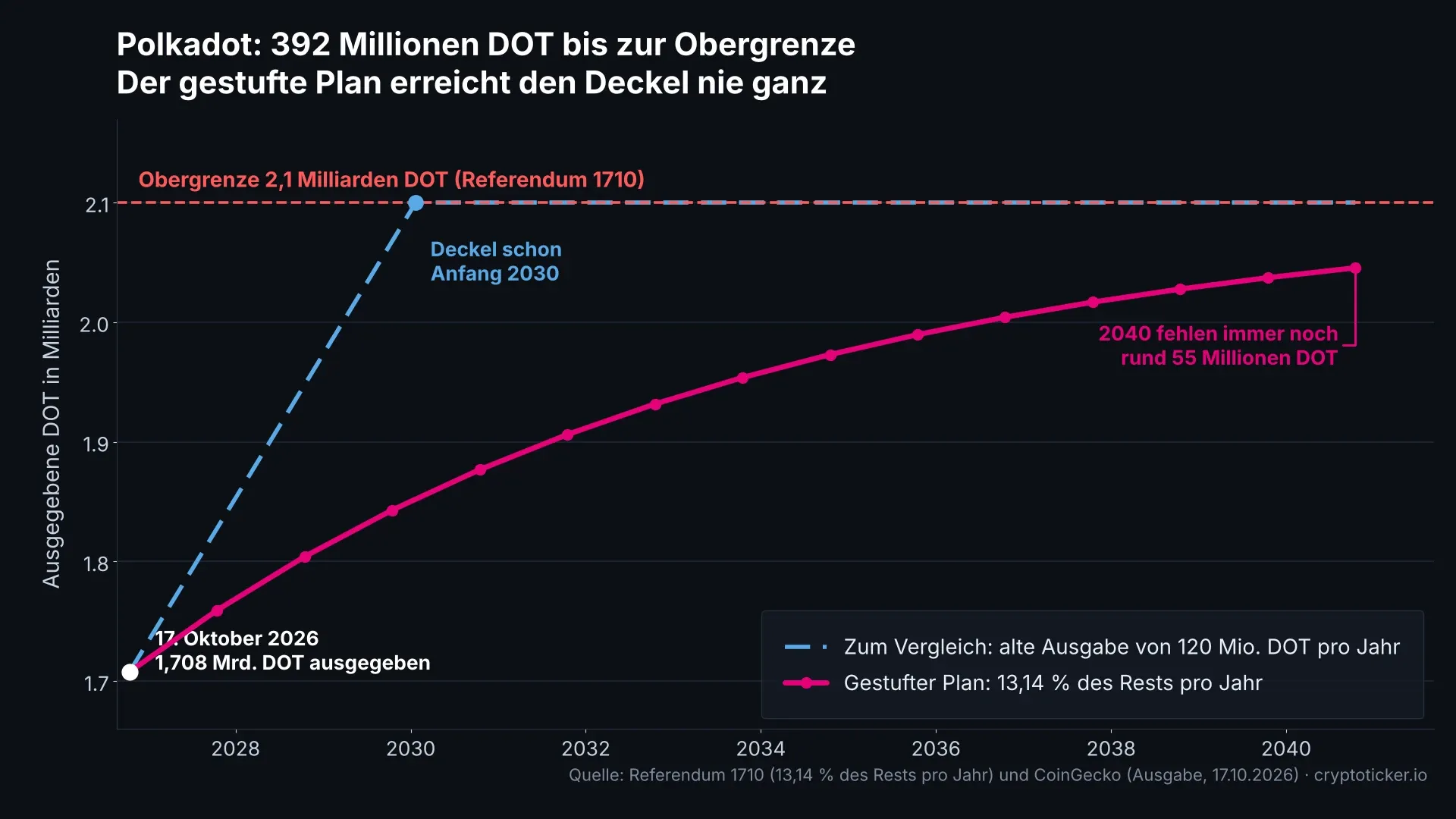
Why issuance fell from 120 million to 55.7 million DOT on March 14, 2026
The proposal cites an immediate cut of 53.6 percent in issuance, followed by a flattening curve up to the cap. The arithmetic works out exactly: 120 million DOT less 53.6 percent gives 55.68 million, and that is precisely 13.14 percent of the amount still missing to the cap in March 2026. The two figures therefore describe the same rule from two angles, once as a one-off cut and once as a standing formula.
One comparison suggests itself, and it limps in one place. A Bitcoin halving cuts issuance in half every four years, a 50 percent reduction at a stroke. Polkadot's first step went beyond that at 53.6 percent, but no second cut of that size follows, only a steady decline of around 13 percent a year. Describing Polkadot as "scarcer than Bitcoin" on that basis sets a one-off reduction against a recurring event.
What the blockchain does with the new DOT
The newly issued DOT do not vanish into thin air. Part goes as rewards to the validators and to holders who have bonded their DOT, and a further part flows into the blockchain's treasury, from which governance pays for projects. That treasury is also the source of funding for the dotUSD stablecoin project, decided by Referendum 1944, which earmarks $2.5 million in USDT and $2.5 million in DOT for a liquidity pool. How issuance is distributed technically is set out in the project documentation at Polkadot Wiki: Learn DOT.
 Find a platform for your DOT rewards
The DOT inflation rate stands at 3.0 percent and falls every year
Set the 51.5 million DOT of the next step against today's circulating supply and the inflation rate comes to 3.02 percent. The year after it is 2.54 percent, then 2.16, then 1.83. From the middle of the 2030s the figure sits below one percent. That is the real lever in the proposal, because an inflation rate affects every holder equally, whether or not they move their DOT.
The number works as a yardstick, though, not as a promise about the price. A year with 3 percent issuance can see a price rise or fall, depending on how much demand meets it. Issuance says how many new units are offered; what they cost is settled by the other side of the market.
What falling issuance does to the staking yield
Staking rewards on Polkadot come predominantly out of current issuance. As issuance falls, so does the sum distributed among bonded DOT. A second variable applies alongside it: the more DOT are bonded in total, the smaller the share for the individual. Both move in the same direction if the schedule takes effect and the bonding ratio stays stable.
In practice, the nominal yield on bonded DOT is more likely to shrink than grow in the coming years. Anyone choosing a platform for their rewards today should therefore watch the fee deducted between reward and payout. With a nominal yield running from double digits towards single digits over the years, a high rate eats a growing share. A look at the staking platform comparison shows how far the rates diverge.
The unbonding period is the second variable
Bonded DOT are not immediately available on Polkadot. Once unbonded, a waiting period runs during which the units neither generate rewards nor can be sold. If you are working around short-term price moves, know that period before you bond; it is the reason a staking position and a trading position should rarely be the same position.
Polkadot price $1.13: down 9.9 percent in seven days
DOT trades at $1.13 on Saturday afternoon, roughly 1.01 euros. Over 24 hours it is down 5.5 percent, over seven days 9.9 percent. Over 30 days, by contrast, it is up 9.5 percent, and over twelve months down 61.1 percent. The figures come from CoinGecko as of October 17.
On October 15 the price in this slot was $1.08, as recorded in our article on the Polkadot ETF and the German ETP. DOT has gained a good 4.6 percent since then, even though the past 24 hours were clearly negative. The week was therefore not a straight path downwards, but a recovery followed by a setback.
The distance to the all-time low and the all-time high
The all-time low was $0.727 on August 18, 2026. Today's price is around 55 percent away from it. From the all-time high of $54.98 in November 2021, DOT is 97.9 percent adrift. The two figures belong together: the recovery since August is real, but it changes little about the scale of the earlier collapse.
The $1.20 and $1.13 levels from the day's trading
Two values serve for short-term bearings on this day, and both come from trading itself rather than from an estimate. The day's high is $1.20 and the day's low $1.13. The current price therefore sits practically on the day's low, which means the downward move had not yet turned at the time of measurement.
The $1.20 level is interesting for the same reason: that is where the price turned lower on the day. While DOT stays below it, the day is technically unchanged. These levels offer no explanation for the 9.9 percent of the week; they only describe where trading took place.

 Calculate your staking income for your tax return
Staking rewards and the holding period: what the tax office sees with DOT
This is where the supply question gets concrete for German investors, because staking rewards are not a price gain. They accrue while you hold, and the tax office records them in the year they accrue. They are valued at the price at the moment of accrual, and because Polkadot distributes at short intervals, a year produces a long list of individual inflows, each with its own price.
A later sale of those same DOT is treated separately. There, the difference between acquisition value and sale value counts, and there the one-year holding period applies, provided it survives in its current form. The German finance ministry has been reticent on the matter of late; we track the current state of the possible reform on an ongoing basis.
Why lower issuance does not simplify the bookkeeping
You might assume that less issuance also means less work. It does not: the number of inflows stays the same, only their amount gets smaller. Anyone who does not record rewards as they arrive faces the same job at year end as before, just with smaller numbers. Automatic recording through the year saves more time here than any calculation in March.
Custody under MiCA: your own wallet, an exchange or a security
There are three usual routes to custody in Germany, and they differ precisely on whether you can generate rewards at all. In your own wallet you keep the keys and can bond directly; responsibility for securing them rests entirely with you. Through an exchange licensed under MiCA the route is more convenient, the exchange holds the keys and takes a fee for bonding.
The third route is an exchange-traded product on DOT. There you buy a security rather than the coin, and staking rewards usually do not reach you directly in that form. In exchange, key management falls away. Which route is right therefore depends less on the price than on whether the rewards matter to you at all.
Our assessment: a cap without demand remains a calculated figure
From the newsroom's point of view, Referendum 1710 is the cleanest tokenomics decision Polkadot has taken so far, and it still does not solve the price problem. The evidence sits in the same dataset: the 53.6 percent cut has been in force since March 14, 2026, and since then DOT has not risen but fallen to an all-time low of $0.727 in August. Tightening supply presupposes demand to meet it; without that, the cap remains a number in the documentation.
The time horizon argues the other way. The schedule works over decades, and the inflation rate falls below one percent by the middle of the 2030s. Anyone holding DOT over such a period gets dilution that is plannable and that did not exist before. For the coming months, by contrast, the proposal supplies no argument, and reading it as a price trigger stretches it too far. Total loss remains possible with any cryptocurrency.
Polkadot's supply cap: 392 million DOT in ever smaller steps
Whether your DOT generate rewards at all is settled by bonding. Beyond that, three steps make sense given this picture:
- Record inflows as they happen rather than retrospectively. Every reward needs a date, a quantity and the price at the moment of accrual. Tools that log this automatically can be found in the comparison of tax tools and portfolio trackers.
- Check the holding period before you sell. For the price gain, the day of acquisition counts, not the day of the last reward. How lawmakers are currently handling the one-year period is set out on our page on the crypto holding period and its possible reform.
- Decide on custody before the next bonding, not after. Bonding yourself calls for secure key management, and unbonding takes time. Which devices come into question is shown by the hardware wallet comparison.
(As of October 17, 2026. This article is not investment advice. Prices and fee structures change; check the terms with the provider before you buy.)
Frequently asked questions about Polkadot
Transparency note: This article was produced with the assistance of artificial intelligence and reviewed by our editorial team before publication. All figures and claims were checked against the primary sources linked in the text. The feature image was generated with AI.
Related articles
- Polkadot Price Recovers 43 Percent: What Is Behind the DOT Rally
- Polkadot vote 1954 stands at 73 percent against: what is behind the DOT DAO mandate
- 28 Days Locked for 2.77 Percent a Year: What Polkadot Staking Means for Your DOT
- Polkadot Is Pumping: Can DOT Hit $5 Soon?
- Polkadot Price Prediction: Will DOT Price Crash to 0?
Which topics should we dive deeper into?
Select what genuinely interests you. Your picks feed directly into our editorial planning.
Crypto news that's actually worth your time.
Weekly. 60 seconds. Carefully curated by our editors: no hype, no promo flood, no spam.

August 5, 2024 11:55 AM

Polkadot Price Prediction: Will DOT Price Crash to 0?
Curious about Polkadot's future? Find out if the price of DOT might drop to zero in our latest analysis

April 13, 2026 9:54 AM

Hyperbridge Exploit: Fake Polkadot $DOT Minting Triggers $20M Flash Crash
Polkadot (DOT) price dropped 5% in minutes following a Hyperbridge exploit where an attacker minted 1 billion fake DOT on Ethereum, causing $20M in market cap loss.

October 15, 2026 4:26 PM

Polkadot ETF holds $11.57 million: the US fund vs the European ETP
The first American spot fund on DOT manages $11.57 million after seven months and trades $111,586 in a day, which is 0.069 percent of the spot market. Investors in Germany cannot buy it, and the route that is open to them costs eight times as much.
October 11, 2026 10:20 PM

QNT token: a £100 Overledger licence a year, 14.88 million supply cap
The QNT token pays the annual licence for Overledger and is to carry the fee for gas and execution in the Fusion Rollup. What it does, where the cap sits and why circulating supply differs by 2.47 million tokens depending on the source.
March 31, 2026 8:12 AM

Is Ethereum Insanely Undervalued? Bitmine’s $6.7 Billion Staking Bet Says Yes
Bitmine has staked 3.31 million Ethereum worth $6.72 billion. Here's why institutional giants are betting on ETH being undervalued and what it means for the price.
May 4, 2025 4:25 PM

Polkadot Just Hit a Danger Zone!
Polkadot (DOT) is slipping toward key support levels as May begins. Will it bounce back or break down further?
January 8, 2024 7:46 AM

Polkadot (DOT) Price Prediction 2024: Is DOT Worth A Big Investment in 2024?
Will the DOT price explode in 2024? Let’s take a look at this Polkadot price prediction 2024 article in more detail.
May 19, 2022 9:41 AM
Polkadot Price Prediction: Can DOT Price Reach 20$ Again?
The Parachain auctions in December had played a vital role in the price gains for the DOT. This post is all about Polkadot price analysis
April 27, 2020 9:50 AM

Cryptocurrency Staking : Tezos Leads With $1.38B Locked, EOS Second
CryptoDiffer released a report based on data from Staking Rewards on Apr 24, detailing the crypto-assets employing Proof of Stake (POS) consensus mechanism and their ranking, based on the percentage of the circulating supply and the resultant USD value of […]
June 3, 2019 8:38 AM
How is the Circulating Supply of Cryptocurrencies Calculated?
The cryptocurrency world is full of surprises and turns. People who are new or who want to invest in this world always find it difficult to understand the market cap of cryptocurrencies. All cryptocurrencies are capped to specific quantities. There […]

October 17, 2026 1:24 AM

Rain (RAIN) after the unlock: $6.3 billion market cap, $7.1 million in daily turnover
Since the token unlock of October 12, 62.08 percent of the RAIN supply is free and 433.15 billion units remain locked. Against a market value of $6.30 billion stands a daily turnover of $7.14 million, the second thinnest in the top 25.
October 10, 2026 10:13 AM

XRP Ledger Closes a 2015 Flaw That Could Create XRP Out of Nothing: What It Means for Your Coins
The XRP Ledger has disclosed an overflow in its payment engine that sat in the code since 2015 and could have created spendable XRP far beyond the total supply. The flaw is closed with xrpld 3.4.1, with no indication of exploitation.
October 9, 2026 7:46 AM

228 million CRO burned, 1.167 billion released a month: the reserve outpaces the burn
The community has burned 228 million CRO and ties the revenue of two products to monthly buybacks. In the same month, around 1.167 billion CRO come free from the Strategic Reserve, several times the entire burn to date.
October 9, 2026 7:35 AM

Polkadot launches dotUSD without an issuer: why MiCA demands one
Polkadot launched its own stablecoin dotUSD on the mainnet on October 8, 2026, with no issuer and steered by DOT holders. On the same day ESMA requires regulated service providers to wind down non-MiCA-compliant stablecoins within three months.

October 8, 2026 4:52 PM

Dogecoin Price at $0.087: 13.55 Million New DOGE Enter Circulation Every Day
Dogecoin trades at $0.087 and has lost 8.1 percent in seven days. Every day 13.55 million new coins come into existence, and unlike with Ethereum there is no compensation for holders.
October 3, 2026 1:30 PM

NEAR Ahead of the Vote on Cutting Issuance to 1.6 Percent: Why the Price Is Falling Now
A proposal in the NEAR governance forum would cut the maximum annual issuance from 2.5 to 1.6 percent over 24 months, pressing the staking yield down from 5.4 to around 3.5 percent. The price loses 5.65 percent on October 3, for a different reason.
October 2, 2026 5:02 PM

Bitcoin or Ethereum in the fourth quarter of 2026: the two largest crypto-assets compared
Bitcoin is scarce by protocol rule, Ethereum only as scarce as its utilisation, and on access and tax in Germany the paths part again. This comparison puts the verifiable figures on supply, usage, staking and purchase route side by side, without making a price call.
October 1, 2026 1:37 AM

Shiba Inu Forecast: 589 Trillion Tokens and What Matters Now for the Price Target
One cent per SHIB would equal 5.89 trillion dollars in market value, three and a half times Bitcoin. What the circulating supply says about realistic price targets, and which tax deadline is now running for investors in Germany.
September 26, 2026 10:33 AM

Monad Unlock on November 24: Why 10.7 Billion MON Equal Around 90 Percent of the Circulating Supply
At the first anniversary of the mainnet launch, Monad's one-year lock-up on team tokens ends. This tranche alone reaches around 90 percent of the amount circulating today. What the primary source evidences, which aggregator figure is wrong, and what you can check before the date.
September 26, 2026 7:24 AM

FF Unlock on September 29: What the End of the Lock-Up at Falcon Finance Means
On September 29, 2026, 203 million FF leave the one-year lock-up at Falcon Finance, which is 6.47 percent of circulating supply. What exactly is released, who receives it, and how to recalculate the release schedule yourself instead of trusting a headline.
August 23, 2026 4:35 AM
Secret Network Quadruples the SCRT Supply: What Holders Have to Check Now
Since the upgrade on August 21, 2026 there are 1.443 billion SCRT on the chain instead of 362 million. The much-quoted Arbitrum snapshot on September 1 is not happening, and at Binance trading ends on September 3.
August 21, 2026 5:08 PM

Ethereum Price Above $2,300: 3 Reasons Why ETH Is Leading This Rally
Ethereum jumped past $2,300 and is now testing $2,400. ETH is outpacing Bitcoin, and the reasons are specific to Ethereum.
August 18, 2026 9:31 AM
Crypto News Today: The CLARITY Act Vote Nears and Bitcoin Holds Its Range
Bitcoin trades near $78,600 with the market cap back above $2.68 trillion. ETF flows turned positive in August, and the CLARITY Act cloture vote lands on 15 September.
January 17, 2024 5:53 AM

Polkadot Price Prediction for 2024: DOT Price Can Reach $50 If This Happens…
Is there a likelihood of a new bullish trend for DOT? Let's take a look at this in this Polkadot price prediction for 2024.
July 2, 2023 7:19 AM

DOT Price Prediction: Polkadot price to explode?
This article aims to delve deeper into the potential DOT price prediction using advanced predictive algorithms and analytical computations.


More from CryptoTicker