
XRP price at $1.36 as Upbit and Bithumb take in 90 million XRP: what to watch now
XRP trades at $1.36 on Tuesday morning, 3.4 percent below the previous day. Behind the quiet number custody is shifting: Korean exchanges hold considerably more XRP, and a major bank is taking Ripple's stablecoin into bank custody for the first time.





Which topics should we dive deeper into?
Select what genuinely interests you. Your picks feed directly into our editorial planning.
Crypto news that's actually worth your time.
Weekly. 60 seconds. Carefully curated by our editors: no hype, no promo flood, no spam.
XRP trades at $1.36, or 1.21 euros, on Tuesday morning. That is 3.4 percent below Monday and 9.7 percent below a week ago, while over 30 days the token still shows a small gain of 1.0 percent. The number on its own explains little. More revealing is where the coins have moved over the past three weeks, because that is what decides the question an investor in Europe can actually answer today: is my XRP sitting somewhere I can reach it if I have to?
Two reports, dated October 12 and 13, point the same way. The Korean exchanges Upbit and Bithumb now hold around 90 million more XRP than they did three weeks ago. And on October 12 Standard Chartered began offering institutional custody for Ripple's stablecoin RLUSD on the XRP Ledger. Both reports turn on the same thing, namely who holds the coins. For a private investor in Europe that is a more practical question than any price forecast.
XRP price at $1.36: day's low $1.31, day's high $1.40
The daily range ran from $1.31 to $1.40 according to CoinGecko data retrieved on Tuesday morning. At $1.31 the price turned higher. Market capitalisation stands at $85.7 billion and turnover over the past 24 hours at $2.15 billion. There are 63.13 billion XRP in circulation.
For context: the all-time high of $3.65 dates from July 17, 2025. The price sits about 37 percent above the twelve-month low of $0.99, and 95 percent below the twelve-month high of $2.65. XRP has spent months in the lower half of its annual range, and the past week has not changed that.
On October 11 we reported an XRP price of $1.39 and the state of the vote on the planned lending function for the XRP Ledger. The price has lost 2.2 percent since then. The lending function itself is still not active: our own query to the XRP Ledger network through the public node xrplcluster.com shows the LendingProtocol amendment still among the amendments that have not been enabled as of October 13. The network was running server version 3.4.1, and the last validated ledger was 107,626,781. Anyone who was waiting for the lending function to launch as a price driver is still waiting.
90 million more XRP on Upbit and Bithumb
The move that stands out this week is not in the chart but in the exchanges' reserve data. According to CryptoQuant figures reported by The Crypto Basic on October 13, XRP holdings at the Korean exchange Upbit rose from 6.39 billion to 6.45 billion XRP between September 23 and October 13. That is 60 million tokens more. Bithumb went from around 1.81 billion to 1.84 billion XRP over the same period, roughly 30 million more.
Together the two Korean venues have therefore taken in around 90 million XRP. They now account for about 76 percent of the observed XRP reserves across the three venues compared. On the other side of the ledger, Binance's XRP reserves fell by 101 million tokens between September 27 and October 13.
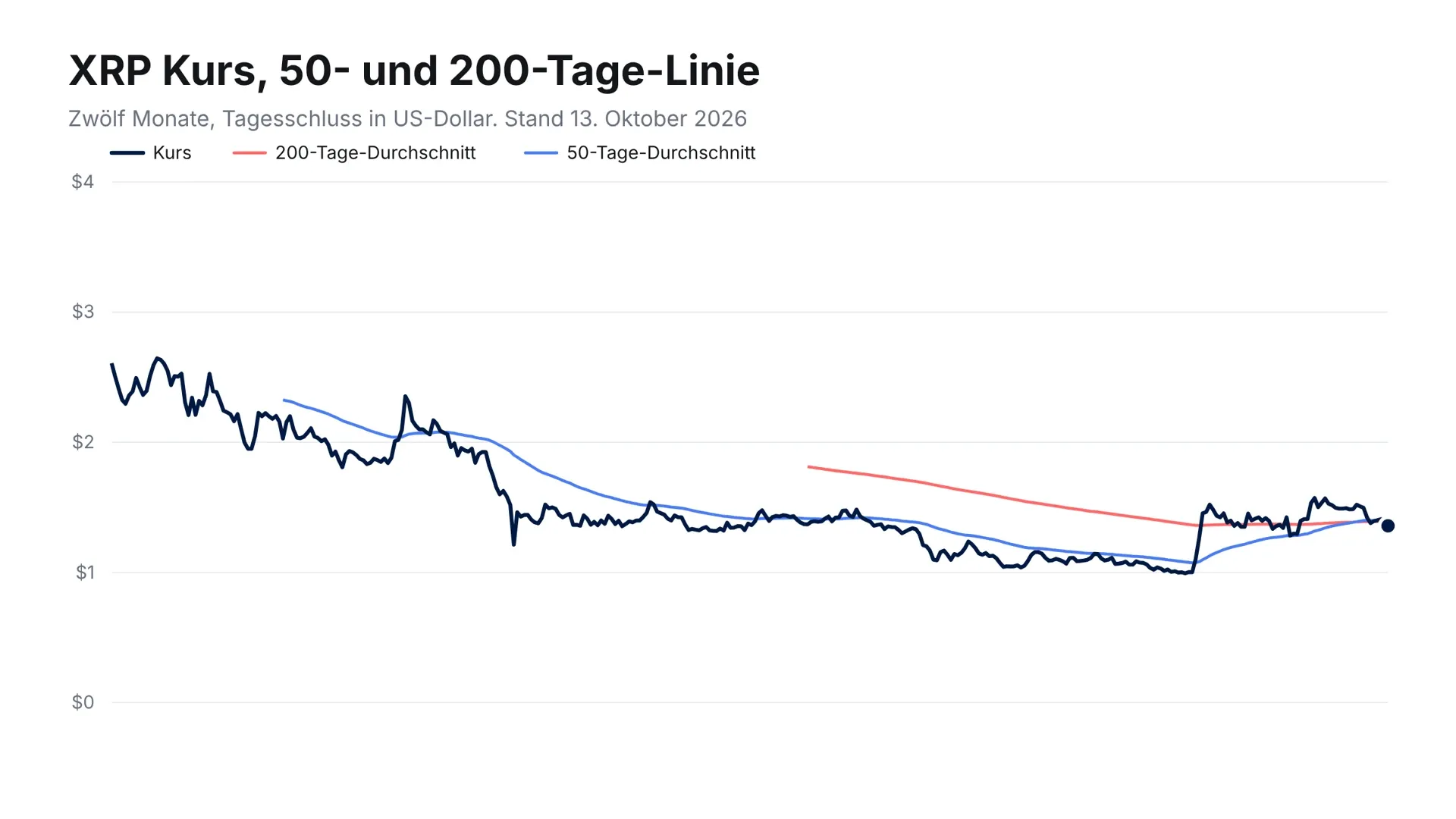
The 50-day and 200-day averages sit less than a cent apart
For the levels we worked through the daily closing prices of the past twelve months ourselves. The 50-day moving average stands at $1.3949 and the 200-day average at $1.3902. The gap between them is 0.47 of a cent, the narrowest of the entire year. In the chart above it is the point on the far right where the red and the blue line converge.
This state of affairs is rare, and it says more than any single daily close. When the short-term and the long-term average sit at the same level, the market has lost its direction. The next decisive move then usually follows whichever way the price leaves that zone. At $1.36, XRP currently sits around 2.5 cents below both lines. The first level on the upside is therefore not a round number but the band between $1.39 and $1.40, where both averages and the day's high coincide. On the downside the next level with evidence behind it is the day's low at $1.31.
What a moving average cannot do
A moving average is an arithmetic aid, not a forecast. It says where the price stood on average over the past 50 or 200 days, and nothing more. Deriving a price target from it invents a precision the data does not hold. The lines are useful as a guide to the level at which a breakout is worth discussing at all.
 Compare exchanges for your XRP
Withdrawals account for 54 percent of transactions on Binance
The reserve data has a second layer. The share of withdrawals in all XRP transactions on Binance rose from 52 to 54 percent between August 26 and October 12, according to the same analysis. Across all the large centralised venues the figure climbed from 51 to 52.7 percent. The share of deposits on Binance fell in return from 47.7 to 45.9 percent, and across all exchanges from 48 to around 47 percent.
These figures call for restraint, and The Crypto Basic says so itself: the shares count transactions, not amounts. A withdrawal of 200 XRP carries the same weight as one of 200 million. A falling reserve is no proof of selling, just as a rising reserve is no proof of long-term holding. A further analysis puts inflows to Binance at around 1.6 billion XRP over the same 30-day window. Reading a price direction out of these numbers goes further than the data supports.
What the numbers do show is a shift in custody. XRP sits more heavily on Korean platforms and more lightly on the largest international exchange than it did in September. For an investor in Europe that is, for now, news about market structure rather than about the price.
Standard Chartered has held RLUSD custody on the XRP Ledger since October 12
On October 12 Standard Chartered said the bank supports institutional custody of Ripple USD, the stablecoin issued on the XRP Ledger. The service runs through the bank's DIFC branch in Dubai, which is supervised by the Dubai Financial Services Authority. In the bank's statement Waqar Chaudry, Global Head of Digital Assets in Securities Services, is quoted as saying: “Institutional clients want to participate in digital asset markets without compromising on how their assets are safeguarded or how risk is managed.”
The LMAX collateral arrangement is announced and not yet live
The same statement contains a second part that is easily confused with the first. Standard Chartered, Ripple and LMAX Group intend to make RLUSD usable as eligible collateral for LMAX products, through a mechanism that mirrors the value of the collateral while the tokens remain in the bank's custody. That part is announced, not launched. The bank writes that the future capabilities are subject to final documentation, successful testing, applicable law, internal approvals and the readiness of the relevant jurisdiction.
The distinction matters for how all of this should be read. What is live today is bank custody for a stablecoin on the XRP Ledger. That is a documented step for the infrastructure around Ripple. It is not a jump in turnover for XRP itself, because RLUSD and XRP are two different assets.
RLUSD has no MiCA authorisation as an e-money token in the EU
This is where the European rulebook comes in. According to its own statement, Ripple received full authorisation as a crypto-asset service provider under MiCA from the Luxembourg regulator CSSF on July 6, 2026, having already obtained an e-money licence in February. That authorisation covers services around crypto assets.
Issuing a dollar stablecoin, however, falls under a separate MiCA regime for e-money tokens. RLUSD would itself have to be authorised as an e-money token and carry an approved white paper before it could be offered publicly in the EU. As things stand that is not the case. In practice that means you will not currently find RLUSD on the menu at an exchange licensed in the EU, while euro and dollar stablecoins that do hold MiCA authorisation can be traded there. If you use stablecoins, it is worth checking before you buy whether the provider holds an EU licence and which tokens it is allowed to list under MiCA.
 Find a hardware wallet for your XRP
Custody: three points that matter before your next purchase
The reserve data and the bank custody describe the same development from two directions. Large institutions are professionalising custody, and at the same time holdings are shifting between trading venues. For your own portfolio three concrete points follow.
First, licensing. Since MiCA took full effect, providers in the EU need permission to operate, and national regulators such as BaFin in Germany list the institutions they have authorised. A look at the register takes two minutes. If you are considering a move, compare the fees and services of the major crypto exchanges first, because the spread between trading fee, bid-ask spread and withdrawal fee weighs more heavily on small amounts than a one percent price move.
Second, self-custody. XRP can be held on the XRP Ledger itself. One particular feature catches many people out: an XRP account requires a base reserve that stays permanently locked and cannot be spent. If you set up your own address, it is better to plan for that amount from the start than to discover it on your first withdrawal attempt. Which devices are suitable and what they cost is set out in our hardware wallet comparison.
Third, spreading the risk. The reserve data above shows how quickly holdings can move between platforms. Keeping an entire holding on a single venue means carrying that venue's risk alone, however large the venue is.
Tax: moving coins to your own wallet is not a sale
Transferring your XRP from an exchange to an address of your own does not trigger a taxable transaction in Germany. There is no disposal, and the asset stays yours. Tax becomes relevant only on a sale or a swap into another coin.
The rules for private disposals under Section 23 of the German Income Tax Act apply here. If more than twelve months pass between acquisition and sale, the gain is tax free. Below that it counts as other income, and an exemption limit of 1,000 euros per calendar year applies to all private disposals taken together. An exemption limit means exactly that: one euro above it and the entire gain is taxable.
Documentation is what matters in practice. When coins move between your own wallets the acquisition date moves with them, but no exchange keeps track of it for you. If you use several addresses, record the purchase date, the amount and the acquisition cost for each lot, otherwise the one-year period cannot be evidenced later. There are tax tools and portfolio trackers for this that pull transactions together from several sources. They are no substitute for tax advice on an individual case.
The newsroom's view: a shift in custody, not a selling wave
In our view this week's reserve data carries less meaning than its headlines suggest. Three pieces of evidence from the text above support that: the share figures count transactions and not amounts, the same data set put around 1.6 billion XRP of inflows against the outflows at Binance over the 30-day window, and the shift of 90 million XRP amounts to around 0.14 percent of the 63.13 billion XRP in circulation.
Against that, the direction has held for three weeks and shows up at two exchanges at once. That is more than noise. Our reading is therefore this: the data evidences a shift in custody, not a selling wave. For the price, the more meaningful figure is the band between $1.39 and $1.40 where both moving averages sit. As long as XRP trades below it, the picture stays directionless. None of this is a recommendation to buy, and a total loss is possible at any time with crypto assets.
XRP at $1.36: the trend decides above $1.39
What is left of this Tuesday can be held onto in three steps:
- Note the level. $1.39 to $1.40 is the zone where the 50-day average, the 200-day average and the day's high coincide. Only a daily close above it changes the picture; on the downside $1.31 is the next level with evidence behind it. We follow how the situation develops on our XRP price prediction page.
- Settle the custody question. Does your provider hold an EU licence, and is your entire holding on a single platform? If you want to switch or spread it, the terms are in our crypto exchange comparison and the devices for self-custody in our hardware wallet comparison.
- Document the holding period. A transfer to your own address is not a sale, but only a recorded purchase date lets you evidence the one-year period later. The tools for that are in our crypto tax software comparison.
(As of October 13, 2026. This article is not investment advice. Prices and fee structures change; check the terms with the provider before you buy.)
Frequently asked questions about XRP
Transparency note: This article was produced with the assistance of artificial intelligence and reviewed by our editorial team before publication. All figures and claims were checked against the primary sources linked in the text. The feature image was generated with AI.
Related articles
- XRP’s RLUSD Stablecoin Launches Tomorrow – What You Need to Know
- XRP Price Prediction: Will XRP Hit $3 Soon or a NEW ATH?
- XRP Price Surge Past Major Key Level Ahead Of Ripple Stablecoin RLUSD Launch
- Ripple (XRP) Defies Market Trends: Will XRP Price Rally Last?
- Ripple News Today: What makes XRP a good investment for 2025
Which topics should we dive deeper into?
Select what genuinely interests you. Your picks feed directly into our editorial planning.
Crypto news that's actually worth your time.
Weekly. 60 seconds. Carefully curated by our editors: no hype, no promo flood, no spam.

July 6, 2026 11:17 AM
XRP Just Got a Massive EU Green Light — But There's a Catch Nobody's Talking About
Ripple scored preliminary MiCA approval to run crypto services across all 30 EEA countries — and $XRP is up ~8% this week. Here's what it really means.
July 21, 2024 6:37 PM

MAJOR Ripple News: How Will These Developments Impact XRP Price?
New developments involving Ripple could have a huge impact on XRP price. What are they and how will XRP price react to this?
September 6, 2024 9:31 PM
XRP Price Analysis As The Ripple Stablecoin Expansion Begins With Japan in Focus
Ripple’s ambitious stablecoin plans in Japan and the current drop in XRP’s price have sparked interest in the crypto world. Will Ripple's global expansion strategy boost XRP price?
January 24, 2025 10:19 AM
XRP News Today: Will the SEC Silence and Trump Crypto Executive Order Fuel an XRP Price Rally?
With the silence revolving around the SEC appeal, followed by the Trump crypto executive order, in favor of digital assets with a focus on America being the capital of AI and Crypto, fuel an XRP price rally soon?
July 21, 2026 4:28 PM

XRP Jumps 4% as MiCA Approval and Bitcoin's Rebound Fuel a Trendline Breakout
XRP is up ~4% today on Ripple's full MiCA approval, wider institutional access, and a resurgent Bitcoin — and the chart just broke a months-long downtrend.

September 23, 2026 7:15 AM

SoFi Settles Card Payments in Stablecoin: What Cardholders Should Check
Since September 22, 2026, the US bank SoFi has run its entire card business through its own stablecoin, SoFiUSD, on the Mastercard network. What sets the model apart from a crypto credit card, and which rules would apply if a European provider followed suit.
September 22, 2026 10:15 PM

Stablecoin Reserves: Why the ECB Wants the Bank Deposit Rule Scrapped
The European System of Central Banks filed its response to the MiCA review on September 22 and calls in it for an end to the requirement to hold 30 to 60 percent of stablecoin reserves as a bank deposit. What lies behind it, and what you can check on your own token.
December 28, 2024 7:45 PM
XRP and BTC Face Volatility: Biden’s Crypto Tax Rule Sparks Ripple Effects
Here are XRP and BTC news as Biden’s crypto tax rule stirs market volatility. Learn how regulatory shifts and SEC decisions are shaping the future of crypto giants.

December 11, 2024 1:32 PM

BIG XRP Price Prediction: XRP To Reach $10?
Analysts predict XRP price could soar between $10 and $50, thanks to promising technical patterns.

September 25, 2026 1:12 PM

XRP Jumps to $1.56: What Holders Should Check on Buying Route, Holding Period and Leverage
XRP trades at $1.56 on September 25, 2026, up 6.85 percent on the day and 16.64 percent on the week. What the on-chain data and the US ETF inflows actually show, and what investors in Germany should check now on buying route, holding period, leverage and custody.
October 7, 2026 4:16 PM

XRP Price Prediction, $1.4445 and a Delayed XRPN Market Debut: What to Watch Now
XRP stands at $1.4445 on October 7, 4.4 percent below the previous day. Three dates shape the week: the XRPN market debut on October 12, the holding-period hearing on the same day and the cabinet session on October 14.
January 18, 2026 4:17 PM

If You Invest $1,000 in XRP Today: 5-Year XRP Price Prediction
XRP trades near $1.57 in September 2026, well below January's $2.05. What $1,000 in XRP buys today, what happened to the CLARITY Act and the 5-year outlook.
October 1, 2026 4:45 PM

XRP price prediction after the release of 1 billion tokens: what to watch now
Ripple took one billion XRP out of escrow on October 1, and the price still stands almost unchanged at $1.49. For you in Germany, though, a different number than the price decides this quarter, namely December 31, 2026.
April 4, 2026 11:00 AM

XRP News Today: Ripple RLUSD Expansion and the CLARITY Act Impact
XRP faces technical pressure while Ripple’s RLUSD stablecoin gains global traction. Explore how the CLARITY Act could redefine the XRP Ledger ecosystem.

September 24, 2026 10:12 AM

XRP Falls 9.7 Percent: What to Check on Holding Period and Buying Route
XRP is down around 9.7 percent on the morning of September 24, twice as much as the typical large crypto asset. Our count of 18 coins shows who the pullback hits and which three things hold true regardless of the price.
August 21, 2026 10:27 PM

Stablecoin as Cash: The Three Criteria to Check Your Balance Yourself
The US accounting board FASB has for the first time named three conditions under which a stablecoin may count as cash on a balance sheet. Those conditions turn into a checklist that lets you place your own holdings in about twenty minutes.
September 24, 2026 1:34 PM

Cardano Slides Below $0.24: What ADA Holders Should Check on Leverage, Liquidation and Holding Period
Cardano has given back its move above $0.25 and trades around seven percent below the high of the past 24 hours. What that means for leveraged positions, the holding period of your tranches and the buying route under MiCA.
September 22, 2026 10:25 PM
Binance Buys Into Circle: What the USDC Deal Means for Your Balance
Binance is taking a $100 million stake in Circle and extending the USDC agreement by five years. For investors in Germany, the sum matters less than the question of who earns money from stablecoins left sitting idle.
September 22, 2026 7:20 PM

ETH Price Prediction: What to Check at the $2,800 Mark Now
Ether stands at $2,735.96 on September 22, 2026, right below the zone at which it has failed repeatedly. Instead of a target number, you get four checks that count before your next order: holding period, buying route, the staking line and the distance to liquidation.
August 19, 2026 4:15 PM

Tether Audit by KPMG: What the Unqualified Opinion Means for USDT in the EU
Tether reported the first full audit of its financial statements by KPMG on August 13, 2026, with an unqualified audit opinion for the 2025 financial year. That changes nothing about whether USDT can be traded at authorised providers in the EU, because Article 48 MiCA decides that question.
July 1, 2026 10:47 AM

Crypto News Today: Binance Exits the EU, Circle Craters, and Bitcoin Slides Below $59K
MiCA reshapes the market as Binance leaves the EU, a 140-firm stablecoin rocks Circle, and Bitcoin sags near multi-year lows. Here's what's moving crypto today.
August 10, 2024 7:25 AM
Ripple News: Ripple Starts Testing of New Stablecoin
Ripple is now testing its new stablecoin on both Ethereum and the XRP Ledger. Discover what this means for the future of digital currencies and Ripple's latest innovations.
October 10, 2026 1:24 PM

TRON (TRX): Polygon Opens Its Payment Stack to $93.44 Billion in USDT: What Matters Now
Polygon opened its Open Money Stack to TRON on October 8: companies can now settle stablecoin payments entirely over the chain. We checked how much USDT really sits there, and show what decides whether it turns into demand for TRX.
October 10, 2026 1:28 AM

XRP Price at $1.39 as Ripple Prime Funds Leveraged ETFs at 8 Percent: How to Check Where the Fees Go
Through its prime brokerage arm, Ripple earns fees for funding American leveraged funds, and one fund pays around eight percent a year for it. Why none of that reaches the XRP price at $1.39, and which route of access is open to German investors at all.
September 24, 2026 1:11 PM

Stellar Becomes a Payment Rail at Mastercard's BVNK: What XLM Holders Should Check on Buying Route, Memo and Holding Period
BVNK has switched on Stellar as a payment rail for business customers in more than 130 countries. On the same trading day XLM falls by around seven percent — we separate what the news means from what the pullback means for your portfolio.
August 13, 2026 6:18 AM

Revolut Delists USDT: Forced Conversion on August 31, 2026 Counts as a Sale
Revolut is taking USDT off the table on August 31, 2026: purchases have already stopped, deposits are blocked, and anyone who fails to act before the deadline faces an automatic conversion that counts as a sale for tax purposes. This article explains the deadlines, the tax treatment under section 23 of the German Income Tax Act and what you can do now.
More from CryptoTicker