
XRP price $1.39, lending function at 17 of 25 votes: how to verify the vote count yourself
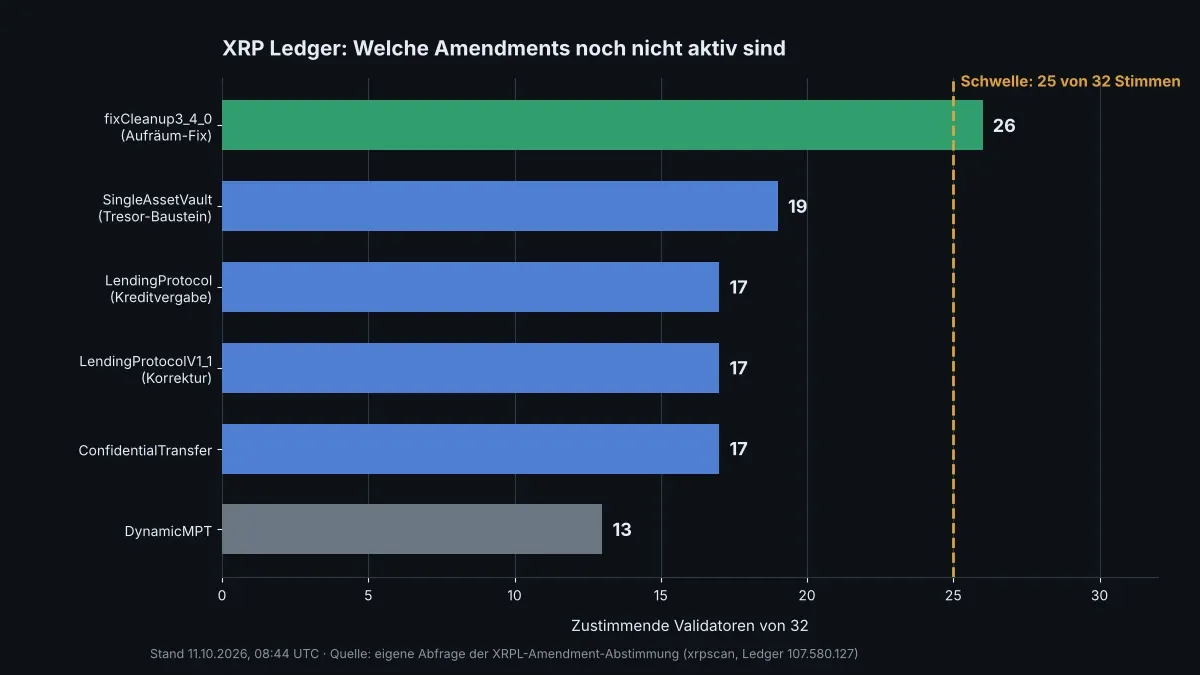
XRP trades at $1.3937 and has stood still for a third day. More is being settled in the ledger meanwhile: a clean-up update activates on October 23, while the lending function hangs at 17 of the 25 votes needed.





Which topics should we dive deeper into?
Select what genuinely interests you. Your picks feed directly into our editorial planning.
Crypto news that's actually worth your time.
Weekly. 60 seconds. Carefully curated by our editors: no hype, no promo flood, no spam.
The XRP price stands at $1.3937 on Sunday morning and has barely moved for the third day running. More interesting than the price this weekend is what is being voted on in the XRP Ledger: a clean-up update has reached the required majority of validators and arms itself automatically on Friday, October 23. The lending function, on which Ripple's business plan for 2027 hangs, by contrast still sits at 17 of the 25 votes needed.
Both figures come from the same source, namely the running amendment vote in ledger 107,580,127. You can look them up yourself without an account and without software, and that is exactly what this article sets out step by step further down.
XRP price at $1.39: three days without direction
Daily closing prices on the Kraken exchange were $1.3944 on October 9, $1.4010 on October 10 and most recently $1.3937 today, October 11. The high and low of the current day sit at $1.4104 and $1.3862, a spread of barely 1.8 percent. Over the average of the past 30 days, the daily range was 5.6 percent.
On a weekly view it looks different. Since the closing price of $1.5202 on October 4, XRP has lost 8.3 percent. The break came on October 7 and 8: from the October 6 close of $1.4970 the price fell to a daily low of $1.3177 on October 8, a drop of barely 12 percent in two days. Market capitalisation stands at around $88 billion according to CoinGecko, with trading turnover over the past 24 hours at about $708 million.
An amendment in the XRP Ledger: 25 of 32 votes and a two-week deadline
An amendment is a change to the rules of the XRP Ledger itself, comparable to a law that takes effect only once enough members of parliament approve it. Unlike a software update, it is not Ripple that decides when it applies but the validators, meaning those servers that confirm new blocks.
The procedure is hard-wired and runs without human involvement. If around 80 percent of the validators on the default list vote for a change, the ledger records the moment. If that majority holds for two weeks straight, the amendment switches itself active. Should support fall below the threshold even once during those two weeks, the clock starts over. The default list currently comprises 32 validators, which puts the threshold at 25 votes.
Two things follow from that for holders. You do not have to do anything, because your coins sit unchanged in the ledger. And you can read off the timetable of a function before a press release confirms it.
fixCleanup3_4_0 activates on October 23, two weeks after the majority
On October 9 the amendment with the unwieldy name fixCleanup3_4_0 reached the majority. The ledger has been running the clock since then, and 26 of 32 validators currently stand behind it. If the deadline runs through without a relapse, the change becomes active on the morning of October 23.
The name already says what it is about: tidying up. Fix amendments of this kind remove old code no longer needed since earlier versions and clear up small inconsistencies in the rulebook. For the price that has no consequences, but for placing the vote it is instructive. The validators decide on technical corrections in a matter of days. In the four days from October 8 to 9, three other amendments became active, among them PermissionDelegationV1_1 and BatchV1_1.

LendingProtocol at 17 votes: three more than on October 6
With the lending function it looks different. The LendingProtocol, which allows loans to be issued and collateralised directly through the ledger, sits at 17 of 32 validators. When we wrote about Ripple's lending plan and the lending amendment on October 6, it was 14 votes. So three have come in over five days, and eight are still missing.
Extrapolate that pace in a straight line and the missing eight votes would be together in a good 13 days, after which the two-week deadline would come on top. That is purely a projection, however, and not a forecast: validators often vote in bursts, for instance when a new server version appears or an operator changes its configuration.
 Where to buy XRP in Europe
SingleAssetVault at 19 votes: the building block lending hangs on
A second point is usually overlooked in the discussion around lending. Directly above it in the list sits SingleAssetVault at 19 votes. A vault in this context is a collective pot in the ledger into which several users pay the same asset and out of which a protocol passes it on.
That pot is exactly what the planned lending needs, because without it there is no place for the lent capital to sit. The corrected version LendingProtocolV1_1 also sits at 17 votes. Three votes therefore hang together, and the foremost of them is still six votes short of the threshold.
The vote count live: two sources with no account and no sign-up
You do not have to take anyone's word for this; you can fetch the figures yourself in a minute. Two routes lead there.
The first route is the explorer XRPScan. Its amendment page lists every change with three details: the number of approving validators, the threshold, and a note on whether the change is already active. To see how far the lending function has come, find the LendingProtocol row there and read the column with the votes.
The second route is the ledger itself, via a public node. A request using the feature method to an XRPL server returns every amendment with the fields enabled and supported; a request using ledger_entry with the amendments switch additionally delivers the Majorities entry. Where a change appears there with a timestamp, the two-week clock is running for it. That is exactly how October 23 came about in this article. Which names belong to which function is set out in the amendment overview in the XRPL documentation.
The difference from a price report is tangible. A vote count can be recounted and changes slowly; a price changes by the second. Holders of an XRP position who want to know whether the promised functions are drawing nearer have the more reliable guide in the vote count. If you are only looking to build a position in the first place, it pays to look at fees and custody beforehand, because those differ markedly between providers: our comparison of the best crypto exchanges sets that out for the European market.

From the October 8 slump to today: $1.4073 as the midpoint of the range
Back to the chart, and with levels that can be justified. The slump from October 6 to 8 led from $1.4970 to $1.3177. The midpoint of that stretch sits at $1.4073. The price has been stuck there for three days, currently barely one percent below it.
That midpoint is interesting because a market often runs back to it after a fast loss and then shows where it really wants to go. October 10 came just past it with a daily high of $1.4117, and today came close to it at $1.4104. On neither day did the price hold above that midpoint. Above it, the next justified level is the 50-day line at $1.4309, that is 2.6 percent above today's level.
Levels to the downside: $1.3177 and the 200-day line at $1.2797
To the downside the first level is the daily low of October 8 at $1.3177. Below that, at a clear distance, follows the 200-day line at $1.2797, calculated from the daily closing prices of the past 200 trading days. The current price sits 8.9 percent above it, so that buffer is there.
For context over a longer period: the monthly high was $1.5723 on September 22, the monthly low $1.2826 on September 15. Today's price sits almost exactly in the middle of that range.
 Interest on crypto: providers compared
Interest from lending and tax: a €256 exemption limit, one year holding period
Should the lending function actually go active, it pays to know the tax treatment beforehand, because it concerns two separate pots.
The first pot is the coins themselves. Under Section 23 of the German Income Tax Act, gains from the sale of privately held cryptocurrencies are tax-free where more than a year lies between purchase and sale. Within the year an exemption limit of €1,000 applies to all private disposals taken together. Whether lending extends the holding period to ten years was an open question for a long time. The Federal Ministry of Finance answered it in the negative with its letter of May 10, 2022, so the one-year period remains in place for lending and staking too.
The second pot is the interest. It counts as other income under Section 22 number 3 of the German Income Tax Act and is taxable at your personal rate as soon as it exceeds €256 in the year. That is an exemption limit, not an allowance: at €257 the full amount is taxable, not just one euro of it. Holders with several sources should note the inflows, because the total is what counts. A tax tool connected to the wallet takes that bookkeeping off your hands.
One point of context that is often missing: the European crypto regulation MiCA governs trading, custody and exchange by supervised service providers. Lending through a protocol does not fall under it. Anyone lending through such a protocol therefore has no investor protection under MiCA and carries the risk of the program code alone. Centralised providers are to be distinguished from that; depending on their structure they are subject to other rules. Which models exist and where the differences lie is shown in our comparison of crypto lending providers.
Our assessment: the vote currently weighs more heavily than the chart
In our editorial view, the vote count in the ledger is the more honest indicator for the coming weeks than the price action. The evidence sits above: three technical amendments became active in four days, and a fourth has a fixed date on October 23. The three building blocks of lending, by contrast, sit at 17, 17 and 19 of the 25 votes needed and have advanced by three votes in five days.
What follows for us: the ledger's technology is visibly moving on, while the business plan meant to turn it into revenue hangs on a vote that cannot be sped up. There is one serious argument against that. Votes in the XRP Ledger tip in bursts rather than linearly, and a single server update can switch several validators at once. The 13-day projection above is therefore a calculation and not a promise. No buy recommendation is meant in either direction: we assess the situation, the decision stays yours, and a total loss is possible at any time with cryptocurrencies.
XRP vote: until October 23 the counter decides, not the chart
Three things can be taken from today's situation, each with a figure behind it.
- October 23 is fixed, the lending function is not. fixCleanup3_4_0 activates on that Friday with 26 votes behind it. LendingProtocol needs eight further votes for the same, and there is no deadline for it so far. Followers of XRP's further development have the earlier signal in the vote count than in any announcement.
- The range between $1.3177 and $1.4309 is the frame. Between them, at $1.4073, sits the midpoint of October's slump, where the price has hung for three days. Only a daily close clearly above $1.4309 or below $1.3177 shifts the picture.
- Interest above €256 a year is taxable, the coins after one year are not. Keeping those two pots separate saves work in the spring. Holders wanting to keep the coins in permanent self-custody need a device for it as well; our comparison of hardware wallets places the models.
(As of October 11, 2026. This article is not investment advice. Prices and fee structures change; check the terms with the provider before you buy.)
Frequently asked questions about XRP
Transparency note: This article was produced with the assistance of artificial intelligence and reviewed by our editorial team before publication. All figures and claims were checked against the primary sources linked in the text. The feature image was generated with AI.
Related articles
- XRP Price Prediction: Ripple's Credit Plan Arrives in 2027, the Lending Amendment Stands at 14 of 35 Validators
- XRP Ledger: permission delegation cannot go live before October 8
- XRP Price Prediction: Three XRPL Updates in 17 Hours from October 8, and What Matters Now
- XRP Ledger Amendment of September 11: What Wallet, Node and AMM Users Should Know About fixCleanup3_3_0
- Ripple Price Prediction: How High will XRP reach in 2050?
Which topics should we dive deeper into?
Select what genuinely interests you. Your picks feed directly into our editorial planning.
Crypto news that's actually worth your time.
Weekly. 60 seconds. Carefully curated by our editors: no hype, no promo flood, no spam.

September 30, 2026 7:37 PM

XRP price prediction: what happens to 473 million XRP after the Nasdaq vote?
XRP trades at $1.51, and two dates within 24 hours decide the quantity on the market: the Nasdaq vote on a treasury holding 473 million XRP, and the escrow release on October 1. This article sorts out levels, tax rules and the buying route for German investors.

September 28, 2024 2:44 PM

XRP Price Surge Past Major Key Level Ahead Of Ripple Stablecoin RLUSD Launch
As XRP Ledger updates come in preparation for the launch of the Ripple stablecoin RLUSD, XRP Price surges past $0.60. What is next for XRP Price?
April 5, 2025 9:39 PM

Ripple News: Brad Garlinghouse Teases Explosive XRP Updates Ahead of XRPL Apex 2025
Ripple CEO Brad Garlinghouse just dropped a bombshell—major announcements are coming at XRPL Apex 2025. The Ripple community is bracing for a potential XRP price breakout.
October 8, 2026 7:30 PM

XRP price prediction, delegation goes live tonight at 23:25: will the $1.34 level hold?
The XRP Ledger unlocks account delegation this evening at 23:25 German time, a date read from the ledger itself. The fix meant to close a known gap in it sits two votes short of a majority. What that means for your XRP holdings, self-custody and the German holding period.

September 20, 2026 10:17 AM

XRP Ledger Explained: How the Network Behind XRP Works
The XRP Ledger is the blockchain behind XRP: consensus without mining, confirmation in three to five seconds and a fee of 0.00001 XRP that is destroyed. This explainer shows how validators and the UNL work, what the DEX, AMM, escrow and Multi-Purpose Tokens do and which amendments went live up to October 2026.
September 2, 2026 4:28 PM
XRP ETFs Just Had Their Best Week of 2026. So Why Is the Price Still Falling?
US spot XRP ETFs pulled in record weekly inflows while XRP slipped toward $1.38. A Senate vote on September 15 may decide who is right.
October 9, 2023 9:27 PM

XRP Ledger Reaches Milestone: Will XRP Price Go UP?
The XRP Ledger (XRPL) stands as a testament to this, achieving milestones that underscore its growth and versatility. Will XRP price increase?
September 18, 2026 4:16 AM

XRP Ledger Batch Amendment: BatchV1_1 Is Now Enabled, What Node Operators Should Check
Update as of September 27, 2026: activation of the BatchV1_1 amendment on the XRP Ledger has been pushed back. A new validator majority restarted the two-week period on September 25; the earliest date is now October 9, 2026 at 14:46:02 UTC. Most XRP holders need to do nothing, node operators need xrpld 3.4.1.

August 14, 2024 11:29 AM
XRP Price Prediction: Can XRP Price Skyrocket By A 10000% Surge?
Is XRP on the verge of a short-term increase or a massive rally to $60? Here are expert predictions and market insights in this comprehensive analysis.
March 19, 2025 8:05 AM

XRP Price Prediction: Can XRP Price Reach $10 after FOMC Meeting?
Can XRP price reach $10 and break past key resistance levels? What will happen to the crypto market after the FOMC meeting today? Full price analysis here!
October 7, 2026 8:42 PM
Can XRP Price Reach $10? Here Is What the Math Says
XRP trades near $1.42 after losing $1.50. We check the $10 forecasts, the charts and the market cap math to see if XRP can really reach $10.
December 19, 2024 2:31 PM

XRP Crash: What Happened and What's Next for the Last Days of 2024?
XRP recent crash has left investors on edge as the crypto faces significant market turbulence. But what are the reasons behind the drop?
June 8, 2026 4:41 PM
XRPUSD Prediction: Will the XRP price ever fall to 0 US dollars?
Can XRP really become worthless? We analyze the risks, opportunities, and the likelihood of an XRP price of $0.
December 16, 2024 9:47 PM
XRP’s RLUSD Stablecoin Launches Tomorrow – What You Need to Know
Ripple is set to disrupt the $140B stablecoin market with the launch of RLUSD, a fully-backed USD stablecoin. Backed by prominent industry figures, this launch could be a game-changer for the crypto world.
August 22, 2026 10:23 PM

XRP Explodes 40 Percent in Seven Days: Now the $1.50 Mark Counts
XRP jumps 40 percent in a week to $1.40, its highest level since May. Open interest, funding and the long-short ratio show how much fuel the rally has left and which levels count over the weekend.
December 5, 2024 11:00 PM

Expert Analysis: How High Will XRP Price Reach Before 2025?
XRP price has soared to $2.64 as of December 2024, becoming the third-largest crypto asset by market cap. What’s next for XRP in 2025? Ryan Lee, Chief Analyst at Bitget Research, weighs in.
November 22, 2024 3:00 PM

XRP Price UP by 33% in 1 DAY - Can it reach a $2 by Week End?
As XRP price rallies 33% to $1.50, driven by multiple factors, it is still far from its all-time high. But speculations now revolve around whether it can reach $2 by the weekend.
April 30, 2026 1:00 PM
XRP Price Prediction May 2026: Will XRP Coin Reclaim $1.80?
XRP enters May 2026 with strong ETF inflows and a critical technical setup. Here are the high and low targets for the XRP coin this month.
December 14, 2025 11:46 AM

XRP Price Prediction: Why the $3 December Target Is More Hope Than Reality
XRP price prediction based on technical analysis. Falling channel, weak momentum, and why a $3 XRP by December looks unlikely.
September 6, 2024 9:31 PM
XRP Price Analysis As The Ripple Stablecoin Expansion Begins With Japan in Focus
Ripple’s ambitious stablecoin plans in Japan and the current drop in XRP’s price have sparked interest in the crypto world. Will Ripple's global expansion strategy boost XRP price?
May 24, 2025 8:00 PM

XRP News Today: Calm Before the Rally? Analysts Predict a Surge to THIS PRICE
Despite underperforming the broader market, XRP is loaded with bullish catalysts. From ETF optimism to major acquisitions, here’s why traders are betting big on a breakout.
April 17, 2026 4:08 PM

XRP Price Prediction: Bullish Breakout to $1.50 as Trump Touts “Hottest Country”
XRP hits $1.50 as bulls target $1.80. Following Trump’s "hottest country" remarks, Ripple's token shows strong momentum. Explore the next targets.
September 22, 2026 5:54 PM

XRP Price Prediction: Breakout Puts $1.80 Back In Play
XRP just snapped its descending trendline and reclaimed $1.50 with RSI at 67. Here is what the daily chart says about the road to $1.80 and above.
February 16, 2025 10:36 AM
XRP Price Forecast: SEC Shift, Key Resistance Levels, and New ATH Predictions
XRP price potential push to a new all-time high is in focus as the SEC's evolving crypto stance, key resistance levels, and bullish analyst forecasts suggest potential gains ahead.
December 3, 2024 12:18 PM

XRP Meme Coins Surge: ARMY, BEAR, and MAG also surge as XRP Hits 7-Year Highs
XRP's impressive surge has fueled the rise of meme coins like ARMY, BEAR, and MAG on the XRP Ledger, creating excitement in the crypto community. Find out what the future holds for XRP-based tokens.
More from CryptoTicker