
Waltio Reviews
Waltio is a European crypto tax tool with more than 700 integrations, full DeFi coverage and a free plan for portfolio tracking alone.

Our Opinion
Waltio is built for investors who want to get their crypto transactions in order without deep tax knowledge. Setup is guided step by step, and with more than 700 supported exchanges, wallets and blockchains it copes with portfolios spread across several platforms. DeFi is not an afterthought here: staking, lending, NFTs and airdrops are all captured in full, which is more than many cheaper tools manage.
The pricing makes for an easy start. Portfolio tracking is free indefinitely; you only pay once you want to generate an official tax report. Plans run from €39 to €999 a year depending on transaction volume – trade very actively and you will land at the upper end quickly. FIFO, LIFO and HIFO are all available as calculation methods, covering the approaches most European tax regimes expect.
The clearest limitation is where the product comes from. Waltio grew up in the French market, and you can see it in the export formats: alongside a general tax statement it produces France's form 2086, with no equivalent for other countries. Germany is on the covered list, but the depth of localisation does not match what specialist local providers offer. If you file outside France and need a report your tax office will accept without rework, check that before you buy.
On balance, Waltio is a sound choice for European investors with DeFi-heavy portfolios who appreciate the free entry point. For a purely German or Austrian tax case, a provider with stronger local coverage remains the more obvious pick.
Pros & Cons
- More than 700 exchanges, wallets and blockchains supported
- Full DeFi coverage including staking, lending, NFTs and airdrops
- Free plan for portfolio tracking; you pay only for the tax report
- FIFO, LIFO and HIFO available as calculation methods
- Works with tax firms and offers support in the event of an audit
- Guided setup that stays followable for beginners
- Pronounced French focus – export formats such as form 2086 are of no use elsewhere
- No public API, so you cannot connect your own tools
- The free plan produces a portfolio overview, not a tax report
- Prices reach €999 a year, which gets expensive at high transaction volumes
- Chat support is reserved for paid plans
User Experiences
AI AnalysisThere are currently not enough public user reviews available for Waltio to generate a data-driven analysis. This section will be added automatically once sufficient reviews are available.
Features
Highlights
- Free entry point covering 50 transactions
- Tax coverage for Germany, France, Belgium, Spain and Italy
- Web application, usable on mobile
- Two-factor authentication to protect your account
Compare Waltio






Recent articles about Waltio

September 15, 2026 3:53 PM
Waltio Confirms Brevo Breach Touched Its User Emails: Here Is What To Do Now
Waltio has told users its Brevo account was accessed during the September breach that also hit Trezor and BitBox. Here is what was exposed.

August 19, 2026 1:31 AM

Crypto Tax Software Compared: What Blockpit, Divly, Waltio and Coinpanda Charge for One Tax Year
On August 14, 2026 we retrieved thirteen pricing pages from providers of crypto tax software and set the four evaluable ones with a German focus side by side. The comparison shows why three of them charge the same price at 1,000 transactions and where the expensive difference really lies.
Similar articles on this topic
October 25, 2026 10:51 AM
Crypto Crash: Why the Top Cryptos Lost Up to 4% in One Week
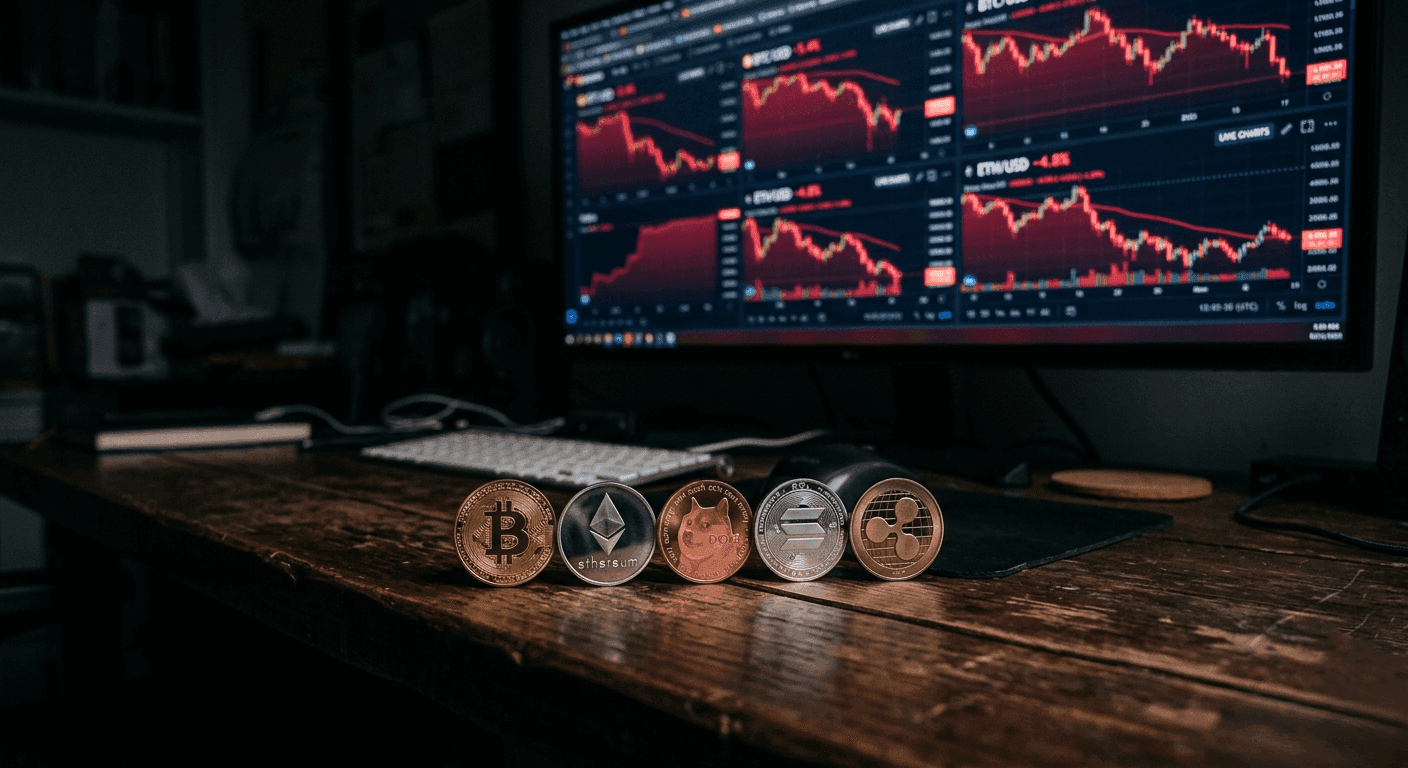
Crypto crash week: the largest cryptos lost up to 4% in seven days. We break down why crypto prices are falling and what to watch next.
October 25, 2026 3:43 AM
Solana staking at 4.96 percent after commission: how to proceed
The yield follows from 3.59 percent issuance and a staking rate of 68.7 percent: 5.22 percent gross, and after the usual commission of 5 percent still 4.96 percent. Plus 665 validators, 63 of them charging full commission, and an epoch of a good 25 hours.
October 25, 2026 3:28 AM

Hard fork or soft fork: what happens to your coins in a split?
A hard fork can split a blockchain in two, and you then hold the same number of coins on each side. A soft fork changes nothing in your wallet. How to tell the two apart, and what the German finance ministry has settled on the holding period for the new coins.
October 25, 2026 3:16 AM

Real World Assets: what 37 percent in one credit product means
Real World Assets are billed as the next big asset class. Our count of October 23 shows that a third of the category are not tokenised assets at all and that 37 percent hangs on a single US credit product. This article also sets out when a token counts as a security in Germany.
October 24, 2026 10:14 PM
159,000 Blocks to the Next Litecoin Halving: Reward Drops to 3.125 LTC
The next Litecoin halving cuts the block reward from 6.25 to 3.125 LTC. It is triggered by block 3,360,000, and on October 24, 2026 roughly 159,000 blocks were still missing.

October 24, 2026 7:14 PM
Ether Below $2,300: Twice as Weak as Bitcoin
Ether lost 4.38 percent over 24 hours to $2,297.96, Bitcoin only 2.41 percent. What lies behind the gap, which levels count now, and what matters for leverage, the holding period and the October 30 expiry.
October 24, 2026 6:00 PM

a16z Drops "Crypto" From Its Name: What the $2.2 Billion Pivot Means for the Market
Andreessen Horowitz renamed a16z Crypto to a16z Frontier and opened its $2.2 billion fund to AI and robotics. Here is what the pivot signals for crypto.

October 24, 2026 4:23 PM

Chainlink in Korea's $68 Billion Market, LINK Falls to $11.47: Why the Price Is Not Moving
Analysis: LG CNS is wiring Chainlink into its platform for Korea's digital asset market, Archax is using the price data for tokenised US Treasuries, and LINK still stands at $11.47 on Friday afternoon. This article separates the documented contract position from what it means for the price and for investors in Germany.