
Waltio Confirms Brevo Breach Touched Its User Emails: Here Is What To Do Now
Waltio has told users its Brevo account was accessed during the September breach that also hit Trezor and BitBox. Here is what was exposed.

Which topics should we dive deeper into?
Select what genuinely interests you. Your picks feed directly into our editorial planning.
Crypto news that's actually worth your time.
Weekly. 60 seconds. Carefully curated by our editors: no hype, no promo flood, no spam.
French crypto tax platform Waltio has started emailing its users about a security incident at Brevo, the third party email provider it uses to send campaigns. The message is calm, carefully worded, and mostly reassuring. It is also the latest confirmation that the Brevo breach of early September has a longer guest list than anyone first thought.
If you are a Waltio user, your tax reports are fine. Your email address may not be. And in crypto, an email address in the wrong hands is not a small thing.
 Compare crypto tax tools
What Did Waltio Actually Tell Its Users?
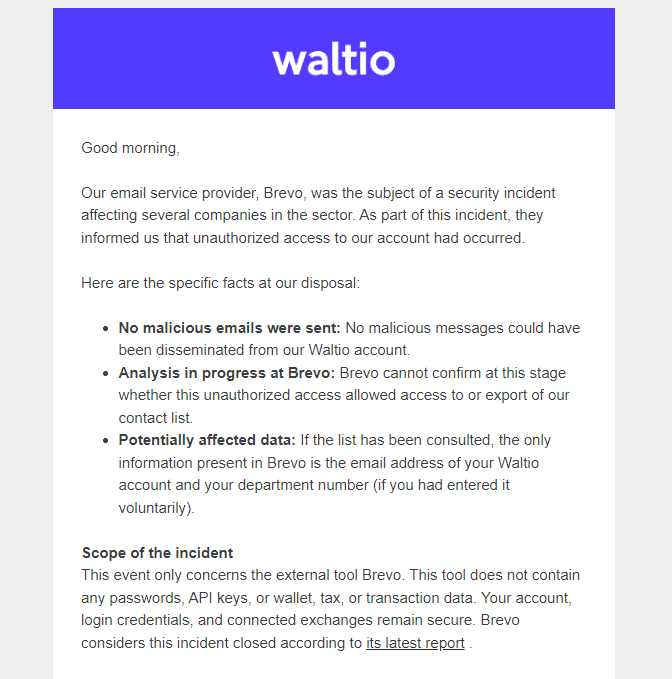
The notice, sent in French under the heading "Information relative à la sécurité de vos données personnelles", sets out four points.
- First, no malicious emails went out from Waltio's account. Nothing was blasted to the contact list pretending to be Waltio.
- Second, Brevo's analysis is still running. Brevo has not been able to confirm whether the intruder actually viewed or exported Waltio's contact list, only that unauthorised access to the account happened.
- Third, the data at risk is thin. The only fields Waltio keeps inside Brevo are the email address tied to your Waltio account and, if you entered it voluntarily, your French department number. That is the two digit administrative region code used in France, so 75 for Paris, 13 for Bouches du Rhône, and so on. Useful for regional tax messaging, and not much else on its own.
- Fourth, the blast radius stops at Brevo. Waltio says the tool holds no passwords, no API keys, no wallet addresses, no transaction history and no tax data. Logins and connected exchanges are untouched. Waltio also notes that Brevo now treats the incident as closed.
How Big Was The Brevo Breach?
Bigger than one French startup. Brevo said an attacker got into around 120 to 138 customer accounts on 9 and 10 September before access was cut off. The company later attributed it to an authorisation flaw in its login and single sign on layer rather than a classic password leak, which meant the attacker could reach every organisation the compromised invited users were entitled to see.
Brevo's own breakdown split the damage three ways: a handful of accounts were used to send phishing, several dozen had contact lists exported, and the large majority showed no activity at all. Waltio's "analysis in progress" language suggests it is sitting somewhere between the second and third bucket, and does not yet know which.
The names already confirmed are a who's who of crypto: Trezor, BitBox, CoinTracking and Solana Mobile. Trezor got the worst of it. Roughly 347,000 newsletter subscribers received a fake security alert about an STM32 entropy vulnerability, pointing to an app that asked for their wallet backup. Trezor killed the domain at DNS level within twenty minutes, but around 2,500 people had already clicked.
Why Does This Matter More For Waltio Than For Other Brevo Clients?
Because Waltio has been here before, and much worse.
In January 2026 the platform suffered a genuine intrusion into its own systems, not a vendor's. Attackers exfiltrated data tied to tax report generation, contacted the company demanding a ransom, and the Paris prosecutor's cybercrime unit handed the investigation to the Gendarmerie's national cyber unit. Waltio confirmed that email addresses, aggregated crypto balances and tax report data had been exposed, while passwords, API keys, wallet addresses and banking details had not. A file circulating on Telegram afterwards was reportedly used to target French crypto holders directly.
That history changes the maths on this new incident. A standalone email address is low value. An email address that can be cross referenced against a leaked file showing roughly how much crypto you hold is a targeting list. France has had a grim run of kidnappings and home invasions aimed at crypto holders, and those cases start with exactly this kind of data stitching.
So the correct reading of the Waltio notice is not "nothing happened". It is "one more identifier of yours may now be in circulation, and you should assume the attackers are patient".
How Do You Spot A Waltio Phishing Email?
The Brevo attack worked precisely because the phishing came through legitimate infrastructure. Sender domain checks, DKIM, SPF, the usual tells, all of it looked correct on the Trezor emails. So domain inspection alone will not save you here.
Judge the ask instead:
- Any message asking for your seed phrase or wallet backup is fraud. Always. Waltio states plainly that it will never ask for a seed phrase, a password or a transfer of funds, by email or by phone.
- Any message pushing you to download an application to "fix" or "verify" something is fraud.
- Any message creating a deadline, a legal threat or a tax penalty scare is worth a second look. Tax angles are the obvious hook for a Waltio user list.
- Never click through from the email. Type waltio.com yourself, or contact support directly at hello@waltio.com.
 Compare crypto exchanges and fees
What Should Waltio Users Do Right Now?
Nothing dramatic, but a few things are worth doing this week.
Turn on two factor authentication on your Waltio account and on every exchange it connects to, using an authenticator app rather than SMS. Review and revoke any exchange API keys you no longer use, and confirm the ones you keep are read only. Change your Waltio password if you have reused it anywhere else. Consider running your address through a breach checker to see what else about you is already public.
And the boring one that actually matters: reduce how much you talk about your holdings, on social media and off it. Data leaks like this one are only the first step. The value is in combining them.
One structural note is hard to avoid. Crypto tax tools sit on the richest dataset in the entire ecosystem, a complete picture of who owns what and where it sits. DAC8 reporting obligations across the EU are pushing more of that data into more places, not fewer. The Waltio notice is a reminder that the weakest link is rarely the platform itself. It is the newsletter tool bolted onto the side of it.
Keeping your keys off the internet entirely is still the strongest answer to any phishing campaign. The CryptoTicker shop stocks hardware wallets at shop.cryptoticker.io.
Partner links: some links on this page are partner links. If you become a customer through one of them, we may earn a commission at no extra cost to you. Selection, ratings and ranking are decided independently by our editorial team. Ethics and Independence · Ownership and Funding
For later? Save this article and find it again in your profile.
Related articles
- Zengo Wallet explained: two key shares replace the seed phrase
- FaceStealer: FBI warns of fake Zoom calls that drain crypto wallets
- Crypto news: Chainstack data breach exposes customer data, node credentials treated as compromised
- NEAR AI hack: data of around 100 users and 18 AI agents exposed
- Pig butchering: FATF traces $100 million of victims' money into a single scam compound
Which topics should we dive deeper into?
Select what genuinely interests you. Your picks feed directly into our editorial planning.
Crypto news that's actually worth your time.
Weekly. 60 seconds. Carefully curated by our editors: no hype, no promo flood, no spam.

November 8, 2026 1:15 PM
Eurojust raid on fake trading platforms: more than 100 servers seized, seven arrests
Investigators from seven countries, led by the public prosecutor's office in Itzehoe, have taken down an alleged supplier of fake trading platforms and seized more than 100 servers. We explain how the scheme works and how to check a provider before your first transfer.
November 6, 2026 9:12 PM
Gnosis Pay data breach: card customer data exposed ahead of the December 20 shutdown
Gnosis Pay confirmed on November 6, 2026 that attackers accessed the system behind its crypto debit cards and exposed customer data. Funds are not affected, according to the company, but cardholders now face phishing with genuine data and must find a new card by December 20.
November 4, 2026 1:22 AM
Restoring a Crypto Wallet: Your Seed Phrase Gets the Coins Back
Phone gone or hardware wallet broken? Twelve or 24 words get you back to your coins. Here is how the recovery works, and where it most often fails.
November 3, 2026 1:36 PM

Crypto data breach: under the GDPR, compensation starts at around €100, according to Germany's top court
After the data breaches at Wagyu and Chainalysis, crypto investors are asking about their rights. Germany's Federal Court of Justice accepts the mere loss of control as damage; what matters are access requests, evidence and secure custody.
November 3, 2026 1:45 AM

Foundation Passport: 23,000 phishing emails came from the wallet maker's own systems
Hardware wallet maker Foundation has admitted that attackers got into its backend infrastructure through a self-hosted application and sent more than 23,000 phishing emails from the company's genuine systems. According to the company, the Passport devices and private keys are untouched, but around 5,600 postal addresses are not.
November 2, 2026 9:43 PM
How to store crypto safely: protect yourself from hacks like the one at Binance
After the $6.3 billion hack at Binance: how to store your cryptocurrencies safely. Hardware wallets compared, wallet scanners such as MetaMask Security Alerts, the key settings on your exchange account and a seven-step checklist.
November 2, 2026 4:04 PM
Chainalysis data breach: AI-driven attack exposes names of investigators and compliance teams
Chainalysis confirms an attack using AI-driven methods in which names, email addresses and roles of platform users were taken. Retail investors are not in the dataset, but should expect phishing in the name of real investigators.
November 2, 2026 9:25 AM
Trezor Safe 5 implant reported at CryptoBilis: who needs a new wallet now
Trezor is warning everyone who has ordered from former reseller CryptoBilis since March 2026: an extra board with a cellular module in a Safe 5 is said to read the recovery phrase. Who is affected, why weighing the device does not help, and how to move to a new wallet.
November 2, 2026 6:19 AM
Monero swap service Wagyu confirms data leak: 4,580 XMR orders exposed with IP addresses
Monero swap service Wagyu.xyz has confirmed a data leak that, according to Hudson Rock, links 4,580 Monero orders to receiving addresses and IP addresses. The Monero blockchain is not affected; the risk for customers is phishing.
October 31, 2026 12:37 PM

Floin Cyberattack: MiCA Crypto Platform From Liechtenstein Goes Offline
Liechtenstein-based crypto platform Floin reports a cyberattack, remains offline and has now confirmed a data breach. What is known about the MiCA-licensed company, which customer data may be affected and what investors should do now.
October 28, 2026 9:30 AM

Data breach at Coinbase vendor Amplitude: contact details exposed, balances untouched
Coinbase traces a security incident to the analytics vendor Amplitude and names email addresses and phone numbers as exposed. Balances, passwords and private keys are untouched according to the exchange, and notification goes out by email.
October 25, 2026 12:35 PM
Private key and public key: 256 bits decide who owns your coins
A private key is a secret number with 78 digits, and the public key can be calculated from it, while the way back cannot. Signature, seed and address all hang on it, and at an exchange or in your own wallet this single value decides who owns the coins.
October 23, 2026 10:21 PM
Ngrave phishing: $2.56 million left 70 wallets after a hijacked push provider
Attackers hijacked the push provider of Belgian hardware wallet maker Ngrave and sent fake security alerts to users of the LIQUID app on October 17. Anyone who entered their recovery words lost their balance: between $2.56 million and $2.65 million flowed out, while the devices themselves remained untouched according to the company.
October 16, 2026 4:15 AM
241 scam sites taken offline, the recovery scam lives on: what to check now
The Brooklyn District Attorney and the FBI shut down a fraud network of 241 websites and 112 servers on 14 October 2026; the second stage of the scheme was a purported recovery service. Five days earlier, German regulator BaFin had warned about exactly this pattern at a purported bank.

October 11, 2026 4:50 AM
90 Crypto Kidnappings and Robberies in 7 Months: Why France Is the Most Dangerous Country for Bitcoin Holders
France logged 90 crypto kidnappings, extortions and violent thefts this year, one every 2.5 days. Leaked tax data is to blame. Here is how to protect yourself.
September 28, 2026 10:26 AM
Phantom Wallet and Solscan: What a Solana Transfer Really Costs and Where It Fails
A transfer on Solana costs 0.000005 SOL, a new token account ties up 0.00148844 SOL once — both values measured on-chain by us today. This practical guide shows how to set up Phantom, how to get there from the exchange, how to read Solscan and what applies for tax in Germany.
September 20, 2026 4:15 PM
Crypto Phishing After a Data Breach: The Warning Signs in a Fake Exchange Email
After every major data breach, the number of phishing emails sent in the name of crypto exchanges and wallet manufacturers rises. This article shows you how to recognise such a message, which data a reputable provider never requests by email, and what to do in the first hour after a click.
September 12, 2026 4:12 PM

Revolut Data Breach: Am I Affected, and What About My Bitcoin History?
After a forged government request, Revolut handed identity documents, account statements and complete Bitcoin transaction histories to an unauthorised party. Here is how to establish whether you are affected, and which protective measure actually achieves anything in this case.
September 10, 2026 1:14 PM
Phishing Email From the Real Sender Address: How to Check a Wallet Security Warning
An alleged security warning to wallet customers travelled through the manufacturer's genuine sending channel and passed every technical authenticity check. The test that still holds costs you four minutes.
September 10, 2026 9:13 AM
Trezor Hack Scare: That STM32 Entropy Email Is a Phishing Attack
Trezor users received a fake STM32 entropy warning sent from a real Trezor address. Here is what happened and what to do if you clicked.
September 5, 2026 10:24 PM

Fake German Finance Ministry Letters: Why Nobody May Demand 19 Percent VAT on Your Crypto Purchase
Since September 1, 2026, Germany's Federal Ministry of Finance has been warning about forged letters that demand 19 percent VAT on cryptocurrency purchases while citing real transactions. That tax does not exist, and this is how to spot the forgery.
September 4, 2026 10:26 PM
Pocket Bitcoin Data Breach: When Name, Home Address and Bitcoin Address Circulate Together
The Swiss Bitcoin service Pocket Bitcoin closed its investigation on September 3, 2026: 5,411 people affected, and for 291 of them the Bitcoin addresses they used along with copies of identity documents. Why this one data pairing has lasting effect, and what you should check with your own provider.
September 4, 2026 10:15 PM
Trezor Data Breach: Am I Affected and What Should I Do Now?
Trezor widened the ShipMonk data breach on September 4, 2026: around 67,000 further people affected, just over 80,000 in total, from orders placed between November 2019 and August 2021. How to check in two minutes whether you are among them, and what an exposed home address means for self-custody.
August 25, 2026 10:31 PM
Crypto Wallet Phishing by Letter: Why the QR Code From Your Postbox Wants Your Recovery Phrase
Letters carrying a QR code urge a supposedly urgent wallet update on grounds of quantum resistance and lead to a page that asks for the recovery phrase. The Federal Office for Cybersecurity reported the ploy on August 18, 2026.
August 23, 2026 4:36 PM
Operation ASTERIX: How a Fake Support Call Delivers a Counterfeit Wallet App
Security researchers analysed an open server on which a phone system, phishing interfaces and cloned wallet programs all came together. The largest list of numbers was the German one.
August 22, 2026 4:13 AM
SafePal Data Breach: 39,798 Customers Exposed With Names, Addresses and Phone Numbers
SafePal confirmed a data breach on August 16, 2026: the names, delivery addresses, phone numbers and order details of 39,798 customers were exposed. Seed phrases and private keys were not affected, but the phishing risk is substantial.
August 13, 2026 4:59 PM
Trezor Data Breach: First 13,689 Customers, Then Roughly 67,000 More Exposed
A breach at Trezor shipping partner ShipMonk exposed names, phone numbers and home addresses of 13,689 customers in August; in September Trezor reported roughly 67,000 more in the US. Devices are safe, phishing risk is not.
More from CryptoTicker