
Dogecoin custody: 144.8 million DOGE across two custodians, and what changes for ETP holders
The largest remaining Dogecoin fund in the United States has kept its coins in two places rather than one since this month. For anyone holding a German Dogecoin ETP the question underneath is the same: who holds the keys, and what does the fund wrapper cost per year?




Which topics should we dive deeper into?
Select what genuinely interests you. Your picks feed directly into our editorial planning.
Crypto news that's actually worth your time.
Weekly. 60 seconds. Carefully curated by our editors: no hype, no promo flood, no spam.
The largest remaining Dogecoin fund in the United States no longer keeps its coins in a single place. In a supplement to its prospectus dated October 5, 2026, Grayscale told the US Securities and Exchange Commission that Anchorage Digital Bank N.A. may serve as an additional custodian for the trust's DOGE holdings. Coinbase Custody remains the primary custodian. Two days earlier the same issuer had switched on in-kind creations, and the day after tomorrow its competitor Bitwise closes its Dogecoin fund for good. For investors in Europe this is not an American footnote, because the question underneath it applies to every German Dogecoin product in exactly the same way: who holds the keys, and what happens if that one custodian fails?
DOGE traded at $0.086 on Monday midday, up 0.9 percent over 24 hours and down 9.5 percent over the week (CoinGecko, as of October 12). Market capitalisation stands at $13.4 billion, with $522 million changing hands in the most recent trading day. The price here is only the frame. The subject of the day is the custody chain, and unlike the price, that can actually be checked.
Grayscale adds Anchorage Digital as a second custodian
The filing is titled Prospectus Supplement No. 1 and amends the prospectus of April 16, 2026. Its operative wording states that Anchorage Digital may serve as an additional custodian for the trust's DOGE holdings (SEC filing on Form 424B3). Coinbase Custody Trust Company, LLC expressly remains the trust's primary custodian, and Coinbase, Inc. remains prime broker. The fund trades on NYSE Arca under the ticker GDOG.
A custodian is the entity that holds the private keys to a fund's coins and moves those coins on instruction. Adding a second one spreads the failure risk: if one entity drops out, through a hack, an insolvency or an order from a regulator, the entire holding no longer hangs on it. How much of the DOGE will actually move is left open. The document says the sponsor has not currently determined the aggregate amount of the trust's DOGE it will transfer to Anchorage Digital.
144,871,236 DOGE in the fund, 117.33 per share
The size of the holding is what makes the filing interesting. As of October 5, 2026, Grayscale reported 144,871,236.7167 Dogecoin for the trust, equal to 117.33314709 DOGE per share at a net asset value of $11.20 per share and assets under management of roughly $13.8 million. The issuer's own overview from October 7 shows $10.38 per share and $12.81 million, which reflects last week's weakness in the price.
Set against the open market: 144.9 million DOGE are worth around $12.5 million at the current price, roughly 2.4 percent of the daily turnover CoinGecko reports for Dogecoin. The fund is therefore no driver of the price, but it is a useful lesson in how professional custody is built.
The sixth amendment to the custody agreement, signed September 29
Legally, the addition rests on a change of contract. The sixth amendment to the Master Custody Service Agreement was signed on September 29, 2026; the original agreement dates from August 8, 2025. Only that amendment creates the framework in which a second custodian can stand alongside Coinbase at all.
The timing next to the second change of the same date is striking. Also with effect from September 29, 2026, the trust may create and redeem shares in kind, that is against delivery of DOGE rather than cash. The authorised participants for this are Virtu Americas LLC and Macquarie Capital (USA) Inc. In-kind settlement means more coin movement between market participants and the fund, and more movement demands more custody capacity. Splitting across two institutions fits that rebuild.

A $5 million liability cap for the additional custodian
To understand what such a split is worth, read the liability clause. For the additional custodian, liability under the contract is capped at the greater of $5 million or twelve months of fees. Measured against trust assets of $12.81 million, that cap covers a substantial share, but not the entire holding, and certainly not every loss automatically.
Two further figures from the same filing set the frame. The custodian must maintain crime insurance or fidelity coverage of at least $100 million in aggregate, and a threshold of $100 million applies per cold storage address. Cold storage means keys that have never touched the internet. The threshold limits how much value may sit at a single address, and is thus the technical counterpart to splitting across two institutions.
Trading in the Bitwise fund ends on October 14
While one issuer builds out its custody, the other withdraws. Bitwise announced the liquidation of its Dogecoin fund on September 10, 2026. According to the issuer, Wednesday, October 14, 2026, is the last trading day on NYSE Arca. On that day the fund's DOGE will be converted into cash, and no new shares will be created from before the market open on October 15.
Remaining shareholders will be paid the net asset value of their shares as of October 21 in cash, on October 22 according to the issuer. The filing on Form 8-K is more cautious and speaks of the holdings being liquidated on or shortly after October 22, 2026. The date is therefore expected, not promised. Bitwise says shareholders need take no action in the process. The fund had become tiny: Decrypt put its net assets at around $722,000 as of September 8.
In our October 10 piece on the wind-down of the Bitwise fund, DOGE stood at $0.0862; a day later, at the $57.2 million exchange outflow, it was $0.0868. Today it is $0.086. The announced closure has therefore moved the price by less than one percent over those two days, which should surprise nobody given a fund size of $722,000. What is new since October 10 is not the price reaction but the custody question on the other side of the market.
 Find the right hardware wallet for your DOGE
The German Dogecoin ETP rests on a single custodian
In Germany nobody gets at a US fund such as GDOG without further ado. Anyone who wants DOGE in a brokerage account buys an exchange-traded product, an ETP, which here is a bearer debt security with assets deposited behind it. The best known is the 21Shares Dogecoin ETP with ISIN CH1431521033 and German security number A4A5WJ, tradable in euros on Deutsche Boerse. The issuer describes it as 100 percent physically backed, with custody handled by BitGo Europe GmbH. A second product came to the Frankfurt exchange from Valour, security number A4AK2K.
The difference from the American filing sits precisely here: the German product names one custodian, not two. That is no weakness of the house but the usual construction of European crypto ETPs, and it has worked for years. It does mean, though, that the question of spreading the risk stays open for German holders while the American competitor is answering it right now.
In-kind instead of cash: the rebuild since September 29
The mechanism behind in-kind settlement is worth two sentences, because it works the same way at an ETP. If new shares are created against cash, somebody has to buy DOGE on the market, and that purchase leaves a trace in the order book. If they are created against delivery of coins, the DOGE move straight from the trading firm into custody without a market order ever appearing. For the price that means less visible pressure in either direction; for custody it means more deliveries in and out each day.
The same filing names the practical limits: the order cut-off is 3:59:59 p.m. New York time, and settlement runs T+1 or T+2, one or two trading days later. A German investor holding an ETP will find the equivalent deadlines in the key information document for that product, and they are rarely identical.
What custody costs per year, counted in euros
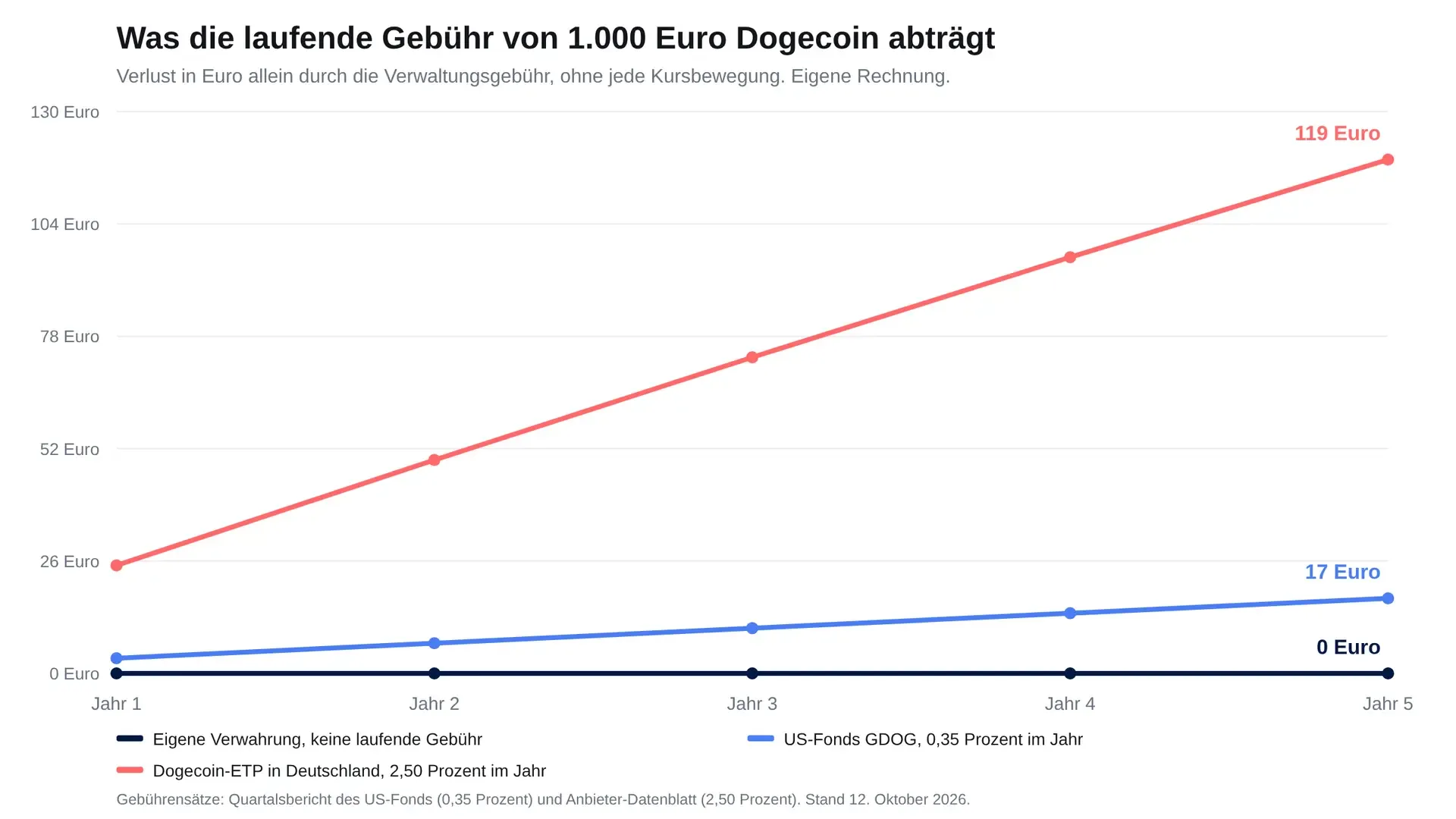
The convenience of a fund wrapper is paid for through the ongoing fee, and the spread between the routes is wide. For GDOG, the first-quarter 2026 report shows a sponsor fee of 0.35 percent annualised, once a temporary waiver has run out. The German 21Shares Dogecoin ETP costs 2.50 percent a year according to the issuer. Self-custody carries no ongoing fee, but a one-off cost for hardware and your own effort.
On a €1,000 stake, and with no price movement whatsoever, five years cost €0 under self-custody, around €17 in the US fund and around €119 in the German ETP. The fee is taken from the holding daily, so the share of coins behind each security keeps shrinking. GDOG makes that legible directly: 117.33314709 DOGE per share is a snapshot that gets smaller with every day.
Four entries in the key information document that put a number on your risk
The details that matter here are public in every product, just rarely in a prominent place. In the key information document and the prospectus for your ETP you will find four points that take minutes to look up: the name of the custodian and its domicile, whether there is one or several, the size of the insurance or of a liability cap, and whether there is a right to delivery of the coins. In a product with a single custodian, that custodian's creditworthiness decides your counterparty risk; with several, the risk is spread.
The benchmark from the American filing serves as a yardstick: insurance of at least $100 million, a cap per cold storage address, a quantified liability for the custodian. If your documents carry no figure for any of those points, that absence is the real information. If you are weighing the alternative and want to hold the keys yourself, the devices and their differences are in our hardware wallet comparison; the price of that route is that you secure the recovery phrase yourself and nobody can replace it for you.
Holding period for self-custody, withholding tax for the ETP
In tax terms the two routes diverge in Germany, and for most holders that difference is larger than any fee. Buying Dogecoin directly and holding it yourself falls under section 23 of the German Income Tax Act: after a holding period of more than one year, the gain from the private disposal is tax free, and within the year an exemption threshold of €1,000 applies.
For an ETP the classification is disputed. Because these are bearer debt securities, treatment as a capital investment under section 20 of the Income Tax Act is the obvious reading, which would mean 25 percent withholding tax regardless of the holding period. For physically backed products carrying a right to delivery of the coins, the specialist literature also argues for section 23. There is no ruling from the Federal Fiscal Court specifically on crypto ETPs. Anyone counting on the holding period should therefore ask the issuer or a tax adviser about the treatment before buying and document their acquisition data cleanly, for which the tools in our overview of tax software and portfolio trackers are suited.
 Check your holding period with a crypto tax tool
What the switch says about the state of the Dogecoin market
Two filings within a few days draw the same picture from two directions. One issuer gives up because, after a good eleven months, barely any money sits in the product; another builds out its custody and opens share creation to in-kind delivery. That says nothing about the price, but something about the infrastructure: the number of products is falling, the quality of those left is rising.
For the price itself the picture stays thin. Dogecoin has lost 9.5 percent over the week and, at a market capitalisation of $13.4 billion, sits well below the large names. A change of custody creates no demand. It only lowers the probability that a technical or legal incident at a single service provider drags an entire fund down with it.
Our assessment of the split across two custodians
In the view of this desk, adding a second custodian is the more useful of the week's two events, for a reason that can be checked: the additional custodian's liability is quantified at a minimum of $5 million, the insurance requirement at $100 million, and the cold storage threshold caps concentration per address at $100 million. Three quantified figures an investor can hold up against their own product are worth more than any announcement without a number.
Against that stands the sponsor leaving open how much it will actually move. As long as the transferred share is not quantified, the split remains a possibility rather than a measured fact, and at assets under management of $12.81 million even a complete transfer would be a small matter financially. We therefore read the filing as a sign of the segment maturing, not as a reason to buy. Which route somebody picks depends on the holding period and on the willingness to secure keys personally, not on where the fund wrapper comes from.
Dogecoin custody: two addresses only lower custodian risk
Splitting across Coinbase Custody and Anchorage Digital changes a fund's counterparty risk, not the price risk of Dogecoin. If you want to take something from it for your own portfolio, work through it in this order. First: look up in the key information document for your product how many custodians are entered and whether a liability sum is quantified. Second: project the ongoing fee onto your intended holding period, because at 2.50 percent a year, five years take around €119 of €1,000 before the price has moved at all; the devices for the route without an ongoing fee are in the hardware wallet comparison. Third: settle the tax treatment of your route before you buy, and document the purchase date and acquisition cost from the outset, for instance with a tool from the overview of tax software and portfolio trackers.
(As of October 12, 2026. This article is not investment advice. Prices and fee structures change; check the terms with the provider before you buy. Crypto investments can lead to a total loss.)
Frequently asked questions about Dogecoin custody
Transparency note: This article was produced with the assistance of artificial intelligence and reviewed by our editorial team before publication. All figures and claims were checked against the primary sources linked in the text. The feature image was generated with AI.
Related articles
- Dogecoin breaks below $0.093: the BWOW fund turns every DOGE into cash on October 14
- Dogecoin at $0.0946: the level that decides before the ETF closes on October 14
- 93.56 million dollars out of the Zcash ETF in one week: what changes for ZEC holders in Europe
- Dogecoin Price: What to Check on Holding Period and Custody Before the Year End
- Dogecoin Price Prediction: $0.10 as the Ceiling, and What to Watch at a 2.5 Percent ETP Fee
Which topics should we dive deeper into?
Select what genuinely interests you. Your picks feed directly into our editorial planning.
Crypto news that's actually worth your time.
Weekly. 60 seconds. Carefully curated by our editors: no hype, no promo flood, no spam.

September 21, 2026 1:13 PM
Ethereum Rises While ETF Money Leaves: What ETH Holders Should Check Now
US ether funds lost $140 million in the week to September 18, ending four weeks of inflows. The ETH price still gained a good 5 percent.

September 9, 2026 4:22 PM
Crypto Tax in Germany: What Applies in 2026 and What Is Set to Change in 2027
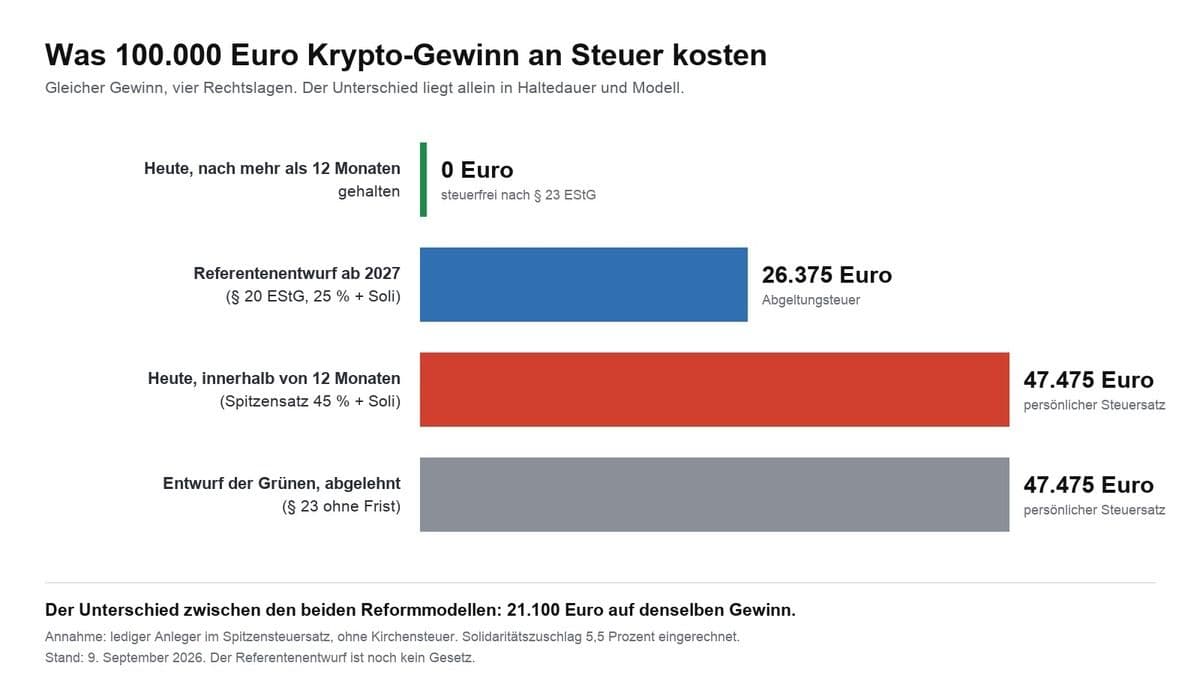
Crypto gains are tax-free after twelve months; before that your personal tax rate of up to 45 percent applies. What triggers tax, how the holding period is calculated, what happens with staking and losses, and what the draft bill would change from 2027.
October 4, 2026 10:14 AM

Dogecoin price at $0.0929: why the 200-day line sits at $0.0878 and not at $0.093
Dogecoin trades at $0.0929 on Sunday morning. Market reports put the 200-day line at around $0.093; recalculated from 366 daily closes it sits at $0.0878. Two October dates that matter for investors in Germany run alongside it.
September 26, 2026 1:19 AM
Germany’s Crypto Holding Period Is Wobbling: What to Check Before December 31
A CDU member of the Bundestag makes it plain: the coalition agreement does not guarantee that the one-year holding period for crypto assets will survive. What that means for purchases made before the planned cutoff date of December 31, 2026.
September 8, 2026 10:21 PM

Crypto Holding Period and Grandfathering: Why December 31, 2026 Becomes the Cut-Off in Germany's Draft Bill
A ministerial draft bill from Germany's finance ministry names a cut-off date for the first time: crypto assets acquired after December 31, 2026 are to fall under the flat-rate withholding tax. What that means for legacy holdings, running savings plans and staking income, and why nothing has been decided yet.
October 10, 2026 7:15 PM

ING and Bitcoin: Around 50 Crypto ETNs in the Portfolio, and What the Delivery Claim Means for Your Holding Period
Bitcoin can be bought at ING, but only as an exchange-traded note: around 50 crypto ETNs from five issuers, as a one-off purchase or a savings plan from one euro. What the offer really costs, and what the one-year holding period hangs on, is not in the advertising but in the key information document.
September 23, 2026 10:11 AM
Kraken: 45 coins are on cancel only, 21 were announced – what to check when trading pairs are blocked
On September 23, 2026 we counted the public market directories of three trading venues. At Kraken, 82 of 1,450 trading pairs are listed as cancel only, a state in which an order can only be cancelled and no longer executed. The 45 underlying assets affected include just 21 that appear in the delisting notice we reported on September 3.
September 22, 2026 4:12 PM

Nearly $1 Billion Into Bitcoin ETFs: What to Check on ETNs, Portfolio and Holding Period
US spot bitcoin ETFs took in a net $999 million on September 21, the third consecutive day of inflows. German investors cannot reach these funds: what ETNs, the holding period and your buying route mean for you.
October 11, 2026 7:26 PM

Stablecoin swaps: France plans the tax Germany has had for years
Swapping bitcoin into a stablecoin in France carries no tax so far. That is set to change from 2027, with the finance committee of the National Assembly having given its approval. In Germany such a swap has long been a taxable event, with one consequence many investors miss: the holding period starts again.
October 9, 2026 10:50 AM

Crypto holding period: the Bundestag rejects abolition by 445 votes to 132: what investors need to know
On 8 October the Bundestag rejected the Greens' bill to abolish the crypto holding period in a recorded vote, and the Left's motion fell too. The result by parliamentary group, the official speech from the media centre, and why it was the SPD that gave investors the real signal in the debate.
September 11, 2026 1:33 PM

Dogecoin ETF Discontinued: Why Bitwise Is Closing BWOW and What Counts in Europe
Bitwise is winding up its Dogecoin ETF: trading ends on October 14, 2026 and the cash payout follows on October 22. Why the product failed for lack of demand, and what is actually tradable for you in Europe.
October 10, 2026 10:25 PM

Chainlink's First Fund Inflow in Five Trading Days: What Changes for Investors in Germany
The two US spot funds on Chainlink took in $9.48 million on October 9, the first inflow after five sessions without any movement at all. Because you cannot buy these funds in Germany at all, your result is decided by a different route and above all by how long you hold.
October 7, 2026 7:18 AM

Certificate, Bitcoin ETN or the coin itself: what each route means for tax and custody
A Bitcoin certificate, an ETN and the coin itself all lead to the same price, but to three different tax treatments and three different risks. The comparison shows which route fits your portfolio and why December 31, 2026 becomes the cut-off date.

September 24, 2026 4:20 PM
Litecoin Jumps by Double Digits While the Market Falls: Check Buy Route, Holding Period and Leverage Now
Litecoin gains 11.29 percent in a day while Bitcoin, Ether and XRP give ground. What sits behind the jump, and the three points you as an investor in Germany should check right now.
September 22, 2026 7:20 PM
ETH Price Prediction: What to Check at the $2,800 Mark Now
Ether stands at $2,735.96 on September 22, 2026, right below the zone at which it has failed repeatedly. Instead of a target number, you get four checks that count before your next order: holding period, buying route, the staking line and the distance to liquidation.
September 19, 2026 4:19 AM
Bitcoin Cash Jumps by Double Digits: What the Grayscale ETF Filing Really Means for You in Germany
Bitcoin Cash gained double digits on September 18 because Grayscale wants to convert its BCH trust into an exchange-traded product. The filing itself, however, states that the basis for it has not been approved at all.
September 8, 2026 1:19 AM

Germany's Crypto Holding Period: What Happens Now Signing for Petition 201716 Closed on September 15
Recap as of September 27, 2026: the signature period for German parliamentary petition 201716, which asks for the one-year crypto holding period to be preserved, closed on September 15, 2026. This article explains what ended that day, how the petitions committee proceeds and why no investor has to sell because of it.
September 9, 2026 1:15 AM

Germany's Crypto Tax: 160 Million Euros for a 555-Billion Budget
The German finance ministry's draft bill puts a figure on the crypto tax for the first time: 160 million euros from 2028. What that number means in the 2027 federal budget, how 11.4 billion became 160 million, and what investors can read from it.
October 8, 2026 4:17 AM

Crypto Holding Period: Without a Purchase Record the Tax Withheld Runs Ten Times Too High
The consultation on Germany's crypto tax bill closed on October 6 and the cabinet is to adopt it on October 14, with tax advisers, banks and the Bitcoin Bundesverband having filed their objections. The sharpest concerns everyone whose purchase data the selling platform does not hold: one adviser calculates a withholding ten times the tax owed.
August 21, 2026 1:42 PM

Writing Off a Total Crypto Loss: When the Tax Office Recognises Worthless Coins
A token that has collapsed only reduces your tax once you actually dispose of it. What applies to delisting, exchange insolvency and worthless holdings under Section 23 of the German Income Tax Act, and how you offset losses.
October 9, 2026 1:18 PM

Bitcoin Tax: One Year Past the $126,080 Peak, Losses No Longer Count
Bitcoin trades at $82,558 on Friday morning, 34.5 percent below an all-time high that is now a good year old. Anyone who bought back then loses more than the prospect of a quick recovery when the one-year period expires: the tax value of the loss goes with it.
September 18, 2026 10:13 AM

Bitcoin and the German Exit Tax: What Applies When You Move Abroad
Anyone emigrating with Bitcoin expects an exit tax on unrealised gains and finds nothing of the sort in the statute. Where the real risks sit is decided at four points: residence, the holding period, the legal form of your investment, and automatic reporting from 2026.
September 16, 2026 1:20 PM

Crypto Loss Carryforward in Germany: What Happens to Old Losses Under the 2027 Tax Plan
Losses from crypto sales land in a ring-fenced pot and can only be set against gains of the same kind. The draft bill for 2027 moves future gains into a different pot, and we show you what that means for your assessed carryforward and what your tax notice should say.
August 21, 2026 4:24 AM

Forced Sale on a Crypto Exchange: Which Moment Counts for the Holding Period and What You Must Document
At Luno, Kraken and Valour the deadlines are running out, after which the provider realises the remaining holding itself. For tax purposes that is a disposal, and what governs it is the exchange's timestamp.
September 14, 2026 10:23 AM

Take Ethereum Profits or Wait Out the Holding Period? What the Price Jump Means for Your Tax Bill
Ether reached its highest level since the end of January on September 11, 2026, and many are asking whether to sell now. In Germany the answer hangs on the purchase date first: we work out which tranches are tax free and which of them are showing a gain at all.
September 9, 2026 4:13 PM

Bitcoin 29 Percent Below Last Year: Which Crypto Losses You Can Still Use Before the One-Year Holding Period Expires
Nine out of ten major crypto assets trade lower today than exactly twelve months ago, Bitcoin alone by 29.2 percent. We measured the price series ourselves and show why the purchase date alone decides the tax value of your loss.
September 16, 2026 7:12 PM

Borrowing Against Bitcoin Instead of Selling: When German Tax Still Applies
Posting Bitcoin as collateral for a loan is not a sale in Germany, because section 39 of the Fiscal Code keeps the coins attributed to you for tax purposes. Tax arises only when the collateral is liquidated, and then the one thing that decides the bill is how long you held the coins beforehand.
More from CryptoTicker