
Bitcoin staking at Babylon, 40,573 BTC in the protocol: is it still worth getting in?
Babylon holds 40,573 Bitcoin; a year earlier the locked capital was worth more than twice as much. The reward comes in BABY, a token trading 92 percent below its peak.





Which topics should we dive deeper into?
Select what genuinely interests you. Your picks feed directly into our editorial planning.
Crypto news that's actually worth your time.
Weekly. 60 seconds. Carefully curated by our editors: no hype, no promo flood, no spam.
Bitcoin staking through Babylon does not earn you Bitcoin, but units of the protocol token BABY. Knowing that before delegating leads to a different decision than expecting a yield on a Bitcoin holding. The protocol currently holds 40,573 Bitcoin, worth roughly $3.34 billion according to DefiLlama's data. A year earlier the figure was $7.14 billion. Bitcoin itself trades at $81,394, or €72,636, on Wednesday evening, a good two percent below the previous day.
This article explains what technically happens in Bitcoin staking, what the yield depends on, which deadlines tie up your holding and how German tax law treats the rewards. Price targets for BABY are not part of it.
Bitcoin staking pays no interest in Bitcoin
Bitcoin staking means locking up Bitcoin as collateral for an external network, which pays a reward in its own token in return. The Bitcoin themselves do not multiply. The Bitcoin protocol has no mechanism that allocates anything to holders for holding; new Bitcoin arise exclusively through mining.
That makes the process fundamentally different from a savings account, even though the terms sound similar. You post collateral, and another network pays you for that collateral in its own coin. Whether it pays off depends on what that coin is worth and stays worth.
Babylon is the protocol that opened this route for Bitcoin. It consists of a locking mechanism on the Bitcoin chain and a proof-of-stake chain of its own called Babylon Genesis, which benefits from the locked Bitcoin collateral and distributes BABY in return. An overview of other providers and their terms is in our comparison of staking platforms.
How Babylon locks up Bitcoin without taking it off the Bitcoin chain
The technical core is a time lock on the Bitcoin chain itself. Your Bitcoin move into an output that, under the rules of Bitcoin script, can only be moved again after a deadline expires or through a route you have signed. Babylon calls this a self-custodial construction and writes on its own site that there is “no wrapping, no bridging to other networks”, the process taking place inside your own wallet.
Wrapping means a custodian retains real Bitcoin and issues a substitute token on another chain in return. A bridge transfers value between two chains and becomes a target for attack in the process. Both fall away at Babylon, and with them the question of whether a custodian stays solvent.
What remains is a different risk that many underestimate: you keep the keys, so you also carry the responsibility for them. If your access is lost, nobody can help you. Which devices come into question for that is set out in our hardware wallet comparison.
40,573 Bitcoin in the protocol: the capital has more than halved within a year
On October 7, 2025, Babylon held Bitcoin worth $7.14 billion, the highest level in the protocol's history. Today it is $3.34 billion, a fall of a good 53 percent. Both values come from DefiLlama's time series, which updates the locked holding daily.
Part of that decline is explained by the Bitcoin price, which fell over the same period. The rest is withdrawn capital. The low point came in mid-July 2026 at $2.63 billion; the holding has grown again since then, without coming anywhere near the level of a year ago.
For assessing the protocol, this movement says more than any yield figure. A protocol whose security capital shrinks by more than half within a year has not convinced its users. Entering today means entering a smaller network, not a growing one.

The yield comes in BABY, and BABY trades 92 percent below its peak
BABY is the token of the Babylon Genesis chain and the only means of payment in which Bitcoin delegators are rewarded. Babylon itself writes in its guide to the second protocol phase that delegators receive “BABY staking rewards” after the transition. There is no payout in Bitcoin.
The token trades at $0.0125, or €0.0112. Its peak dates from April 12, 2025 and stood at $0.1661. The gap to it comes to roughly 92 percent. The total market value of all circulating BABY adds up to $61.2 million, which puts the token in 402nd place by market capitalisation. These figures come from CoinGecko.
Two numbers beside the price matter more. In circulation are 4.89 billion BABY, with a total supply of 11.01 billion. More than twice as many units therefore sit on the books as are traded today, and the rewards for Bitcoin collateral are paid out of that issuance. A yield accruing in a token with a growing supply and a falling price is a different yield from one in euros.
We deliberately do not name a percentage here. The actual payout depends on the chain's issuance, on the number of competitors for that same issuance and on the commission of the provider you delegate to. Any fixed figure would be a snapshot that no longer holds by the time you read it.
 Staking providers compared
Slashing capped at 0.1 percent: the penalty risk is small, but it is not zero
Slashing means the confiscation of part of the posted collateral as a penalty for misconduct in the network. In Bitcoin staking through Babylon, that penalty does not hit you personally but the provider you assigned your collateral to, and through them you as well.
The upper limit is stated in Babylon's own guide to the second protocol phase: the collateral becomes exposed “at a maximum slashing rate of 0.1%”. On one locked Bitcoin that would be a thousandth, so about €73 at today's price.
That order of magnitude puts the risk in perspective without removing it. Slashing is triggered by double signing, meaning contradictory signatures from the same provider on the same block. That is an error in their operation, over which you have no influence. Your only lever lies in the selection.
1,008 Bitcoin blocks of waiting: the unbonding period ties up your holding for seven days
Unbonding is the process by which you release locked collateral. It does not run immediately. In the same guide, Babylon states that after it is triggered, “1,008 Bitcoin blocks, approximately 7 days” must pass before the holding can be withdrawn.
Seven days is a long time in the crypto market. If the price falls ten percent during that week, you cannot react, because the Bitcoin are immobile. This waiting period is the real price of Bitcoin staking, and it appears in no yield promise. How long lock-up periods run at other networks is set side by side in our overview of staking lock-up periods.
The period runs in Bitcoin blocks, not in calendar days. If the network finds its blocks more slowly than average, it takes longer. Treat seven days as a guide value, then, and not as a commitment.
Finality providers: how to check commission and minimum amount before delegating
A finality provider is the operator you assign your Bitcoin collateral to and which uses it to confirm the finality of blocks on the Babylon Genesis chain. It retains a commission from the rewards before the remainder reaches you. Babylon puts the relationship briefly in its guide: a lower commission means more reward for the delegator.
Before a first delegation, three points are worth a look. First the commission, because it comes off every payout permanently. Second the operating history, because double signing happens exactly there. Third the minimum amount, because on small positions the Bitcoin transaction fee for locking and for later withdrawal eats a noticeable part of the return.
That last point decides everything on small amounts. Two Bitcoin transactions arise regardless of the sum you lock. On a fraction of a Bitcoin, that fee can exceed several months of rewards.

Liquid staking through LBTC puts a second layer of risk over your holding
Liquid staking describes offers that issue you a tradable substitute token for locked Bitcoin, so your capital does not lie idle. The best-known offer on Babylon is LBTC from Lombard, which currently holds $643.9 million according to DefiLlama's data.
The appeal is obvious: you keep a position you can sell or use elsewhere, and you sidestep the seven-day period. The price for that is an additional layer. To Babylon's protocol risk is added the risk of the contracts that issue and redeem LBTC, and the risk that LBTC trades below the value of a Bitcoin on the market when many want out at once.
If self-custody is your main argument for Babylon, such a substitute token partly gives it up again. Both routes are defensible, but they are not the same route, and they do not carry the same risk.
 Keep your keys offline
Tax in Germany: staking rewards are other income under Section 22 no. 3 of the Income Tax Act
For German tax law the BABY rewards are not a capital gain but income. The tax authorities generally classify passive delegation as other income under Section 22 no. 3 of the Income Tax Act. The authority is the Federal Ministry of Finance circular on crypto assets of March 6, 2025, which replaced the 2022 guidance.
Each reward is valued at its market value in euros at the time it accrues. An exemption threshold of €256 per calendar year applies to this income, covering all other income from services together. An exemption threshold is not an allowance: at €255 everything stays tax-free; at €256 the entire amount is taxable, not only the part above it.
The accrual value applied becomes your acquisition cost for those BABY at the same time. If you sell them later, a one-year period of their own under Section 23 of the Income Tax Act runs for them. That makes two transactions per reward, both of which have to be documented. What this looks like in practice is set out in our article on staking and taxes in Germany.
With a token in the tenth-of-a-cent range, that quickly turns into an accounting task. Thousands of small accruals, each with its own price and its own date, cannot be kept cleanly by hand.
Tax reform from 2027: the cabinet date of October 14 and the year-end cut-off
For the question of whether to enter now, a change in the law that has not yet been adopted matters. Our reporting of October 1 names October 14, 2026 as the cabinet date for a draft bill that would move gains from exchange crypto assets out of Section 23 and into Section 20 of the Income Tax Act and charge them 25 percent withholding tax from 2027. December 31, 2026 is envisaged as the cut-off date for existing holdings.
Three qualifications belong with that. It is not yet a law, because the Bundestag and Bundesrat follow the cabinet, and changes are possible at every step. For the current year the one-year holding period applies unchanged. And anyone buying by the end of the year stays under the old rules as the draft currently stands.
Staking rewards are affected only indirectly, because they are recorded as income and not as a disposal gain. What would be affected is the later sale of the tokens received. Until the draft is a law, that remains a planning figure and not a legal position.
MiCA and BaFin: authorisation as a crypto service provider does not automatically cover staking
MiCA is the EU regulation on markets in crypto assets, in force since 2024, which subjects service providers to an authorisation requirement. It covers custody, exchange, trading and several further services. It contains no separate permission category for staking as a service.
A widespread misunderstanding hangs on that gap: a provider can be authorised in Germany and still run a staking offer that this authorisation does not cover. What matters is whether it holds your keys in the process, because custody requires permission. At Babylon in its self-custodial form, nobody holds anything for you, which is why no supervision applies there for want of a custodian.
This position is uncomfortable, because it withdraws protection without issuing a prohibition. If a finality provider fails or behaves improperly, there is no German supervisor to turn to and no deposit guarantee. Which providers hold an authorisation in Germany at all is examined in our overview of staking under MiCA.
Bitcoin staking: 0.1 percent penalty risk, yield only in BABY
Bitcoin staking through Babylon is solved more cleanly in technical terms than the label suggests, and more weakly in economic terms than the headlines promise. Self-custody remains, the penalty risk is small at a thousandth, but the reward comes in a token trading 92 percent below its peak whose supply keeps growing. Three steps help with the decision:
- Work out the incidental costs before the yield. Two Bitcoin transactions and the operator's commission arise regardless of the sum. Enter the expected rewards into a tool that records accruals with date and price; the common programmes are in the comparison of tax and portfolio tools.
- Compare several routes before delegating. Rewards in a secondary token are not the only form of staking, and established networks pay in their own, more liquid currency. The terms are in the comparison of staking platforms.
- Secure the keys before you lock up. Without a custodian there is no recovery. A device that keeps the key offline is the precondition and not the extra; the selection is in the hardware wallet comparison.
(As of October 8, 2026. This article is not investment advice. Prices and fee structures change; check the terms with the provider before you buy.)
Frequently asked questions about Bitcoin staking
Transparency note: This article was produced with the assistance of artificial intelligence and reviewed by our editorial team before publication. All figures and claims were checked against the primary sources linked in the text. The feature image was generated with AI.
Related articles
- Bitcoin Lending in Austria: When Tax Falls Due
- Cardano Slides Below $0.24: What ADA Holders Should Check on Leverage, Liquidation and Holding Period
- Staking Taxes in Germany: The Inflow, the 256-Euro Threshold and the Holding Period
- MyNearWallet Closes on October 31: What It Means for Your NEAR Coins
- The RAIN Token After the Enlivex Termination: What to Check on Access, Forced Sale and Holding Period
Which topics should we dive deeper into?
Select what genuinely interests you. Your picks feed directly into our editorial planning.
Crypto news that's actually worth your time.
Weekly. 60 seconds. Carefully curated by our editors: no hype, no promo flood, no spam.

September 24, 2026 1:24 PM

NEAR Falls Almost 8 Percent After a 62 Percent Week: What to Check on Perps, Buying Route and Holding Period
NEAR Protocol loses up to 7.9 percent on September 24, 2026 and is still more than 55 percent higher over the week. The rally was carried by a confidential perp offering via Hyperliquid, which raises questions of its own on buying route, leverage and holding period in Germany.

August 18, 2026 7:13 AM

Bitcoin Tax Reporting in Austria 2026: What Applies
Bitcoin tax reporting in Austria: which data investors can request from crypto exchanges in 2026, and when the report matters for the tax return.
August 11, 2026 5:14 AM

Bitcoin Bought Before March 2021: Is the Sale Tax-Free in Austria?
Bought Bitcoin before March 2021? Why legacy holdings can still be sold tax-free in Austria in 2026, and which exceptions apply.
September 9, 2026 4:29 PM
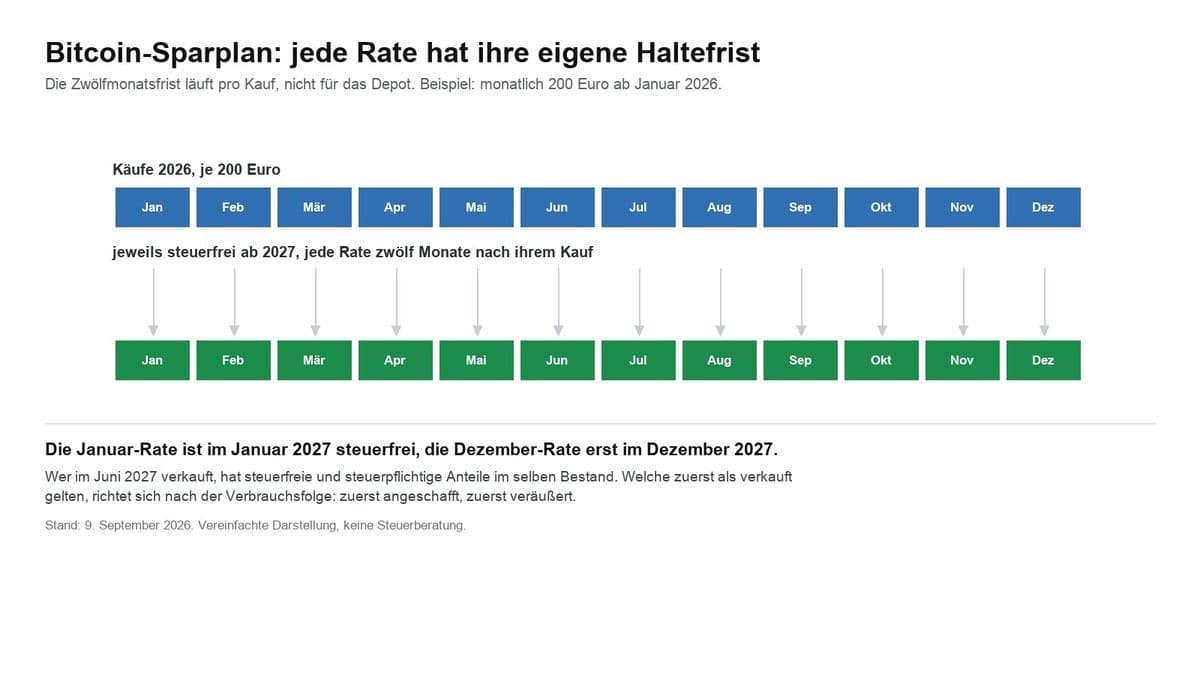
Bitcoin and Taxes in Germany: Holding Period, Savings Plan, ETP and Mining
Bitcoin gains are tax-free after twelve months. What that means for a savings plan with twelve deadlines, why ETPs are taxed differently, and what applies to mining, gifts and losses.
August 18, 2026 4:22 AM

Bitcoin for gold: is the swap taxable in Austria?
Swapping bitcoin directly for gold? In Austria this can already trigger 27.5 percent tax on the capital gain. What investors should know.
September 13, 2026 4:23 AM

Staking Lock-Up Period: How Long You Wait for Your Coins After Unstaking
Eight days on Ethereum, exactly 21 on Cosmos, not a single hour on Cardano: the lock-up period decides when you reach your coins again after unstaking. We queried the deadlines directly at the chains on September 13, 2026, and show you how to check them yourself before every decision.
September 9, 2026 4:22 PM
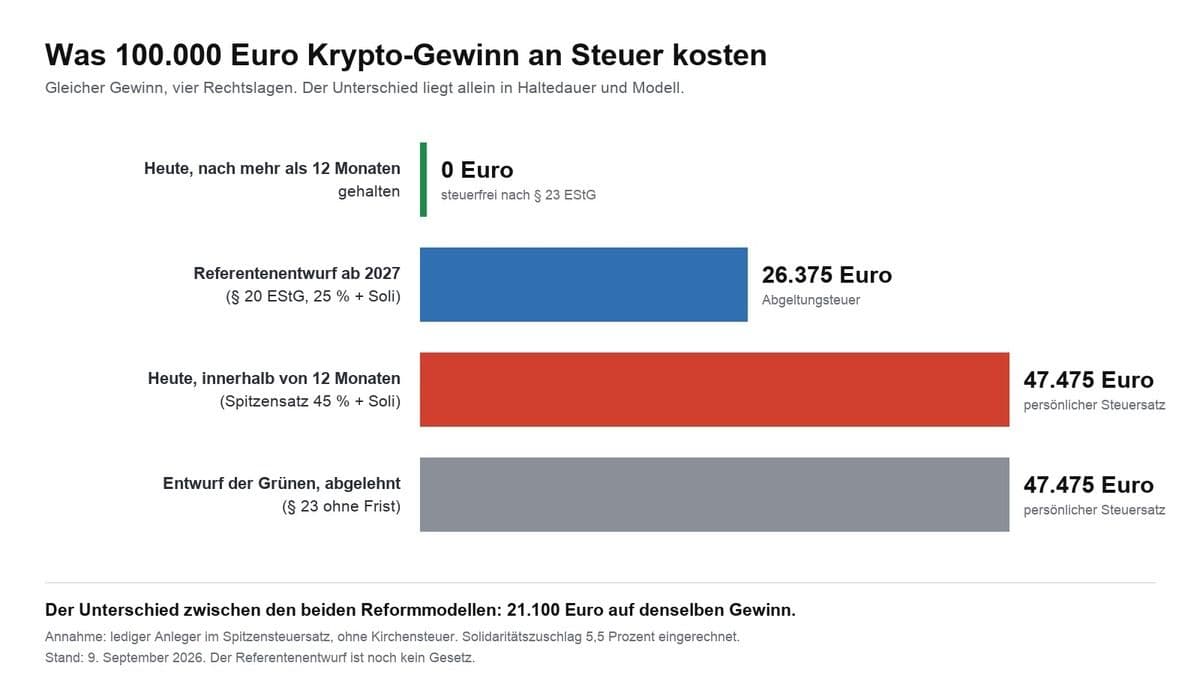
Crypto Tax in Germany: What Applies in 2026 and What Is Set to Change in 2027
Crypto gains are tax-free after twelve months; before that your personal tax rate of up to 45 percent applies. What triggers tax, how the holding period is calculated, what happens with staking and losses, and what the draft bill would change from 2027.
October 6, 2026 4:32 AM
Bitcoin for a gift card: what paying with crypto means for your holding period
Paying for a gift card with Bitcoin is a sale for tax purposes. What counts as the disposal proceeds, when the twelve-month holding period bites, and the four records the tax office expects.
September 17, 2026 7:12 PM

Gifting Bitcoin to Children: Allowance, Holding Period and the Tax Office Report
Transferring Bitcoin to your child hands over your holding period and your entry price along with the coins. This guide sets out what really applies in Germany on the allowance, the reporting deadline, representation and custody.

January 10, 2025 11:00 PM
Bitget Token Price Surge amid Market Downturn: New 2025 BGB ATH?
In this week's turbulent crypto market taken by downward pressure, BGB made it the top gainer with an impressive price surge. Will it end the week with a new ATH in 2025?
October 2, 2026 4:39 AM

Donating bitcoin: when does the full market value count, when only the purchase price?
A bitcoin donation to a charitable organisation is deductible as a donation in kind, and the donation itself produces no taxable gain. The size of the deduction turns solely on whether a sale would have been taxable on the day of the transfer.

September 23, 2026 7:22 PM
Solana Price Holds $114: What Holders Check Five Days Before Alpenglow
SOL stands at $114.55 on September 23, after a 17.7 percent gain in seven days and a 2.2 percent loss on the day. Two deadlines matter more than the daily move: Alpenglow opens on September 28, and every purchase made this week starts a holding period of its own.
September 22, 2026 10:13 AM

Circle Lends Against Bitcoin via cirBTC: Why the Wrapper Can Cost You the German Holding Period
Circle launched loans against deposited bitcoin on September 21, 2026. In Germany, the detour through the cirBTC token is very likely a swap, and a swap restarts your one-year holding period.
September 8, 2026 1:25 PM

Bitcoin Mining in Austria: How Mining Rewards Are Taxed
Bitcoin mining in Austria: when mining rewards are taxed at 27.5 percent, and when a commercial activity brings the progressive income tax rate into play.
September 8, 2026 1:19 AM

Germany's Crypto Holding Period: What Happens Now Signing for Petition 201716 Closed on September 15
Recap as of September 27, 2026: the signature period for German parliamentary petition 201716, which asks for the one-year crypto holding period to be preserved, closed on September 15, 2026. This article explains what ended that day, how the petitions committee proceeds and why no investor has to sell because of it.
October 5, 2026 7:21 PM

Bitcoin price at $85,662 one year after the all-time high: what to watch now
Bitcoin stands at $85,662, which is 32.1 percent below the all-time high whose anniversary falls on October 6. In euros the gap is smaller, and for anyone who bought in October 2025 the one-year tax period is running out at the same time.
October 3, 2026 4:40 PM

Investing in Bitcoin With a Savings Plan or a Lump Sum: What the December 31 Tax Cut-Off Changes
Anyone putting money into Bitcoin now chooses between a lump sum, a monthly instalment and an ETN in a securities account. The German finance ministry’s draft bill would keep the one-year holding period only for holdings bought by December 31, 2026.
September 22, 2026 1:28 PM

Selling Bitcoin and Cashing Out in Euros: How It Works in Germany
Between the sell order and the euros in your current account stand the exchange, your bank and the tax office. Knowing the order of events saves fees, waiting time and, in the best case, the entire tax on the gain.
October 7, 2026 7:18 AM

Certificate, Bitcoin ETN or the coin itself: what each route means for tax and custody
A Bitcoin certificate, an ETN and the coin itself all lead to the same price, but to three different tax treatments and three different risks. The comparison shows which route fits your portfolio and why December 31, 2026 becomes the cut-off date.
October 6, 2026 1:23 AM
50 euros a month in Bitcoin, 118 instalments since 2017: savings plan vs lump sum
118 monthly instalments of 50 euros since January 2017 add up to €5,900 paid in and around €54,500 today. The same instalment since January 2024 is up only 14.5 percent, and since October 2025 the savings plan beats the lump sum by almost 39 percentage points.
October 5, 2026 4:36 AM

Ethereum pays 2.66 percent, just over 2.2 arrives: what investors need to know about staking
The Ethereum network pays out around 2.66 percent a year, and just over 2.2 percent arrives through Lido and Rocket Pool. Where the gap comes from, how long the exit takes and what applies for tax in Germany.
September 22, 2026 4:12 PM

Nearly $1 Billion Into Bitcoin ETFs: What to Check on ETNs, Portfolio and Holding Period
US spot bitcoin ETFs took in a net $999 million on September 21, the third consecutive day of inflows. German investors cannot reach these funds: what ETNs, the holding period and your buying route mean for you.
September 22, 2026 1:37 AM

Swapping Bitcoin for Gold: What Happens for Tax in Germany
Moving from coins into gold is a sale in the eyes of the tax office, and the one-year period decides the bill. Where bars, gold ETCs and tokenised gold diverge for tax, and which records you need.
September 18, 2026 10:13 AM

Bitcoin and the German Exit Tax: What Applies When You Move Abroad
Anyone emigrating with Bitcoin expects an exit tax on unrealised gains and finds nothing of the sort in the statute. Where the real risks sit is decided at four points: residence, the holding period, the legal form of your investment, and automatic reporting from 2026.
August 24, 2026 10:29 AM
Buying More Bitcoin at $77,000: Savings Plan or Lump Sum
Bitcoin stands at $77,256 after gaining 22.78 percent in a week. This guide shows you how to buy more cleanly at this price and which method fits which starting position.
October 2, 2026 5:02 PM

Bitcoin or Ethereum in the fourth quarter of 2026: the two largest crypto-assets compared
Bitcoin is scarce by protocol rule, Ethereum only as scarce as its utilisation, and on access and tax in Germany the paths part again. This comparison puts the verifiable figures on supply, usage, staking and purchase route side by side, without making a price call.
September 30, 2026 10:15 AM

Ethereum Price Prediction: 1.6 Million ETH Face a 28-Day Wait for Activation, and What You Can Do Now
1,603,958 ETH are standing in the entry queue for Ethereum staking and waiting almost 28 days for activation. What that tied-up supply means for the price levels, for your yield and for the 256 euro exemption limit at the German tax office.
More from CryptoTicker