
Financial crisis and recession: bitcoin lost 77 percent in the 2022 rate turn
In each of the last three crises, bitcoin lost more than stocks and gold, but recovered faster once central banks cut rates. We run the numbers on 2020, 2022 and 2025 and show where the German economy stands in November 2026.


Which topics should we dive deeper into?
Select what genuinely interests you. Your picks feed directly into our editorial planning.
Crypto news that's actually worth your time.
Weekly. 60 seconds. Carefully curated by our editors: no hype, no promo flood, no spam.
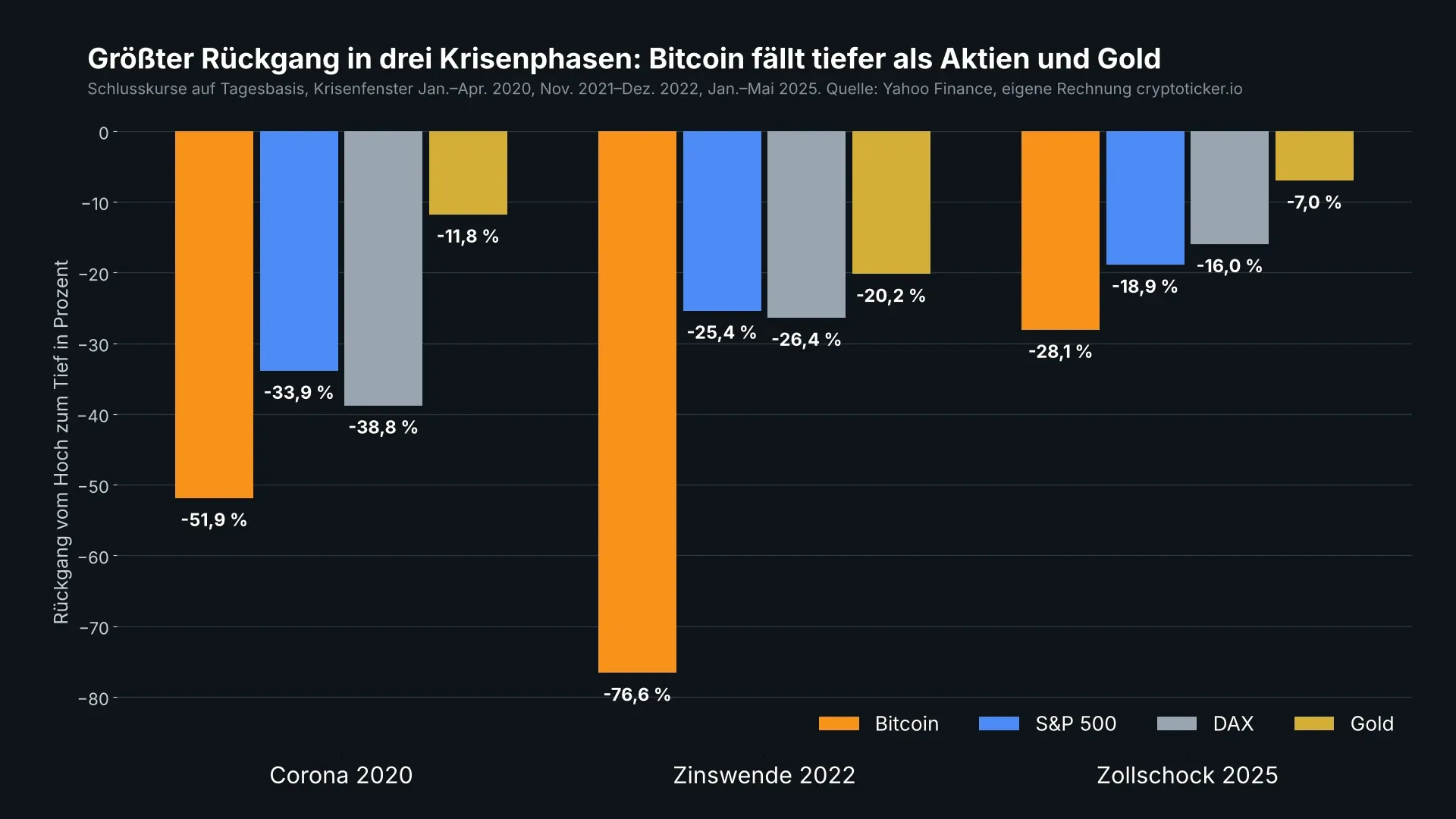
So far, bitcoin has not protected against losses in a financial crisis or recession. In the last three major downturns, the bitcoin price fell further than stocks and gold each time: by 52 percent in the 2020 Covid crash, by 77 percent in the 2022 rate turn and by 28 percent in the 2025 tariff shock. Afterwards, however, it often recovered faster than the stock market once central banks were pumping money back into the markets. Anyone wanting to understand what crypto does in an economic crisis therefore has to look less at the economy and more at interest rates and liquidity.
That contradicts the image many people have of bitcoin as "digital gold". The price data show a risk asset that is sold alongside tech stocks in a panic and gains more strongly in a recovery. For you as an investor in Germany, this is above all a question of position size and how you buy in, for example through regular purchases with one of the providers in our bitcoin buying comparison. The following sections run the numbers on the crises of 2020, 2022 and 2025 and assess where the economy stands in November 2026.
What is a recession, and when does it become a financial crisis?
A recession is a decline in overall economic output over several months. In Germany, the rule of thumb of a technical recession usually applies: gross domestic product (GDP), the value of all goods and services produced in the country, falls in two consecutive quarters compared with the previous quarter. In the US, the National Bureau of Economic Research (NBER) determines recessions and also looks at employment, income, consumption and industrial production.
A financial crisis is something else. Its origin lies in the financial system itself: banks run into liquidity trouble, credit dries up, asset prices collapse. The 2008 financial crisis triggered a deep recession, whereas the 2020 Covid recession was caused by the economy shutting down, while the banking system remained largely stable. For crypto the difference matters, because bitcoin was created explicitly as a response to the 2008 banking crisis: the first block of the bitcoin blockchain, dated January 3, 2009, carries a newspaper headline about a second bank bailout in Britain.
Telling economic crisis, bear market and crash apart
In everyday use the terms blur. A bear market means a market falling at least 20 percent from its high, a crash a slump within days. Both can happen without a recession. How bitcoin reacts to a pure stock market crash is covered in our guide to the 2026 stock market crash. This article is about the longer phases in which the economy shrinks or central banks put the brakes on growth.
Bitcoin in the 2020 Covid recession: down 52 percent, then a record year
According to the NBER dating, the shortest recession in US history lasted only two months: the peak in economic output was in February 2020 and the trough in April 2020. On the markets the crisis moved even faster. The S&P 500 fell 33.9 percent from February 19 to March 23, 2020, and the DAX 38.8 percent from February 19 to March 18.
Bitcoin was hit harder. From a close of around $10,330 on February 12, 2020, the price fell to about $4,970 by March 12, a drop of 51.9 percent. On March 12 alone, the day that went down in crypto history as "Black Thursday", bitcoin lost 37 percent on a closing basis. Investors sold everything that could quickly be turned into cash, and bitcoin could be traded around the clock. Even gold fell 11.8 percent in this phase, because many market participants needed cash for margin calls.
The rapid recovery after the flood of money
Then the picture changed. The US Federal Reserve cut its policy rate to zero in March 2020 and bought bonds on a large scale, while governments handed out support programmes. Bitcoin was back above its February high on July 27, 2020, the S&P 500 only on August 18 and the DAX not until December 28, 2020. Across the whole of 2020, bitcoin gained around 300 percent and the S&P 500 15 percent. The lesson from 2020: the first blow of a crisis hits crypto disproportionately, but so does the rescue policy that follows.
The 2022 rate turn: why bitcoin lost 77 percent without a recession
The year 2022 shows the second type of crisis. There was no recession in the US by the NBER definition, but inflation rose to its highest level in four decades, and the Fed raised its policy rate in rapid steps from near zero to over four percent. Rising rates make safe investments such as government bonds more attractive and drain capital from speculative assets. That is exactly what hit crypto.
From a close of around $67,570 on November 8, 2021, bitcoin fell to about $15,790 by November 21, 2022. That is 76.6 percent. Over the same period, the S&P 500 lost 25.4 percent from peak to trough, the DAX 26.4 percent and gold 20.2 percent. The slump was amplified by crises within the industry: the collapse of Terra and Luna in May, the bankruptcies of crypto lenders in the summer and the fall of the FTX exchange in November 2022.
A long dry spell back to the old high
This time the recovery took longer. Bitcoin did not surpass its November 2021 high again until March 4, 2024, more than 15 months after the low. The S&P 500 made it on January 19, 2024, and the DAX as early as May 2023. Anyone who sold in a panic in 2022, however, missed a rise of a good 150 percent in 2023. Anyone who bought at the high and held on needed just over two years to break even.
 Buy bitcoin: compare providers
The 2025 tariff shock: bitcoin fell further than the S&P 500
The third test case is not long ago. After the US government's tariff announcements in early April 2025, many economists expected a recession in the US. The S&P 500 fell 18.9 percent from its high on February 19 to April 8, 2025, and the DAX 16 percent from March 6 to April 9. Bitcoin lost around 28 percent from a close of about $106,150 on January 21, 2025 to April 8, trading at around $76,270 at one point.
Gold behaved in this phase the way investors expect a crisis hedge to behave: it rose to record levels, and its largest pullback in the window to the end of May was seven percent. The predicted recession did not materialise, and markets recovered when the tariffs were partly suspended. Here too, then, bitcoin fell further than stocks but recovered along with them.
Correlation with stocks: bitcoin trades like a tech stock in crises
Correlation measures how closely two prices move in step. A value of 1 means moving in complete lockstep, 0 no relationship, minus 1 opposite moves. We compared the daily price changes of bitcoin and the S&P 500 for each calendar year. In 2019 the value was minus 0.12, so bitcoin largely went its own way. In 2020 it rose to 0.43, in 2022 to 0.56. In the current year, 2026, it stands at 0.47.
For comparison, the correlation between bitcoin and gold has not been above 0.27 in any year since 2019. In practice, this means that since the arrival of large institutional investors and the spot ETFs, bitcoin has been swinging more closely with the stock market than before. In a crisis in which funds cut risk, they sell stocks and bitcoin together.
2026: bitcoin falls while stocks rise
The current year shows that the correlation is not a fixed rule. Since the turn of the year, bitcoin has lost around 17 percent as of November 10 and stands at about $73,500, some 24 percent below its high for the year on January 14. Over the same period, the S&P 500 is up a good nine percent and the DAX a good seven percent. A sharp setback on the stock market in early November nevertheless dragged bitcoin down with it, as our analysis of the bitcoin crash of November 5 shows. The link therefore works mainly to the downside.
Liquidity and central banks: what drives the recovery after a crisis
The most important driver for bitcoin in crises is liquidity: the amount of money and credit available to investors. If a central bank cuts rates or buys up bonds (quantitative easing), liquidity rises and high-risk assets benefit disproportionately. If it raises rates or shrinks its balance sheet (quantitative tightening), the opposite happens.
The three crises show the pattern clearly. In 2020, the Fed and the European Central Bank responded within days with rate cuts and bond purchases, and bitcoin recovered in four months. In 2022, central banks fought inflation, liquidity fell throughout the year, and bitcoin only found a floor after rate hikes ended. For a future recession, this means the decisive question is whether inflation leaves central banks room to cut rates. A recession with high inflation, known as stagflation, would be the less favourable environment for crypto.
The 2023 banking crisis: the case in which bitcoin rose
There is one exception to the pattern. When Silicon Valley Bank collapsed in March 2023, bitcoin rose around 36 percent from March 10 to 17, the S&P 500 only 1.4 percent. This time the crisis concerned the banking system itself, and the US authorities guaranteed all deposits. Many investors read the price rise as confirmation of the original idea behind bitcoin: an asset that does not depend on the health of individual banks. A single case, however, is no proof of lasting behaviour.

 Set up a bitcoin savings plan: providers compared
Digital gold? Bitcoin and gold compared in crises
The "digital gold" label rests on two properties: the supply is limited, to 21 million units in bitcoin's case, and no state can print new coins. A store of value is an asset that preserves its purchasing power over a long period. Over ten years, bitcoin has fulfilled this role so far, but not in acute crises. Gold lost at most just over 20 percent in the three phases examined, bitcoin up to 77 percent.
Gold has a head start of millennia: central banks hold it as a reserve and buy more in crises. Bitcoin, by contrast, is held mainly by private investors, funds and companies, which are more likely to have to sell in a recession. Whether that changes as adoption grows is an open question. Anyone looking for protection against an economic crisis today will, on the data, find it in gold and high-quality government bonds rather than in bitcoin.
Recession signals in 2026: where the German economy stands in November
Germany is not currently in a technical recession. According to the Federal Statistical Office's flash estimate of October 30, 2026, GDP grew by 0.2 percent quarter on quarter in the third quarter of 2026, adjusted for price, seasonal and calendar effects, and by 1.3 percent year on year adjusted for price, as DATEV reports the Destatis release. Consumer spending rose slightly, while investment declined. Growth is weak, but positive.
Signals you can follow if you want to know whether a recession is drawing closer:
- GDP flash estimates from Destatis, published about 30 days after the end of each quarter. Two minus signs in a row mean a technical recession.
- Labour market: rising unemployment figures from the Federal Employment Agency and in the US jobs reports are among the NBER's criteria.
- Yield curve: if yields on short-dated government bonds are above those on long-dated ones, this is called an inverted yield curve. Such a curve has preceded many recessions in the US, albeit with a long and variable lead time.
- Purchasing managers' indices: readings below 50 indicate that the companies surveyed expect business activity to shrink.
- Central bank decisions: the most important for crypto. Rate cuts in a weak economy have so far helped bitcoin, rate hikes have hurt it.
A crypto portfolio in an economic crisis: you must be able to bear a 50 percent drop
The figures allow a few sober conclusions for your crypto portfolio. First, position size: if bitcoin can realistically lose half or more of its value in a crisis, its share of your assets should be sized so that you can withstand such a drop without having to sell. Anyone who needs money for daily life during a crisis sells at the worst moment.
Second, how you buy in: a savings plan spreads purchases over many months and reduces the risk of investing everything just before a crash. Third, custody: in a financial crisis, crypto exchanges also come under pressure, as the FTX case showed in 2022. Anyone holding larger amounts for the long term should consider their own wallet or at least an exchange authorised under the European MiCA crypto regulation.
Fourth, tax: in Germany, gains from selling bitcoin are tax-free after a holding period of more than one year (Section 23 of the Income Tax Act). Losses from sales within the one-year period can be offset against gains from other private disposals. Anyone selling in a crisis should first check how long they have held the coins.
Bitcoin in a recession: without a turn in rates there is no tailwind
In the crises of 2020, 2022 and 2025, bitcoin was a risk asset with deep setbacks and a quick recovery as soon as money became cheaper. For a possible recession, this means: expect large swings and plan so that you do not have to sell.
- Spread your entry: Compare providers for regular purchases in the bitcoin savings plan comparison instead of investing a large amount at once.
- Choose how to buy: You will find the platforms' fees, spreads and withdrawal options in the comparison of providers for buying bitcoin.
- Secure custody: Look for MiCA authorisation; the comparison of regulated crypto exchanges offers an overview.
(As of November 10, 2026. This article is not investment advice. Prices and fee structures change; check the terms with the provider before you buy.)
Frequently asked questions about bitcoin in a recession
Transparency note: This article was produced with the assistance of artificial intelligence and reviewed by our editorial team before publication. All figures and claims were checked against the primary sources linked in the text. The feature image was generated with AI.
More on Bitcoin: All Bitcoin news at a glance
Related articles
- Is Gold a Safe Haven? Gold Price Falls 27% From Its Record as Stocks Crash
- Fed rate decision without a cut: “Inflation remains elevated”
- Swapping Bitcoin for gold: what it means for your holding period and tax
- Revolut wins a crypto licence in Gibraltar, but your German account stays with Cyprus
- Swapping Bitcoin for Gold: What Happens for Tax in Germany
Which topics should we dive deeper into?
Select what genuinely interests you. Your picks feed directly into our editorial planning.
Crypto news that's actually worth your time.
Weekly. 60 seconds. Carefully curated by our editors: no hype, no promo flood, no spam.

August 19, 2026 10:14 AM

Sparkasse Crypto Trading: An Assessment of the Planned October Launch
The Sparkassen are set to offer crypto trading in their own app from mid-October 2026, built by DekaBank. This assessment separates what is documented from what remains judgement.

August 18, 2026 2:48 PM

Citi Bitcoin Custody Confirmed for 2026: BTC Price Impact
Citi Bitcoin custody is going live later this year via its new Custody+ platform. Here is what a $24 trillion custodian holding BTC means for crypto prices.
August 18, 2026 4:22 AM

Bitcoin for gold: is the swap taxable in Austria?
Swapping bitcoin directly for gold? In Austria this can already trigger 27.5 percent tax on the capital gain. What investors should know.

August 11, 2026 2:48 PM

How Many Bitcoins Does Donald Trump Own?
Trump Media disclosed 14,139 BTC on August 10. The president's own filings report value brackets, not coin counts. The figures, examined.
August 10, 2026 5:15 PM

Bitcoin Lending in Austria: When Tax Falls Due
Lending Bitcoin and earning interest: when lending income is taxed at 27.5 percent in Austria and which exchange rate counts.
August 5, 2026 6:05 PM

Gold Price Jumped 4.4% in a Day — Why Bitcoin Stalled at $64,000
Gold gained 4.4%, adding roughly $1.3 trillion in market value, while Bitcoin remained near $64K. Here is why crypto failed to follow.
July 28, 2026 5:16 PM

Russia Just Passed Its Own Crypto Clarity Act While the US Senate Keeps Stalling
Russia's crypto trading law is on its way to Putin's desk while the US CLARITY Act sits unvoted on a shelf. Here is what the split means for prices.
July 25, 2026 7:02 PM
AI Stocks Went From A Few Trillion To $22 Trillion. Can The CLARITY Act Do The Same For Crypto?
The CLARITY Act is one Senate floor vote from law. Here is what the viral AI-stock comparison gets right — and what it gets badly wrong.
July 20, 2026 1:26 PM

Russia's Crypto Bill Advances: Cross-Border Trade Stays in Focus as Bitcoin Prints 5-Week High
Russia's revised crypto bill clears committee ahead of a second reading, keeping cross-border trade central — as Bitcoin posts its best weekly close in weeks.
July 15, 2026 5:09 PM

Japan Recognizes Crypto as Financial Assets — Are Bitcoin ETFs and a 20% Tax Next?
Japan has passed a landmark crypto law. Could regulated Bitcoin ETFs and a lower 20% tax rate bring billions into the market?
June 11, 2026 10:00 AM

Global Markets Crash: Why Millions Are Fleeing Stocks, Crypto, and Gold for This One Safe Haven
A massive multi-asset selloff is hitting stocks, crypto, and gold. Discover why investors are dumping everything to hoard cash as economic uncertainty peaks.
June 10, 2026 5:18 PM

Trump Warns Iran Will "Pay the Price" After Helicopter Downing: Crypto and Global Markets React
Donald Trump warns Iran will pay the price after a US helicopter downing, triggering military strikes and volatility across crypto and global markets.
June 9, 2026 6:39 PM

Crypto Market Crash Deepens as Stocks, Gold, and Bitcoin Sell Off Together
Crypto market crash deepens as Bitcoin, stocks, gold, silver, and oil fall together. Is this panic selling or a deeper market reset?
June 7, 2026 7:30 PM

Market Analysis: Why Bitcoin and Global Markets Just Collapsed
A hotter-than-expected jobs report and an AI sector panic triggered a $2.5 trillion global market liquidation, dragging Bitcoin to the $60,000 brink.
May 15, 2026 3:56 PM

Bitcoin Price Drops Below $80,000 as $700 Billion Wiped from US Stocks
Bitcoin plunges under $80,000 as US stock markets lose $700 billion at the open. Gold and silver see $1.5 trillion wiped in a massive global asset liquidation.
April 30, 2026 8:09 PM

Bitcoin vs Gold: Why History Suggests a Massive Rally After the 2026 Drop
Gold just hit a massive peak in early 2026, and Bitcoin followed with a -33% drop. Is this the setup for a 500% surge? Historical data suggests a pattern.
April 21, 2026 8:57 AM
Aave Liquidity Crisis: The 'Slow Burn' Trap Freezing Millions in USDC and USDT
Aave faces a liquidity trap as USDC/USDT utilization hits 100%. Here's how the 'Slow Burn' mechanism freezes lender withdrawals and benefits borrowers.
April 2, 2026 12:08 PM

Safe Havens Are Failing — Why Gold, Silver, and Crypto Are All Falling Together
Gold and silver are crashing despite war tensions. Why are safe havens failing—and what does it mean for crypto markets?
March 27, 2026 9:47 PM
Gold vs Bitcoin Analysis 2026: Why Both Are Dropping Despite Geopolitical Risks
Gold and Bitcoin prices are facing a sharp 2026 correction. Why is the correlation between XAU and BTC shifting amid Fed hawkishness and Middle East risks?
March 19, 2026 2:30 PM

Bitcoin News Today: Why BTC Dropped Below $70,000 After a Massive Rally
Bitcoin news today shows BTC dropping below $70,000 as rising oil prices and a hawkish Federal Reserve halt the recent crypto market rally.
March 15, 2026 6:00 AM

Bitcoin ETFs See $760M Inflows as Operation Epic Fury Reshapes Global Finance
Amidst Operation Epic Fury, Bitcoin ETFs recorded $760M in net inflows this week. While traditional markets lose $5T, BTC consolidates its role as digital gold.
March 14, 2026 9:45 AM

War in the Middle East: Stock Market Bleeds $2.4 Trillion While Crypto Gains Ground
The US-Iran war triggers a $2.4T stock market wipeout while crypto gains $250B. Discover why the total crypto market cap is up 5% amid global conflict.
March 5, 2026 2:11 PM

Bitcoin Safe Haven Narrative Returns: Will Global Instability Push Investors Toward BTC?
As geopolitical tensions rise worldwide, investors are asking if Bitcoin can act as a safe haven like gold. Could global instability push more money into BTC?
March 4, 2026 4:57 PM
Bitcoin Breaks $73K as Global Markets Shake: Is Crypto Becoming the World’s Crisis Hedge?
Bitcoin breaks $73K while global markets drop amid geopolitical tensions. Is crypto emerging as the world's crisis hedge during global instability?
February 20, 2026 6:00 AM
Top 3 Reasons Why Cryptos Might Crash Hard Soon: Geopolitics and Macro Risks
Is a crypto crash coming? Explore the top 3 reasons why Bitcoin and altcoins could face a major sell-off, from Middle East tensions to Fed policy.


More from CryptoTicker