
Russia's Crypto Bill Advances: Cross-Border Trade Stays in Focus as Bitcoin Prints 5-Week High
Russia's revised crypto bill clears committee ahead of a second reading, keeping cross-border trade central — as Bitcoin posts its best weekly close in weeks.





Which topics should we dive deeper into?
Select what genuinely interests you. Your picks feed directly into our editorial planning.
Crypto news that's actually worth your time.
Weekly. 60 seconds. Carefully curated by our editors: no hype, no promo flood, no spam.
Russia's push to bring digital assets into international commerce is moving forward, though not as quickly as first planned. After passing its first reading back in April, the government's crypto bill has been revised and cleared for its next stage. Russia's State Duma committee has approved a revised cryptocurrency regulation bill for its second reading, removing a proposed requirement to declare crypto wallet addresses while adding provisions for crypto-funded investments and new transfer controls.

The headline feature for businesses is unchanged: crypto stays banned for domestic payments but is permitted for cross-border trade. Meanwhile, Bitcoin is flashing strength of its own, closing above key long-term support for a third straight week. Below, we cover both the regulatory update and what the BTC chart is signaling.
Where does Russia's crypto bill actually stand right now?
It has passed one of three required readings. The bill, formally titled "On Digital Currency and Digital Rights," passed its first reading with 327 of 340 deputies voting in favor. Since then it has been reworked. Russia's Financial Markets Committee approved the revised bill for its second reading, with Chairman Anatoly Aksakov saying the proposal removes wallet address reporting while strengthening legal protections for crypto owners.
Importantly, the second-reading floor vote hasn't taken place yet. The committee endorsement was announced through Aksakov's Telegram channel, and records on the State Duma website had not yet been updated since the bill cleared its first reading in April. Two Duma readings, Federation Council approval, and a presidential signature are still required before it becomes law.
What changed in the revised bill?
Several things. The updated draft no longer requires cryptocurrency holders to declare wallet addresses; instead, users would only need to report wallet balances and transaction volumes. Aksakov said the revision is intended to reduce the risk of sensitive information being exposed in ways that could be used against Russia.
New investment and control provisions were also added. Investors would be allowed to purchase Russian securities and Digital Financial Assets using cryptocurrencies, and licensed Russian brokers and asset managers could eventually gain access to approved foreign crypto exchanges, subject to additional conditions. Retail investment limits remain unchanged, while the bill introduces a new provision allowing authorities to delay certain large outbound crypto transfers for up to two days. The retail cap holds at 300,000 rubles annually.
 CryptoTicker trading game: try it free
Why does the cross-border trade angle matter?
Because it hands Russian companies a settlement route outside sanctioned banking channels. The bill maintains crypto's ban for domestic payments while carving out its use in foreign trade and, in the revised text, covering investor eligibility, consumer protections, cross-border crypto transactions, and the use of digital assets in Russia's financial markets. The scale is significant: Russian exporters and importers moving goods across an estimated $240 billion in trade volume and facing payment friction would gain a legal pathway to settle contracts in cryptocurrency.
Only major assets are expected to qualify. Only cryptocurrencies with market caps above 5 trillion rubles (around $66.6 billion) and a five-year trading history would be eligible, with Bitcoin and Ethereum the expected first approvals.
When will the law take effect?
Later than originally targeted. Finance ministry official Alexey Yakovlev told Interfax the bill is largely ready but unlikely to be adopted by the initial July 1, 2026 target, having been sent back for committee review before its second reading. No firm replacement date has been confirmed, so the timeline now hinges on how quickly the remaining readings and approvals proceed.
Bitcoin Price Analysis: Why s Bitcoin Price UP?
Bitcoin just delivered its highest weekly close in five weeks. More notably, $BTC closed above its 200-week moving average support for the third consecutive week — resilience that stands out given the Nasdaq 100 fell more than 4% over the same period. That divergence from tech equities at a major support zone is exactly what bulls want to see.
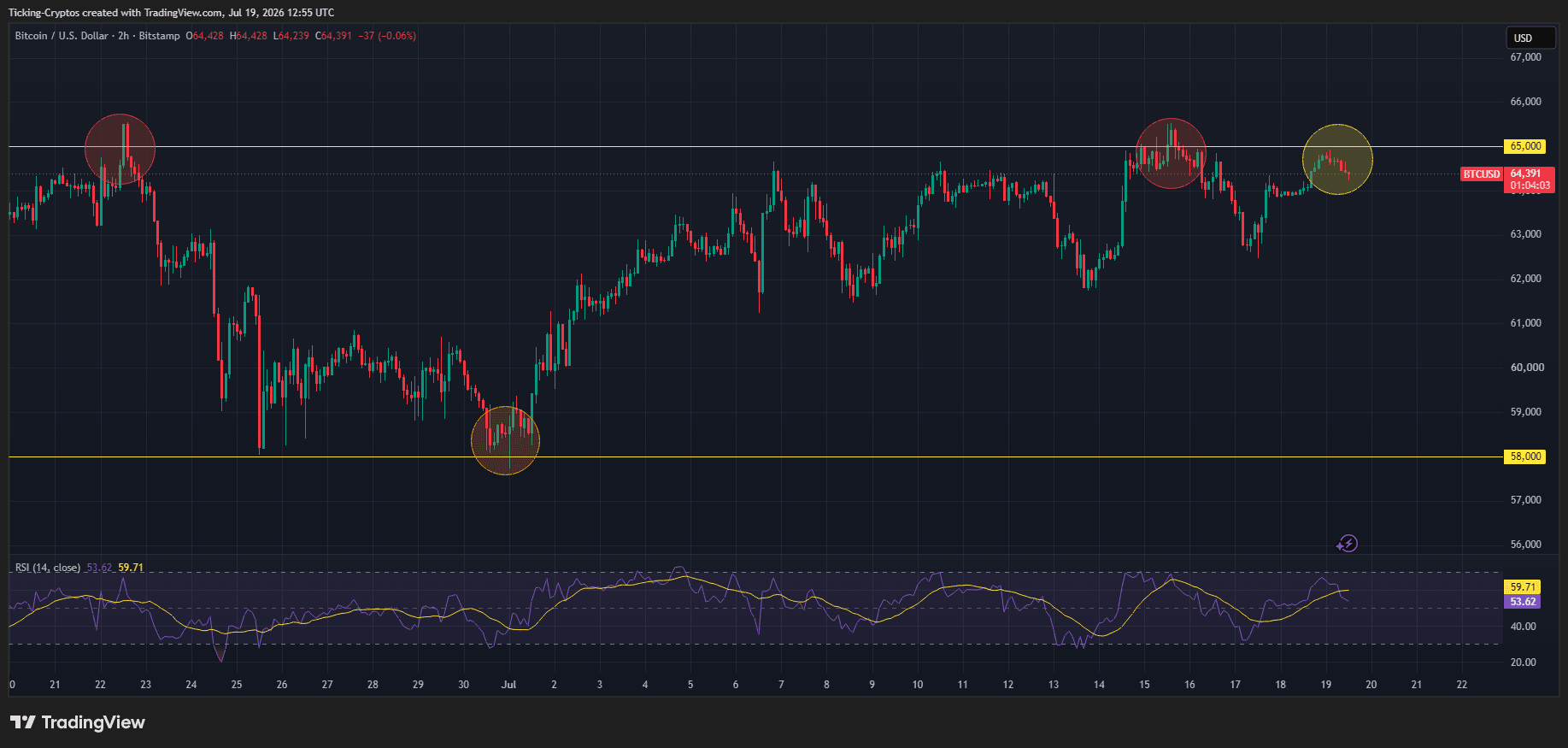
The technical picture is constructive. The MACD has turned bullish, the RSI bullish divergence remains valid, and the Stochastic RSI is showing positive momentum. The bullish engulfing candle from three weeks ago is also still holding — a pattern that has appeared three times this cycle, each time followed by a strong rally.
Which Bitcoin levels matter most?
The map is clean on both sides. Resistance sits at $67,000, then $83,000. Support sits at $58,000, then $49,000.
Two scenarios stand out. If BTC holds above $58K, it could break toward $67K and then $83K. If instead BTC closes below $58K on the weekly chart, the next meaningful support is around $49K. With price currently trading near $64K, the $58K weekly close is the line in the sand to watch.
Frequently asked questions about Russia's crypto law
Related articles
- Russia Just Passed Its Own Crypto Clarity Act While the US Senate Keeps Stalling
- Bitcoin Price Corrects After $76,000 High: Is This a Consolidation or a Crash?
- Crypto Market Crash News As BTC Price Crash Back To 56K
- Ripple Leads the Tokenization Revolution with XRP
- What Bitcoin Strategy yields $400M in Profits?
Which topics should we dive deeper into?
Select what genuinely interests you. Your picks feed directly into our editorial planning.
Crypto news that's actually worth your time.
Weekly. 60 seconds. Carefully curated by our editors: no hype, no promo flood, no spam.

June 24, 2024 10:37 AM

Bitcoin Price Prediction: Can BTC Price Fall Below 50K?
The profitability of Bitcoin futures cash-and-carry trades has plummeted amid a significant crypto market selloff. What are the reasons behind the decline and what can traders expect next?
July 1, 2024 9:20 AM

Bitcoin News Today: Why Is Bitcoin Price Up Starting July?
Starting July, recent market movements, political debates, and court rulings are shaping the future of Bitcoin and the broader crypto market. Here are the latest insights and analysis...
May 1, 2026 8:29 AM

Bitcoin Ends April with 11.87% Gain as Bulls Reclaim Key Support
Bitcoin closed April 2026 with an 11.87% gain, decisively finishing above the $75,900 monthly high and signaling a major shift in macro momentum.
April 18, 2025 1:05 PM

Massive BTC & ETH Options Expiry Today – What It Means for the Market
Over $2.25 billion in Bitcoin and Ethereum options are expiring today, sending ripples across the crypto market. With traders eyeing the “max pain” levels, could we see sudden price swings in BTC and ETH?
March 11, 2026 8:31 AM

Why is Bitcoin Moving Sideways? 3 Reasons for the BTC Price Consolidation
Bitcoin has dropped only 0.9% this month but remains trapped in a range. Here's why BTC is moving sideways and how traders are profiting from 63K to 73K.
August 4, 2024 12:18 PM

Bitcoin Price Prediction: Will BTC Rebound or Crash Below Key Support?
Bitcoin has experienced a significant price drop, falling from $67.5K to around $60,750 over the past week. What's next for Bitcoin price?

March 22, 2026 1:16 PM

Bitcoin Price Prediction: This Might Be the BEST TIME to Trade BTC for Profit...
Bitcoin price hovers near $69,000 as volatility returns. Here are the latest Bitcoin price predictions and professional strategies to profit from this market phase.
April 22, 2026 9:11 AM
Bitcoin Price Hits $78,000 as Ceasefire Extension Ignites Bullish Momentum
Bitcoin breaches $78,000 following the US-Iran ceasefire extension and a $2.5 billion MSTR purchase. Here is the weekly BTC chart for key 2026 price targets.
June 25, 2024 6:26 PM

Solana Price Prediction: Will SOL Surpass 200$?
Why Solana, Shiba Inu, and Cardano are poised for a major rebound, according to the latest market analysis. Can Solana capitalize on the buy signals and reach a new price target?
February 12, 2025 8:00 AM

Crypto News & Finance Updates: Hong Kong Recognizes Bitcoin & Ethereum for Investment Visa
Hong Kong has officially recognized Bitcoin and Ethereum as valid proof of wealth for its CIES. Could this decision drive BTC and ETH prices higher signaling a major shift in crypto adoption?
January 22, 2026 2:51 PM

Bitcoin Price Prediction: Will Geopolitical Tensions Push BTC Below $85,000?
Bitcoin price faces heavy pressure as geopolitical tensions over Greenland and US-EU trade wars trigger a flight to safety. Can BTC hold key support?
September 10, 2024 1:54 PM
Bitcoin Price Analysis: Why Is BTC Price Up TODAY?
Why Bitcoin price surged today, and was it driven by market anticipation of U.S. inflation data and the Trump vs. Harris debate?
April 17, 2026 9:21 AM

Bitcoin News Today: BTC Coin Hits $75,000 as US Treasury Injects $15B Liquidity
Bitcoin price breaks $75,000 for the first time in 73 days. Read why the massive US Treasury buyback and BlackRock inflows are fueling this historic BTC rally.
July 7, 2024 6:40 PM

Will BTC Price Crash Again After The Dormant Bitcoin Whale Move?
A decade dormant Bitcoin Whale just moved 140 BTC. Is it a sign of a new BTC price crash or surge soon? What is there to know...
October 21, 2025 4:17 PM

Bitcoin Surges Past $112,000 as the Fed Opens Doors to Crypto: What’s Next?
Bitcoin jumps above $112,000 after the U.S. Federal Reserve hinted at granting crypto firms access to its payment network. Here’s what this means for BTC and the broader market.
April 30, 2026 8:09 PM

Bitcoin vs Gold: Why History Suggests a Massive Rally After the 2026 Drop
Gold just hit a massive peak in early 2026, and Bitcoin followed with a -33% drop. Is this the setup for a 500% surge? Historical data suggests a pattern.
September 1, 2024 1:30 PM

Bitcoin Price Prediction: How Will September Unfold For BTC Price?
Bitcoin price is facing significant market volatility, as it hovers around $58,000. What are the key indicators and on-chain data shaping the future of BTC Price, and how will September unfold?
August 17, 2024 2:55 AM

Bitcoin Price Prediction: How Will BTC Price Move Following Gold's Surge?
Will Bitcoin break through resistance and rally, or are there further declines on the horizon, for the second half of August? This is the latest analysis of Bitcoin’s price...
March 10, 2026 8:47 AM

Bitcoin Reclaims $70,000: Why is BTC Price Surging Despite Middle East Tensions?
Bitcoin price has surged back above the $70,000 mark. Explore the technical chart analysis and how Middle East instability is shaping the current BTC rally.
March 4, 2025 9:17 PM

Bitcoin Price Prediction ahead of the Upcoming White House Crypto Summit
With the remarkable Bitcoin volatility, and after briefly surging earlier this week before dropping again. Is a Bitcoin price surge expected ahead of or after the upcoming White House Crypto Summit?
September 14, 2024 12:01 PM
Bitcoin Surges Past $60K: The Start of a Major Rally or Just Another Bull Trap?
Bitcoin has surged past $60,000, sparking optimism among investors. But with looming market volatility and whale activity, is this the start of a new rally or just another bull trap?

February 26, 2024 7:36 AM

Bitcoin Price Prediction: When will the Bitcoin price surge to $70,000?
Recently, Bitcoin's price has surged dramatically over the past few weeks. Let's take a look at this Bitcoin price prediction article.
January 13, 2024 7:10 AM
Bitcoin Price Prediction: Will the BTC Price Crash to $35,000?
Will the BTC price crash to $35,000? Let's take a look at this Bitcoin price prediction article in more detail.
May 26, 2020 12:37 PM

Bitcoin Price Analysis: Is BTC Price Recovering?
The Bitcoin halving event is just a few days away. The Bitcoin price is already showing a slight recovery after a considerable decline. Is this the perfect time for a rally above $10,000 and towards the all-time high at $20,000? […]
February 27, 2026 5:23 PM

Bitcoin Price Analysis: BTC Drops to $65K as Market Enters Critical Consolidation Phase
Bitcoin price faces a sharp correction to $65,000. Here's the latest BTC analysis, key support levels, and why the market is entering a consolidation phase.

More from CryptoTicker