
Is Gold a Safe Haven? Gold Price Falls 27% From Its Record as Stocks Crash
Gold fell 3.6 percent on the day US stocks crashed and is now 27 percent below its January record. Our comparison of six crises since 2007 shows when gold protects investors, when it fails and what would make it a safe haven again.





Which topics should we dive deeper into?
Select what genuinely interests you. Your picks feed directly into our editorial planning.
Crypto news that's actually worth your time.
Weekly. 60 seconds. Carefully curated by our editors: no hype, no promo flood, no spam.
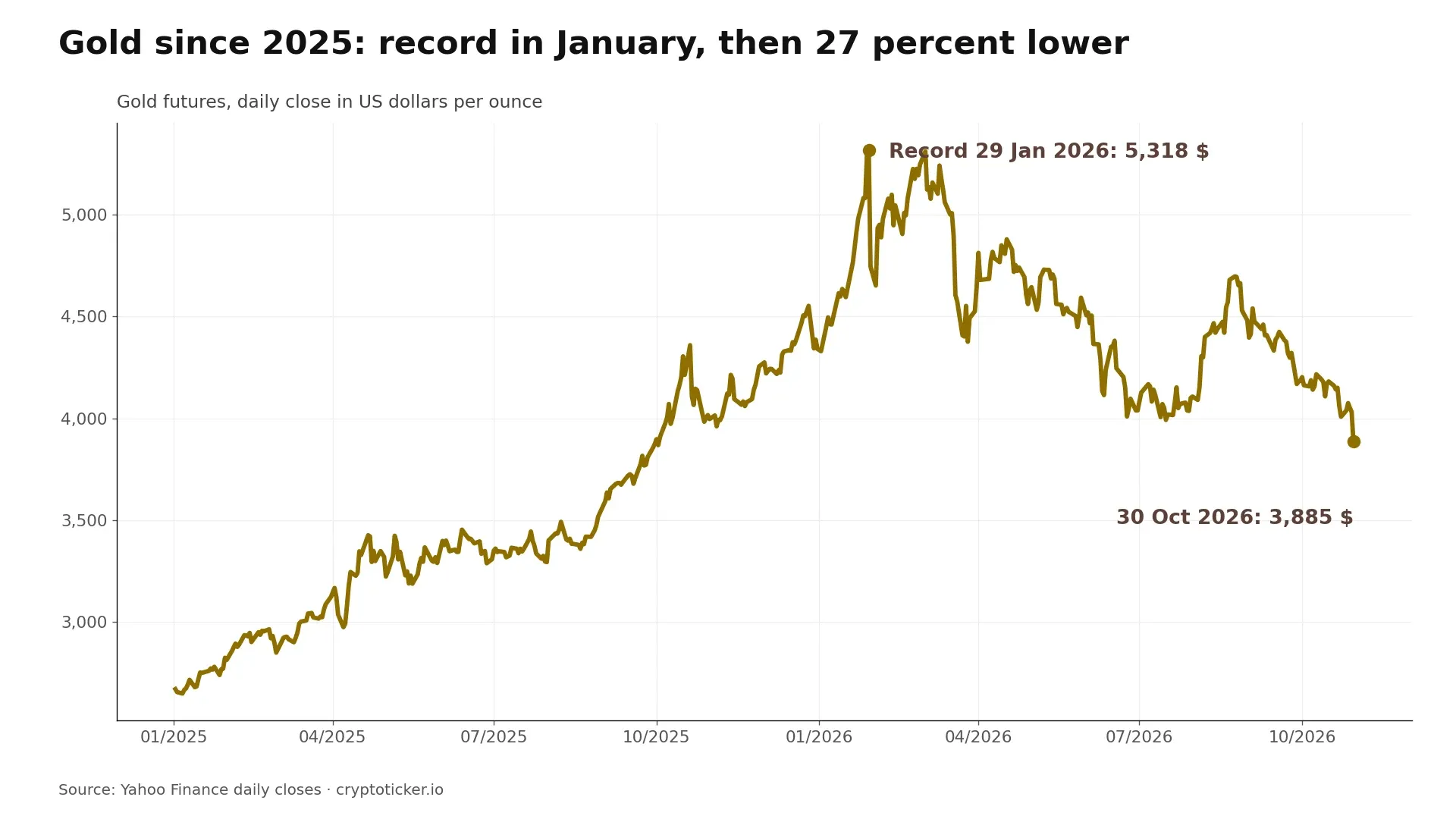
Gold is not protecting investors in this crash. While the US stock market had its worst day since June on Friday, 30 October 2026, gold futures fell 3.6 percent to $3,884.90 per ounce, according to daily closes on Yahoo Finance. In October the gold price lost 7.2 percent, its second monthly decline in a row. Since its record close of $5,318.40 on 29 January 2026, gold is down 27 percent. Our analysis of six market crises since 2007 shows that this is not unusual: in the acute phase of a crash, gold often falls together with stocks. It only proved its value as a safe haven later, when central banks started to cut rates.
Gold price in the crisis: the key facts
- Friday, 30 October: gold futures −3.6 % to $3,884.90, Nasdaq −2.86 %, S&P 500 −1.82 %.
- October 2026: gold −7.2 %, Bitcoin −7.6 %, Nasdaq −5.3 %, S&P 500 −0.9 %.
- Since the record: −27.0 % from the close of $5,318.40 on 29 January 2026; year to date −10.5 %.
- Main driver: expectations of further rate hikes by the Fed, fuelled by higher oil prices.
- History: in the Covid crash of March 2020 gold fell 11.7 percent in ten days, then set a record in August.
- Long view: over the full financial crisis from 2007 to 2009 gold gained 24.5 percent while the S&P 500 lost 56.8 percent.
The stock market sell-off itself is covered in our analysis why US stocks now swing like meme tokens. Here we look at the other side: where investors could have hidden, and why gold did not help this time.
Why is the gold price falling? Three reasons
1. Rate hikes instead of rate cuts. Gold pays no interest. When rates rise, holding it becomes more expensive compared with bonds. The Fed kept its key rate at 3.75 to 4.00 percent on 28 October, but two officials voted for a hike, and futures markets price a hike in December at around 80 percent according to the CME FedWatch tool. That is the opposite of the environment in which gold rallied in 2025.
2. Oil drives inflation fears. On Friday, renewed attacks on commercial shipping in the Strait of Hormuz pushed crude oil higher and reinforced inflation concerns, Kitco reported. Normally geopolitical tension supports gold. This time it strengthens the case for higher rates, and that weighs more. Silver fell to its lowest level of the year at around $50.
3. Selling for liquidity. When stocks fall sharply, investors sell what they can sell quickly and at a profit, and gold had more than doubled in the two years before the record. Analysts at XTB ask exactly that question: the end of the safe-haven myth, or a search for liquidity?
The break in the trend came earlier. Gold crashed 10.8 percent on 30 January 2026, its worst day in our data series since 2005, after the nomination of Kevin Warsh as Fed chair; we analysed that day in why gold plunged $600 in 24 hours.
 Crypto brokers compared
Is gold a safe haven? What six crises show
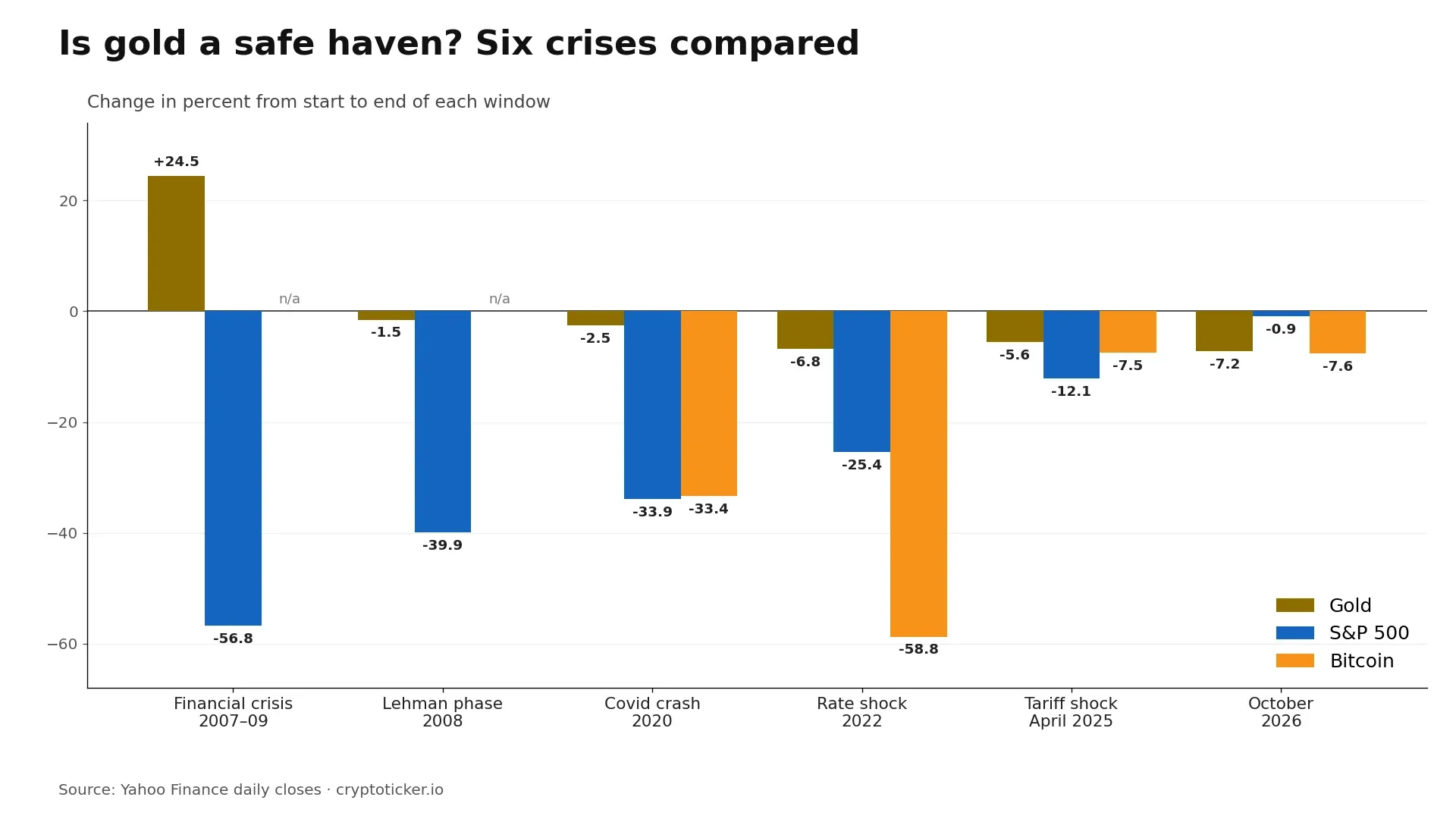
Gold is a safe haven over years, but rarely in the first weeks of a crash. That is the result of our comparison of gold futures, the S&P 500 and Bitcoin in six crisis windows, each measured from the market peak to the low or over the acute phase.
| Crisis | Window | Gold | S&P 500 | Bitcoin |
|---|---|---|---|---|
| Financial crisis | 9 Oct 2007 to 9 Mar 2009 | +24.5 % | −56.8 % | not traded yet |
| Lehman phase | 12 Sep to 20 Nov 2008 | −1.5 % | −39.9 % | not traded yet |
| Covid crash | 19 Feb to 23 Mar 2020 | −2.5 % | −33.9 % | −33.4 % |
| Rate shock | 3 Jan to 12 Oct 2022 | −6.8 % | −25.4 % | −58.8 % |
| Tariff shock | 2 to 8 Apr 2025 | −5.6 % | −12.1 % | −7.5 % |
| October 2026 | 30 Sep to 30 Oct 2026 | −7.2 % | −0.9 % | −7.6 % |
Three patterns stand out:
- Gold loses less, but it often loses. In all five shorter windows gold fell, and in four of them far less than the S&P 500. In 2008 and 2020 it was a cushion, not a winner.
- The first wave hits gold too. In March 2020 gold fell 11.7 percent between 9 and 19 March, from $1,674 to $1,479, because investors needed cash. In 2008 gold lost 27 percent between March and October, from about $1,001 to $729. Today's 27 percent drop from the record is therefore not without precedent.
- The rebound comes with rate cuts. After both crashes, central banks cut rates to zero and printed money. Gold then set new records: $2,069 in August 2020, and a gain of 24.5 percent over the full financial crisis. In 2022, when the Fed hiked aggressively, gold lost, and this is the situation markets are now pricing again.
October 2026 is a special case: gold and Bitcoin fell further than the S&P 500. Both suffer from the same factor, expected rate hikes, while the broad stock index was still close to its record at the start of the month.
 Regulated crypto exchanges compared
Gold vs Bitcoin in 2026: neither was a safe haven
Since the start of the year gold has lost 10.5 percent and Bitcoin 11.8 percent, while the S&P 500 is still up 10.7 percent, measured from the closes on 31 December 2025 to 30 October 2026. The two assets that are sold as protection against inflation and money printing are both under water in a year of rising rate expectations. For Bitcoin, the Binance hack on 29 October came on top; we explain the case in North Korea behind the Binance hack.
Our view: gold and Bitcoin are bets on falling real rates and on doubts about paper money. As long as the Fed is expected to hike, both lack their most important tailwind. That says nothing about the long term, as 2008 shows, but it explains why neither helped in October. A longer comparison of both assets is in our analysis Bitcoin vs gold.
What would make gold a safe haven again
History points to three signals that preceded the big gold rallies after crises:
- The Fed stops hiking. The next data points are the US jobs report on 6 November and the Fed meeting on 9 December.
- The economy weakens noticeably. September brought only 29,000 new jobs; a weaker October would shift expectations from hikes to cuts.
- The oil price calms down. As long as the Strait of Hormuz drives inflation fears, gold reacts to rates rather than to fear.
None of these signals is visible yet. The midterm elections on 3 November add uncertainty, but historically elections have moved gold less than interest rates.
How investors can hold gold
There are four common ways: physical bars and coins, exchange-traded products backed by gold, gold futures for professionals, and tokenised gold such as PAX Gold (PAXG) or Tether Gold (XAUT), which trade on crypto exchanges around the clock. Tokenised gold combines the price of gold with the trading hours of crypto, but it depends on the issuer that holds the bars. Anyone who wants to buy gold or Bitcoin through an exchange should compare costs and regulation first; our crypto exchange comparison lists the providers. This article is not investment advice; gold, like Bitcoin, can fall sharply.
FAQ: gold in the crisis
Transparency note: This article was produced with the assistance of artificial intelligence and reviewed by our editorial team before publication. All figures and claims were checked against the primary sources linked in the text. The feature image was generated with AI.
Related articles
- Copper Price Slides as Gold and Silver Crash — What It Signals for Crypto and Markets
- Why Is Crypto Crashing Today? Bitcoin Slides to $76,000 as the CLARITY Act Vote Wobbles
- Gold vs Bitcoin Analysis 2026: Why Both Are Dropping Despite Geopolitical Risks
- Why is the Market Dumping? Bitcoin Below $66k as Geopolitical Risks Explode
- Bitcoin Price Crash: Top 3 Reasons Why BTC Price Dropped Below $80,000
Which topics should we dive deeper into?
Select what genuinely interests you. Your picks feed directly into our editorial planning.
Crypto news that's actually worth your time.
Weekly. 60 seconds. Carefully curated by our editors: no hype, no promo flood, no spam.

March 27, 2026 9:55 PM

Why Are Gold and Silver Crashing While Bitcoin Is Rising? Markets Send a Strange Signal
Gold and silver drop sharply while Bitcoin climbs back above $73K. Why are traditional safe havens falling while crypto rises?
October 8, 2026 4:38 AM

Crypto Market Slides: Bitcoin Loses 4.2 Percent and $651 Million of Long Bets Are Liquidated
Bitcoin has lost 4.2 percent since Tuesday afternoon, and ether and XRP more still. Three reasons can be documented: outflows from the US ETFs, $651 million of forcibly closed long bets and Fed minutes holding out the prospect of another rate rise. A crash it is not, and what to check before buying more is set out here.
July 28, 2026 11:53 AM

Why Is Crypto Down Today? The Reasons Behind Every Crypto Sell-Off
Why crypto is falling today, updated with every major move: the current trigger, the six forces behind almost every crypto sell-off, a five-minute checklist and a timeline of the 2026 drops.
April 2, 2026 12:08 PM

Safe Havens Are Failing — Why Gold, Silver, and Crypto Are All Falling Together
Gold and silver are crashing despite war tensions. Why are safe havens failing—and what does it mean for crypto markets?
January 23, 2026 1:00 PM

Gold Hits New All-Time Highs as Crypto Struggles — Is Capital Bracing for a Global Shock?
Gold and silver hit new all-time highs as crypto struggles to hold support. Is rising geopolitical risk pushing markets into defensive mode?
March 4, 2026 4:57 PM
Bitcoin Breaks $73K as Global Markets Shake: Is Crypto Becoming the World’s Crisis Hedge?
Bitcoin breaks $73K while global markets drop amid geopolitical tensions. Is crypto emerging as the world's crisis hedge during global instability?
October 20, 2026 10:38 AM
Crypto Crash Today: Why Is Bitcoin Stuck Below $82,000?
Bitcoin can't hold $82K, Ethereum is down 20% in 2026 and ETF money keeps leaving. Here is what is really behind the crypto crash today.
June 15, 2024 3:00 PM
Bitcoin Price Prediction in June 2024: Why is Bitcoin Price Down?
Bitcoin's recent plunge from its psychological price of $70,000 to $66,250 has triggered widespread concern in the cryptocurrency market. Why is Bitcoin price down?
January 29, 2026 9:00 AM

Gold vs Bitcoin Analysis: Why Gold is Shifting the Safe Haven Narrative in 2026
Gold hits record highs above $5,500 while Bitcoin struggles to hold $90,000. Analyze the decoupling of digital and physical gold in the 2026 market.
January 28, 2026 10:44 AM

FOMC Rate Decision: Bitcoin Braces for Volatility as Gold Hits $5,300
Bitcoin stays under $90k as the FOMC meeting approaches. With Gold hitting a record $5,300, traders expect major crypto market volatility after Powell's speech.
March 14, 2026 9:45 AM

War in the Middle East: Stock Market Bleeds $2.4 Trillion While Crypto Gains Ground
The US-Iran war triggers a $2.4T stock market wipeout while crypto gains $250B. Discover why the total crypto market cap is up 5% amid global conflict.
August 28, 2024 6:13 PM
Bitcoin Price CRASH: BTC Falls Below $60K, Eyes Support at $56.7K
BTC fails to breach the $66K level, crashing below $60K to around $58K. Can Bitcoin find support at $56.7K, or is another drop on the horizon?
October 30, 2026 8:02 AM

Bitcoin Price After Binance Hack: Only 2% Down. What Comes Next?
Bitcoin fell only 2% after the biggest crypto hack ever drained $2.8 billion from Binance. Here are the higher and lower Bitcoin price targets now.
September 10, 2024 1:54 PM

Bitcoin Price Analysis: Why Is BTC Price Up TODAY?
Why Bitcoin price surged today, and was it driven by market anticipation of U.S. inflation data and the Trump vs. Harris debate?
September 29, 2026 10:38 AM

Bitcoin Falls Toward $83,000 as Trump Rejects Iran Ceasefire Deal
Bitcoin slipped toward $83,000 after Trump rejected Iran's Hormuz proposal, sending oil above $100 and wiping out $478 million in crypto liquidations.
October 27, 2026 5:23 PM

China AI Bubble Bursts: $480 Billion Gone, So Why Is Bitcoin Not Crashing?
China’s AI stock bubble has burst, erasing $480 billion as the STAR50 drops 40%. Here is why it happened and what it means for Bitcoin and crypto.
October 25, 2026 10:51 AM

Crypto Crash: Why the Top Cryptos Lost Up to 4% in One Week
Crypto crash week: the largest cryptos lost up to 4% in seven days. We break down why crypto prices are falling and what to watch next.
May 28, 2026 6:42 PM

Crypto Market Crash Deepens While S&P 500 Hits New All-Time High: Why Is Bitcoin Falling?
Crypto prices fall as Bitcoin, Ethereum, and Solana struggle while the S&P 500 hits a record high. Why is crypto not following stocks?
April 12, 2026 11:07 AM

Bitcoin Price Drops to $71,500 as US-Iran Peace Talks Collapse in Islamabad
Bitcoin retraces to $71,500 after failed US-Iran peace talks in Pakistan. Geopolitical tensions resurface, impacting the global crypto market sentiment.

October 29, 2026 9:40 PM

Crypto Crash After Binance Hack: $628 Million Liquidated in One Hour
At 20:24 UTC a Binance hot wallet was drained of about $2.8 billion. Within an hour Bitcoin fell below $79,000 and BNB lost 6.3%. Here is the minute-by-minute timeline, the prices of all major coins and what could come next as Asia wakes up.
June 4, 2026 9:52 AM

Why is Crypto Down Today? Market Liquidation Erases Billions
The cryptocurrency market is facing severe downward pressure today. Bitcoin fell over 5% while altcoins like Solana and Ethereum incurred heavier losses.
March 26, 2026 1:23 PM

Crypto Ignores Bullish News as War Risk Takes Over — Why Bitcoin and Ethereum Are Falling Anyway
Bitcoin and Ethereum fall despite bullish crypto news as war risks, oil spikes, and macro pressure dominate market sentiment.
March 15, 2026 6:00 AM

Bitcoin ETFs See $760M Inflows as Operation Epic Fury Reshapes Global Finance
Amidst Operation Epic Fury, Bitcoin ETFs recorded $760M in net inflows this week. While traditional markets lose $5T, BTC consolidates its role as digital gold.
March 2, 2026 2:47 PM

Oil vs Gold vs Bitcoin: Which Asset Wins During Middle East Tensions?
Oil surges, gold rallies, and Bitcoin struggles as Middle East tensions rise. Which asset performs best during geopolitical crises?
July 25, 2024 12:35 PM

Ethereum Price Analysis: Why is Ethereum Price Down?
Here is the impact of the recent Ethereum ETF launch on the crypto market, leading to a significant sell-off and a $300 million liquidation event. Not what was expected?


More from CryptoTicker