
Velocity Replaces Drift After the 285 Million Dollar Hack: What Changes for Investors in Germany
The Solana perp DEX Drift is back as Velocity, and since September 29, 2026 a new team has been running it. What the overhaul after the outflow of 285 million dollars means for your deposits, for settlement in USDT and for the legal position in Germany.





Which topics should we dive deeper into?
Select what genuinely interests you. Your picks feed directly into our editorial planning.
Crypto news that's actually worth your time.
Weekly. 60 seconds. Carefully curated by our editors: no hype, no promo flood, no spam.
The perpetuals venue Drift on Solana has been called Velocity since its relaunch, and since September 29, 2026 a different team has been running it. Co-founder Cindy Leow has stepped back from her role, five months after attackers pulled around 285 million dollars out of the exchange's vaults on April 1. For you this is more than a change of name: trading is now settled in USDT instead of USDC, several functions have disappeared, and there is still no MiCA authorization for the German market.
A perp DEX is a decentralized exchange for open-ended futures contracts where you bet on price moves with leverage without owning the coin itself. The money does not sit with a bank; it sits in smart contracts, the so-called vaults. Those vaults were exactly what the April attack went after.
Velocity replaces Drift: the relaunch in numbers
The way back came in stages. On September 17, 2026 the project opened up its source code. On September 21 the whitelist fell, which until then had let only selected accounts trade, and the public beta was open to everyone. On September 29 the change at the top followed.
Leow explained her departure on X by pointing to the phase the project is now in. Her strength, she said in substance, lies in building from zero to one, and Velocity now needs people who take it from one to ten; she trusts this team to do that. Five names are taking over: a lead for fund recovery and law enforcement, a protocol engineer who previously headed the Helium Network, a product chief with a Binance background, a partnerships lead and a growth lead who comes from Binance and Trust Wallet.
The scale involved can be read off the back story. Before the attack, Drift had handled more than 150 billion dollars in trading volume, according to figures from around the project. Solana's perp platforms together reached 1.08 trillion dollars in cumulative volume by August 2026. Its own token, DRIFT, trades at around 0.019 dollars at the turn of the month, far below the big names; on the market-value ranking it sits around position 1,080.
The April 1 attack: 285 million dollars out of the vaults
On April 1, 2026 around 285 million dollars flowed out of the vaults. Before the attack more than 550 million dollars were locked in the protocol, so the outflow amounted to roughly half of the total value deposited. TVL, short for total value locked, describes the sum of all deposits sitting in a protocol's contracts.
That figure puts the case in order of magnitude. In September 2026, losses from crypto attacks across the industry added up to 766 million dollars. A single incident of 285 million dollars therefore belongs in the top category of what has happened this year, and the venue it hit was among the most active in the Solana ecosystem.
Fake collateral token: the attack path in detail
The technical lever was a forged collateral token. Collateral is the security you post so the exchange allows you a leveraged position; the contract weighs its value against your risk. If a worthless token can be made to count as valuable security, a real payout can be drawn against thin air.
What came before that was social engineering rather than a technical break-in. According to the project's account, the attackers obtained administration rights by building trust over months and manipulating people. Leow spoke of an infiltration prepared over six months. This is the part that code alone cannot catch: where a human grants the permission, the human is the point of attack.
For you as a user of a trading venue, that leads to an uncomfortable insight. A protocol can be cleanly written and audited several times and still fall because someone with elevated rights was deceived. Anyone who leaves a balance sitting on an exchange permanently carries that risk too. An overview of which venues come into question for perpetuals at all, and how they are set up on custody and safeguards, is in our comparison of perp DEXs.

 Find the right perp DEX for your trades
North Korea attribution: what Mandiant and TRM Labs record
The forensics firms Mandiant and TRM Labs trace the attack to an actor with links to North Korea. Leow herself called it a state-level attack. The difference between attribution and proof matters here: such analyses rest on traces in transaction chains, on recurring tools and on patterns in how the perpetrators work. No court has ruled on it, and the firms frame their results as an assessment.
For judging the case, the attribution remains significant all the same. State-backed groups work with longer lead times and larger means than opportunists. Anyone using a venue that comes into the sights of such groups cannot assume that an audit alone is enough.
Tether puts up 127.5 million dollars: how the rescue package was built
Two weeks after the attack, on April 16, 2026, the funding for the return was in place. Tether committed up to 127.5 million dollars, and further partners contributed 20 million dollars. In total, up to 147.5 million dollars were available, so just under 150 million and about half of the outflow.
That calculation is the reason the relaunch was possible at all, and at the same time the point where you should look closely. A package of around 147 million dollars does not cover 285 million dollars. How the funds were allocated to deposits in detail, and which claims have been met and to what extent, cannot be derived from the public statements. Anyone who held a balance on the platform at the time should therefore check their own position directly in their account and not through third-party summaries.
It is also worth noting who steps in here. A stablecoin issuer and a number of private partners carried the case. No deposit guarantee fund set up by law was involved, and no legal obligation required anyone to step in. Precisely this difference from the regulated world is the core of what counts for you in Germany.
USDT instead of USDC: the change in settlement
Velocity settles differently from Drift. Settlement, meaning the currency in which gains, losses and collateral are booked, now runs through Tether's USDT rather than Circle's USDC. Spot markets remain only for collateral, for securing loans and for lending; trading itself concentrates on perpetuals.
The change has practical consequences. If you hold USDC, you need a conversion step before you can trade, and every swap costs a fee and time. On top of that, issuer risk shifts: in settlement you depend on the creditworthiness and the reserve policy of a different issuer. Both stablecoins are large, USDT leads the stablecoin ranking by market value and trades steadily at around one dollar, but it is a different promise from a different company.
The narrower range of functions is a deliberate choice. Fewer products mean fewer interfaces at which something can go wrong. Anyone who was looking for isolated markets or leveraged products outside perpetuals will no longer find them here and has to use another venue.

OtterSec and Asymmetric Research: 154 findings in the audit
Before the relaunch, the team had the code reviewed. OtterSec carried out the security audit and noted 154 findings, none of which the report classes as critical. Asymmetric Research took on operational security, meaning processes, rights management and the handling of keys. Since September 17 the code has been open, so third parties can look for themselves.
154 findings sound like a lot and are not. An audit report lists every observation, from the stylistic note to the genuine bug, and the classification into severity levels carries the information. The second part of the finding is what counts: that no finding is rated critical covers the program code. What a code audit does not cover is the April attack path, which ran through deceived people and granted rights. Operational security review stands for that, and its results are harder to judge from outside than a list of code findings.
How resilient a venue is shows up for you in three verifiable things: whether audit reports are public and dated, whether the code is open, and whether anyone is liable for failures. Velocity meets the first two points. On the third it gets thin, and here it helps to look at regulated crypto exchanges, whose duties are written into law.
Perp DEX without MiCA authorization: the legal position for German users
MiCA, the EU regulation on markets in crypto-assets, has governed step by step since 2024 who may offer crypto services in the European Union. A provider with authorization is subject to requirements on own funds, separation of client money, complaints procedures and supervision by an authority; in Germany that is BaFin. Which duties this brings for companies is something we have set out in our overview of the MiCA license and its obligations.
Velocity does not operate as an authorized provider in the EU. MiCA's protections therefore do not apply to you. There is no authority you can turn to in a dispute, no legal duty to separate client money and no deposit guarantee. The fact that private funds were collected in April shows the difference clearly: there, companies decided voluntarily; here, an authority would have set requirements.
At decentralized futures venues this is the rule. The same position applies at Hyperliquid, which is also reachable from Germany without MiCA authorization. Technically usable and legally protected are two different things.
Leverage and liquidation: the risk is unchanged
The relaunch has changed nothing about the product itself. A perpetual runs without an expiry date, and the funding rate balances the difference from the spot price at regular intervals; depending on market conditions you pay it or receive it. Liquidation means the exchange closes your position automatically as soon as your collateral no longer covers the losses. At high leverage, a price move of a few percent is enough for that.
The market around it is calm at the moment, and that is easy to misread. Solana trades at around 118 dollars at the turn of the month and has gained roughly 63 percent in two months, up from about 73 dollars. DeFi deposits on Solana stand at 6.5 billion dollars again, a gain of 38 percent in two months. Count the recovery in SOL rather than in dollars, however, and it looks smaller: with a 63 percent price gain and a 38 percent rise in dollar value, there is on balance rather less SOL in the protocols than before. A rising dollar figure is no proof that confidence has returned.
Tax on perp gains: the holding period does not apply here
With crypto-assets you hold directly, a gain is tax-free in Germany after a holding period of one year; within the year the threshold for private disposals applies. This logic comes from section 23 of the German Income Tax Act and assumes that you bought and sold an asset.
With a perpetual you do not buy the coin. You hold a futures contract, and gains from it are regularly treated as investment income under section 20 of the German Income Tax Act, with the flat-rate withholding tax and the offsetting restrictions that apply there for losses from futures transactions. There is no holding period after which something becomes tax-free. How an individual case is classified depends on your overall situation, and the legal position on futures transactions is in flux; this text does not replace tax advice. What you need regardless is a complete record of every position, and that calls for clean documentation of every position.
Velocity and Drift: Your next three steps
- Clarify your old account balance. If you held a balance on Drift in April, call up your position in the account yourself and note what of your claims has been met. The rescue package of up to 147.5 million dollars does not fully cover the outflow of 285 million dollars, and outside summaries are no substitute for your own look; to document your positions, use tax tools and portfolio trackers.
- Plan for the settlement switch. Work out what converting USDC into USDT costs you in fees, and decide how much balance you want to leave permanently on an exchange without MiCA authorization. Alternatives under statutory supervision are in the comparison of regulated crypto exchanges.
- Separate holdings from the exchange. What you hold long term belongs in your own custody; only the funds for open positions stay on the venue. Which devices are suitable is shown by the hardware wallet comparison.
The primary source on the relaunch is the exchange's own site, Velocity. The figures on the outflow and on the recovery of deposits on Solana were compiled by Crypto Briefing.
(As of October 1, 2026. This article is not investment advice. Prices and fee structures change; check the terms with the provider before you buy.)
Frequently asked questions about Velocity and Drift
Transparency note: This article was produced with the assistance of artificial intelligence and reviewed by our editorial team before publication. All figures and claims were checked against the primary sources linked in the text. The feature image was generated with AI.
Related articles
- 17 of 20 top coins down, Ethereum at $2,380: where the sell-off is measured
- Crypto News Today: Bitcoin Holds Steady BUT Ethereum Gears Up for Glamsterdam
- Perp DEX Explained: How Funding Rate, Liquidation and Taxes Work on Perpetual Futures
- Solana DEX Trades Overtake the NYSE: What to Check on Swaps, Tax and Oversight
- MiCA Consultation Closes September 30: What to Check and Submit Before Then
Which topics should we dive deeper into?
Select what genuinely interests you. Your picks feed directly into our editorial planning.
Crypto news that's actually worth your time.
Weekly. 60 seconds. Carefully curated by our editors: no hype, no promo flood, no spam.

August 11, 2026 9:18 AM

Your Crypto Exchange Is Telling You to Withdraw: How to Spot Phishing After the MiCA Deadline
Unauthorised crypto providers now have to tell their EU customers to withdraw, which leaves fraudsters an easy run with faked requests. Here is how to check in two minutes whether the message is genuine.
May 18, 2026 8:15 AM
Bitget Review 2026: Fees, Safety After the $388M Hack and Who Can Use It
Bitget review for October 2026: fees, the $388 million hack, withdrawals, Proof of Reserves and the countries where Bitget cannot be used.
September 25, 2026 4:13 PM
Crypto Exchange Protection Funds Recalculated: What Really Covers Your Balance After the Bitget Hack
The $351.6 million attack on Bitget would eat up three quarters of the exchange's in-house protection fund. We retrieved the protection promises of several exchanges ourselves and measured them against deposit insurance and MiCA liability.

February 26, 2025 9:00 PM
Backpack Crypto: Interest-Bearing Futures are here to Help you Make Money
Backpack Exchange has introduced Interest Bearing Perpetuals, a feature designed to improve capital efficiency and optimize trading strategies.
October 12, 2026 7:17 PM
Crypto Futures Tax in Germany: 25 Percent From the First Trade, No One-Year Rule
Crypto futures and perpetuals fall under Section 20 of the German Income Tax Act and therefore a flat 26.375 percent, with no holding period and no 1,000-euro exemption. Since the Annual Tax Act 2024, losses on them can again be offset without limit.

September 26, 2026 7:40 AM
The RAIN Token After the Enlivex Termination: What to Check on Access, Forced Sale and Holding Period
Enlivex terminated a share placement of 66,666,667 shares payable in RAIN tokens on September 22, 2026. The token sits 46.4 percent below its all-time high, and at Kraken the withdrawal deadline expired long ago.
October 5, 2026 1:29 AM

Chainalysis attributes $387 million from the Bitget hack to North Korea: what matters now for investors in Germany
The analytics firm Chainalysis attributes the theft of around $387 million at Bitget to actors with ties to the DPRK and puts the annual total above one billion dollars. What that means for custody, choice of exchange and record-keeping in Germany.
September 30, 2026 10:24 PM

$766 Million Lost to Crypto Hacks in One Month: What It Means for Your Custody
CertiK counts around $766.4 million in damage for September 2026, the highest monthly figure of the year. Two incidents carry more than 92 percent of it, and both hit a place where your balance could be sitting too.
September 29, 2026 10:14 AM
Bitget discloses the flaw at its supplier and sets out the timetable for withdrawals
Bitget has disclosed how the attackers reached its withdrawal systems on September 24: through a previously unknown flaw in a security product it had bought in. The second stage of the withdrawal schedule opens today at 08:00 UTC, and for the balance you keep on any exchange the case changes the arithmetic.
September 4, 2026 4:39 AM

Source of Funds at a Crypto Exchange: Why a Deposit Can Freeze Your Account for 15 Days
OKX chief Star Xu described on September 2 what an unusual deposit sets off: reviews of 15 days and longer, during which balances and account functions can be restricted. What that means for investors in Germany, and which documents you should keep to hand.
August 6, 2026 1:00 PM

$42 Million in Eight Days: Why ‘Decentralised’ Stopped Protecting Perp DEX Traders
Ostium and AFX were drained inside eight days – both times through keys, not smart contracts. The seven questions you must answer before any deposit.

July 2, 2026 8:59 PM
Binance Is Out of the EU: How to Move to a MiCA-Regulated Exchange
Binance has left the EU market. Which exchanges hold a MiCA licence, how to verify an authorisation is real, and how to move your holdings across step by step.
May 15, 2026 9:47 AM

Top 10 Altcoins to Buy in May 2026 as Bitcoin Recovers
Here are the top 10 altcoins to buy in May 2026 as Bitcoin rebounds near $80K and market momentum shifts.
October 13, 2026 10:26 AM

Hyperliquid falls 5.9 percent while Bitcoin loses 0.8: $1.66 billion of leverage sits on HYPE
HYPE drops to $82.61 while Bitcoin gives up only 0.8 percent. An own survey of the exchange shows why: $1.66 billion of open leveraged positions stand against $611 million of daily turnover.

October 1, 2026 7:25 AM

US core inflation falls to 3.0 percent: what investors need to know before the Fed decision on October 28
US core inflation ran at 3.0 percent in August, clearly below the expected rate. That shifts expectations for the Fed meeting on October 28 and helps decide how much room the Bitcoin price gets in the fourth quarter.
September 30, 2026 4:25 PM

Shiba Inu price 4.9 percent below the month high: Why SHIB is falling
Shiba Inu trades at $0.00000581 on Wednesday afternoon, 4.9 percent below the high of September 23, even though the coin is up 17.0 percent over 30 days. The reasons are not in the chart but in the network data and in the cost structure of trading.
September 26, 2026 4:14 PM

Bitget Withdrawals Resume on September 28: What to Check on a Residual Balance Now
Bitget is releasing the withdrawals frozen after the September 24 incident in four stages from September 28. For a residual balance held from Germany that is a deadline, not a reason to wait.
September 25, 2026 4:11 AM
Bitget Pauses Withdrawals: Where Existing Customers in Europe Stand
Bitget reports unauthorised outflows of around $351.6 million (later revised to $387.5 million) and has suspended withdrawals. For existing customers in Europe, that closes the one route MiCA had left them.
September 20, 2026 10:11 PM
Kraken Review: Fees, MiCA Licence and Withdrawals in Euro
A purchase through Kraken's standard interface costs 1 percent plus spread; on Kraken Pro it is 0.40 to 0.80 percent. What deposits, trading, withdrawals and tax records really cost at the crypto exchange, with the numbers from the official fee schedule.

December 18, 2021 8:45 AM
Ultimate Guide on What is Raydium DEX and How to Use it
In this article, we will be talking about Raydium DEX and the properties it possesses that traders can enjoy
June 18, 2025 12:05 PM

BREAKING: Israeli-Linked Hackers Allegedly Wipe Out Nobitex Exchange
Nobitex, Iran’s top crypto exchange, has reportedly lost $48.65 million in a massive hack. Linked to Israeli cyber group Predatory Sparrow, the attack allegedly wiped out 95% of the platform’s assets.
September 29, 2026 7:12 PM
MEXC Refunds $340,000: The Attacker's API Key Survived the Account Freeze
During an account takeover at MEXC, an attacker created an API key with withdrawal rights that the exchange did not revoke when it restored the account. Twenty-seven minutes after the withdrawal freeze expired, roughly $340,000 was gone.
August 6, 2026 3:05 PM
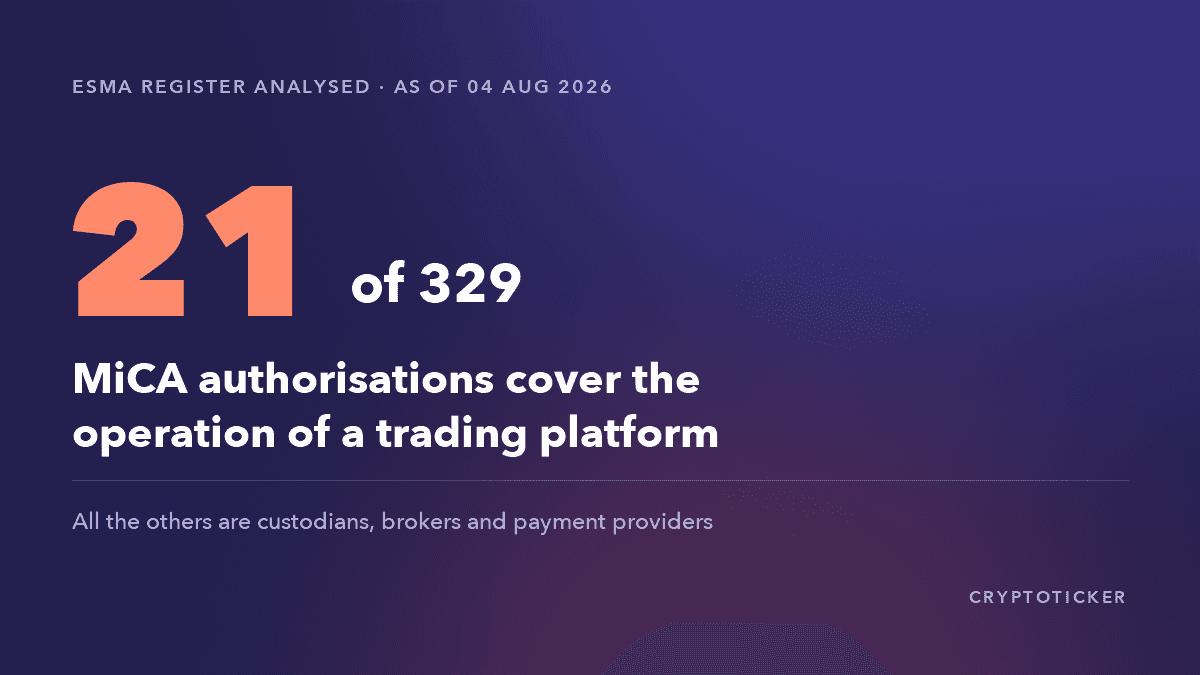
MiCA Register 2026: Only 21 of 329 Licences Are Real Exchanges
ESMA publishes the register of MiCA-authorised providers as an open file. We worked through all of it — and the result is not what the phrase “licensed crypto exchange” suggests.
June 30, 2026 11:20 PM

How to Switch from Binance to a MiCA Regulated Crypto Exchange
Binance is winding down EU services after missing the MiCA deadline. Here's why it's happening and how to move your funds to a regulated platform safely.
December 26, 2025 1:50 PM
Breaking: Trust Wallet Chrome Extension Hack Drains $7M, Full Reimbursements Promised
A supply-chain attack hit Trust Wallet’s Chrome extension, draining $7M from users. Binance’s CZ says all victims will be reimbursed.
September 10, 2026 1:21 AM

Crypto Exchanges Head to Head: Which Pairing Is Cheaper Where
Before opening an account, the question is rarely which exchange is best overall, but whether it should be this one or that one. This article sorts through the most searched head-to-heads, puts the cost per 1,000 euros side by side and explains the most expensive mix-up: one provider with two interfaces and a factor of seventeen between them.
September 8, 2026 7:23 AM
Compensation After an Exchange Hack: What Twelve Crypto Providers Really Promise German Customers
After $322 million in losses in a single September week, the question is who replaces stolen coins. On September 8, 2026 we retrieved the security and legal pages of twelve providers and evaluated what is promised there.
More from CryptoTicker