
Crypto lending under MiCA: BTCS Strategy Advisor Wojciech Kaszycki on the EBA's plans
The EBA wants crypto lending and access to DeFi brought under MiCA. Wojciech Kaszycki, Strategy Advisor at BTCS S.A., explains in this interview which part of the market stays in the EU and where the rules reach their limit.





Which topics should we dive deeper into?
Select what genuinely interests you. Your picks feed directly into our editorial planning.
Crypto news that's actually worth your time.
Weekly. 60 seconds. Carefully curated by our editors: no hype, no promo flood, no spam.
The European Banking Authority wants crypto lending brought under the MiCA regulation, explicitly including cases where providers give their customers access to DeFi lending protocols. That is the position in its response of September 24, 2026 to the European Commission's review of MiCA. We put three questions to Wojciech Kaszycki, Strategy Advisor at Warsaw-listed BTCS S.A. and founder of the payments company Mobilum. His short version: collateralized lending to businesses and wealthy clients fits MiCA and stays, while retail yield moves away. His test for supervisors: "If the firm can lose your money, regulate the firm. If it can't, you're regulating a website."

About the interviewee: Wojciech Kaszycki is Strategy Advisor at BTCS S.A.. The company holds bitcoin on its balance sheet; its shares trade on the NewConnect market of the Warsaw Stock Exchange under the ticker BTF and on the Frankfurt Open Market. Kaszycki founded the payments company Mobilum and chairs it. He gave his answers in writing in October 2026.
What the EBA proposes for crypto lending under MiCA
MiCA has applied in full since December 30, 2024 and covers the issuance of crypto-assets and the services of exchanges, custodians and brokers. Lending and borrowing crypto-assets is not yet one of the services that require authorization. Article 142 of the regulation only called for a stocktake, for which the EBA and ESMA delivered a joint report in January 2025. The Commission is now reviewing MiCA, and its MiCA consultation closed on September 30, 2026.
In its response to the MiCA review, the EBA recommends regulating crypto lending, including where crypto-asset service providers facilitate access to DeFi protocols. It points to earlier research showing crypto lending and borrowing in at least 16 EU member states, and notes that easy access through crypto firms and AI tools is blurring the line between centralized and decentralized finance. These are the measures it puts on the table:
| EBA proposal | What it would mean |
|---|---|
| Intermediated lending as a regulated service | The Commission should run a cost-benefit analysis on adding intermediated crypto lending and borrowing to the list of MiCA services that require authorization. |
| Suitability tests, leverage limits, more disclosure | Client protection rules of the kind that are standard for conventional financial products. |
| Limits on lending with stablecoins | Lending involving asset-referenced or e-money tokens that require MiCA authorization could be restricted. |
| Certification of DeFi lending protocols | Vetted protocols as the basis for regulated access. |
The recommendation is not binding. Whether it becomes law depends on a legislative proposal from the Commission, which Parliament and Council would then negotiate.
 Compare where you can lend your crypto
Crypto lending in the EU: what survives and what moves offshore
CryptoTicker: If the EBA gets its way and crypto lending falls under MiCA, which part of the EU lending market actually survives and which part moves offshore?
Wojciech Kaszycki: What survives is the boring part, and the boring part is most of the money. Collateralized lending to businesses and wealthy clients, run by licensed firms that already do custody and KYC, fits MiCA easily. Banks will like this: a rulebook for Bitcoin-backed loans invites them in, and they have the balance sheets. Suitability tests and leverage caps cost them nothing because they already do that for every other product.
What moves is retail yield. The 8% on stablecoins, the leveraged loops, the "deposit and earn" buttons. Those live on DeFi front ends today, and a front end moves jurisdictions in an afternoon. We've seen this film: when MiCA's stablecoin rules landed, non-compliant tokens didn't disappear; EU users got geofenced and went to self-custody and offshore venues. The EBA says lending already happens in 16 member states. After the rules, it will still happen in 16 member states, just with a VPN. So Europe keeps the institutional book and loses the retail flow. That may be the trade the regulator wants. It should say so openly.
For context: no issuer may pay interest on stablecoins in the EU even today, article 50 of MiCA forbids it. Where a yield is shown, it comes from lending, as we explain in our piece on stablecoin interest and the MiCA ban.

What MiCA lending rules change for a listed bitcoin treasury company
CryptoTicker: BTCS put bitcoin into a yield program in March. From a listed treasury company's view, what would the lending rules change in practice about how that bitcoin is put to work?
Wojciech Kaszycki: In our case, less than people think, and that's the point. BTCS put 50 BTC into a Bitcoin L2 liquidity program in March. It's our own balance sheet, not client money, approved under a board treasury policy, every step disclosed in ESPI filings in Warsaw. MiCA regulates people who provide services to clients. We're the client. Six months later we got 51.84 BTC back, paid in bitcoin, and reported that too.
What would change is the menu. If the firms that structure these programs for institutions need a MiCA license to offer "DeFi access", the EU-based ones that stay will cost more, and the rest will stop serving EU companies. The reward leg matters as well: our program paid in BTC and USDC, and the EBA floats restricting lending that touches stablecoins that need MiCA authorization. That alone could force a redesign.
The upside: a certified protocol list would shorten the auditor conversation. Honestly, that's where we spend most of our time today, not on the trade.
The figure can be checked against the terms BTCS published in March 2026: a six-month program with 50 to 100 BTC on the Hemi network, with a minimum annualized yield of 10 percent for the first two months and 6 percent for the following four. On 50 BTC that works out as follows:
| Period | Minimum yield per year | Return on 50 BTC |
|---|---|---|
| Months 1 and 2 | 10 percent | 0.83 BTC |
| Months 3 to 6 | 6 percent | 1.00 BTC |
| Total after six months | combined | 1.83 BTC, so 51.83 BTC |
| Stated by Kaszycki | paid out | 51.84 BTC |
The repayment he cites therefore sits at the promised floor. For retail investors it is no benchmark: anyone who lends crypto carries the risk of the protocol and of the counterparty, and a floor only holds as far as the party promising it can pay. How such returns arise and which risks remain is covered in our guide to crypto lending, interest and risks.
 Compare exchanges with a MiCA licence
Where regulating DeFi lending through its access points breaks down
CryptoTicker: Regulating DeFi through the companies that connect users to it sounds workable on paper. Where does it break down?
Wojciech Kaszycki: It breaks at the definition. "Facilitating access" sounds precise until you ask what it covers. A website? A wallet with a browser inside it? An AI agent that moves funds for you? The EBA itself admits AI tools are blurring the line, which is another way of saying the perimeter won't hold.
Second, it breaks on cost. A licensed front end carries liability for a protocol it doesn't control. So it will offer only two or three whitelisted protocols, or none. Users don't stop lending. They open the unlicensed front end or talk to the contract directly, at zero cost. You get concentration and no protection.
Third, protocol certification assumes the code stays still. It doesn't. Versions change, forks appear, and the certified one is yesterday's.
Where it does work: when the intermediary actually holds your money. Custodial "DeFi" products are just CeFi with a longer explanation, and regulating that firm is right. My test is simple. If the firm can lose your money, regulate the firm. If it can't, you're regulating a website.
What the MiCA plans for crypto lending mean for you today
As of October 21, 2026 nothing changes yet for lenders in the EU. The EBA has made a recommendation, the Commission is evaluating the consultation, and there is no legislative proposal. Kaszycki's distinction still works today as a check for any lending offer: if the provider holds your coins, you carry its default risk, and its licence matters. If it only routes you to a protocol, you carry the risk of the smart contract.
Which providers offer which terms is shown in our crypto lending comparison, and which exchanges already hold a MiCA licence in our comparison of regulated exchanges.
The MiCA review continues now that the consultation has closed, and whether lending ends up in the regulation will be decided by the Commission's proposal. You can follow the next steps from the Commission and the supervisors in the crypto news on CryptoTicker.
(As of October 21, 2026. This article is not investment advice. Crypto lending carries high risks up to a total loss; check the terms with the provider before every deposit.)
Frequently asked questions about crypto lending under MiCA
Transparency note: This article was produced with the assistance of artificial intelligence and reviewed by our editorial team before publication. All figures and claims were checked against the primary sources linked in the text. The feature image was generated with AI.
Related articles
- MiCA Review: What the European Commission Could Change About the EU Crypto Rules
- MiCA Consultation Closes September 30: What to Check and Submit Before Then
- Crypto Lending: Where the Interest Comes From and Which Risks You Carry
- Inside Bitget: How COO Vugar Usi Zade Is Shaping the Future of Crypto Trading
- ESMA Calls for Advertising Rules on Crypto Influencers: Six Changes Now Sitting With the EU Commission
Which topics should we dive deeper into?
Select what genuinely interests you. Your picks feed directly into our editorial planning.
Crypto news that's actually worth your time.
Weekly. 60 seconds. Carefully curated by our editors: no hype, no promo flood, no spam.

August 10, 2026 5:15 PM

Bitcoin Lending in Austria: When Tax Falls Due
Lending Bitcoin and earning interest: when lending income is taxed at 27.5 percent in Austria and which exchange rate counts.

June 17, 2026 7:21 PM

Binance EU Access at Risk: What MiCA Could Mean for BNB and Crypto Users
Binance is facing one of its biggest regulatory tests in Europe as the MiCA deadline approaches. Could this put BNB and EU crypto users under pressure?
August 6, 2026 3:05 PM
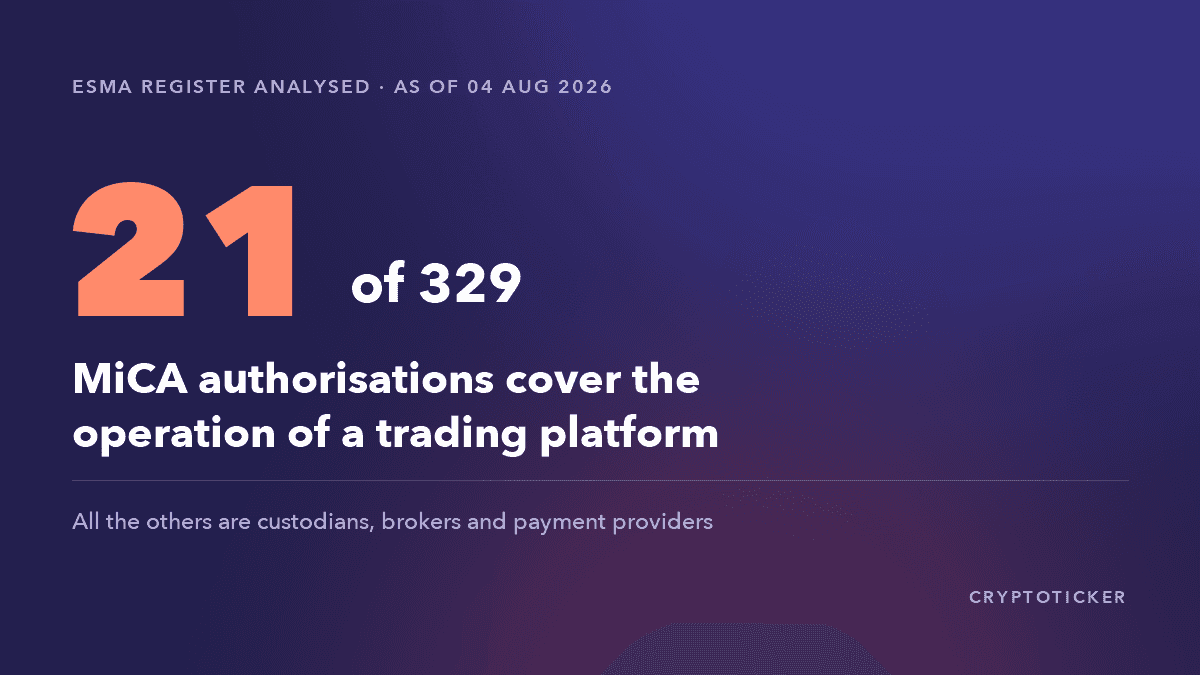
MiCA Register 2026: Only 21 of 329 Licences Are Real Exchanges
ESMA publishes the register of MiCA-authorised providers as an open file. We worked through all of it — and the result is not what the phrase “licensed crypto exchange” suggests.

June 30, 2026 11:20 PM
How to Switch from Binance to a MiCA Regulated Crypto Exchange
Binance is winding down EU services after missing the MiCA deadline. Here's why it's happening and how to move your funds to a regulated platform safely.
July 7, 2025 8:12 PM

BIG Crypto News: EU Approves 14 Stablecoin Issuers Under MiCA
Six months into the MiCA rollout, Europe’s crypto regulatory landscape is taking shape. From authorized stablecoin issuers to licensed crypto service providers, here’s the full July 2025 update.
July 10, 2026 10:30 AM
Binance Reveals Where Its EU Users Went After MiCA
Binance just revealed where most departing EU users moved their crypto after MiCA — and the answer is raising hard questions about the new rulebook.
June 26, 2026 9:09 AM
Why Nearly 100 Catholic Leaders Just Turned Against Crypto's CLARITY Act
Nearly 100 Catholic leaders are fighting a key CLARITY Act provision over trafficking concerns — and it's piling pressure on an already-bleeding crypto market.
June 25, 2026 11:19 AM

Binance Pulls Its EU Licence Bid: What It Means for Your Crypto
Binance just withdrew its MiCA licence application in Greece days before the EU deadline. Here's what it means for users, your funds, and the crypto market.
March 11, 2026 12:37 PM

Why Crypto Projects Are Failing: The Hidden Truth Behind the 2026 Stagnation
The crypto gold rush has hit a wall. Why are retail projects stalling as institutional giants and strict regulations reshape the market in 2026?
September 21, 2026 7:20 PM

Morpho Stands Out: 33 Percent Below Its High
Morpho gains about 12 percent. A different number is more striking: the token sits only 33 percent below its all-time high, while the day's other winners stand 80 to 90 percent below theirs. What lies behind it.
August 30, 2026 10:30 PM

Moonwell Exploit on Base: How a MAMO Oracle Manipulation Drained $8.7 Million From the Lending Market
An attacker drove the price of the thinly traded MAMO token fortyfold and borrowed $11.03 million against it from the Moonwell lending protocol on Base. Around $9.13 million remains open and falls on depositors who never touched MAMO.
August 21, 2026 10:27 AM

Complaining About a Crypto Exchange: the Deadlines Article 71 MiCAR Sets and Why BaFin Will Not Decide Your Case
Authorised crypto providers have to run a formal complaints procedure, and Delegated Regulation (EU) 2025/294 sets a hard limit of two months for it. Our own analysis of the ESMA list shows at the same time that no complaints link is on file for Germany to this day.
July 9, 2026 10:12 AM

MiCA Wiped Out 92% of Europe's Crypto Firms: Here's Who Survived and Who's Cashing In
The July 1 deadline turned 3,000+ EU crypto firms into a few hundred. Binance is out, Tether's gone, and a handful of winners now own the market.
May 12, 2025 9:05 PM

US-EU Trade Tensions Rise as US-China Conflict Cools Down
Just as the long-standing US-China trade war appears to ease, new tensions are emerging between the United States and the European Union. With Trump calling Europe “nastier than China,” are we about to witness a new transatlantic trade conflict?
October 13, 2026 10:37 PM

ESMA will supervise only 10 to 15 of 360 crypto firms: your exchange stays with its home regulator
On October 9, 2026 EU finance ministers agreed to place only the largest crypto service providers under direct ESMA supervision. For the vast majority of the roughly 360 authorised firms, the national authority stays in charge, in Germany BaFin.
September 25, 2026 7:11 AM

EU Supervisors Rate Quantum Risk as High: What to Check on Crypto Custody and Exchange Choice
EBA, EIOPA and ESMA name quantum computers explicitly as a threat to blockchain cryptography in their autumn risk picture of September 23. What the paper says, which migration deadlines run to 2030, and three things you can check about your custody.

September 19, 2026 7:17 AM

Chainlink Jumps Above $12: What LINK Holders Should Check Now
Chainlink trades at $12.34, 7.4 percent higher than yesterday. What part of the move is the broad market rally, what Chainlink itself contributes, and the three things you should check as a LINK holder.
September 6, 2026 10:20 PM

Bison App: a 1.25 Percent Spread, 27 Percent of the Staking Rewards and Trading Without an Order Book
The crypto app of Boerse Stuttgart advertises freedom from fees. You pay through the spread instead. What the licences actually cover, why there is no order book, and why the tax report loses its value once you transfer coins out.
September 6, 2026 10:12 PM

MoonPay Fees: Up to 4.5 Percent, a Partner Margin on Top, and a Markup You Never See as a Fee
MoonPay is the buy button built into many crypto wallets. The European price list names four layers of cost, and only three of them show up as line items. What the provider is allowed to do, and what it expressly is not.
September 4, 2026 4:39 AM

Source of Funds at a Crypto Exchange: Why a Deposit Can Freeze Your Account for 15 Days
OKX chief Star Xu described on September 2 what an unusual deposit sets off: reviews of 15 days and longer, during which balances and account functions can be restricted. What that means for investors in Germany, and which documents you should keep to hand.
August 21, 2026 4:17 PM

Crypto Withdrawals to Your Own Wallet: Why Exchanges Demand Proof of Address Ownership Above €1,000
Above €1,000 your provider has to establish whether the destination address really belongs to you. Article 14(5) of the transfer of funds regulation, five permitted methods, and the reason a withdrawal stalls without this step.
August 19, 2026 10:37 AM

Who Regulates Crypto in the US? CFTC and SEC Compared
On 20 August 2026 the new innovation advisory committee of the US derivatives regulator CFTC meets for the first time, staffed with the chief executives of Coinbase, Kraken, Gemini and Ripple. What separates the two US agencies, and why MiCA and BaFin still count for your portfolio.
July 6, 2026 11:17 AM

XRP Just Got a Massive EU Green Light — But There's a Catch Nobody's Talking About
Ripple scored preliminary MiCA approval to run crypto services across all 30 EEA countries — and $XRP is up ~8% this week. Here's what it really means.
October 6, 2026 10:32 AM

FinCEN drops the reporting duty for withdrawals to private wallets: what matters now for European investors
The US anti-money-laundering agency FinCEN withdrew two proposals on October 5, 2026 covering the reporting duty for self-custodied wallets and for mixers. In the EU the development runs in exactly the opposite direction: proof of ownership from 1,000 euros today, a ban on anonymous accounts from July 2027.
October 2, 2026 10:28 PM

GENIUS Act stablecoin rules: what applies today and what stays open until 2027
The GENIUS Act creates the US framework for payment stablecoins. Which proposals are already on the table, why the OCC matters and what stays open until January 2027.
September 18, 2026 7:26 PM

$3.5 Million Against $550,000 of Collateral: How to Check Which Tokens Your DeFi Lending Market Accepts
One manipulated price was enough to borrow 3.5 million US dollars from the Nostra Finance money market on Starknet — backed by a token worth half a million dollars. Four figures from the documentation show you whether your own lending market has the same gap.
October 20, 2026 4:17 AM

Stablecoin interest: MiCA article 50 bans it, and lending yield is taxable from 256 euros
No issuer in Europe pays interest on the token itself, and article 50 of MiCA expressly forbids it. Where a quoted yield actually comes from and how the tax office treats it.
More from CryptoTicker