
The Silent Takeover: How Stablecoins Are Becoming the New Global Dollar
Stablecoins are expanding globally as PayPal and US regulators push adoption. Are they becoming the new digital dollar system?

Which topics should we dive deeper into?
Select what genuinely interests you. Your picks feed directly into our editorial planning.
Crypto news that's actually worth your time.
Weekly. 60 seconds. Carefully curated by our editors: no hype, no promo flood, no spam.
Stablecoins are rapidly moving from niche crypto tools to a central pillar of the global financial system. While much of the market focuses on Bitcoin volatility and geopolitical tensions, a quieter but far more structural shift is taking place.
From regulatory breakthroughs in the United States to global expansion by major payment companies, stablecoins are positioning themselves as the digital version of the dollar — faster, borderless, and increasingly integrated into everyday finance.
This raises a critical question: are stablecoins quietly becoming the new global dollar?
PayPal and Big Tech Are Accelerating Stablecoin Adoption
One of the clearest signals of this shift comes from PayPal, which has expanded its stablecoin services to over 70 countries. This move significantly lowers the barrier for millions of users to access digital dollars without relying on traditional banking systems.
Unlike earlier crypto adoption cycles driven by speculation, this wave is infrastructure-driven. Payment giants are embedding stablecoins directly into financial ecosystems, allowing users to send, receive, and store value globally in seconds.
This is not just innovation — it is a transformation of how money moves.
US Regulation Is Turning Bullish for Stablecoins
At the same time, regulatory clarity is beginning to emerge in the United States. Coordination between agencies like the U.S. Securities and Exchange Commission and the Commodity Futures Trading Commission is reducing uncertainty that has long slowed crypto adoption.
More importantly, recent discussions between lawmakers and the White House around stablecoin frameworks signal a shift toward integration rather than restriction.
This is a major turning point.
Instead of treating stablecoins as a threat, regulators are increasingly viewing them as an extension of the dollar’s global dominance — but in digital form.
Stablecoins Are Solving Real Global Problems
Stablecoins are gaining traction because they address real-world inefficiencies in traditional finance:
- Cross-border payments remain slow and expensive
- Banking access is limited in many regions
- Currency instability drives demand for dollar-based assets
Stablecoins offer:
- Instant transactions
- Lower fees
- Access to dollar liquidity anywhere in the world
In regions facing inflation or capital controls, stablecoins are already functioning as a practical alternative to local currencies.
A New Financial System Is Emerging
What makes this shift particularly important is its timing.
As geopolitical tensions rise and global trade faces increasing friction, the demand for neutral, digital, and liquid financial tools is growing.
Stablecoins are uniquely positioned at the center of this transformation:
- Backed by fiat currencies
- Integrated into crypto ecosystems
- Increasingly adopted by institutions
This creates a hybrid financial system where traditional and digital finance converge.
Risks and Challenges Still Remain
Despite their rapid growth, stablecoins are not without risks:
- Regulatory fragmentation across countries
- Dependence on underlying reserves
- Centralization concerns
- Potential competition from central bank digital currencies (CBDCs)
However, these challenges are being actively addressed as the market matures and institutions become more involved.
Conclusion — The Rise of the Digital Dollar
Stablecoins are no longer just a crypto niche — they are becoming a core layer of global finance.
With major companies expanding access, regulators moving toward clarity, and real-world demand increasing, stablecoins are quietly evolving into the digital equivalent of the dollar.
This transformation may not be as visible as Bitcoin price swings, but its long-term impact could be far greater.
For later? Save this article and find it again in your profile.
Related articles
- CBDCs explained: 146 countries are exploring central bank digital currency, three have issued one
- Deutsche Bank now holds bitcoin and ether in custody, but retail clients are left out
- Midterms Recap: The Crypto Roadmap to January 3, When the CLARITY Act Expires
- South Korea Makes Stablecoins an Official Means of Payment: What the New Rule Really Says
- CLARITY Act: what the US crypto law would do and where it stands in the Senate
Which topics should we dive deeper into?
Select what genuinely interests you. Your picks feed directly into our editorial planning.
Crypto news that's actually worth your time.
Weekly. 60 seconds. Carefully curated by our editors: no hype, no promo flood, no spam.

October 21, 2026 10:13 PM

Revolut wins a crypto licence in Gibraltar, but your German account stays with Cyprus
The Gibraltar Financial Services Commission has authorised Revolut Global Digital Assets Limited for order execution, custody and staking. For customers in Germany the Cypriot EU entity remains the counterparty, and that is what decides which regulator and which MiCA rights apply to your balance.
October 20, 2026 10:18 AM
Coinbase converts USDT and DAI into USDC on October 30: the swap restarts the one-year holding period
On October 30 Coinbase will convert the remaining USDT, DAI and PYUSD balances in the European Economic Area into USDC. The swap counts as a disposal under section 23 of the German Income Tax Act, and the one-year clock starts again for the new balance.

October 16, 2026 4:25 AM

“Not just for stablecoins, but for every form of money”: Mastercard opens stablecoin payouts to bank accounts
Mastercard and BVNK launched the Global Money Platform on 15 October: fiat and stablecoin accounts, real-time exchange, cards and payouts to local bank accounts through one interface. For German users two questions hang on it that the announcement does not answer: the fees and MiCA authorisation.
October 15, 2026 4:24 AM

Philippines VASP regulation: BSP draft would pause new payment operator applications for twelve months
A BSP draft could suspend OPS applications for twelve months and apply stricter checks to payment relationships with VASP-adjacent firms. What applies to providers and customers.
October 13, 2026 7:19 AM

Financial Stability Board on 300 billion dollars in stablecoins: “untested in severe stress and insolvency”
The Financial Stability Board handed the G20 a status report on stablecoins on 12 October: a market worth 300 billion dollars, 99 percent of it pegged to the US dollar, and a supervisory structure that remains untested in severe stress and insolvency. Here is what the gaps it describes mean for holders in Europe, where MiCA already closes them and which ones stay open.
October 3, 2026 10:20 PM

2027 start for the UK stablecoin regime: what the Bank of England mandate means
The Bank of England's new innovation objective is a signal for digital payments, not a stablecoin licence. What still decides the outcome are the FCA rules, supervision and the timetable running to 2027.
October 2, 2026 10:28 PM

GENIUS Act stablecoin rules: what applies today and what stays open until 2027
The GENIUS Act creates the US framework for payment stablecoins. Which proposals are already on the table, why the OCC matters and what stays open until January 2027.
October 2, 2026 7:30 AM

Revolut EURR Stablecoin: What the Launch in Three Markets Really Means
Revolut is testing the euro stablecoin EURR in Denmark, Poland and Portugal first. Whether it becomes usable in practice depends on access, liquidity, costs and acceptance.

September 29, 2026 11:10 AM
CLARITY Act 2.0: What Happens to US Crypto Regulation After the Senate Defeat?
The CLARITY Act failed 49-50 in the Senate. A rewrite is taking shape while the SEC and CFTC move on their own. Where US crypto regulation stands now.
September 15, 2026 5:00 PM
What Happens If the CLARITY Act Fails Today: Will Crypto Still Win?
The Senate votes on the CLARITY Act today. Even if it fails, US crypto keeps its rules, its regulators and its president. Here is why.
September 15, 2026 4:12 PM

Digital Euro Holding Limit: What the Planned Cap Means for Your Account and Your Crypto
The digital euro is getting a cap, and the trilogue has yet to settle who fixes it and how high it goes. What the draft means for your current account, for euro stablecoins and for your crypto holdings.
September 6, 2026 7:11 PM

EUDI Wallet: The EU Deadline Falls on December 24, 2026, Germany Targets January 2, 2027
Two deadlines, both verifiable, and both counted from the implementing acts of December 2024 rather than from the day the regulation entered into force. Plus the honest answer to the question of whether crypto exchanges have to accept the wallet.
September 3, 2026 11:37 AM

Standard Chartered Just Opened Institutional Bitcoin Trading in the UAE
Standard Chartered launches institutional Bitcoin and Ether spot trading in the UAE. Here is what it means for BTC and ETH prices right now.
August 29, 2026 5:02 PM
CLARITY Act Senate Vote of September 15: Failed 49 to 50, and What the Bill Would Have Done
The US Senate rejected the CLARITY Act 49 to 50 on September 15, 2026. Here is what the bill would have done and why the market had bet against it.
August 20, 2026 10:24 PM

MiCA Review: What the European Commission Could Change About the EU Crypto Rules
The European Commission has reopened MiCA for review after barely two years and is asking 86 questions covering the stablecoin interest ban, staking, lending and DeFi. Brussels is taking responses until September 30, 2026.
August 19, 2026 10:37 AM

Who Regulates Crypto in the US? CFTC and SEC Compared
On 20 August 2026 the new innovation advisory committee of the US derivatives regulator CFTC meets for the first time, staffed with the chief executives of Coinbase, Kraken, Gemini and Ripple. What separates the two US agencies, and why MiCA and BaFin still count for your portfolio.
August 7, 2026 1:08 PM
The Crypto Bill Washington Promised Just Got Pushed Back Again
The Senate walked away from the CLARITY Act before recess. Here is what stalled the crypto market structure bill and what happens in September.

July 28, 2026 5:16 PM
Russia Just Passed Its Own Crypto Clarity Act While the US Senate Keeps Stalling
Russia's crypto trading law is on its way to Putin's desk while the US CLARITY Act sits unvoted on a shelf. Here is what the split means for prices.
July 25, 2026 12:44 PM
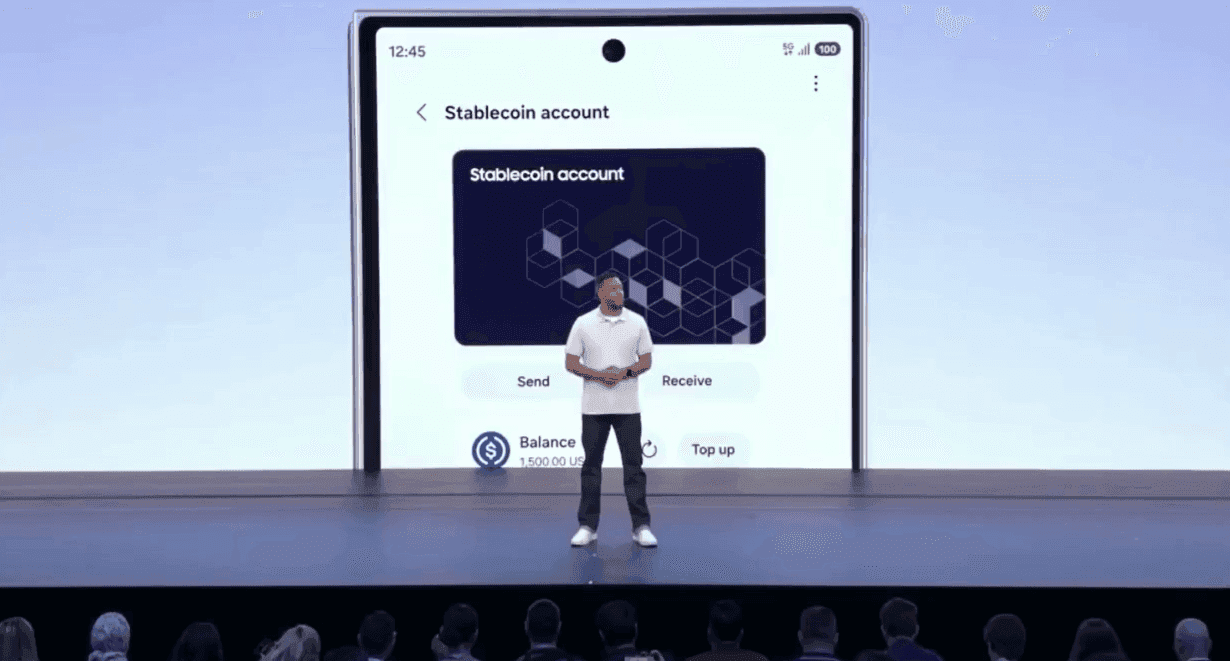
Samsung Puts Stablecoins in Its Wallet: What It Means for Crypto Prices
Samsung Wallet is getting native stablecoin support, with USDC demoed on stage. No launch date yet — but the distribution potential is real.
July 16, 2026 5:34 AM
Trump Just Threw His Weight Behind Stablecoins — And US Banks Are Panicking
Trump backs a UK-US stablecoin pact as the CLARITY Act nears a Senate vote — and banks warn it could drain deposits from smaller lenders. Here's what's at stake.
July 11, 2026 12:43 PM

Circle Just Became a Bank: What the OCC Trust Bank Approval Means for USDC
The USDC issuer just cleared a milestone no stablecoin company has reached at this scale — and it changes how the biggest regulated stablecoin is backed.
May 9, 2026 10:16 AM
Crypto Clarity Act Vote: Could May 14 Finally Push US Crypto Regulation Forward?
The Crypto Clarity Act heads to a May 14 Senate Banking vote as banks, Coinbase, and lawmakers clash over stablecoin rewards.
May 2, 2026 7:00 PM

Crypto Regulation News: Stablecoin Yield Rules Could Trigger the Next Bitcoin Move
New US stablecoin yield rules could reshape crypto regulation, stablecoin adoption, and Bitcoin’s next major market move.
April 14, 2026 3:00 PM
Tax-Free Stablecoins? This US Bill Could Trigger the Next Crypto Bull Run
A new US bill could make stablecoin transactions tax-free. Here’s how it could boost crypto adoption and trigger the next bull run.
April 8, 2026 4:30 PM
Bitcoin Replaces Oil Payments? Iran’s Hormuz Move Could Change Global Finance Forever
Iran may require Bitcoin for oil transit through Hormuz. Could crypto replace USD in global trade? A major shift in finance may be starting.


More from CryptoTicker