
Samsung Puts Stablecoins in Its Wallet: What It Means for Crypto Prices
Samsung Wallet is getting native stablecoin support, with USDC demoed on stage. No launch date yet — but the distribution potential is real.

Which topics should we dive deeper into?
Select what genuinely interests you. Your picks feed directly into our editorial planning.
Crypto news that's actually worth your time.
Weekly. 60 seconds. Carefully curated by our editors: no hype, no promo flood, no spam.
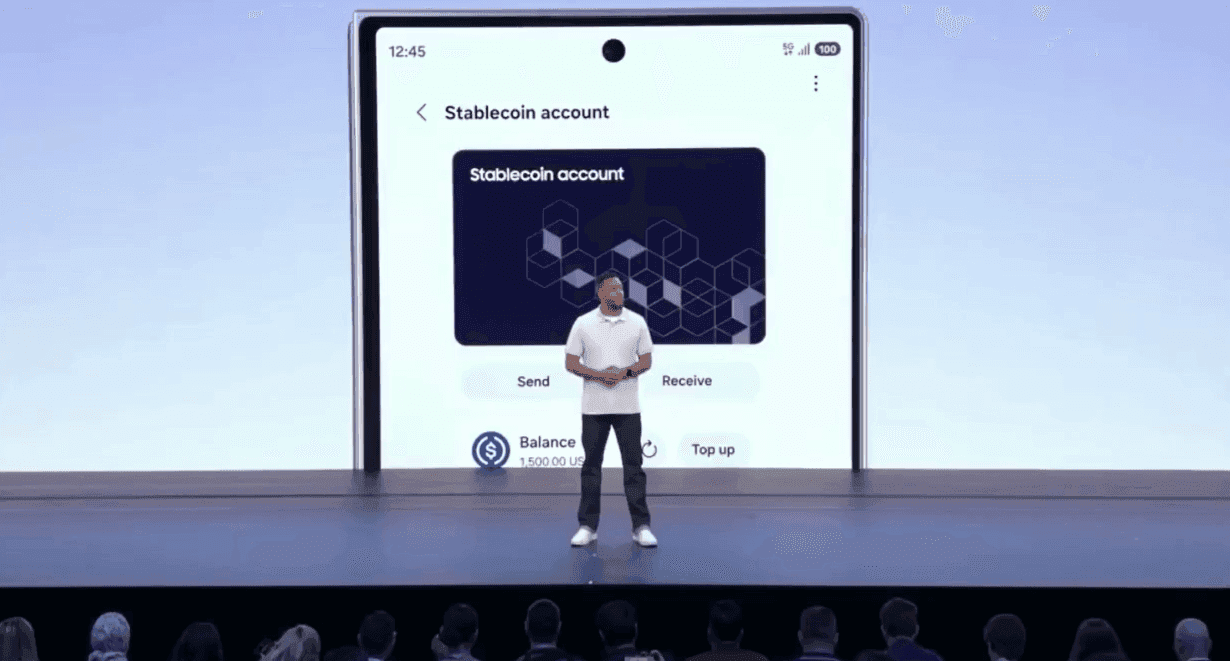
Samsung has put stablecoins on the roadmap for Samsung Wallet. The announcement came at Galaxy Unpacked 2026 on 22 July, and would place dollar-pegged digital currencies directly inside an app already installed on millions of devices. Samsung says the move would make it one of the first major mobile brands to support stablecoins natively on smartphones.
That is a genuinely significant distribution story. It is also, for now, an announcement rather than a product — and the distinction matters a great deal when you start asking what it does to prices.
 Software wallets compared
Samsung Stablecoins: What exactly did Samsung announce?
During the Galaxy Unpacked event, Samsung said its in-house wallet app will include stablecoin support, positioning Wallet as "the foundation of a connected financial ecosystem" across Galaxy devices and services, bringing payments, rewards and digital assets into one experience.
The on-stage demo showed a USDC account with send, receive and top-up functions. Samsung did not, however, confirm partnerships with any stablecoin issuers.
It arrived bundled with a more concrete product. Samsung launched the Galaxy Card in the US with Barclays and Visa — the first financial product built directly around Samsung Wallet. The card offers 5% cashback on certain purchases in Samsung's own stores alongside other perks. The pattern here is worth noting: the card is shipping, the stablecoin support is signposted.
Is this really a billion-user crypto on-ramp?
Samsung's global Galaxy install base is frequently put in the region of a billion devices, and that is the ceiling this story points at. But Samsung Wallet itself is not available everywhere — it operates in roughly 30 to 40 markets, and the Galaxy Card launching alongside the announcement is US-only. One estimate framed the immediately addressable figure at 241 million Galaxy phones.
Samsung has not confirmed a timeline or a regional rollout plan. Stablecoin regulation differs sharply across its markets, and that alone makes a simultaneous global switch-on implausible. The US, where the Galaxy Card and Barclays partnership are launching, is the likely first target.
So: a billion-device ceiling, a low-hundreds-of-millions realistic near-term ceiling, and an actual launch audience of zero until Samsung ships it.
Why does this matter more than previous Samsung crypto moves?
Because it changes what the wallet is rather than what it links to.
Samsung has been circling crypto for years. It shipped an embedded cryptocurrency wallet with hardware-backed security in the Galaxy S10 back in 2019, and integrated Coinbase One into Samsung Wallet in the US to give millions of consumers an easier path into crypto.
But offering users the ability to buy Bitcoin through a partner app is one thing. Embedding a dollar-equivalent digital currency into the core wallet experience is a fundamentally different proposition.
Stablecoins have largely stayed inside crypto — circulating between exchanges and platforms that ordinary users never touch. A default slot in the wallet app that comes preinstalled on the phone removes the single biggest barrier to that changing: nobody has to download anything, sign up anywhere, or learn what a seed phrase is.
The competitive pressure is the other half of the story. Apple, which restricted NFC access on iPhones until EU regulatory pressure forced changes, has announced no stablecoin integration for Apple Wallet. If Samsung ships this at scale, rival manufacturers and wallet providers face pressure to move sooner than they had planned.
 CryptoTicker trading game: try it free
How would this affect crypto prices over the medium term?
Here is where a lot of coverage gets sloppy, so let's be precise about the mechanism.
Stablecoin adoption is not a direct bid on Bitcoin. Someone topping up a USDC balance to buy coffee is not buying BTC. They may never buy BTC. The demand this creates flows to dollar-pegged tokens, and issuing more USDC means Circle buys more short-term Treasuries — not more crypto.
The transmission to asset prices is indirect and works through three channels:
1. Settlement layers capture the fees. Stablecoin transactions have to settle somewhere. Whichever chains Samsung routes volume through — Ethereum, its L2s, Solana, or something else — would see real transaction demand rather than speculative demand. That is the clearest medium-term link to a tradeable asset, and it depends entirely on technical choices Samsung has not disclosed.
2. Issuers are the direct beneficiaries. Circle's listed equity (CRCL) is a far more direct expression of this trade than any token. Stablecoins already exceed $320 billion in market capitalisation, dominated by USDT and USDC. Distribution through a top-two smartphone vendor moves that number.
3. The funnel effect — slow, real, unquantifiable. Users who hold a stablecoin balance in an app they already trust are meaningfully closer to buying a volatile asset than users who hold nothing. Historically, that's how retail crypto adoption has worked: stablecoin first, speculation second. But this operates over years, not quarters, and no one can put a number on the conversion rate.
And over the long term?
The answer is that infrastructure announcements of this type have a poor record of showing up in price charts on any timeline traders care about.
Samsung has not disclosed which stablecoins will be supported or when the feature launches globally. Until those two questions are answered, this is a directional signal about where consumer fintech is heading, not a catalyst.
What it does change is the structural argument. The case for stablecoins as payment infrastructure — rather than as trading collateral — gets materially stronger when the default wallet on hundreds of millions of phones supports them natively. Visa and blockchain data firm Allium now publish on-chain stablecoin volumes, reflecting how far fiat-backed tokens have already moved beyond trading into payments infrastructure.
For anyone positioning around this: watch for the launch date, the named issuer, the chain, and the first market list. Those four details will tell you whether this is a headline or a business.
Worth keeping in perspective, too, that the wider market is not currently trading on adoption news. $Bitcoin is around $63,900 and down roughly 27% year-to-date, with the Fed's 28–29 July meeting dominating positioning. A roadmap item at a phone launch will not outweigh that.
Partner links: some links on this page are partner links. If you become a customer through one of them, we may earn a commission at no extra cost to you. Selection, ratings and ranking are decided independently by our editorial team. Ethics and Independence · Ownership and Funding
For later? Save this article and find it again in your profile.
Related articles
- Crypto Crash Prediction: Where Will 3 Major Coins Bottom Out?
- Crypto Crash: Why Bitcoin, Ethereum, XRP and Solana Fell This Week and What Comes Next
- BTCPay Server Hack: Bitcoin Hot Wallets Drained, Shut Your Server Down Now
- TRX gains 6 percent: TRON outperforms the market as crypto slides
- USDT Frozen: We Counted What Tether and Circle Really Blocked in the Binance Hack
Which topics should we dive deeper into?
Select what genuinely interests you. Your picks feed directly into our editorial planning.
Crypto news that's actually worth your time.
Weekly. 60 seconds. Carefully curated by our editors: no hype, no promo flood, no spam.

October 29, 2026 9:38 PM
Binance Hack: Around $2.8 Billion Drained From a Hot Wallet
On Thursday evening, roughly $2.8 billion left the Binance wallet “Binance 14” within minutes. The attacker had tied the wallet to their own contract via EIP-7702. Tether and Circle have frozen about $2.4 billion, and Binance says it is investigating.
October 29, 2026 12:28 AM
Bitget Wallet opens EUR accounts: incoming euros become USDT or USDC
Since October 27, 2026 Bitget Wallet gives its users their own account number in euros and US dollars, and the app converts incoming money automatically into USDT or USDC. What that means for SEPA transfers, the MiCA status of the two stablecoins and the holding period is set out here.

October 25, 2026 3:23 PM
USDC on 82 million Samsung phones: the level that decides for Solana
In the last week of October, Samsung is switching on USDC transfers over Solana on 82 million Galaxy devices, with custody through Bastion and Coinbase. What that means for the SOL price we measure against fees, emission and fund flows.

October 25, 2026 10:51 AM
Crypto Crash: Why the Top Cryptos Lost Up to 4% in One Week
Crypto crash week: the largest cryptos lost up to 4% in seven days. We break down why crypto prices are falling and what to watch next.
October 23, 2026 4:57 PM

South Korea Makes Stablecoins an Official Means of Payment: What the New Rule Really Says
South Korea is rewriting its forex law to classify stablecoins as a means of payment. Crypto Twitter calls it adoption. The fine print says surveillance.
October 20, 2026 10:18 AM

Coinbase converts USDT and DAI into USDC on October 30: the swap restarts the one-year holding period
On October 30 Coinbase will convert the remaining USDT, DAI and PYUSD balances in the European Economic Area into USDC. The swap counts as a disposal under section 23 of the German Income Tax Act, and the one-year clock starts again for the new balance.
October 20, 2026 4:17 AM

Stablecoin interest: MiCA article 50 bans it, and lending yield is taxable from 256 euros
No issuer in Europe pays interest on the token itself, and article 50 of MiCA expressly forbids it. Where a quoted yield actually comes from and how the tax office treats it.
October 16, 2026 1:25 AM
USDC becomes the EU's first significant e-money token: what changes for holders on November 12
The European Banking Authority classified USDC as the EU's first significant e-money token on October 14. From November 12 it will examine the issuer's reserve, own funds and liquidity itself, rather than leaving that to the French supervisor alone.

October 14, 2026 1:21 AM
BNB zero fees for USDC and USD1 until October 31: what changes for investors in Germany
On the BNB Smart Chain, withdrawals and wallet transfers in USDC, USD1 and U cost no gas until October 31. The 37th auto-burn is also due, and total supply still sits 33.16 million tokens above the target of 100 million.
October 12, 2026 10:40 PM
Shiba Inu and the Fake Airdrop of October 12: “no such airdrop. this is a drainer”
An account on X advertised a supposed SHIB airdrop on October 12. An adviser to the project calls the page a wallet drainer. What is behind it and how to check and revoke your token approvals.
October 10, 2026 1:24 PM
TRON (TRX): Polygon Opens Its Payment Stack to $93.44 Billion in USDT: What Matters Now
Polygon opened its Open Money Stack to TRON on October 8: companies can now settle stablecoin payments entirely over the chain. We checked how much USDT really sits there, and show what decides whether it turns into demand for TRX.
October 8, 2026 10:18 AM
Solana Price at $115.23, Samsung Brings USDC to 82 Million Galaxy Phones: US Only at Launch
Samsung Wallet is set to settle USDC transfers over Solana from the last week of October, starting on 82 million Galaxy devices in the United States. Nothing changes for holders in Germany for now, and the price barely moved on Thursday.
October 8, 2026 1:37 AM

MyNearWallet Closes on October 31: What It Means for Your NEAR Coins
MyNearWallet shuts down on October 31, 2026, and its feature set starts shrinking in October. Your NEAR stay onchain, but browser access falls away: what to know about migration, the staking unbonding period, phishing and the holding period.
October 5, 2026 10:14 AM

Solana price 108.46 euros: a 2.4 percent gain in euros, a 2.5 percent loss in dollars: what to check now
Solana is quoted at 108.46 euros and $121.30 on Monday morning. That leaves a gain of 2.4 percent for 2026 in euros and a loss of 2.5 percent in dollars. The difference comes purely from the exchange rate, and in Germany it decides the holding period, the tax threshold and the figure that ends up on the tax return.
October 2, 2026 7:30 AM

Revolut EURR Stablecoin: What the Launch in Three Markets Really Means
Revolut is testing the euro stablecoin EURR in Denmark, Poland and Portugal first. Whether it becomes usable in practice depends on access, liquidity, costs and acceptance.
September 29, 2026 10:15 PM

Citi Becomes the Bank Behind Coinbase's Stablecoin Accounts: What Changes for Investors in Europe
Citi and Coinbase announced two products on September 28, 2026 that tie stablecoin payments to a global bank: dedicated payment accounts at Coinbase and stablecoin acceptance for Citi clients. Both launch in the United States. For your balance in Europe, MiCA, the Article 50 interest ban and Section 23 of the German Income Tax Act apply.
September 24, 2026 10:11 PM

Bitcoin Price Prediction: What to Check on Levels, Holding Period and Leverage Before the October 28 Rate Decision
Bitcoin is trading at around $83,800, a third below its October 2025 high, while the sentiment index reads greed. Which dates, levels and deadlines over the coming weeks really decide your net gain, and which of them you steer yourself.
September 24, 2026 1:34 PM
Cardano Slides Below $0.24: What ADA Holders Should Check on Leverage, Liquidation and Holding Period
Cardano has given back its move above $0.25 and trades around seven percent below the high of the past 24 hours. What that means for leveraged positions, the holding period of your tranches and the buying route under MiCA.
September 24, 2026 1:11 PM

Stellar Becomes a Payment Rail at Mastercard's BVNK: What XLM Holders Should Check on Buying Route, Memo and Holding Period
BVNK has switched on Stellar as a payment rail for business customers in more than 130 countries. On the same trading day XLM falls by around seven percent — we separate what the news means from what the pullback means for your portfolio.
September 22, 2026 10:25 PM
Binance Buys Into Circle: What the USDC Deal Means for Your Balance
Binance is taking a $100 million stake in Circle and extending the USDC agreement by five years. For investors in Germany, the sum matters less than the question of who earns money from stablecoins left sitting idle.
September 12, 2026 4:49 AM

USDC Bridge CCTP V1 Is Shutting Down: How to Check Whether Your Stablecoin Can Still Change Chain From December
Circle halts the old version of its official USDC bridge on December 1, 2026, and the caps start falling on October 31. Our own count shows which 29 chains already have the successor, which two are left out, and how much USDC still sits on the discontinued chain Noble today.
September 3, 2026 11:37 AM

Standard Chartered Just Opened Institutional Bitcoin Trading in the UAE
Standard Chartered launches institutional Bitcoin and Ether spot trading in the UAE. Here is what it means for BTC and ETH prices right now.
August 20, 2026 4:24 PM

Bitcoin Across Multiple Wallets: How Austria Works Out the Acquisition Cost
Bitcoin spread across several wallets? How Austria works out the acquisition cost and the rolling average price for tax purposes.
August 16, 2026 9:11 PM
Swapping Bitcoin for Stablecoins: Does Austria Charge Tax?
Anyone swapping bitcoin for USDT or another stablecoin usually pays no tax in Austria yet. When the swap does become taxable after all.
July 11, 2026 12:43 PM

Circle Just Became a Bank: What the OCC Trust Bank Approval Means for USDC
The USDC issuer just cleared a milestone no stablecoin company has reached at this scale — and it changes how the biggest regulated stablecoin is backed.
More from CryptoTicker