
Gram (GRAM): why the price gave back 7.5 percent after Telegram opened its wallet
Telegram widened access to its non-custodial Money wallet on 9 October, and Gram can now be sent straight inside the messenger. The price jumped to $1.4871 and stands at $1.3761 five days later.




Which topics should we dive deeper into?
Select what genuinely interests you. Your picks feed directly into our editorial planning.
Crypto news that's actually worth your time.
Weekly. 60 seconds. Carefully curated by our editors: no hype, no promo flood, no spam.
Telegram widened access to its own wallet, called Money, on Friday 9 October 2026. Since then, far more users can send and receive Gram directly inside the messenger and pay for digital collectibles with it. The price jumped to $1.4871 that Friday and is back at $1.3761 this Wednesday, according to CoinGecko on 14 October at around 01:00. The gain from the news has been given back in full within five days.
For holders in Europe, the wallet is still the more important half of the story. Money is built to be non-custodial: the private keys sit with the user alone. Telegram cannot view them, cannot reverse a transfer and cannot restore a lost balance. Switching the feature on means taking on a responsibility that someone else carries on an exchange account.
What Telegram changed about the Money wallet on 9 October
Money is not a new product but the new name of the former Gram Wallet. Telegram announced it in July, and a limited launch ran for selected accounts in August. On 9 October that limit largely fell away: access now reaches beyond the selected circle and is being rolled out more broadly across the messenger's audience, which numbers more than a billion people.
The wording matters. Neither Telegram nor the outlets reporting on it say that every account already has the feature. FinanceFeeds states explicitly that the announcement is no evidence of a full rollout, and crypto.news likewise speaks of an expansion beyond the users selected so far. If you cannot see the wallet in your app yet, you have done nothing wrong.
Functionally, Money does two things: it holds and sends Gram, and it buys Telegram gifts and collectible usernames. Transfers from an existing Walt account are described by the provider as a matter of a few steps, credited immediately and without a network fee.
Money and Walt: two Telegram wallets with two custody models
This is where most of the confusion arises, so here is the difference in one sentence per product. Money is the new, non-custodial wallet inside the messenger: the keys sit with the user. Walt is the older wallet service, which continues under its own brand and holds the balance on the user's behalf.
The term behind it: a non-custodial wallet is one in which only the user holds the private key and nobody else can reach the balance. The counterpart is custodial safekeeping, where a provider holds the key and moves the balance on request, much as a bank runs an account.
Both models have a price. With a custodial account you carry the risk that the provider fails, is suspended or halts withdrawals. With your own wallet you carry the risk of losing the key. Which design suits you depends less on the coin than on the sum involved and on how often you move it. An overview of the designs and their pitfalls is in the software wallet comparison.
Non-custodial means nobody can restore your balance
The sentence sounds technical and has a very practical consequence. If the phone is lost, stolen or ends up in the dishwasher, your Gram stands or falls with the recovery phrase, the sequence of words from which the private key can be recalculated. Telegram does not have it. There is no hotline, no ID upload and no form that could retrieve access for you.
A wrongly addressed transfer is just as final. A transaction on the blockchain cannot be cancelled, and with a non-custodial wallet there is nobody who could try on your behalf. The same mechanism has in the past left Gram transfers stuck in the network when a required comment was missing. We took that case apart on the network data at the end of September.
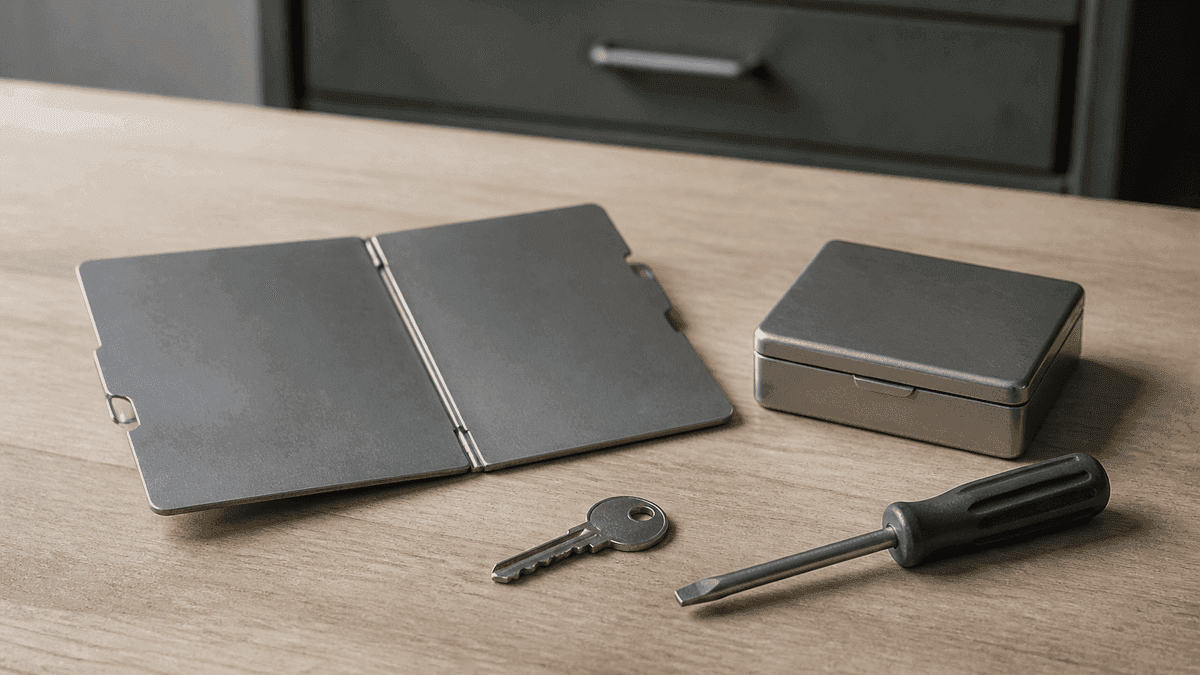
In practice, that means the recovery phrase belongs offline, on paper or better in metal, in two separate places. A screenshot in your photo library is not a backup but a copy in the cloud.

The Gram price this week: $1.38 and 9.5 percent below the weekly high
The figures for the past seven days, all from CoinGecko as of Wednesday 14 October at around 01:00: Gram stands at $1.3761, or roughly €1.23. The weekly high was $1.5198 on 7 October, the weekly low $1.3480 on 8 October. Over seven days that works out to a loss of 9.45 percent, over 30 days a gain of 2.47 percent.
Market capitalisation is around $3.89 billion, which corresponds to rank 32. Roughly 2.83 billion Gram are in circulation. Trading volume over 24 hours is around $31 million, so less than one percent of market capitalisation. The all-time high of $8.25 dates from 14 June 2024, leaving today's price 83.3 percent below it.
On the move on the day of the news itself, the figures diverge, and we are not smoothing them over. In the report linked above, crypto.news puts Friday at around nine percent. Our own count of CoinGecko's hourly values comes out somewhat lower: from $1.3762 at 01:00 to $1.4871 at 14:00, so a little over eight percent. Depending on which start and end point a newsroom picks, a different number comes out. The range from just under seven to just under nine percent describes the same event.
 Compare hardware wallets for self-custody
The Toncoin to Gram rename in June played out almost identically
For this article we set CoinGecko's daily values around this year's two big Telegram stories side by side. The pattern repeats strikingly closely.
On 15 June 2026 Toncoin was officially renamed Gram after a community vote passed; what the switch meant for holders in Europe is something we described on 27 September in Toncoin is now Gram. The price stood at $1.7529 that day, the highest point of that week. Two weeks later, on 29 June, it was at $1.5864. That is 9.5 percent lower.
On 9 October 2026 Telegram opened the Money wallet and the price rose to $1.4871. Five days later it is at $1.3761, so 7.5 percent lower. Two pieces of news, both read as milestones, and both times the premium was eaten up within two weeks.
A second point from the same rename is still visible today: the official guide recommended displaying "Gram (prev. Toncoin)" for a transitional period of three months. CoinGecko still carries the name in exactly that form four months after the cut-off date. The blockchain itself is still called The Open Network, or TON. Only the token's name and ticker were changed.
A wallet opening rarely carries the price for longer than a day
Why does news like this fizzle out? With infrastructure stories the mechanism is almost always the same. A wallet creates no additional demand for the token, it only lowers the barrier to using it. On the day of the news, buying comes from traders reacting to that very headline, and selling comes from the same traders as soon as the headline has run its course.
Add to that the size of the market. With daily volume of around $31 million against a market capitalisation of $3.89 billion, even a mid-sized sale moves the price noticeably. Inflows that come from actual use, by contrast, work slowly: first people have to have the feature switched on at all, then they have to buy Gram in order to pay for something with it.
That is exactly why the cautious wording of the announcement is no side issue. As long as there is no evidence of how many of the more than one billion accounts really see the wallet, the usage effect remains an expectation rather than a number.
Our assessment: distribution decides, not the announcement
From the newsroom's point of view, the Money opening is the most important Gram story since the rename, and it still does not justify a higher price while three pieces of evidence are missing. First, no source gives a figure for how many accounts actually have the wallet today; FinanceFeeds explicitly treats a full rollout as unproven. Second, the market itself shows that it does not trust the news: 7.5 percent below the high of the news day, on volume of less than one percent of market capitalisation. Third, 15 June offers a directly comparable case in which 9.5 percent was gone after two weeks.
There is a serious argument on the other side: a payment route built into a messenger with this reach starts from a different position than an app you first have to download. If Telegram really does switch the feature on across the board over the coming months, demand will come from payments rather than from a headline. That cannot be evidenced today; it can be measured later against the network's transaction counts. None of this is a recommendation to buy, and a total loss remains possible with any token.

Buying Gram in Europe: exchanges with MiCA authorisation
A wallet is no substitute for a way to buy. You still get Gram through a trading venue, and now that the European MiCA regulation applies in full, providers actively targeting customers in the EU need an authorisation as a crypto-asset service provider for it. MiCA is the EU regulation on markets in crypto-assets, which sets authorisation, capital requirements and disclosure duties uniformly across Europe.
In practice that means two things for your purchase. Before your first deposit you should check whether the provider holds a MiCA authorisation from a European supervisor, because deposit protection questions, complaint routes and tax documentation all depend on it. And you should look at total costs rather than the stated order fee alone: with smaller altcoins the larger share of the cost regularly sits in the spread, the gap between the buying and the selling price. Which venues hold the authorisation is set out in the overview of regulated crypto exchanges below.
 Find an exchange to buy Gram
Holding period and tax: what a transfer into your own wallet triggers
Moving from an exchange into the Money wallet regularly raises the same worry. The reassurance first: a transfer between two wallets that both belong to you is not a sale. In Germany it triggers no taxable event and does not restart the holding period under section 23 of the Income Tax Act.
Documentation is what counts. For the one-year holding period, the date of acquisition is what matters, and you have to be able to evidence it once the coins no longer sit on the platform where you bought them. So keep the exchange's purchase record and note the transaction ID of the transfer. Anyone moving coins between platforms and their own wallet more often loses that thread quickly.
Two points are less obvious. If you buy a digital collectible with Gram, for tax purposes that is a disposal of the Gram and not merely a purchase, because you are handing over a crypto asset. And network fees incurred when sending count towards acquisition costs or disposal costs respectively. With the fee-free transfers from a Walt account that Telegram describes, that item does not arise.
Levels above and below: $1.35 and $1.52
As an observation, not a price target: on the downside the next reference is the weekly low of $1.3480 from 8 October. The current price of $1.3761 sits only about two percent above it, so the distance is small. Below that comes the round level of $1.30.
On the upside the weekly high of $1.5198 from 7 October is the first hurdle, with the news day's intraday high of $1.4871 in between. The fact that this high was sold off completely within five days makes it the obvious yardstick: only above it would the wallet news really have carried the price.
Scams around the name change
A name change is an invitation to fraudsters, and the scheme has run unchanged since June. The official rename guide is explicit: balances never had to be swapped, claimed or moved, and holdings stayed as they were. Any site asking you to "migrate" or "claim" Gram is therefore an attempted fraud.
The wallet opening adds a second variant. Anyone who receives a message offering to help them "unlock" Money and asking for the recovery phrase in the process is dealing with an attack. No genuine wallet, no support desk and no messenger ever asks for that sequence of words. You enter it only in the device itself, when you are restoring a wallet.
An older principle still applies too: a second account with the same name and picture says nothing about authenticity. Always check features in the app itself and follow no link from an unsolicited message.
Money wallet: without the recovery phrase the balance is gone
The wallet opening is good news for how usable Gram is and, so far, none for the price. If you switch the feature on, the backup is what matters most.
- Secure the recovery phrase offline before you move any balance. Two copies in two places, on paper or in metal, never as a screenshot. For larger holdings a separate hardware solution remains the more robust choice; the designs are in the hardware wallet comparison.
- Start with a small amount. Send a sum whose loss would not hurt you first, and bring it back once. Only when both directions have worked should the rest follow. For the purchase itself, use a provider with European authorisation, as listed among the regulated crypto exchanges.
- Record the acquisition date and the transaction ID. That costs a minute during the move and later decides whether you can evidence the one-year holding period to the tax office. The tax tools take the note-keeping off your hands.
(As of October 14, 2026. This article is not investment advice. Prices and fee structures change; check the terms with the provider before you buy.)
Frequently asked questions about Gram (GRAM)
Transparency note: This article was produced with the assistance of artificial intelligence and reviewed by our editorial team before publication. All figures and claims were checked against the primary sources linked in the text. The feature image was generated with AI.
Related articles
- Toncoin Is Now Gram: What the Telegram Wallet Changes for Holders
- Wallet App Without BaFin Authorisation: When Holding Crypto-Assets Requires a Licence
- Pocket Bitcoin Data Breach: When Name, Home Address and Bitcoin Address Circulate Together
- Toncoin Price Drop Below Its $4.70 Support Level Warns Of A Major Crash On The Horizon
- Hedera (HBAR): HashPack Switches On Apple and Tesla Tokens, What Matters Now
Which topics should we dive deeper into?
Select what genuinely interests you. Your picks feed directly into our editorial planning.
Crypto news that's actually worth your time.
Weekly. 60 seconds. Carefully curated by our editors: no hype, no promo flood, no spam.

October 2, 2026 4:32 AM

NEAR Intents halts withdrawals after a $3.8 million exploit: here are the reasons
NEAR Intents confirms an exploit of more than $3.8 million and holds deposits and withdrawals on eleven networks. Reimbursement is promised, a date for it is not.
October 1, 2026 1:49 PM
TON wallet and Tonviewer: what you can do when your Gram never reaches the exchange
The transfer shows up in the explorer, the exchange account stays empty. Almost always a single line is missing, the one TON calls a comment. How to send Gram properly, what it costs and how to recognise a TON address.
October 9, 2026 7:29 AM
Exodus Wallet: 71.5 percent of revenue comes from swaps, the spread vs the exchange fee
The Exodus Wallet is free to download, yet 71.5 percent of the provider's revenue in the second quarter of 2026 came from swaps inside the app. What the spread costs, how custody works and from what point a device of your own pays off.
August 16, 2026 12:21 PM

Is Toncoin a Good Buy at Current Prices?
Toncoin has reclaimed both of its moving averages and now goes by the name Gram. We weigh what the chart, the RSI and the recovery in trading volume say for and against buying at current prices.

June 6, 2026 1:44 AM

Toncoin Crashes to $1.53 as Key Ecosystem Services Face Major Outages
Toncoin (TON) price has crashed sharply to $1.53 amid widespread infrastructure issues, leaving major mini-apps and network portals completely offline.
August 31, 2026 10:14 PM
Trust Wallet Drops 25 Networks: What Users Should Know After September 15
Recap as of September 27, 2026: Trust Wallet had announced it would remove built-in support for 25 blockchain networks from its app on September 15, 2026, among them MultiversX, Polygon zkEVM and Moonbeam. Your coins stay yours, the convenient access does not: this article shows how to add a chain by hand and for which nine networks that route is not open.
October 11, 2026 1:24 AM
Three Mistakes When Setting Up Trust Wallet: The Twelve Words Never Belong on the Phone
Trust Wallet is set up in five minutes, yet three mistakes in those minutes regularly cost the entire balance. This guide covers the six steps, the real cost of a swap, and what applies in Germany on the holding period and supervision.
September 17, 2026 4:14 PM
D'CENT App Wallet: How to Tell If Your Recovery Phrase Has to Move Now
Manufacturer IoTrust reports suspicious asset transfers in the D'CENT app wallet and asks users to move their holdings. One question decides the matter: has your recovery phrase ever been entered into the app?
August 21, 2026 4:17 PM
Crypto Withdrawals to Your Own Wallet: Why Exchanges Demand Proof of Address Ownership Above €1,000
Above €1,000 your provider has to establish whether the destination address really belongs to you. Article 14(5) of the transfer of funds regulation, five permitted methods, and the reason a withdrawal stalls without this step.
September 7, 2026 7:26 PM
Stolen Keys Beat Code Flaws: Why the Private Key Is the Way In for 2026 Crypto Hacks
Compromised private keys overtook smart contract code flaws as the most common attack route for the first time in 2026. What sits behind the shift, and how to check your own setup for its single point of failure.
August 11, 2026 1:32 PM
How to Store a Seed Phrase Safely: What Steel, a Passphrase and Multisig Do for Your Wallet Backup
The Coldcard case pushed the manufacturer question to the front, while barely touching on where the backup is kept. This guide places paper, steel, the passphrase and splitting methods against the BIP-39 and SLIP-0039 standards.

June 28, 2024 5:22 PM

TON Coin Price Prediction: A New SURGE or DIP Ahead?
Toncoin's on-chain data shows significant activity from large investors, hinting at a potential price rally. But how high can TON go, and at what level will it fall back?
May 12, 2024 4:17 PM

Toncoin Price Prediction: Will TON Price reach $10?
Despite the bearish crypto market, Toncoin continues to make higher highs, reaching an ATH price of more than $7. How high will TON price reach?

October 7, 2026 10:33 PM

Bitcoin Price Falls as 41,700 BTC Leave Binance: The Exchange Reserve Drops to 663,100 BTC
Binance's bitcoin reserve has fallen by 41,700 BTC to around 663,100 bitcoin since September 20, the largest weekly outflow since June 2023. Why the price is giving way all the same, and what the finding means for your custody.
October 6, 2026 10:32 AM

FinCEN drops the reporting duty for withdrawals to private wallets: what matters now for European investors
The US anti-money-laundering agency FinCEN withdrew two proposals on October 5, 2026 covering the reporting duty for self-custodied wallets and for mixers. In the EU the development runs in exactly the opposite direction: proof of ownership from 1,000 euros today, a ban on anonymous accounts from July 2027.
September 30, 2026 4:15 PM

Zcash today: 2,746 ZEC from the Bitget hack vanish into the Ironwood pool
Wallets from the Bitget break-in pushed 2,746 ZEC into Zcash's Ironwood pool on Wednesday morning, roughly $3.9 million. What the shielding means for tracing, and what applies to your exchange account from July 2027.
September 4, 2026 10:15 PM
Trezor Data Breach: Am I Affected and What Should I Do Now?
Trezor widened the ShipMonk data breach on September 4, 2026: around 67,000 further people affected, just over 80,000 in total, from orders placed between November 2019 and August 2021. How to check in two minutes whether you are among them, and what an exposed home address means for self-custody.
September 4, 2026 10:17 AM
Cypher Shutdown on September 6: What Users Should Know Now the Withdrawal Deadline Has Passed
Recap as of September 27, 2026: Cypher had announced it would take its app, dApp and withdrawal window offline on September 6, 2026 and end the token protocol. This article describes the situation before the deadline, how the payout worked and what our own measurement showed at the time about what was left of the CYPR token.
August 30, 2026 10:38 PM
Crypto Cards: Where Your Card Balance Really Sits and What the August 28 Solana Exploit Reveals About It
An attack on a card balance contract on Solana took the loaded balance from 1,685 users while their wallets stayed untouched. The case shows why it matters whether your crypto card holds funds as e-money at a licensed institution or in a smart contract.
August 21, 2026 7:26 PM

Restoring a Seed on Another Manufacturer's Wallet: What BIP39 Guarantees and What It Does Not
Your seed is yours; the device belongs to a company. This article explains what the open BIP39 standard actually guarantees, why a wrong derivation path makes a full wallet look empty, and the test that settles both in twenty minutes.
August 19, 2026 10:24 AM

Privacy Coins and EU Anti-Money-Laundering Law: An Assessment of the Ban From July 2027
Article 79 of the EU anti-money-laundering regulation bars crypto service providers from keeping accounts that obscure transactions, and it names anonymity-enhancing cryptocurrencies explicitly. This assessment separates the documented wording, including the 10 July 2027 application date, from what follows for individual coins.
August 4, 2026 1:21 PM
Coldcard Losses Near $114 Million as a Fourth Sweep Hits: Why Is Bitcoin Rising Anyway?
A fourth wave of Coldcard sweeps took another 449 BTC on Monday, yet Bitcoin climbed back toward $64,000. Here is what changed and who is still exposed.

March 22, 2025 2:39 PM
Toncoin Price Prediction: Can TON Price Reach $20?
Toncoin is gaining bullish momentum after a strong breakout but can it really climb all the way to $20?
March 15, 2025 4:01 PM
Toncoin Surges 10% as Bulls Regain Control
Toncoin is making a strong comeback, surging 10% as buyers step in. After weeks of decline, the price is showing signs of recovery.
October 1, 2024 11:05 AM
Toncoin (TON) Price Analysis: Will TON Price Continue To Surge?
Toncoin's price is on the rise as more users jump in, driven by the growing buzz around the Telegram Airdrop.
October 27, 2024 5:07 AM
Toncoin Price Prediction: TON Surpasses Cardano and Avalanche with $12.5 Billion Market Cap
Toncoin has proven its strength in the market, with its market cap surpassing big names like Cardano (ADA) and Avalanche (AVAX).
October 12, 2026 1:42 AM
Bitget Wallet is not the exchange: one of two required key shares sits on Bitget's server
The attack on the Bitget exchange of September 24, 2026 hit the venue's hot and warm wallets, not the keys in users' wallets. What matters all the same is which variant you run: in the keyless wallet every signature needs a key share from the provider's server.
More from CryptoTicker