
Banking Crisis in Paraguay: 3 Million Customers Locked Out, President Peña Offers to Resign, What Crypto Can Do
Paraguay's central bank has shut Ueno Bank, three million customers are locked out and President Peña has handed in his resignation. Plus: what the viral list of bank hacks in 15 countries gets right, why Thursday was no record on Wall Street and how crypto protects you.

Which topics should we dive deeper into?
Select what genuinely interests you. Your picks feed directly into our editorial planning.
Crypto news that's actually worth your time.
Weekly. 60 seconds. Carefully curated by our editors: no hype, no promo flood, no spam.
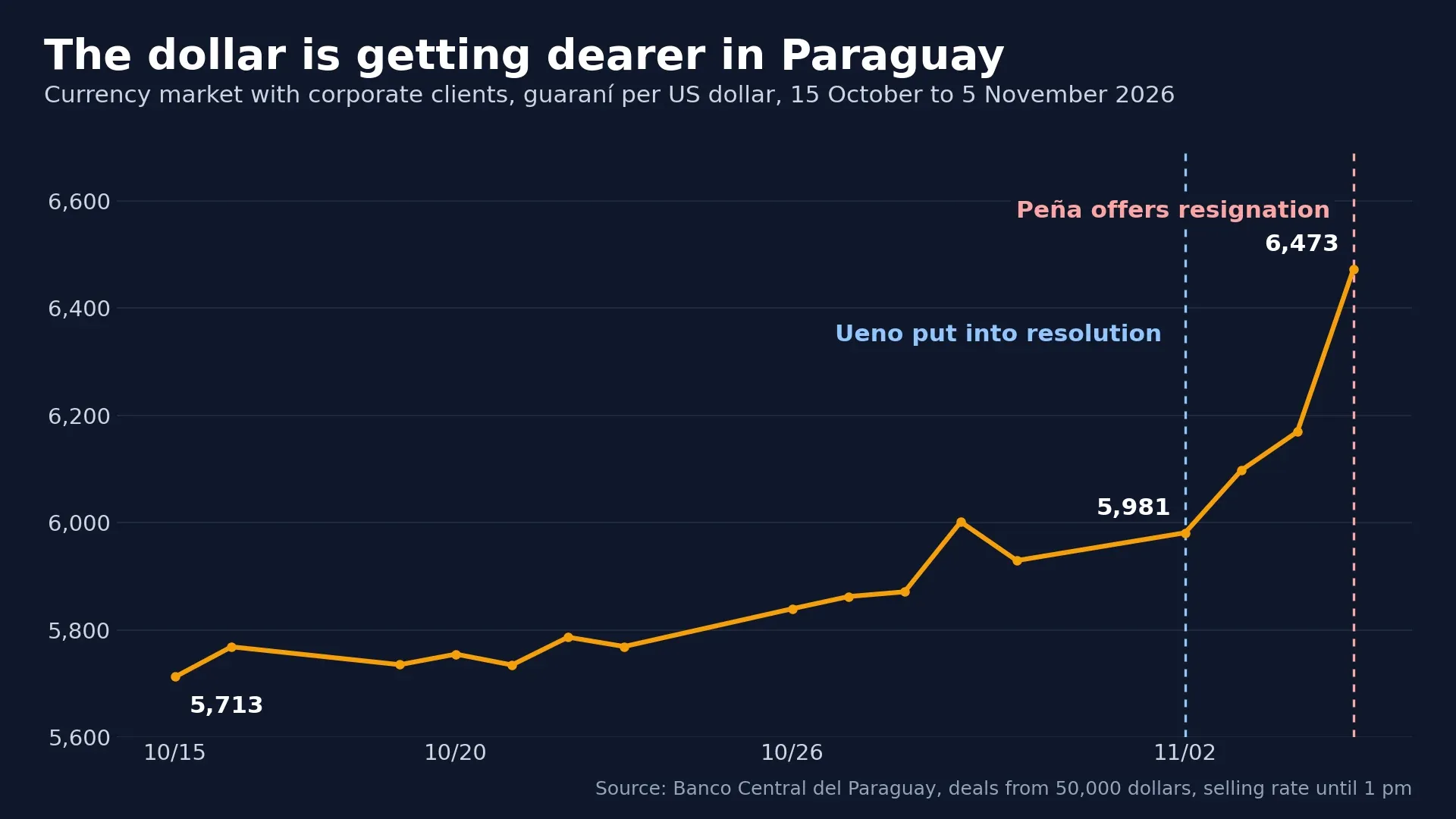
Paraguay's central bank put Ueno Bank into resolution on 2 November. Since then, around three million customers have been locked out of their accounts in a country of 6.5 million people. On Thursday, 5 November, President Santiago Peña handed in his resignation, which has not been accepted so far. On the currency market, the guaraní has lost 7.6 percent of its value against the dollar since the intervention.
The banking crisis in Paraguay lands in a week full of alarming headlines: a list of bank hacks in 15 countries is going viral on X, AI stocks crashed on Wall Street, and Bitcoin fell with them. Here is what holds up and what crypto can do in a situation like this, beyond being an investment. If you want to secure your own coins first, our hardware wallet comparison is the place to start.
What happened at Ueno Bank in Paraguay?
Ueno Bank is insolvent. On 2 November, the central bank's board unanimously decided to open resolution proceedings under deposit guarantee law 2334/03, reports the Argentine newspaper Perfil. The bank's solvency ratio had fallen to 5.56 percent against a required minimum of 12 percent.
The trigger was balance sheet adjustments of more than 1.6 trillion guaraní, roughly 250 million dollars, and a 70 million dollar hole in the bank's reserve requirement. Ueno started as a fintech and grew into a mid-sized bank that managed almost 850 million dollars of public money, according to Al Jazeera. Figures from Perfil and AP show that the fallout reaches far beyond its customers:
- 2,941,996 customers banked with Ueno in June 2026. According to AP, the bank claimed to reach more than 60 percent of the country's adults.
- Around 355 million dollars of the state social security fund IPS were invested with Ueno, about 9 percent of its portfolio.
- Around 32,000 pensioners received their pensions through the bank.
- Eight senior executives were detained and 27 bank officials and business associates charged, reports the Associated Press.
In the capital Asunción, protesters chanted "Give us back our money", and police used pepper spray and rubber pellets.
Why did Paraguay's President Santiago Peña hand in his resignation?
After the Ueno collapse, Peña lost the backing of parts of his own Colorado Party and announced his resignation in a video address on Thursday. He said he was acting with "the stability of our country, social peace" and the preservation of democratic institutions in mind, according to Al Jazeera.
Lawmakers accuse him of conflicts of interest, misuse of pension funds and a cover-up. According to Perfil, Peña was a shareholder of Ueno Holding, kept business ties to the group until March 2025 and appointed then Ueno chief Carlos Carvallo as head of the central bank, the very authority meant to supervise the bank. Carvallo stepped down at Peña's request, and according to AP Pedro Acosta Bernal is running the central bank on an interim basis.
The resignation has not been accepted. Thursday's joint session of both chambers collapsed without a quorum after lawmakers of the Colorado Party walked out, so Peña formally remains president, reports the Paraguayan newspaper La Nación. The Chamber of Deputies had previously voted unanimously to impeach him; the Senate decides on that. If Vice President Pedro Alliana takes over, he will serve out the term until August 2028.
 Hardware wallets compared
Will Ueno Bank customers get their money back?
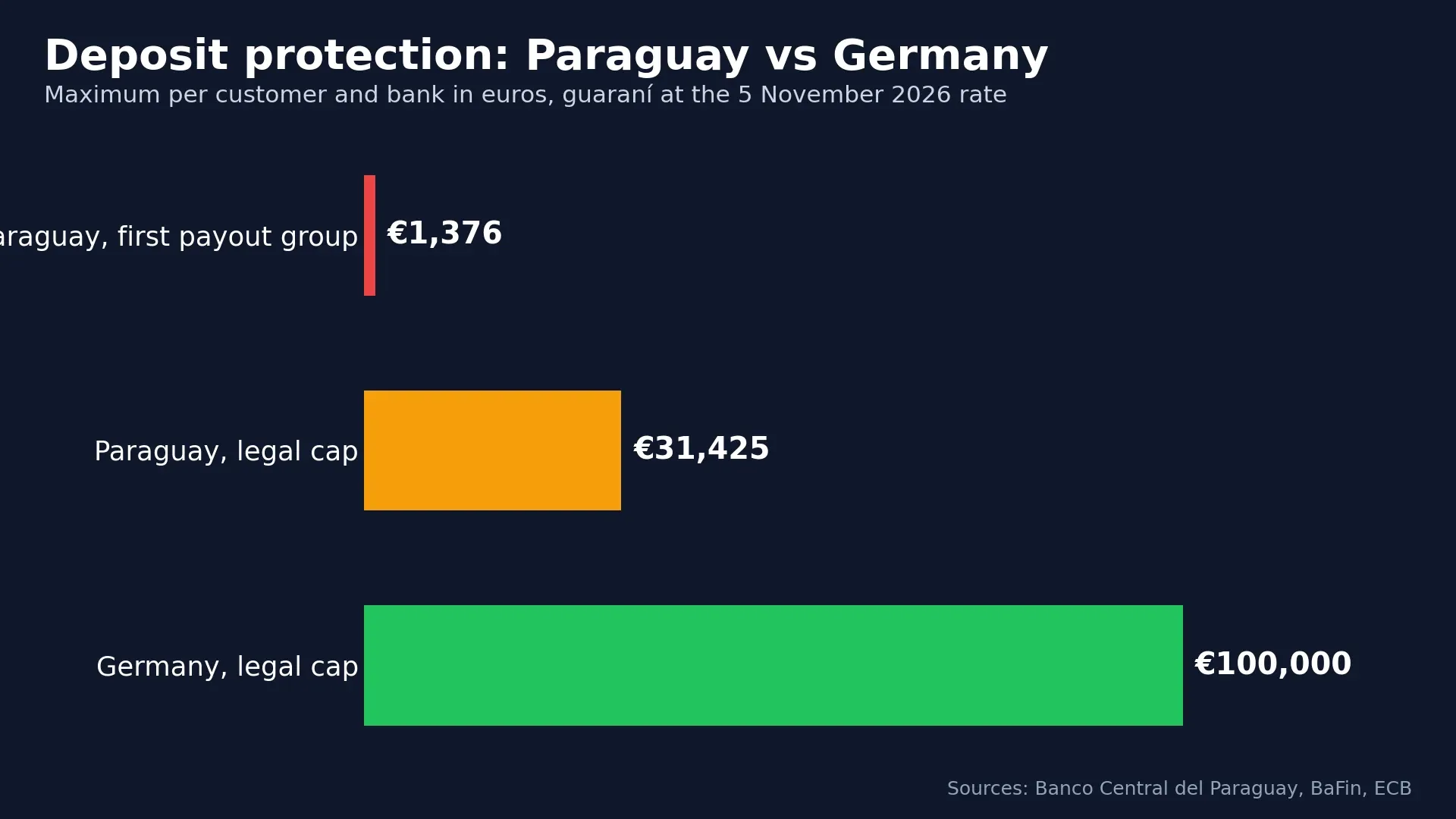
Many will, but in stages. Paraguay's deposit guarantee covers up to 228.3 million guaraní per customer and bank, equal to 75 monthly minimum wages. The fund first pays customers whose balances total no more than 10 million guaraní, who owe Ueno nothing and who hold an active account at another domestic bank. They receive their full balance, reports crypto.news, citing the central bank. Around 280,000 customers who banked only with Ueno are being given accounts at other banks, according to AP.
The payout window is 15 calendar days, until 17 November, and can be extended to 2 December. Anything above the cap depends on the banking supervisor's review.
A second problem only shows up in dollars: the guaraní is losing value. On 2 November, one dollar cost 5,981 guaraní on the currency market for corporate clients, and 6,473 on 5 November, according to central bank data for deals of 50,000 dollars or more. The 10 million guaraní threshold for this first group was worth 1,672 dollars on the day of the intervention and 1,545 dollars three days later. The currency had already been weakening since mid-October, and on Thursday alone the dollar rose 4.9 percent.
The crypto market offers a hint of the demand for dollars: one seller on Bybit asked 6,942 guaraní for one Tether dollar (USDT) on the morning of 5 November, about 13 percent above the previous day's reference rate by crypto.news' calculation. Other offers were well below that.
Bank hacks in 15 countries: what the viral list on X gets right
The list that has been shared on X since Thursday warns of a "bank lockdown". Check each case against its original source and a different picture emerges: there is no coordinated attack, only unrelated individual cases, many of them months or years old. Only in Taiwan, South Korea, Singapore, Nepal and France did the incident itself happen in October or early November 2026. The post itself notes that no government has frozen accounts.
| Country | What happened | When |
|---|---|---|
| Taiwan | Bank SinoPac: 427 unauthorised transfers from 419 customers, over NT$40 million in total, fully refunded; the entry point was suppliers of the new mobile banking system (Focus Taiwan) | November 2026 |
| South Korea | 40 incidents at 37 financial firms, around 473,000 records leaked (Munhwa Ilbo) | 30 September to 3 November 2026 |
| France | Crédit Mutuel Arkéa: fraudulent transfers after a cyberattack, around 100 million euros, the loot was swapped into crypto and part of it frozen (Capacity) | Early November 2026 |
| Singapore | Company wires 12.8 million US dollars to Cambodia on a forged approval letter, police recover all of it (The Star) | October 2026 |
| Nepal | The central bank takes its own website offline over a critical security flaw and tells all banks to tighten protection (ShareSansar) | October 2026 |
| Indonesia | Bank Jambi: around 144 billion rupiah drained from 6,609 customer accounts and swapped into crypto within hours (Antara) | February 2026 |
| USA | 14 people indicted over SIM swaps and corrupt insiders; the targeted accounts held 373 million US dollars in total (US Department of Justice) | Crimes 2023 to 2024 |
| Japan | Fake bank calls to companies in Yamagata, losses of 912 million yen (Sakigake) | March 2025 |
The pattern behind the real cases: attackers rarely break into the vault. They come in through suppliers, fake emails, phone scams and bribed staff. Brazil's central bank reports 99 cyber incidents through September, more than in all of 2025 (CNN Brasil). Crypto cuts both ways here: the thieves at Bank Jambi and at Crédit Mutuel Arkéa swapped their loot into cryptocurrencies.
Worst day in stock market history? What really happened on Wall Street
No, Thursday was not a record. The S&P 500 lost 4.4 percent, the Nasdaq 5.5 percent and the Dow Jones 3.4 percent. For the S&P 500 it was the worst day since April 2025, when US tariffs rattled markets, AP reports via BNN Bloomberg. For comparison: on Black Monday in 1987, the Dow Jones lost 22.6 percent in a single day (Federal Reserve History).
In dollar terms the day was huge: the S&P 500 alone shed around 2.8 trillion dollars in market value, according to NBC News. That money was not pulled out of the market, though: every sale has a buyer, and market value shrinks because prices fall. The trigger was concern that the Democrats' midterm wins will slow the construction of AI data centres; Nvidia lost 9.3 percent. The background is in our article on the Nasdaq crash.
The widely shared rumour that China would dump all its US Treasuries at an emergency meeting does not fit the data either. Mass selling would have pushed yields up; instead the 10-year Treasury yield fell from 4.90 to 4.84 percent on Thursday as investors fled into government bonds. China held 590.7 billion dollars in August according to the US Treasury, the lowest since 2008 (South China Morning Post), and has been reducing its holdings step by step for years.
Bitcoin fell with tech stocks and traded at 75,818 dollars late on Thursday evening, 5.5 percent lower than 24 hours earlier. What that means for the price is covered in our analysis of the Bitcoin crash.
 Regulated crypto exchanges compared
How can crypto protect you in a banking crisis?
Crypto does not protect you from falling prices. It protects you from what three million people in Paraguay are going through right now: a bank or an authority cutting off access to your money. If you hold Bitcoin or stablecoins in your own wallet, you need no bank, no branch and no opening hours to send a payment.
- Self-custody: If you hold your private key yourself, your holdings do not depend on any bank or account freeze. The safest place for your keys is a hardware wallet; our hardware wallet comparison shows which devices fit.
- Protection from your own currency: The guaraní has lost 7.6 percent against the dollar since the intervention. Anyone who kept savings in dollar stablecoins avoided that loss. That is exactly why people in countries with weak currencies use stablecoins as a digital dollar account; we compare the most important ones in our stablecoin list.
- Available around the clock: The Bitcoin network has no bank holidays. A transfer goes through even when branches are closed and ATMs are empty.
- No access for third parties: In the 2013 rescue of Bank of Cyprus, 47.5 percent of deposits above 100,000 euros were converted into the bank's shares (Bank of Cyprus). Bitcoin in self-custody cannot be tapped that way.
Where crypto does not protect you in a banking crisis
Crypto is not all-round protection. If you use it as a reserve, you should know its limits:
- Price: Bitcoin fell with the Nasdaq on Thursday. If you need cash quickly in a crisis, you may end up selling at the worst moment.
- Balances on an exchange: Coins on a trading platform are a claim against the provider, just like a bank balance. Only withdrawing to your own wallet protects you from the provider going bust. Under MiCA, providers in the EU must keep client assets separate from their own, but there is no deposit insurance for crypto assets as there is for banks.
- Stablecoin issuers: Behind every stablecoin is a company that holds reserves and can freeze addresses. In the EU, regulated exchanges mainly offer MiCA-compliant stablecoins such as USDC and EURC. They are not covered by deposit insurance either.
- Your key: If you lose your recovery phrase or hand it to scammers, you lose everything. Self-custody means self-responsibility.
What does the banking crisis in Paraguay mean for your money?
In the EU, deposits of up to 100,000 euros per customer and bank are protected by law. In Germany the money is paid out within seven working days without an application, according to the financial supervisor BaFin, and this also applies to partnerships and corporations. In the US, the FDIC insures up to 250,000 dollars per depositor and bank. At the 5 November exchange rate, Paraguay's cap is around 31,400 euros.
What you can take away from Paraguay:
- Spread it out: If you hold more than the insured limit at one bank, split it across several institutions. The limit applies per bank, not per account.
- A reserve outside the banking system: If you want to hold a small share independently of banks, you can keep Bitcoin or euro stablecoins in your own wallet. You can buy them from a MiCA-licensed provider, see our comparison of regulated crypto exchanges, and then withdraw to your own wallet.
- Protect your logins: Most bank hacks run through fake calls, emails and approvals. No bank will ask for your one-time codes over the phone.
As of 5 November 2026, 11 pm CET. This article is not investment advice; crypto assets can lose value sharply.
FAQ: the banking crisis in Paraguay
Transparency note: This article was produced with the assistance of artificial intelligence and reviewed by our editorial team before publication. All figures and claims were checked against the primary sources linked in the text. The feature image was generated with AI.
Related articles
- Floin Cyberattack: MiCA Crypto Platform From Liechtenstein Goes Offline
- Deutsche Bank to Custody Bitcoin and Ether: Why Retail Clients Are Missing and What to Check in Your Own Custody
- Stolen Keys Beat Code Flaws: Why the Private Key Is the Way In for 2026 Crypto Hacks
- Germany’s Banking Giants Go Crypto: Deutsche Bank and Sparkassen, the 2026 Launch Status
- Kraken parent Payward buys Saldo Bank: the first crypto firm with a bank of its own in the EU
Which topics should we dive deeper into?
Select what genuinely interests you. Your picks feed directly into our editorial planning.
Crypto news that's actually worth your time.
Weekly. 60 seconds. Carefully curated by our editors: no hype, no promo flood, no spam.

August 21, 2026 4:27 PM

Wallet App Without BaFin Authorisation: When Holding Crypto-Assets Requires a Licence
On 19 August 2026 BaFin published two consumer notices on wallet offerings. Who controls the means of access decides whether an authorisation is needed.
August 21, 2026 4:17 PM
Crypto Withdrawals to Your Own Wallet: Why Exchanges Demand Proof of Address Ownership Above €1,000
Above €1,000 your provider has to establish whether the destination address really belongs to you. Article 14(5) of the transfer of funds regulation, five permitted methods, and the reason a withdrawal stalls without this step.
October 30, 2026 12:40 PM

Binance SAFU fund: full reimbursement pledged for $6.3 billion
Binance puts the damage from the attack of October 29, 2026 at around $6.3 billion and intends to carry all losses, from the SAFU fund and from company funds. The fund holds 15,000 bitcoin, which at the current price comes to barely a fifth of the damage.
August 15, 2026 9:31 PM
Crypto Exchange Shutting Down: What to Do Before the Deadline Passes
Binance, BitMart, Luno and Revolut have ended or cut back their European business within seven weeks. This guide shows which deadline expires first, how a forced sale is treated for tax, and what to secure before the account closes.

April 3, 2026 8:40 AM
Coinbase Receives OCC Approval for National Trust Charter
Coinbase has secured conditional OCC approval for a National Trust Charter, a historic move that signals a massive shift in the U.S. crypto market structure.
October 29, 2026 12:28 AM
Bitget Wallet opens EUR accounts: incoming euros become USDT or USDC
Since October 27, 2026 Bitget Wallet gives its users their own account number in euros and US dollars, and the app converts incoming money automatically into USDT or USDC. What that means for SEPA transfers, the MiCA status of the two stablecoins and the holding period is set out here.
September 29, 2026 10:14 AM
Bitget discloses the flaw at its supplier and sets out the timetable for withdrawals
Bitget has disclosed how the attackers reached its withdrawal systems on September 24: through a previously unknown flaw in a security product it had bought in. The second stage of the withdrawal schedule opens today at 08:00 UTC, and for the balance you keep on any exchange the case changes the arithmetic.
September 23, 2026 10:11 AM
Kraken: 45 coins are on cancel only, 21 were announced – what to check when trading pairs are blocked
On September 23, 2026 we counted the public market directories of three trading venues. At Kraken, 82 of 1,450 trading pairs are listed as cancel only, a state in which an order can only be cancelled and no longer executed. The 45 underlying assets affected include just 21 that appear in the delisting notice we reported on September 3.
August 30, 2026 10:38 PM
Crypto Cards: Where Your Card Balance Really Sits and What the August 28 Solana Exploit Reveals About It
An attack on a card balance contract on Solana took the loaded balance from 1,685 users while their wallets stayed untouched. The case shows why it matters whether your crypto card holds funds as e-money at a licensed institution or in a smart contract.
July 11, 2026 12:43 PM
Circle Just Became a Bank: What the OCC Trust Bank Approval Means for USDC
The USDC issuer just cleared a milestone no stablecoin company has reached at this scale — and it changes how the biggest regulated stablecoin is backed.
October 27, 2026 12:48 PM
Bloom trading bot: 9,408 SOL drained, what to watch now
The Telegram trading bot Bloom reports an outflow of 9,408 SOL from 49 addresses and points to a flaw in a third-party module. The provider promises reimbursement in full; the decisive question about the key remains open.
October 11, 2026 1:24 AM
Three Mistakes When Setting Up Trust Wallet: The Twelve Words Never Belong on the Phone
Trust Wallet is set up in five minutes, yet three mistakes in those minutes regularly cost the entire balance. This guide covers the six steps, the real cost of a swap, and what applies in Germany on the holding period and supervision.
October 6, 2026 10:32 AM

FinCEN drops the reporting duty for withdrawals to private wallets: what matters now for European investors
The US anti-money-laundering agency FinCEN withdrew two proposals on October 5, 2026 covering the reporting duty for self-custodied wallets and for mixers. In the EU the development runs in exactly the opposite direction: proof of ownership from 1,000 euros today, a ban on anonymous accounts from July 2027.
October 5, 2026 4:16 PM
World Liberty Financial US Trust Bank: What the Abu Dhabi Report Leaves Open
The reported Abu Dhabi stake in World Liberty Financial raises questions. Here is what OCC filings show about the trust company, USD1 reserves and the authorisation to open.
October 2, 2026 4:32 AM
NEAR Intents halts withdrawals after a $3.8 million exploit: here are the reasons
NEAR Intents confirms an exploit of more than $3.8 million and holds deposits and withdrawals on eleven networks. Reimbursement is promised, a date for it is not.
September 26, 2026 4:14 PM

Bitget Withdrawals Resume on September 28: What to Check on a Residual Balance Now
Bitget is releasing the withdrawals frozen after the September 24 incident in four stages from September 28. For a residual balance held from Germany that is a deadline, not a reason to wait.
September 26, 2026 4:11 AM
Shielded Bitcoin: what the privacy proposal means for your Bitcoin addresses
Three researchers published a draft for encrypted Bitcoin transfers without a soft fork on September 24, 2026. What Shielded Bitcoin hides, what stays public and which points you can check on your own wallet today.
September 17, 2026 4:14 PM
D'CENT App Wallet: How to Tell If Your Recovery Phrase Has to Move Now
Manufacturer IoTrust reports suspicious asset transfers in the D'CENT app wallet and asks users to move their holdings. One question decides the matter: has your recovery phrase ever been entered into the app?
September 4, 2026 10:26 PM
Pocket Bitcoin Data Breach: When Name, Home Address and Bitcoin Address Circulate Together
The Swiss Bitcoin service Pocket Bitcoin closed its investigation on September 3, 2026: 5,411 people affected, and for 291 of them the Bitcoin addresses they used along with copies of identity documents. Why this one data pairing has lasting effect, and what you should check with your own provider.
September 4, 2026 10:15 PM
Trezor Data Breach: Am I Affected and What Should I Do Now?
Trezor widened the ShipMonk data breach on September 4, 2026: around 67,000 further people affected, just over 80,000 in total, from orders placed between November 2019 and August 2021. How to check in two minutes whether you are among them, and what an exposed home address means for self-custody.
September 4, 2026 10:17 AM
Cypher Shutdown on September 6: What Users Should Know Now the Withdrawal Deadline Has Passed
Recap as of September 27, 2026: Cypher had announced it would take its app, dApp and withdrawal window offline on September 6, 2026 and end the token protocol. This article describes the situation before the deadline, how the payout worked and what our own measurement showed at the time about what was left of the CYPR token.
September 3, 2026 4:41 AM
Kraken Delists 21 Tokens: Trading End on September 11 Has Passed, Withdrawals Run Until December 10
As of September 27, 2026: Kraken had set the end of trading and deposits for 21 cryptocurrencies for September 11, 2026 at 14:00 UTC, and that date has passed. According to the exchange, withdrawals remain possible until December 10, 2026 at 15:00 UTC. Our September 3 survey showed that none of these tokens could be deposited at Bitvavo, Coinbase or Bitstamp.
August 20, 2026 4:20 AM

Crypto Exchange Delisting: What Happens to Your Tokens When Trading and Withdrawals Close
A delisting runs in four stages, and only one of them is genuinely dangerous: the end of the withdrawal deadline. Using two live OKX dates as the example, we show what happens at each stage and how to tell whether it affects you.
August 19, 2026 7:27 AM
Blockchain Rollback After an Exploit: What Happens to Your Tokens When a Chain Is Reset
At Harmony, roughly four billion ONE were minted without authorisation, and a rollback of the chain has been on the table ever since. This piece explains what a blockchain rollback means technically, when it can still succeed, and what it triggers for your holding period.
August 11, 2026 1:32 PM
How to Store a Seed Phrase Safely: What Steel, a Passphrase and Multisig Do for Your Wallet Backup
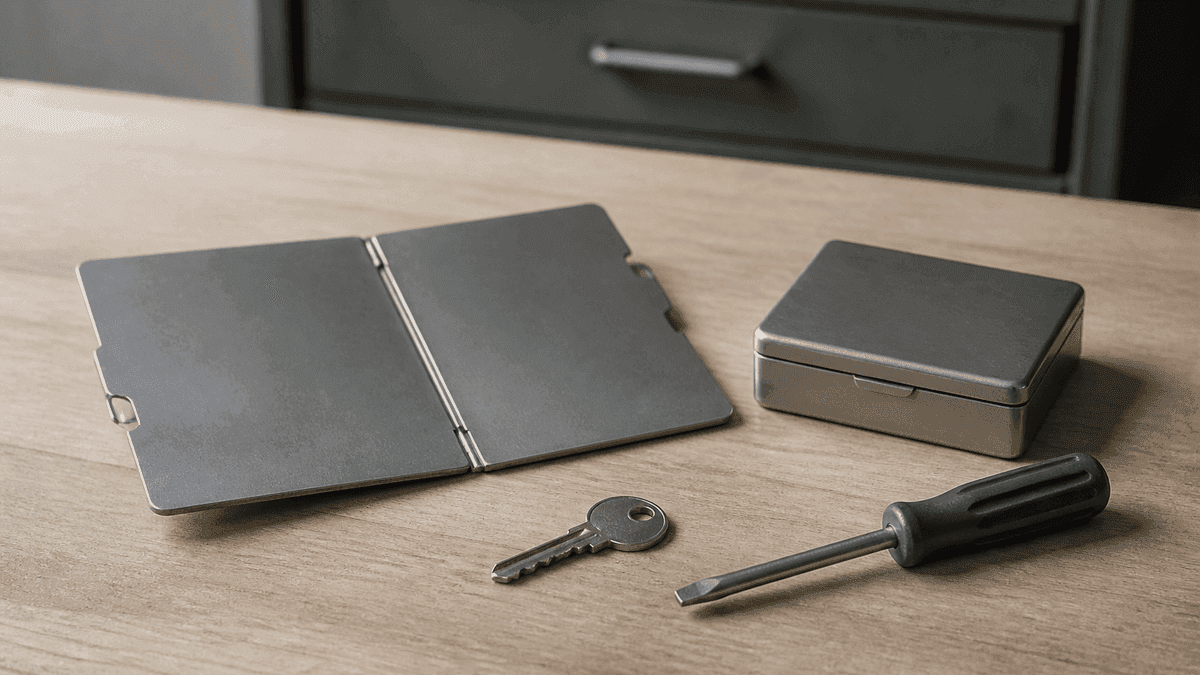
The Coldcard case pushed the manufacturer question to the front, while barely touching on where the backup is kept. This guide places paper, steel, the passphrase and splitting methods against the BIP-39 and SLIP-0039 standards.


More from CryptoTicker