
Ethereum price prediction: 322,586 ETH expire on October 30, what investors need to know
Analysis: on October 30, 322,586 ETH options expire on the derivatives exchange Deribit, 21.1 percent of total open interest and around $777 million at $2,407.76. What the date means for the levels between $2,300 and $2,600, for leveraged positions and for the German one-year deadline.





Which topics should we dive deeper into?
Select what genuinely interests you. Your picks feed directly into our editorial planning.
Crypto news that's actually worth your time.
Weekly. 60 seconds. Carefully curated by our editors: no hype, no promo flood, no spam.
Here is what is documented: on Friday, October 30, 322,586 Ethereum options expire on the derivatives exchange Deribit. That is 21.1 percent of all open ETH contracts held there and, at a price of $2,407.76 on Friday evening, roughly $777 million. The figures come from our own analysis of public Deribit data from October 23.
Our assessment follows further below: the mountain of call options at $2,600 is a bet on a recovery that the spot market is not delivering so far. Where the price can point over a horizon of months is set out in our Ethereum price prediction.
322,586 ETH on October 30: the largest expiry of the month
An option is a contract that gives its buyer the right to buy or sell ETH at a fixed price. When the contract runs out, it is settled. October 30 is the last Friday of the month and therefore the monthly expiry, where the large positions gather.
The comparison shows how big the gap to the other October dates is: October 24 accounts for 35,377 ETH, October 25 for 14,079, October 26 for 24,197 and October 27 for 3,423. The monthly expiry alone carries more than four times those four days combined. Only the November date on the 27th, with 152,364 ETH, is in the same order of magnitude at all.
Total open interest in ETH options stands at 1,527,306 contracts. For comparison: Ethereum currently has a market capitalisation of $294 billion. The derivatives market is therefore no sideshow, but it does not move the price on its own either.
Max pain at $2,500: what the metric measures
Max pain denotes the price at which all expiring options together hold the least intrinsic value, the point at which the buyers of the contracts receive the least in total. For October 30 that point sits at $2,500 according to our own calculation from the Deribit data, and at $2,400 for the October 24 date.
What the metric is not: a forecast. Max pain describes a set of interests, not a mechanism that pulls the price there. Anyone reading it as a price target is mistaking an accounting figure for a prediction. It is useful as a guide to where the bulk of the contracts actually sits.
The current price is $92 below the max pain point of the monthly expiry, or 3.8 percent.
The call mountain at $2,600 and the put wall at $2,300
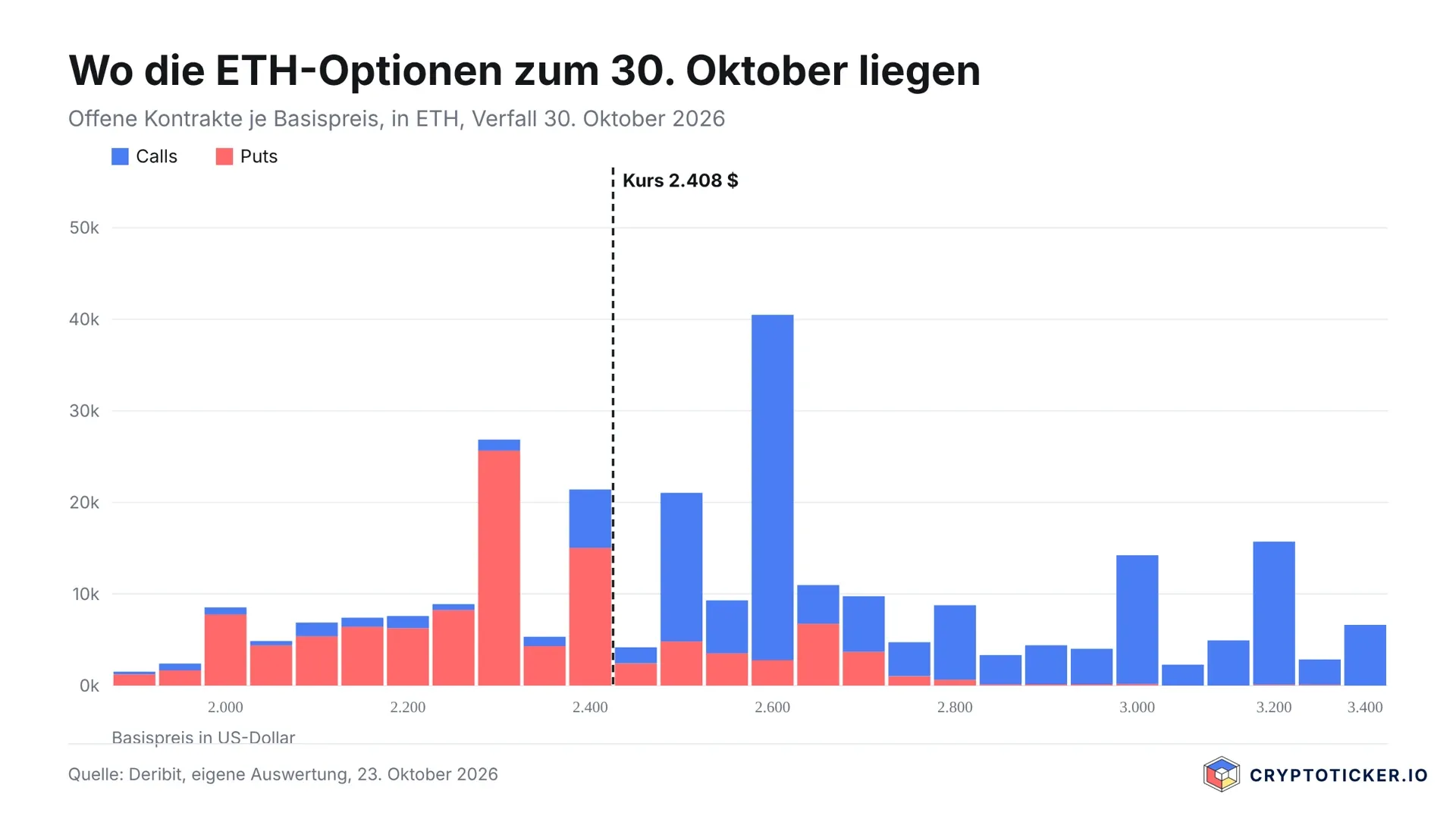
The distribution across strike prices is strikingly uneven. By far the strongest strike for October 30 is $2,600 with 40,492 contracts, 37,712 of them calls. Below that comes $2,300 with 26,867 contracts, here almost exclusively puts, namely 25,661. At $2,400 there are 21,416 contracts, at $2,500 there are 21,051.
Above today's price sit 191,913 contracts, below it 109,257. The put-to-call ratio for the monthly expiry is 0.77, so calls clearly dominate. Further up there are another 15,717 contracts at $3,200 and 14,238 at $3,000, both almost purely calls.
A put wall is the term for a cluster of put options at one strike. Such a wall does not mean the price holds there. The finding is a different one: below that level many contracts move into the money, and the counterparties have to adjust their hedges.
Delta hedging: how an expiry acts on the spot price
Whoever sells an option usually hedges on the spot market. If the price rises towards a strike where many calls are attached, the seller of those options has to buy more ETH to maintain the hedge. If the price falls, they sell again. This continuous readjustment is called delta hedging.
The closer the expiry comes, the more violent this readjustment becomes on small price moves, because the hedging requirement changes abruptly shortly before settlement. That is why prices often run more restlessly in the hours around large expiries, and why they frequently calm down again afterwards.
For October 30 that means concretely: the space between $2,300 and $2,600 is the range in which most contracts decide their direction. At today's price, 8 percent lies between those two levels to the downside and 8 percent to the upside.
October 24 already delivers a small dress rehearsal for that tomorrow.
 Find the right perp DEX for your trades
35,377 ETH expire as soon as Saturday, with puts in the majority
The next date is October 24, that is Saturday. 35,377 contracts are open there, around $85 million. The picture turns compared with the monthly expiry: 15,167 calls face 20,210 puts, a ratio of 1.33.
The focal points lie low. At $2,300 there are 4,384 contracts, 4,357 of them puts, at $2,280 another 3,639 puts. Towards the upside, 2,270 calls gather at $2,460 and 1,847 at $2,700. The max pain point sits at $2,400, eight dollars below the current price.
The total is small enough that this date moves little on its own. It is interesting as a sentiment reading: at the short end more investors are hedging to the downside, for the month end more are betting on rising prices.
Since the Glamsterdam article of October 22: $64 lower
On October 22 this column covered the Glamsterdam fork on the Hoodi testnet on October 26 and the raised gas limit. Nothing has changed on the protocol roadmap since then, but the price has.
At the start of the day on October 22 ETH stood at $2,472.68, at the start of today at $2,386.48, currently at $2,407.76. That is $64.92 or 2.6 percent less than two days ago, with an interim low in the morning. The hurdle of $2,518 named back then has not been tested once in these two days.
What has been added since is exactly the subject here: positioning on the derivatives market has concentrated on the monthly expiry while the spot market moved sideways to slightly lower. That is the second angle alongside the chart, and it points in a different direction than the price action of the past two days.
The levels: $2,413 above, $2,373 below, $2,500 not seen for eleven days
Over the course of the day the high was $2,413.74 and the low $2,373.40, a range of 1.7 percent. The price therefore stands at the upper edge of the day, 1.0 percent above the level of 24 hours ago.
The more important level lies higher. The last daily reading above $2,500 dates from October 12 at $2,534.63. Eleven days have passed since then in which not a single daily reading has reached that line. That is exactly where the max pain point of the monthly expiry sits, and exactly where the call mountain at $2,600 begins to take effect.
To the downside, $2,373 is the first level of the day, followed by the put wall at $2,300. In euro terms ETH stands at 2,150.86 euros.
Deribit is not a route for retail investors in Germany, the spot market is
The figures in this article come from a derivatives exchange that holds no authorisation under the EU regulation MiCA for retail business in Germany. For you as a reader that means: the options data are a measuring instrument, not a product offer. From them you read where other market participants have positioned their money.
What is tradable for you in Germany is the spot market via an exchange with an EU licence. The difference matters for the arithmetic: on the spot market the coin belongs to you, there is no expiry date and no obligation to post additional margin.

Leverage and liquidation around an expiry
Anyone working with leverage should know the range between $2,300 and $2,600 before October 30 arrives. A liquidation is the forced closing of a leveraged position as soon as the posted collateral is no longer sufficient. With fivefold leverage a move of 20 percent against the position is enough, with tenfold leverage one of 10 percent.
The distance from today's price to the put wall at $2,300 is 4.5 percent. At tenfold leverage that would already be almost half the way to liquidation. Which providers run which leverage and which margin rules is shown by the overview of crypto brokers. Two numbers belong on the table before any leveraged entry: your own liquidation price and the distance to it in percent.
Without leverage this calculation falls away entirely. What remains is the question of entry timing, and around an expiry that is neither easier nor harder to answer than at any other time.
 Find the right crypto tax tool
The one-year deadline: whoever bought on October 23, 2025 paid $3,805
For investors in Germany today carries a second meaning. Anyone who bought ETH exactly one year ago reaches the one-year holding period under paragraph 23 of the German Income Tax Act today. A sale after this deadline has passed is no longer a private disposal transaction.
The price on October 23, 2025 stood at $3,805.88. Against today's $2,407.76 that is 36.7 percent less. Anyone who bought back then is therefore sitting on a loss, and here the deadline becomes a double-edged thing: once the year is up a gain stays tax-free, but a loss can no longer be offset against other disposal gains either.

This calculation is not tax advice and it depends on the individual case, for example on the order of several purchases. How far the announced reform of the holding period has progressed by now is recorded in the status of the crypto holding period. As long as nothing else is noted there, the one-year deadline applies unchanged.
The editorial view: the call mountain at $2,600 is a bet, not a forecast
In its favour is that the positioning is unambiguous: 37,712 calls at $2,600 are by far the largest single item of the monthly expiry, and above the current price stand 191,913 contracts against 109,257 below it.
Against it is the spot market. Since October 12 no daily reading has reached 2,500 again, the price sits 3.8 percent below the max pain point and 8.0 percent below the strike with the most contracts. For the calls at $2,600 to hold intrinsic value on October 30, ETH would have to make up 8 percent in seven days. Over the past eleven days that has not succeeded for even a single daily reading.
Our assessment: the distribution of contracts describes an expectation, not a price path. The more robust information sits in the put wall at $2,300, because it marks the point from which a downward move generates additional hedging pressure. That assesses the situation and is not a recommendation to buy or sell.
Expiry on October 30: below $2,400 the picture tips
The situation in three steps, with numbers instead of mood:
- Note the range. $2,300 below, $2,600 above, $2,500 as the max pain point of the monthly expiry. If the price falls below 2,400, the 15,030 puts at that strike move into the money, and the dominance of the calls loses its basis. Where you trade at which fees is shown by the overview of crypto exchanges.
- Recalculate your own leverage. Liquidation price and distance in percent, before October 30 and not after. At 4.5 percent distance to the put wall, a double-digit leverage is a different calculation from a twofold one. The fee and leverage models of the derivatives platforms are in the comparison of perp DEXs.
- Look up your purchase date. If the entry lies more than a year back, a sale is settled for tax purposes, but a loss can no longer be offset either. Anyone with several purchases needs the order to be documented; the crypto tax tools help with that.
The raw data for all figures in this article are publicly available in the Deribit options metrics, the price data come from CoinGecko, retrieved on Friday evening.
(As of October 23, 2026. This article is not investment advice. Prices and fee structures change; check the terms with the provider before you buy.)
Frequently asked questions about the ETH options expiry
Transparency note: This article was produced with the assistance of artificial intelligence and reviewed by our editorial team before publication. All figures and claims were checked against the primary sources linked in the text. The feature image was generated with AI.
More on Ethereum: All Ethereum news at a glance
Related articles
- Massive BTC & ETH Options Expiry Today – What It Means for the Market
- Bitcoin price prediction: 132,411 Bitcoin hinge on the December 25 expiry: is $100,000 still within reach?
- Bitcoin price prediction: 18,029 contracts expire Friday, and the level that decides is $80,000
- Bitcoin Price Prediction: 140,844 BTC Expire on October 30, and What Matters Now at $80,000
- Ethereum price prediction: the price turned higher at $2,495.93, and two dates decide this week
Which topics should we dive deeper into?
Select what genuinely interests you. Your picks feed directly into our editorial planning.
Crypto news that's actually worth your time.
Weekly. 60 seconds. Carefully curated by our editors: no hype, no promo flood, no spam.

October 17, 2026 4:17 PM

Bitcoin price prediction: $12.2 billion in options expire on October 30, and what you can do now
On October 30, 149,686 Bitcoin contracts with a notional value of $12.2 billion expire on the Deribit options exchange, two thirds of them calls. With the largest bets at $95,000 and $100,000 but the market pricing only a 6 percent move, the day that decides is not the expiry but the $79,000 level.
September 9, 2026 1:26 PM

Bitcoin Options Expiry of September 25: What Holders of Leveraged Positions Should Know in Hindsight
Recap as of September 27, 2026: Bitcoin options worth $14.39 billion were due to expire on September 25, alongside Ether options worth $1.81 billion. This article describes the situation before that date, our own count of the derivatives market and what holders of leveraged positions should have checked at the time.

January 2, 2026 12:03 PM

Ethereum Hits a New Yearly High as Volatility Builds Across the Crypto Market
Ethereum breaks to a new yearly high as options expiry injects volatility into the market, with Bitcoin also flashing strength near key levels.
June 24, 2024 10:37 AM

Bitcoin Price Prediction: Can BTC Price Fall Below 50K?
The profitability of Bitcoin futures cash-and-carry trades has plummeted amid a significant crypto market selloff. What are the reasons behind the decline and what can traders expect next?

October 3, 2026 1:22 PM

Ethereum Price Prediction: Ether ETFs Lose $118 Million in Three Days, Bitcoin Funds Gain
Roughly $118 million has left the US spot Ether ETFs over three consecutive trading days, while the Bitcoin funds are gathering cash again. ETH closes at its lowest level since September 20. These are the levels that now count.
June 12, 2024 2:17 PM

Ethereum (ETH) Price Prediction For BULLISH And BEARISH Scenarios
The latest analysis of Ethereum's price movements as of June 12, is divided between the 2 scenarios: bullish and bearish. But what drives each, and which is more likely to occur?
August 10, 2024 6:02 PM

Ethereum Price Prediction: Amid Mixed Signals What To Expect For ETH Price?
Ethereum faces volatility and competition, but signs of bullish activity and whale accumulation suggest potential recovery. How does it compare to Solana, and what does the future hold for ETH?
October 4, 2026 7:26 PM

Ethereum price prediction: five strong Octobers since 2018, but the last two closed lower
For Ether, October has been a positive month in five of the eight years since 2018, though not in 2024 and 2025. ETH enters this October at around $2,690, and the Sepolia testnet forks on October 6. What the record shows and which levels count.
August 15, 2025 11:54 AM

Massive Crypto Moves: $7.9B in Options Expire, $2B USDT Minted in 24 Hours
The crypto market is heating up with $7.9B in Bitcoin and Ethereum options expiring and a record-breaking $2B in USDT minted as whales buy the dip. Could this trigger a major rally?
August 2, 2024 10:32 PM

Ethereum Price Crash: What Next Support Levels For ETH Price Below $3K?
Ethereum fees just hit their lowest since late 2023, and now Ethereum price is trading near $3K with a high potential to drop below it... What's next?
May 27, 2025 11:59 AM

Ethereum Price Prediction: Will ETH Hit $3,000 in May and a New ATH in 2025?
Ethereum (ETH) is the most trending coin in May 2025. With Bitcoin cooling off, investors are now turning to ETH as their next opportunity. Potential breakout above $3,000 this month and a new all-time high before the year ends?
March 16, 2026 10:31 AM

Ethereum Price Prediction: ETH Coin Reclaims $2,250 as Bull Run Targets THIS New Price
Ethereum price surges 7% in 24 hours, breaking the $2,250 resistance. Analysts eye this target next, while key support levels at $2,200 and $2,050 remain critical.
December 19, 2024 11:38 AM
Is an Ethereum Price Crash Imminent?
Ethereum price has dipped igniting fears of a potential price crash. Analysts highlight bearish signals, but some still predict a recovery. Which is it next?
April 6, 2025 9:31 PM

Ethereum Price Crash Below $1,800 - Is $1,200 Next?
Ethereum just suffered one of its worst daily drops in recent months, plunging below key support levels. With the broader crypto market in freefall and heavy outflows hitting exchanges, what's next for ETH?
August 25, 2024 11:08 AM

Ethereum Price Prediction: ETH Eyes $3,000 After 5% Weekly Gain
Ethereum price gained 5% over the past week, reaching the critical price area of $2,750. Can Ethereum break through the psychological barrier of $3,000?
September 27, 2026 4:25 PM

Ethereum Price Prediction: What to Check on ETH Before the Quarter Turns
Ethereum trades at 2,714.60 dollars on September 27, 2026 and remains pinned to the zone between 2,750 and 2,820 dollars. Which levels decide October, how far apart the analyst targets sit, and which checks to complete before the quarter turns.
January 2, 2026 5:34 PM
Crypto Markets Surge Following $2.2B BTC and ETH Options Expiry
Crypto prices opened 2026 sharply higher as $2.2 billion in Bitcoin and Ethereum options expired, triggering a broad risk-on move.
August 24, 2026 12:22 PM

Ethereum Price Prediction: Is $3,000 the Next ETH Target?
ETH ripped 29% and reclaimed the 200 EMA. Our Ethereum price prediction explains the path to $3,000 and the one level that kills the bull case.
December 4, 2025 7:45 AM
Ethereum Price Explodes Back Above $3,200: Bigger Moves Coming?
Ethereum jumps back above $3,200 as Bitcoin reclaims $90K. Fresh U.S. liquidity signals and strong risk-asset demand now set the tone for ETH in December.
January 28, 2026 2:45 PM
Ethereum Price Reclaims $3,000: Market Gains Momentum Ahead of FOMC
Ethereum price reclaims the $3,000 level as the crypto market turns green. Here is an analysis of the ETH chart and key resistance levels as FOMC volatility looms.
August 4, 2025 1:02 PM

Ethereum Price Prediction: Can ETH Break $4,000 or Is a Correction Coming?
Ethereum is trying to recover after dipping below $3,500. With support holding and RSI bouncing, is a breakout to $3,838 next, or are we due for a deeper pullback?
February 6, 2026 7:27 PM
Breaking: Ethereum Price UP Above $2,000 Again, but Traders Remain Cautious
Ethereum price climbs back above $2,000 after a brutal market crash. Technical analysis suggests this relief rally faces massive resistance.
April 23, 2026 4:25 PM

Ethereum Price Analysis: ETH Coin Targets $2,500 as Bulls Defend a Strong Support
Ethereum holds firm above $2,300 while Bitcoin leads the rally. Technical analysis suggests a potential ETH coin breakout toward $2,500 in the coming days.
February 19, 2025 7:40 PM

Ethereum Price Prediction: Is ETH Heading Toward $4,000?
Ethereum is showing signs of a major price move, with only 6.38% of its total supply left on exchanges. Could ETH be heading toward $4,000? Here’s what on-chain data and market trends indicate.
March 30, 2025 2:12 PM

Ethereum Price Prediction March 2025: Can ETH Price Surge Back Over $3K?
Ethereum price predictions for March 2025 with the latest Ethereum news can be highly controversial. Check the Ethereum price analysis, the factors influencing ETH price, and the multiple Ethereum price predictions.


More from CryptoTicker