
Bitcoin price prediction: 18,029 contracts expire Friday, and the level that decides is $80,000
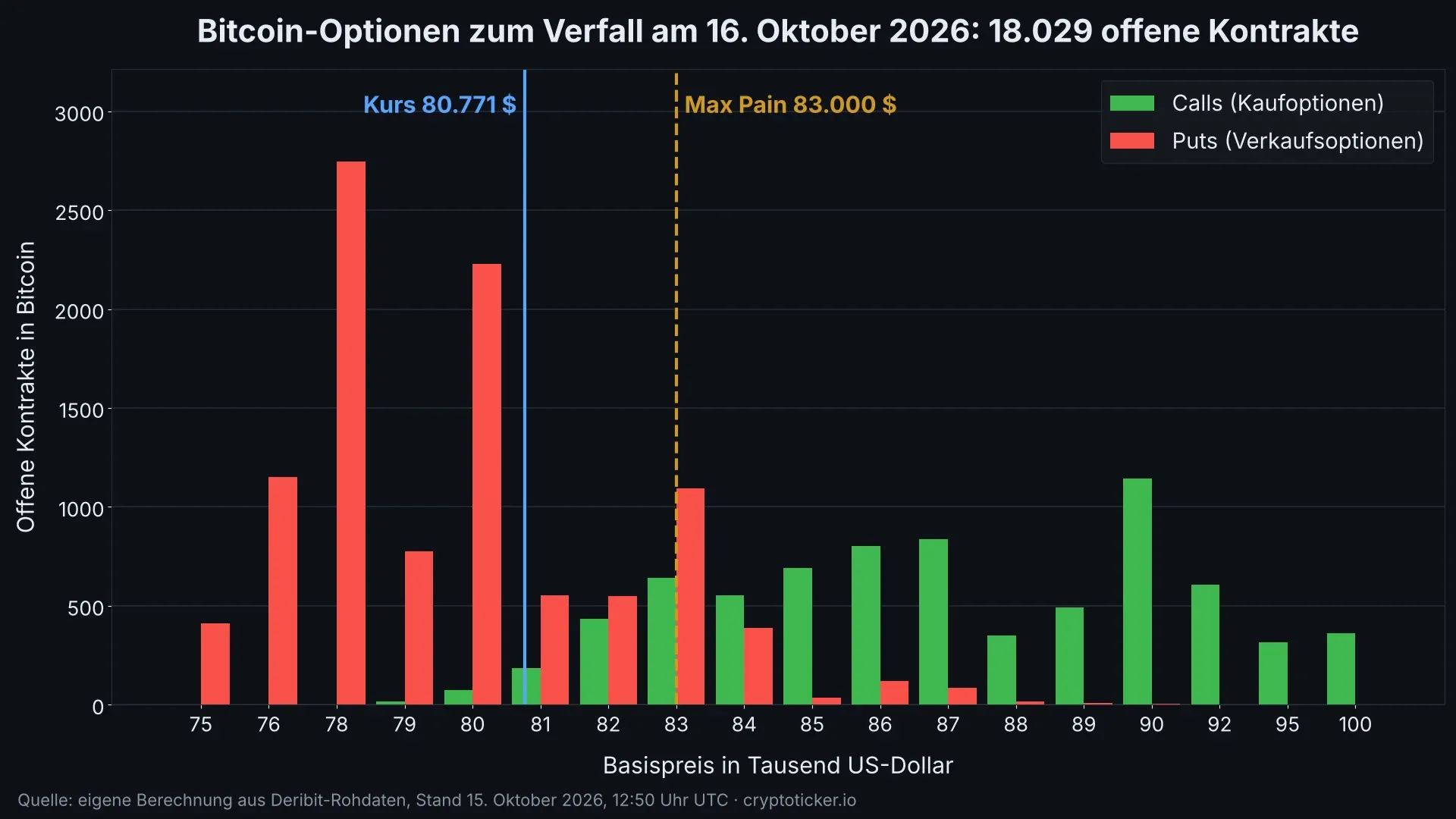
On Friday 18,029 Bitcoin options run out on Deribit, the calculated max pain sits at $83,000 and therefore $2,229 above the price. The spread of open contracts shows why the $80,000 level matters more on this expiry day than the $83,000 figure.





Which topics should we dive deeper into?
Select what genuinely interests you. Your picks feed directly into our editorial planning.
Crypto news that's actually worth your time.
Weekly. 60 seconds. Carefully curated by our editors: no hype, no promo flood, no spam.
On Friday, October 16, 18,029 Bitcoin contracts expire on the options exchange Deribit. The calculated pain point of this expiry sits at $83,000, while the price on Thursday afternoon was $80,771. That leaves $2,229 between the market and the level at which options buyers collectively gain the least. Whether the gap closes on Friday is not for the expiry alone to decide, and the structure of the open contracts explains fairly precisely why.
Bitcoin traded at $80,771, or 72,029 euros, at around 2:50 pm German time on October 15, down 2.46 percent over 24 hours (source: CoinGecko). The high of the day was $83,005, the low $80,444. Over a week the loss stands at 2.12 percent, and the price is 35.9 percent below the record of $126,080 set on October 6, 2025.
Friday's Bitcoin options expiry: 18,029 contracts on Deribit
Deribit is the largest venue for Bitcoin options. An option is a right, not an obligation: the buyer of a call may buy Bitcoin at an agreed strike price, the buyer of a put may sell at that price. If the option runs out without the right being worth exercising, it expires worthless.
For Friday's expiry, our own reading of the Deribit raw data from October 15, 12:50 pm UTC, shows 18,029 open contracts. Of those, 10,410 are puts and 7,619 are calls. Measured against a price of roughly $80,800, that is a notional value of a good $1.45 billion. One Deribit contract covers one Bitcoin.
For a sense of scale: the monthly expiry on October 30 carries 148,348 contracts, more than eight times as many. Friday is one of the small weekly dates, not a quarterly event.
Max pain at $83,000: what the Bitcoin options figure measures
Max pain is the strike price at which the sum of all payouts to options buyers comes out smallest. The calculation is plain: for every conceivable closing price, the combined worth of all calls and all puts is added up, and the price with the smallest result is the point of maximum pain.
For October 16 our own calculation puts that point at $83,000. At $80,000 the options together would be worth around 8.2 million units, at $83,000 only 2.3 million, and at $86,000 again 7.2 million. The curve has a clear trough, and the trough lies above today's price.
What the figure is not: a price target. Max pain describes where the interests of the options writers lie, not a forecast. The notion that the market drifts towards maximum pain on expiry day is an observation with plenty of counter-examples, not a law. Read the number as a target and you have mistaken a statistic for an intention.
A Bitcoin put-call ratio of 1.37: hedging has the upper hand
Divide the open puts by the open calls and Friday comes out at a ratio of 1.37. For every three calls there are a good four puts. A reading above 1 means more capital is positioned for falling prices, or for protection, than for rising ones.
The comparison with the monthly expiry makes the difference visible. For October 30 the ratio is 0.52, with 97,612 calls against 50,736 puts. Positioning further out is therefore mostly bullish, while the near term looks defensive. Together the two describe a market that is hedging the next few days without writing off the month.
How a Bitcoin options expiry affects the price at all
The mechanism runs through the traders who sold the options. A writer carries the other side's risk and offsets it on the futures market by buying or selling Bitcoin. How much they have to move depends on how close the price is to the strikes at which they hold open contracts.
As the price approaches a strike with many open contracts, the hedge required changes quickly, and the trader has to adjust more often. In quiet phases that adjustment dampens the market, because it works against the move. It can also amplify, when the price cuts through a densely occupied level and many traders have to buy or sell in the same direction.
After the expiry that tie is cut. The bigger move therefore often comes not on expiry day itself but in the days that follow, once the hedge is no longer needed.
The Bitcoin put clusters at $78,000 and $80,000
The densest positions into Friday are the puts below the price. At $78,000 there are 2,746 contracts, at $80,000 2,142, at $76,000 1,150 and at $79,000 777. Those four strikes alone carry 6,815 contracts, or 38 percent of the entire expiry.
On the other side the calls sit far above: 1,144 contracts at $90,000, 835 at $87,000, 690 at $85,000 and 606 at $92,000. Those levels are 5 to 11 percent away from today's price and play practically no part in Friday.
The $80,000 level deserves particular attention because it counts twice: as the second-largest put cluster of the expiry, and as a level $771 below the current price. Should Bitcoin fall through it, those 2,142 contracts move into the money, and the writers on the other side have to widen their hedge.
The monthly Bitcoin expiry on October 30: 148,348 contracts
The month's real date falls on October 30, two days after the next US Federal Reserve rate decision on October 28. It carries 148,348 open contracts, by far the largest position of the coming weeks. The expiry on November 27 follows with 25,150 contracts.
For placing Friday in context, that means the small date clears out short-dated hedging while positioning for the end of the month is left untouched. The next larger turning point is more likely to come at the end of October than on Friday.
What has changed since Tuesday's inflation reading
In our article of October 14 on US inflation at 3.7 percent and the core rate above forecast, Bitcoin stood at $83,115 on the day. The price has since given up 2.8 percent and sits at $80,771. The $82,000 level discussed at the time broke during Wednesday and has not been recovered.
In between came a wave of liquidations on Thursday morning, in which market data show $489 million of leveraged positions closed within an hour; the details are in our report on the liquidation cascade. What is new since Tuesday is therefore less the direction than the nature of the move: the selling pressure now comes from the futures market rather than from the macro headline.
Sentiment has turned accordingly. The Fear and Greed Index from alternative.me stands at 53 points on October 15, which is neutral, after 62 points and greed the day before.
Our assessment: Friday's expiry will not carry the big move
In the view of the editorial team, Friday's expiry is too small to pull the price to $83,000 on its own. Three pieces of evidence support that. First, the volume of 18,029 contracts is only a good eighth of the monthly expiry on October 30. Second, the futures market is not stretched right now: the funding rate on the Deribit perpetual is 0.0041 percent per eight hours and 0.0046 percent at OKX, both close to zero and therefore without an imbalance on either side. Third, historical volatility at Deribit stands at 32.8, in the lower range of recent months.
The argument against: the put clusters at $78,000 and $80,000 sit tightly below the price. If the $80,000 level goes, the writers' hedging amplifies the move downwards instead of damping it. The expiry is then not a driver, but an amplifier. Our assessment weighs up the situation and is not a recommendation to buy or sell.

 Find a perp DEX for your leverage
Leverage and liquidation on a Bitcoin expiry day
Open positions in the Deribit perpetual add up to $881.5 million. Perpetuals are futures contracts without an expiry date, tied to the spot price through a funding rate. When that rate sits near zero as it does today, the long and short sides pay each other almost nothing, and the market carries no pronounced imbalance.
For leveraged positions an expiry day is still the more uncomfortable part of the week, because swings around densely occupied levels increase. The liquidation price is the price at which the exchange force-closes a position because the posted collateral has run out. At five times leverage it sits around 20 percent from entry, at ten times around 10 percent, at twenty times still around 5 percent.
Applied to today's price, twenty times leverage means a liquidation price of roughly $76,700. That value sits between the two largest put clusters of the expiry. If you hold a leveraged position, set your own liquidation distance against the $80,000, $78,000 and $76,000 levels instead of thinking of it in percent. Which venues charge which fees and demand which collateral is set out in our comparison of the best perp DEXs.
Thursday morning's wave shows how fast that happens: $489 million in one hour is more than half of all open interest in the Deribit perpetual.
Holding period and exemption limit: December 31 is closing in
For investors in Germany, more hangs on the turn of the year than the price question. Under Section 23 of the German Income Tax Act, the gain on a Bitcoin sale is tax-free if more than a year lies between purchase and sale. Inside that window the gain is taxed at the personal income tax rate, though an exemption limit of 1,000 euros per calendar year applies to all private disposals taken together.
Exemption limit means a gain of 999 euros is taxed at nothing, while a gain of 1,001 euros is taxed in full. The difference from a tax-free allowance is expensive here, and it is regularly confused.
A planned extension of the holding period was recently on the political agenda without a decision being taken. The cabinet date passed without a result, so the December 31 cut-off stands unchanged. To offset this year's losses against gains, you need your transactions documented cleanly by the turn of the year; a tax tool with a portfolio tracker takes that work off your hands.
Buying route and custody under MiCA
Since the EU's MiCA regulation applied in full, providers of crypto services in the EU need authorisation and are supervised, in Germany by BaFin. For the buying route that means an authorised provider must hold client funds separately from its own assets and must evidence custody.
The choice between an exchange and self-custody is untouched by that. Leave Bitcoin sitting on an exchange and you hold a claim against that exchange, not Bitcoin on the blockchain. Move it to your own wallet and you carry responsibility for the key yourself. For amounts beyond what you intend to trade at short notice, self-custody is the safer route.
 Compare exchanges for your Bitcoin purchase
Bitcoin expiry on October 16: $2,229 short of max pain
With 18,029 contracts, Friday's expiry is a small date with a clear tilt to the downside. The deciding question is not the $83,000 calculation but whether the $80,000 level holds.
- Recalculate your liquidation distance. Put your own liquidation price next to the $80,000, $78,000 and $76,000 levels. If it falls between them, the leverage is too high for this expiry day. The terms offered by the venues are in the perp DEX comparison.
- Sort the holding periods in your portfolio. Every position that completes its year before December 31 can be sold tax-free afterwards. Which transaction was bought when is settled faster by a tax tool with a portfolio tracker than by a spreadsheet kept by hand.
- Check the buying route for authorisation. Before the next purchase it is worth looking at fees, withdrawal costs and the provider's MiCA authorisation; the exchange comparison provides the overview.
The next test comes on October 28 with the US Federal Reserve's rate decision, two days before the monthly expiry and its 148,348 contracts. Until then the $80,000 level remains the line on which October is decided.
(As of October 15, 2026. This article is not investment advice. Prices and fee structures change; check the terms with the provider before you buy.)
Frequently asked questions about the Bitcoin options expiry
Transparency note: This article was produced with the assistance of artificial intelligence and reviewed by our editorial team before publication. All figures and claims were checked against the primary sources linked in the text. The feature image was generated with AI.
Related articles
- Massive BTC & ETH Options Expiry Today – What It Means for the Market
- Bitcoin Price Prediction: 140,844 BTC Expire on October 30, and What Matters Now at $80,000
- Bitcoin Price Prediction: Can BTC Price Fall Below 50K?
- Bitcoin Price Prediction: BTC Price Over $100,000 AGAIN Soon?
- Bitcoin Options Expiry of September 25: What Holders of Leveraged Positions Should Know in Hindsight
Which topics should we dive deeper into?
Select what genuinely interests you. Your picks feed directly into our editorial planning.
Crypto news that's actually worth your time.
Weekly. 60 seconds. Carefully curated by our editors: no hype, no promo flood, no spam.

January 15, 2024 6:37 AM

Is Bitcoin (BTC) Price Poised to Hit $1 Million within Days to Weeks? – Max Pain Theory Factor?
With the impending Bitcoin halving in April, experts hold varying opinions on the prospective trajectories of Bitcoin price.

August 15, 2025 11:54 AM

Massive Crypto Moves: $7.9B in Options Expire, $2B USDT Minted in 24 Hours
The crypto market is heating up with $7.9B in Bitcoin and Ethereum options expiring and a record-breaking $2B in USDT minted as whales buy the dip. Could this trigger a major rally?
January 9, 2025 3:30 PM

2025 Bitcoin Price Prediction: What if BTC Price breaks below $90K Support?
The 2025 Bitcoin price prediction hinges on its critical $90,000 support level. Will it hold, or could we see declines to lower levels? Explore key insights shaping the short-term Bitcoin trajectory.
March 15, 2025 5:40 PM

Bitcoin Price Prediction March 2025 with FOMC and TRUMP in Play
Bitcoin price prediction for March 2025 is one to expect, ahead of the upcoming FOMC meeting and Trump's strategic crypto reserve. What to expect for BTC price?
July 8, 2024 7:51 AM

Crypto Market Crash News As BTC Price Crash Back To 56K
With the crypto market crash, and Bitcoin price drop to below 56k with recent dormant BTC whales activity, what comes next: a correction or further crash soon?
October 14, 2024 12:38 PM

Today's Top Performers: Solana, Bitcoin and Ethereum
Today marks a positive day for most cryptocurrencies, with Solana, Bitcoin, and Ethereum leading the top 10 with impressive surges. But what to expect from each?
January 2, 2026 12:03 PM

Ethereum Hits a New Yearly High as Volatility Builds Across the Crypto Market
Ethereum breaks to a new yearly high as options expiry injects volatility into the market, with Bitcoin also flashing strength near key levels.
December 12, 2024 11:28 AM
Bitcoin Hits $100K Again – But a Crash to $60K Might Be Next
Bitcoin is back at $100K after dropping to $94K, but concerns are growing as BTC faces strong resistance at $104K. Will the bullrun continue, or is a major crash coming in January?
November 24, 2024 9:23 PM

Bitcoin Price Prediction 2025: What to Expect amid TRUMP's Administration?
Bitcoin price is currently among the trendiest topics with Elon Musk's recent post and with the aspiration for 2025 amid Trump's new administration. Here is what to expect!
May 15, 2024 6:05 PM

Bitcoin Price Prediction: 60K CRITICAL LEVEL, What Next?
After a recent crash, the crypto market has shown resilience, with Bitcoin surging over 3% in the past day. What's next for BTC as it hovers around $60,000?
July 7, 2024 6:40 PM

Will BTC Price Crash Again After The Dormant Bitcoin Whale Move?
A decade dormant Bitcoin Whale just moved 140 BTC. Is it a sign of a new BTC price crash or surge soon? What is there to know...
December 16, 2024 5:11 PM

Bitcoin Price Prediction: Can Bitcoin Reach $110,000 After Today's New ATH near $107K?
Bitcoin price has hit a record-breaking ATH of $106,803 fueled by Trump's proposal for a U.S. Bitcoin reserve. This has the crypto market sparking with Bitcoin price predictions.
September 14, 2024 12:01 PM

Bitcoin Surges Past $60K: The Start of a Major Rally or Just Another Bull Trap?
Bitcoin has surged past $60,000, sparking optimism among investors. But with looming market volatility and whale activity, is this the start of a new rally or just another bull trap?

October 12, 2026 10:19 AM

Ethereum price prediction: the price turned higher at $2,495.93, and two dates decide this week
Ether's daily low came in at $2,495.93, so the level held by 93 cents. Two fixed dates shape the week: the US price index on Wednesday and the options expiry on Friday.
March 27, 2026 9:51 PM

Why is XRP Price Crashing? Here are the Main Reasons...
XRP price is tumbling alongside Bitcoin as geopolitical tensions in the Middle East and a massive options expiry trigger a broad crypto market sell-off today.
August 17, 2024 2:55 AM

Bitcoin Price Prediction: How Will BTC Price Move Following Gold's Surge?
Will Bitcoin break through resistance and rally, or are there further declines on the horizon, for the second half of August? This is the latest analysis of Bitcoin’s price...
April 13, 2025 11:22 AM

Bitcoin Dollar Price Jumps: Is the Bitcoin Price Rally Just Starting?
After dropping to $75,000 during Trump’s tariff war, Bitcoin has bounced back significantly. With the current Bitcoin dollar price at $84,800, the $100K milestone is once again in sight. What’s next?
February 21, 2026 4:00 PM

Bitcoin Price Prediction: Can BTC Break the $70,000 Resistance This Week?
Bitcoin tests key resistance levels as bulls eye a return to $70,000. Analyze the technical triggers and market sentiment driving the next BTC move.
December 10, 2024 12:30 AM

Bitcoin Price Drops Below $100K – Is a Bigger Crash Coming?
Bitcoin has fallen below $100K, triggering a broader market correction of over 8% in the last 24 hours. With profit-taking and large sell-offs hitting the market, could Bitcoin drop to $90K or lower?
April 22, 2026 9:11 AM

Bitcoin Price Hits $78,000 as Ceasefire Extension Ignites Bullish Momentum
Bitcoin breaches $78,000 following the US-Iran ceasefire extension and a $2.5 billion MSTR purchase. Here is the weekly BTC chart for key 2026 price targets.
April 29, 2025 7:00 PM

Bitcoin Price Prediction 2025: BTC Surges 10% but Caution Persists on THIS Chart
Bitcoin surges 10% with a bullish breakout—can it hit $109,356? Analysts highlight opportunities and risks. Here's what you need to know.
February 16, 2025 5:31 PM

Bitcoin News: BTC Price Faces Uncertainty Amid Network Decline, and Institutional Developments
Bitcoin price remains uncertain as network activity declines, institutional involvement increases, and bold predictions suggest a potential $2 million valuation. What to expect for BTC price?
February 15, 2025 11:34 AM

Bitcoin Price Surges Amid International Governmental Adoption - Can It Break $100K?
Bitcoin price is on the rise, fueled by massive international adoption and growing interest in crypto custody services. Will these developments push Bitcoin past the elusive $100K mark?
June 26, 2024 5:00 PM

Bitcoin Price Prediction: The Tenfold Surge SOON?
After the Fall, the Surge? Bitcoin's tenfold potential predicted by experts: Could Bitcoin surpass $100K?
November 15, 2025 10:47 AM

Bitcoin Crash: Analysts Warn of Deeper Downside as Oversold Levels Hit Extremes
Bitcoin is deeply oversold and at risk of further losses. Analysts warn the crash could extend if key support levels fail.


More from CryptoTicker