
21Shares Pays Out Staking Income From Five Funds: US Distributions vs Xetra Accumulation
21Shares has paid staking income on five US staking funds, with September 30, 2026 as the pay date. The same house's European ETPs on Xetra distribute nothing at all, with consequences for fees, compounding and your tax return.




Which topics should we dive deeper into?
Select what genuinely interests you. Your picks feed directly into our editorial planning.
Crypto news that's actually worth your time.
Weekly. 60 seconds. Carefully curated by our editors: no hype, no promo flood, no spam.
21Shares has declared a distribution on five of its US-listed staking funds, payable today, September 30, 2026. The money does not come out of the issuer's own pocket but out of the staking income earned by the coins sitting inside the funds. If you invest from Germany, the side note matters more than the figure: the same house's European staking products, the ones you can actually put into your brokerage account via Xetra, distribute nothing at all. They credit the identical income to the fund's assets instead, so it ends up in the price rather than in your cash account.
That difference sounds like bookkeeping, and it is in fact the point where tax burden, compounding and the workload of your annual tax return begin to diverge. Buy a crypto product because it carries the word staking in its name and, depending on the wrapper, you are buying two very different things.
What 21Shares paid out: $0.031602 per share in the Ethereum staking fund
The issuer declared the September distributions on September 28, 2026. Five funds are affected, and the per-share amounts differ widely, because the underlying networks hand out different levels of reward and the share prices sit far apart:
- Ethereum staking fund (TETH): $0.031602 per share
- Solana staking fund (TSOL): $0.076590 per share
- Hyperliquid staking fund (THYP): $0.191360 per share
- Sui staking fund (TSUI): $0.052939 per share
- Polkadot staking fund (TDOT): $0.045029 per share
These amounts are not a dividend. A dividend is paid by a company out of its profit. Here the fund passes on what the networks credited it for helping to validate: if you stake Ethereum, you post capital to the network as collateral, confirm blocks with it and receive newly issued coins plus a share of the transaction fees in return. The fund does nothing else, only on behalf of all shareholders at once and at a scale individual investors cannot reach.
Staking means: you deposit coins in a network that runs on proof of stake and receive an ongoing reward for securing its operation. Unlike a savings account, that reward is not promised; it moves with the number of stakers and with the load on the blockchain.
Record date, ex-date and pay date: how a staking fund distribution is scheduled
Three dates decide who receives the payment. For this distribution the record date and the ex-date both fell on September 29, 2026, and payment follows on September 30. The record date determines whose holding is counted. The ex-date is the first trading day on which a buyer no longer buys the distribution along with the shares; on that day the price gives up exactly the amount distributed. Step in on the ex-date and you save nothing and miss nothing. You simply get the lower price without the payment.
That is why a distribution does not create income out of thin air. The amount merely moves out of the product and into your account. What it does change is the moment the tax office gets access, and the question of whether you have to reinvest the money yourself.

Staking fund and staking ETP: the difference between distributing and accumulating
A distributing product hands the income out in cash. An accumulating one keeps it and adds it to the net asset value, meaning the value of the fund's assets per share. 21Shares describes its European staking products in precisely those terms: the staking yield accrues to the net asset value daily rather than going to holders as a cash distribution.
Three things follow for you. First, an accumulating product produces no incoming payment that you would have to react to, and no reinvestment fee. Second, compounding works automatically, because the income stays inside the product and keeps working. Third, you will not see the income anywhere as a separate position: it sits in the price, and it only becomes visible when you sell. cryptoticker.io already took the two designs apart on August 14, 2026.
 Find the best staking rewards for your coins
The five products belong to the US range: TETH, TSOL, THYP, TSUI and TDOT
All five funds with a September distribution are approved and traded in the United States. That is not a detail at the margin but the heart of the matter for an investor with a German brokerage account: as a rule you will not be able to buy these shares at a German bank, a German broker or a German trading app, however attractive the distribution may look.
Nor do the per-share amounts say anything about the yield on their own. A fund with a high share price can distribute more cents at a lower percentage yield than a cheap share with a high yield. If you want to compare products, convert the distribution into a percentage of the share price, or use the staking yield figure the issuer publishes itself.
PRIIPs and the key information document: why a US fund is missing from your German account
The reason does not lie with the brokers but in European law. The PRIIPs Regulation obliges anyone offering a packaged investment product to retail investors in the EU to provide a standardised key information document in the local language. US funds do not produce that document, because they do not need it for their home market. Without it an issuer may not actively offer the product to retail clients in Germany, and so the large brokers simply shut it out of trading.
In practice that means a report about a distribution at a US staking fund is news about the state of the market for you, not a buying opportunity. The route for retail investors in Germany runs through exchange-traded products approved in Europe, or through holding the coins directly. Which European crypto exchange-traded products exist and how to tell them apart is set out in the overview of crypto ETFs and ETPs in Germany.
The German route via Xetra: what the European staking ETPs do with the income
21Shares runs a separate European range, and that one is reachable through German trading venues. The house's Ethereum staking ETP carries the ISIN CH0454664027 and is listed on Deutsche Boerse Xetra, on the Stuttgart, Duesseldorf and Vienna exchanges, via Gettex and on the SIX in Zurich, among others. The management fee is 1.49 percent a year according to the issuer. For the Solana staking ETP, 21Shares reports a staking yield of 5.28 percent, derived from the network's reward rate.
In legal terms these products are not funds but exchange-traded debt securities collateralised with the coins, and they make no cash distribution. So if you expect an ongoing payment because the name carries the word staking, you are expecting the wrong thing from the European variant. Anyone who wants an ongoing payout is more likely to end up with a platform that passes staking rewards on directly; which providers do that on what terms is worth a piece of research in its own right.

Tax in Germany: how a crypto ETP is classified
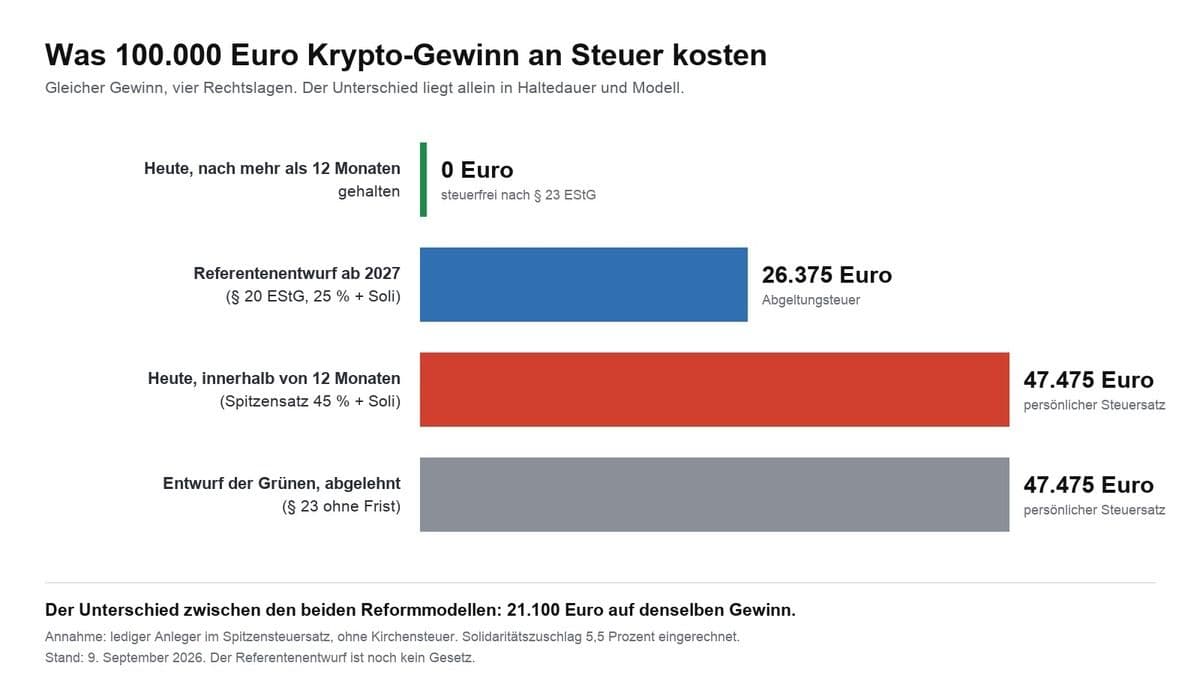
Caution is in order here, and genuinely so. The tax treatment of crypto exchange-traded products in Germany has not been settled uniformly. Because they are bearer debt securities, classification as an investment of capital under Section 20 of the German Income Tax Act suggests itself; the flat-rate withholding tax of 25 percent then applies, plus the solidarity surcharge and church tax where relevant, regardless of how long you have held. For physically collateralised products carrying a right to delivery of the coins, the specialist literature also argues for classification as a private disposal transaction under Section 23 of the German Income Tax Act, which would bring the one-year holding period into play.
Which classification holds for your particular product is not something a news report can tell you. It is in the key information document and the securities prospectus, and it hangs on how the delivery claim is construed. That is a question for a tax adviser, not for a rule of thumb. The only certainty is this: a cash distribution of the kind the US funds are making today would be a clear inflow in the year of payment, whereas an accumulating product generates no cash flow at all until you sell. If you want to keep an overview of your positions and their acquisition dates, you will struggle to do without software; the common tax tools and portfolio trackers sit side by side in our comparison.
Regardless of the product question, the new reporting obligation for crypto service providers has applied since January 1, 2026, implementing the EU's DAC8 directive in Germany through the Crypto Asset Tax Transparency Act. The first reporting period is the 2026 calendar year; the first annual report goes to the Federal Central Tax Office by July 31, 2027. The fact that data will reach the tax office anyway changes nothing about the legal position, but it does change the likelihood that a gap in your own records will be noticed.
 Find the right crypto tax tool
Fee against yield: what 1.49 percent a year leaves of the income
A management fee of 1.49 percent a year is no small item when the network's staking yield sits in the mid single digits. At a network reward of a good five percent, as 21Shares reports for the Solana product, roughly a quarter to a third of the gross income goes on administration before tax is even discussed. That is the price of someone else running the validators, holding the keys and ensuring tradability on an exchange.
On top of that comes the spread at the trading venue. Crypto ETPs are thinly traded outside main trading hours, and the gap between bid and ask can then be a multiple of the regular one. Place an order without a limit in the evening or at the weekend and you pay that gap. A limit costs nothing and prevents the worst execution.
The calculation that always pays off
Take the staking yield the issuer quotes for the product, subtract the management fee and set the result next to what a platform credits you for the same coin after its own fees. Only that difference says anything about whether the product wrapper is worth its price. The wrapper buys convenience, eligibility for your brokerage account and the liability of a regulated issuer; in exchange it costs the same percentage every year, including in a year without a price gain.
Staking without a product wrapper: what separates direct holdings from an ETP
If you hold the coins yourself and stake them through an exchange or your own wallet, the picture changes. Directly held crypto assets fall under the one-year holding period of Section 23 of the German Income Tax Act: after more than twelve months the disposal gain is tax free, below that your personal income tax rate applies, and the exemption limit for other private disposal transactions is 1,000 euros a year. Exceed that limit and the entire gain is taxable, not just the part above it.
The staking rewards themselves have to be kept separate and accrue to you at the moment they are credited; for tax purposes they count as other income. A fresh holding period then starts for the subsequent sale of the coins received, counted from the inflow. This is precisely where records come apart in the spring: receive small rewards daily over the course of a year and you end up with hundreds of individual acquisitions, each with its own date and its own price.
That is the real trade-off, and it is not a question of yield alone. The product wrapper costs a fee and may take the holding period away from you, but it spares you key management and the bookkeeping over many individual inflows. Direct holdings keep the chance of tax exemption after a year and demand in return that you document cleanly yourself.
Staking distributions: the key points for your decision
The distribution of September 30, 2026 is not an opportunity for retail investors in Germany but a reason to read your own position correctly. Three steps take you further:
- Check your account to see whether your product distributes or accumulates. The detail is in the key information document and on the issuer's product page. Without that information you can assess neither the income nor the tax effect. Which alternatives offer an ongoing payout is shown by our comparison of staking platforms.
- Put the network yield and the management fee on one line. At a fee of 1.49 percent against a good five percent reward, the difference decides, not the headline. Compare the result with what a crypto exchange leaves you for the same coin after deducting its costs.
- Settle the tax classification before you build a position, not in May afterwards. With an ETP it hangs on how the product is construed and belongs with a tax adviser; with direct holdings you need complete documentation of every inflow. The appropriate tax tools and portfolio trackers take the logging off your hands.
Sources for this article: the issuer's product details on the Ethereum staking ETP with ISIN CH0454664027 and the list of the five September distributions per share.
(As of September 30, 2026. This article is not investment advice. Prices and fee structures change; check the terms with the provider before you buy.)
Frequently asked questions about staking ETPs
Transparency note: This article was produced with the assistance of artificial intelligence and reviewed by our editorial team before publication. All figures and claims were checked against the primary sources linked in the text. The feature image was generated with AI.
Related articles
- NEAR Staking ETP Passes $100 Million: What to Check on Yield, Brokerage Account and Holding Period
- Bitwise Lighter Staking ETP Lists on Xetra: What to Check on BLIT Before You Buy
- Staking ETPs: Distribution, Accumulation and the Tax Question in Germany
- Zcash ETP: What to Check on Broker Access, Fees and Tax
- Bitcoin ETFs Lose $487 Million in a Single Day: the Reasons Behind the Outflow
Which topics should we dive deeper into?
Select what genuinely interests you. Your picks feed directly into our editorial planning.
Crypto news that's actually worth your time.
Weekly. 60 seconds. Carefully curated by our editors: no hype, no promo flood, no spam.

October 17, 2026 1:26 PM

Dogecoin: Bitwise pays out in cash on 22 October, what it means for your coins
The Dogecoin fund BWOW is being wound down, and on 22 October the money reaches the last shareholders. What is left of the US fund market, and why in Germany it is the product wrapper that decides the tax.

October 1, 2026 4:28 PM

Solana loses $11.1 million from the US ETFs: here are the reasons
The US spot ETFs on Solana lost a net $11.1 million on September 30, ending a record week of $188 million. The price stands at $117.66, and the switch to Alpenglow runs over epoch boundaries in October rather than a date.

September 19, 2026 4:19 AM

Bitcoin Cash Jumps by Double Digits: What the Grayscale ETF Filing Really Means for You in Germany
Bitcoin Cash gained double digits on September 18 because Grayscale wants to convert its BCH trust into an exchange-traded product. The filing itself, however, states that the basis for it has not been approved at all.
October 10, 2026 10:25 PM

Chainlink's First Fund Inflow in Five Trading Days: What Changes for Investors in Germany
The two US spot funds on Chainlink took in $9.48 million on October 9, the first inflow after five sessions without any movement at all. Because you cannot buy these funds in Germany at all, your result is decided by a different route and above all by how long you hold.
October 10, 2026 10:33 AM

Dogecoin at $0.0862 and Bitwise Winds Down Its DOGE ETF on 14 October: Why That Barely Moves the Price
Bitwise is winding down its Dogecoin ETF BWOW: trading ends on 14 October and the money flows on 22 October. The holding amounts to 0.14 percent of one trading day. What that means for the price and why the German route runs through an ETP costing 2.50 percent a year.
October 5, 2026 1:40 AM

Crypto at comdirect: 29 certificates with no order fee in a savings plan, but not a single coin
comdirect puts crypto into your securities account as a certificate, not as a coin. Our count of October 4, 2026 shows 29 securities from five issuers on 12 cryptocurrencies. On a one-off purchase the minimum fee of 9.90 euros amounts to 9.90 percent on 100 euros invested; in a savings plan the 1.5 percent is waived until the end of 2027.
October 1, 2026 7:36 PM

Crypto tax and withholding at source from 2028: what to check now
The German Federal Ministry of Finance’s draft bill goes to cabinet on October 14, 2026. The underexposed part of it is the deduction of tax from 2028: which providers are to withhold the tax on investment income, why self-custody and foreign platforms stay exempt from it, and what you should document by December 31.
October 6, 2026 1:46 AM

Why Gram makes way for Litecoin in the Virtune altcoin ETP on Xetra: the reasons behind the rebalancing
Virtune has rebalanced the altcoin index of its Xetra-listed ETP: Gram is out, Litecoin is in, and all ten positions stand at 10.00 percent again. What the change means for your account, the trading hours and the tax question.
August 21, 2026 7:30 AM

Crypto ETF Approval in the US: Why the SEC Is Rewriting Its Rules for Staking and Altcoin Funds
The US securities regulator has opened a proceeding that will help decide the next generation of crypto funds, and is putting 27 questions on the table. Anyone can file a comment until August 31, 2026, from Europe as much as from the United States.
October 16, 2026 7:16 AM

Staking ETF: the SEC must decide by November 15, and Europe has had the product since January
The SEC has until November 15, 2026 to rule on the first American fund on a liquid staking token, and it can no longer delay. In Europe the same product has been on the shelf since January, with assets of $1.19 million.
September 11, 2026 1:33 PM

Dogecoin ETF Discontinued: Why Bitwise Is Closing BWOW and What Counts in Europe
Bitwise is winding up its Dogecoin ETF: trading ends on October 14, 2026 and the cash payout follows on October 22. Why the product failed for lack of demand, and what is actually tradable for you in Europe.
October 20, 2026 4:17 AM

Stablecoin interest: MiCA article 50 bans it, and lending yield is taxable from 256 euros
No issuer in Europe pays interest on the token itself, and article 50 of MiCA expressly forbids it. Where a quoted yield actually comes from and how the tax office treats it.
October 14, 2026 1:19 PM

Solana ETF in Hong Kong at 0.6 percent: what changes for European investors
Hong Kong has launched its second spot ETF on Solana at a management fee of 0.6 percent. You cannot buy it from Europe, but the number throws light on European costs: on Xetra, a full percentage point a year separates two Solana wrappers.
October 4, 2026 4:15 AM

SEC clears six 3x leveraged Bitcoin and Ether ETPs: how to check the daily math
The SEC approved the listing of six triple-leveraged exchange-traded products on October 2, 2026, among them the first ones on bitcoin and ether. Nothing trades yet, and for German accounts a separate hurdle applies.
September 14, 2026 7:12 PM

XRP ETF, Solana ETF, Ethereum ETF: What You Can Actually Buy in Germany
Spot ETFs on XRP, Solana and Ethereum trade in the United States, and your German broker does not carry them. This guide explains the two EU rules behind that, which security does the same job instead, and what to check on backing, delivery claim and costs.
September 10, 2026 1:13 AM
Staking Taxes in Germany: The Inflow, the 256-Euro Threshold and the Holding Period
Staking is taxed twice: once when the reward arrives and once when you sell it later. This article explains both moments, the threshold of 256 euros, the separate twelve-month period and what applies to liquid staking, restaking and staking ETPs.
October 6, 2026 1:34 AM

93.56 million dollars out of the Zcash ETF in one week: what changes for ZEC holders in Europe
The Grayscale Zcash ETF lost money for the first time since launch in the week to October 5, 2026, a net $93.56 million. What the figure says about demand and what it means for ZEC holders in Europe.
September 26, 2026 4:28 AM
NEAR ETF NRR is approved: what you have to check in Germany instead
The SEC made the registration of the Bitwise NEAR ETF effective on September 24, and NYSE Arca approved the listing under the ticker NRR. The prospectus rules out distribution outside the United States, so these are the routes left to you in Germany.
September 23, 2026 7:22 PM
Solana Price Holds $114: What Holders Check Five Days Before Alpenglow
SOL stands at $114.55 on September 23, after a 17.7 percent gain in seven days and a 2.2 percent loss on the day. Two deadlines matter more than the daily move: Alpenglow opens on September 28, and every purchase made this week starts a holding period of its own.
October 5, 2026 4:36 AM

Ethereum pays 2.66 percent, just over 2.2 arrives: what investors need to know about staking
The Ethereum network pays out around 2.66 percent a year, and just over 2.2 percent arrives through Lido and Rocket Pool. Where the gap comes from, how long the exit takes and what applies for tax in Germany.
October 18, 2026 10:16 AM
Ethereum staking pays 2.21 percent while the ECB pays 2.50
Ethereum's staking yield of 2.21 percent sits below the European Central Bank's deposit rate of 2.50 percent. What that gap means for the price, for the levels at $2,364 and $2,438 and for your tax return.
September 9, 2026 1:15 AM

Germany's Crypto Tax: 160 Million Euros for a 555-Billion Budget
The German finance ministry's draft bill puts a figure on the crypto tax for the first time: 160 million euros from 2028. What that number means in the 2027 federal budget, how 11.4 billion became 160 million, and what investors can read from it.
October 3, 2026 1:41 PM

Dogecoin Price Prediction: $0.10 as the Ceiling, and What to Watch at a 2.5 Percent ETP Fee
Dogecoin trades at $0.0927 on October 3 and therefore sits on its 200-day average. More important than the mark at $0.10 is the route question for German investors: a 2.50 percent fee in the Xetra ETP against the one-year holding period on a direct purchase.
September 22, 2026 4:12 PM

Nearly $1 Billion Into Bitcoin ETFs: What to Check on ETNs, Portfolio and Holding Period
US spot bitcoin ETFs took in a net $999 million on September 21, the third consecutive day of inflows. German investors cannot reach these funds: what ETNs, the holding period and your buying route mean for you.
September 26, 2026 10:12 PM
Solana Price Above $120: What to Check on Staking Yield, Holding Period and Spread
Solana is trading at $121.00 on September 26, 2026, 8.6 percent above its level a week earlier. What a self-measured staking yield of 5.27 percent is worth, how the one-year holding period applies to staked SOL, and what an order in euros really costs.
September 9, 2026 4:22 PM
Crypto Tax in Germany: What Applies in 2026 and What Is Set to Change in 2027
Crypto gains are tax-free after twelve months; before that your personal tax rate of up to 45 percent applies. What triggers tax, how the holding period is calculated, what happens with staking and losses, and what the draft bill would change from 2027.
September 26, 2026 1:19 AM
Germany’s Crypto Holding Period Is Wobbling: What to Check Before December 31
A CDU member of the Bundestag makes it plain: the coalition agreement does not guarantee that the one-year holding period for crypto assets will survive. What that means for purchases made before the planned cutoff date of December 31, 2026.
More from CryptoTicker