
Zcash falls almost 8 percent: why developers want 20-second blocks
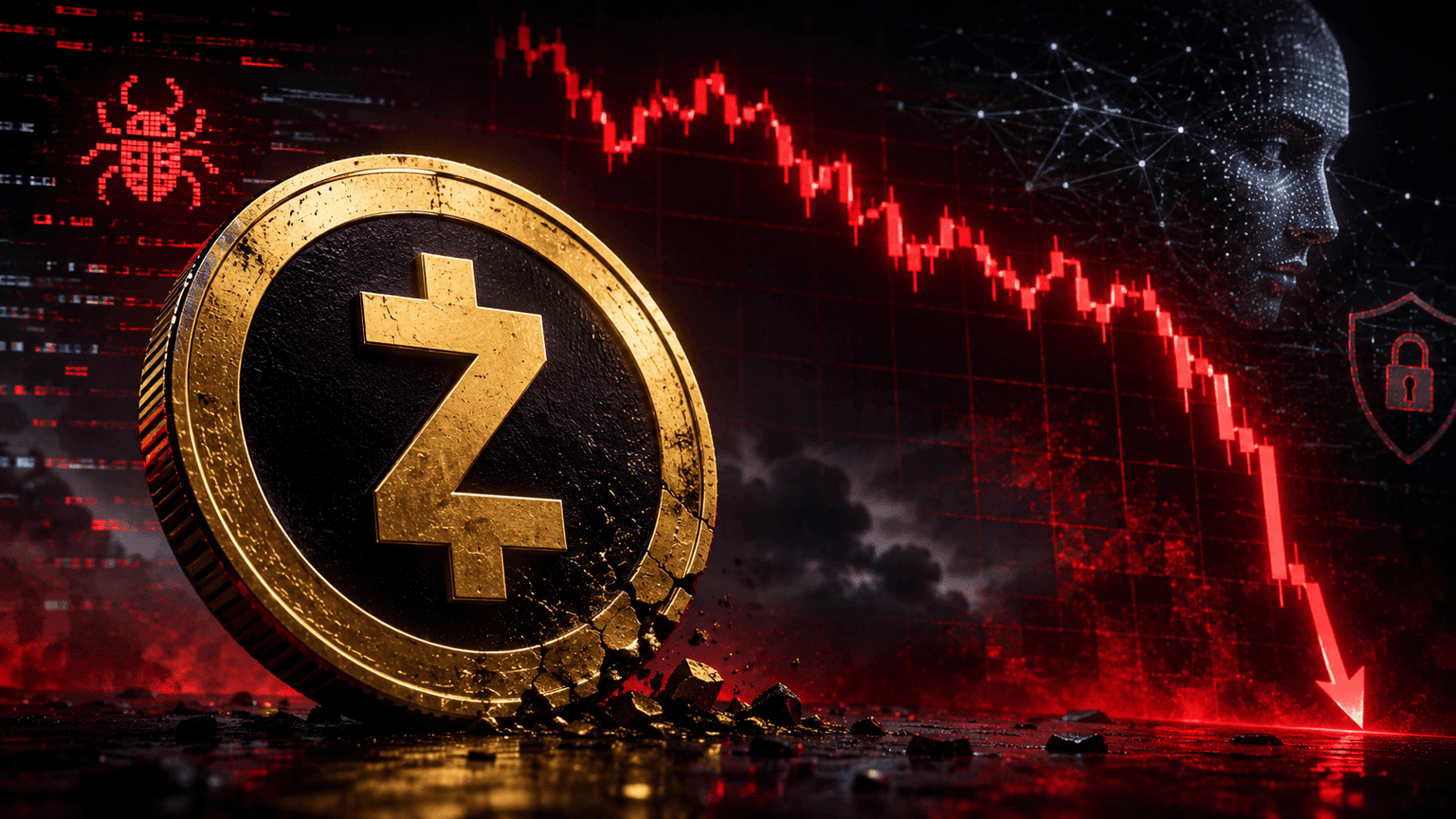
Zcash loses 7.9 percent on Monday, falling harder than any other top-25 coin. At the same time, developers propose cutting the block time from 25 to 20 seconds with the NU7.1 upgrade, without increasing the issuance of new ZEC.

Which topics should we dive deeper into?
Select what genuinely interests you. Your picks feed directly into our editorial planning.
Crypto news that's actually worth your time.
Weekly. 60 seconds. Carefully curated by our editors: no hype, no promo flood, no spam.
Zcash is falling much harder than the rest of the crypto market on Monday. The price of Zcash (ZEC) stands at around $1,165 in the evening, roughly €1,041, and 7.9 percent below the previous day. According to CoinGecko, no other coin among the 25 largest cryptocurrencies is falling more. At the same time, a new proposal from the developers is on the table: with the next small network upgrade, NU7.1, the block time is to drop from 25 to 20 seconds.
The two are not causally linked. The decline follows the broad sell-off in ether and XRP and meets a futures market in which many traders had bet on rising prices. The proposal, by contrast, is a draft that the community still has to vote on. If you hold Zcash or want to buy it, you should know both threads, because they play out over different time frames.
Zcash price on Monday: $1,165 and a daily low at $1,164
According to CoinGecko, Zcash traded at $1,165.20 at around 19:50 on Monday evening. The high over the past 24 hours was $1,266.72 and the low $1,163.94, so the price ended the evening almost at the bottom of the daily range. Over seven days it is down 5.1 percent. Zcash is around 63 percent below its all-time high of $3,191.93 from October 2016.
A report from TokenPost captures the sharpest part of the move: by 18:26, Zcash had fallen 3.72 percent within four hours on the Binance spot market, to $1,171. In the hour before, long positions worth $1.54 million were forcibly closed across Binance, Bybit and OKX, against only around $50,000 in shorts. A liquidation is the automatic closure of a leveraged position once the posted collateral no longer covers the loss. The total is modest, but the split shows the direction: it was mainly leveraged buyers who were hit.
By comparison, bitcoin slipped only 1.7 percent over the same period to around $74,600. The Fear and Greed Index from alternative.me, a sentiment gauge from 0 (extreme fear) to 100 (extreme greed), stands at 29, in fear territory.
Block time of 20 instead of 25 seconds: what the NU7.1 proposal sets out
The block time is the average interval at which a new block is added to the blockchain. Only with that block is a payment considered confirmed once. With the NU7 upgrade, which activated on November 6 at block 3,543,405, this interval on Zcash fell from 75 to 25 seconds; we explained the switch in our article on the NU7 block time.
At 21:56 on Sunday evening, the developer ValarDragon proposed the next step in the Zcash community forum. He sees it as a continuation of ZIP 218, the Zcash Improvement Proposal that introduced the 25 seconds. A ZIP is a formal change request for the protocol, comparable to a draft bill. The key points of the draft:
- The target block time falls from 25 to 20 seconds.
- The caps on shielded actions per block are scaled by a factor of 4/5: the shared budget and the Orchard and Ironwood actions from 330 to 264, Sapling inputs and outputs from 300 to 240.
- The maximum block size of 2 MB stays.
- The default expiry of a transaction rises from 120 to 150 blocks, so that it stays the same in minutes.
The developers want to bring the proposal to the next vote and earmark it for NU7.1. The draft gives no date for the upgrade. It describes NU7.1 as a very small, low-risk upgrade.
Why shorter blocks: payments at the till and swaps via NEAR Intents
The reasoning in the forum is simple. Every transaction waits for the next block, even when blocks are almost empty. That slows down payments at the shop till, exchange deposits and swaps between blockchains. NEAR Intents is named explicitly: market makers there only trade once a payment has at least one confirmation. Five seconds less waiting per block adds up when several confirmations are needed.
In the discussion, one participant asked whether 20 seconds was really the best figure, or whether 17 or 21 seconds would fit better. ValarDragon replied that the block time is only part of the solution. Sub-second confirmations would need other approaches; after the 20 seconds, a doubling of the block size should come next. Another participant raised a change of consensus mechanism, but considered it hard to push through without a split.
Orphaned blocks: why the orphan rate decides the block time
The price of shorter blocks is the orphan rate. An orphaned block arises when two miners find a valid block almost simultaneously and the network settles on only one of them. The other drops out and its computing work is lost. The shorter the block time, the more often this happens, because a new block has not yet reached the whole network before the next one is found. If the rate rises too far, well-connected large miners gain an advantage and security suffers.
 Compare exchanges that trade Zcash
So the developers measured it. On a test network with 80 miners at twelve locations worldwide, including New York, Singapore, London and Bangalore, full 2 MB blocks at 20-second intervals produced an orphan rate of 1.9 percent when all nodes ran the Zakura software. With a mix of Zakura and Zebra-Andele, the rate was 3.3 percent. For the 25 seconds, a measured rate of 4.68 percent was considered acceptable in May. According to the draft, the new interval therefore meets the same security threshold as the old one. ValarDragon also writes that the actual orphan rate on mainnet has been lower since NU7 than before the upgrade.
The load remains low. According to figures from the discussion, Zcash processes around 80 kilobytes per second at peak times; with 20-second blocks it would be about 100 kilobytes.
Issuance and halving: the block reward falls, the daily amount stays
One point matters most for holders: the number of new ZEC per day is not meant to change. Because 20 percent more blocks are produced, the reward per block falls to four-fifths. Counted in blocks, the halving, the regular halving of the block reward, moves from 5,040,000 to 6,300,000 blocks. In calendar time it therefore stays on the same date. The window over which the network readjusts mining difficulty is also stretched from 102 to 128 blocks, so that it stays the same length in minutes.
The proposal does not, then, expand supply. Monday's price drop cannot be derived from the draft; the evidence for it lies in the market.
Open interest at OKX: new positions opened into the decline
Open interest measures the total value of all open futures contracts on a coin. If it rises while the price falls, traders are opening new positions into the move. If it falls, positions are being closed or liquidated. For the perpetual ZEC-USDT contract at OKX, 25 hourly readings from 19:00 on Sunday to 19:00 on Monday give the following picture:
- Open interest fell from $185.8 million to $154.4 million. In ZEC terms it dropped from 146,744 to a low of 123,767 ZEC at 16:00.
- It then climbed back to 132,250 ZEC by 19:00, even though the price fell from $1,226 to $1,167 over those three hours.
- The ratio of accounts with long positions to accounts with short positions rose from 1.05 to 1.36.
- The funding rate, the balancing payment between the long and short sides every eight hours, was most recently plus 0.01 percent. On Sunday afternoon it was still negative at minus 0.028 percent.
cryptoticker.io compiled this analysis itself on November 9, 2026. It is based on OKX's public market data on open interest, account ratio, funding and hourly prices for the ZEC-USDT perpetual.
The figures match the picture from the liquidations. On Sunday and Monday morning, positions were reduced. Since the afternoon, new ones have been added, and more and more accounts are betting on a recovery. If the price keeps falling, it is exactly this side that is in the firing line. The ratio counts accounts, though, not capital: a few large short positions can outweigh many small long accounts.

Ether, XRP and Zcash: the sell-off ahead of the US inflation data
Zcash is not falling alone. According to CoinGecko, ether is down 4.9 percent to around $2,125, XRP 5.6 percent to $1.09 and Solana 3.4 percent. At 14:30 on Tuesday, the US Labor Department publishes consumer prices for October. If they come in higher than expected, the prospect of rate cuts by the Federal Reserve fades and risk assets come under pressure. Many traders reduce their risk ahead of such dates.
The decline is also the second within a few days. Over the weekend, after the NU7 launch, Zcash had already given back some of its gains. Fund-flow figures for November are not yet reliable, so we do not cite them here as a cause.
 Find a perp DEX with clear liquidation rules
Buying Zcash in Germany: MiCA exchange, holding period and shielded addresses
If you want to use the decline as an entry point, check the trading venue first. In the EU, crypto exchanges may only offer their services with authorisation under the MiCA regulation, the European market rules for crypto assets. Not every exchange lists Zcash, because some providers avoid privacy coins on account of anti-money-laundering rules. Our crypto exchange comparison shows which platforms trade ZEC and at what fees.
Zcash has two types of address. Transparent addresses work as they do on Bitcoin, and every payment is publicly visible. Shielded addresses hide the sender, recipient and amount using zero-knowledge proofs. Before you move ZEC from an exchange to your own wallet, it is worth checking the provider's help pages to see which address type it pays out to.
For tax purposes in Germany, Zcash is treated the same as other cryptocurrencies. Under Section 23 of the Income Tax Act, a gain is tax-free if more than one year passes between purchase and sale. Below that, gains from private disposals remain tax-free only as long as they stay below the €1,000 exemption limit in total for the year. Losses from a sale within the holding period can be offset against such gains. If you sell at a loss now, you will need a clean record of all purchases and sales for your tax return.
Leverage and liquidation: the levels at $1,120 and $1,050
At $1,163.94, the daily low is only just below the current price. The next levels come from the daily candles of the past 45 days on the OKX spot market. On November 3, Zcash turned higher at $1,121.60, and on November 2 the low was $1,127.68. The area around $1,120 is therefore the first zone where buyers have recently stepped in. Below that lies the lowest level of the entire period: on October 18, Zcash fell as far as $1,048.53. On the upside, the daily high at $1,266.72 marks the area Zcash would have to reclaim to make up Monday's decline. cryptoticker.io also compiled these levels itself on November 9, 2026, from OKX daily prices.
If you trade with leverage, you should know your position's liquidation price and not place it near these levels. At ten times leverage, a decline of around ten percent is enough to wipe out the collateral. Ahead of a date like the inflation data in particular, prices often jump in both directions before one prevails. Low leverage and a firmly set stop-loss protect against a forced closure at the worst possible moment.
Zcash below $1,200: before November 10, protection comes first
All told, a market-wide decline meets a futures market that is filling up with long positions again. The proposal for 20-second blocks changes nothing about issuance and still has to pass the vote. Three steps help put it in context:
- Before buying, check whether your exchange holds a MiCA licence and lists Zcash at all. Our comparison of regulated crypto exchanges offers an overview.
- Use leverage sparingly ahead of Tuesday's US inflation data and know your liquidation price. The comparison of perp DEX providers shows which platforms offer which safeguards for perpetuals.
- Record purchases and sales with date and price, so that the holding period and exemption limit can be proven later. Crypto tax software helps with this.
(As of November 9, 2026. This article is not investment advice. Prices and fee structures change; check the terms with the provider before you buy.)
Frequently asked questions about Zcash
Transparency note: This article was produced with the assistance of artificial intelligence and reviewed by our editorial team before publication. All figures and claims were checked against the primary sources linked in the text. The feature image was generated with AI.
Related articles
- XRP price prediction: Korea drives 17 percent of Upbit trading, and $1.08 is the level that decides
- Binance XRP scarcity index at a four-year high: XRP price prediction ahead of the weakest weekly close since August
- Zcash gives back its NU7 gains: ZEC drops 7.4 percent on liquidations and an ETF outflow
- Can XRP reach $100? The maths as of November 2026
- Will Bitcoin Go Back Up? Three Scenarios to Year-End: $70,000, $80,000 or $100,000
Which topics should we dive deeper into?
Select what genuinely interests you. Your picks feed directly into our editorial planning.
Crypto news that's actually worth your time.
Weekly. 60 seconds. Carefully curated by our editors: no hype, no promo flood, no spam.

November 7, 2026 7:14 AM
XRP Price Prediction: Long Squeeze Drags XRP to $1.15, the Level That Decides
Analysis: XRP fell to $1.1518 early on Saturday, its lowest level since August 20, after a long squeeze forced $16 million of positions shut. Yet on OKX, 4.3 long accounts still face every short account, and below the price sits a band with almost no trading history.

November 6, 2026 5:11 PM
Zcash after the NU7 upgrade: ZEC climbs 7 percent while the market falls
Zcash's NU7 upgrade has been live since the night of November 6 and cuts block time to 25 seconds. ZEC rose 7 percent the same day while Bitcoin and Ether fell.

November 6, 2026 11:24 AM

Shiba Inu Price Prediction: OKX Long-Short Ratio Slides to 2.2 Before Jobs Data
Analysis: on OKX, there are now only 2.2 long accounts for every short account in SHIB, down from 2.8 three days earlier. What the long unwind, the US jobs report at 14:30 German time and the levels between $0.00000412 and $0.00000515 mean for the days ahead.
November 5, 2026 1:09 PM

Cardano Price Prediction: Down 26.5 Percent in 30 Days, the Levels ADA Must Hold Now
Cardano lost 26.5 percent in 30 days, four times as much as Bitcoin. Now the 20-day and 200-day averages sit almost at the same price right above the market. Why this zone decides and which scenarios follow for ADA.
November 4, 2026 9:13 PM

Zcash Grants Committee Drops Its 98,000 ZEC Plan: Is the Funding Dispute Over?
Zcash Community Grants will not redirect around 98,000 ZEC into the reserve for mining rewards, while three rival proposals remain open. ZEC is up 5.7 percent, a little over 31 hours before NU7 activates.
November 4, 2026 3:12 AM
Zcash NU7 upgrade: Zebra 7.0.0 fixes seven security flaws
Zcash is up 8.6 percent in 24 hours, roughly 50 hours before NU7 activates at block 3,543,405. The Zcash Foundation has closed seven security holes with Zebra 7.0.0, and the Zodl wallet requires an update beforehand.
November 3, 2026 7:13 AM
Zcash drops 11 percent as a dispute over ZCG grant money precedes the NU7 upgrade
Zcash falls to around $1,135, and on-chain data show one large buyer losing $5.84 million. Behind the move are the dispute over the $124 million ZCG grant pool and the NU7 upgrade in the early hours of November 6.
November 2, 2026 11:19 PM
Zcash falls 7.4 percent ahead of block 3,543,405, the NU7 cut-off for old Sprout funds
Zcash lost 7.4 percent to $1,228.33 on October 30, 2026, making it the biggest loser in the top 25. The protocol deadline matters more than the price: with NU7 at block height 3,543,405, balances left in the old Sprout pool become unusable.

November 2, 2026 7:33 PM
US Midterms Tomorrow: 5 Scenarios for Bitcoin, XRP and Solana
America votes on Tuesday and crypto has over 170 million dollars riding on it. Five election outcomes and what each one would mean for Bitcoin (BTC), XRP and Solana (SOL) prices.
October 29, 2026 6:31 PM
Zcash NU7 cuts the block time to 25 seconds: what changes for your coins
NU7 takes effect at block 3,543,405, and on October 28, 2026 that was 10,300 blocks away. The block time then drops from 75 to 25 seconds, version 4 transactions become invalid, and balances in the Sprout pool may never be movable again.
October 23, 2026 1:13 AM
Zcash falls 10.5 percent as block 3,543,405 enters the NU7 document: why the date points to November 6
The deployment document ZIP 259 now carries mainnet height 3,543,405 for the Zcash upgrade NU7, while the project's official upgrade page still lists the height as not set. ZEC loses 10.5 percent on the same day, to $1,206, making it the biggest loser among the 25 largest cryptocurrencies.
October 22, 2026 1:20 AM
Zcash NU7: developers name block 3,543,405, yet the activation height is in no document
Developers have agreed on block 3,543,405 as the NU7 activation height, according to Cointelegraph, but the Zcash upgrade page still lists it as not set on October 21. Our count shows all six NU7 ZIPs carry the status Draft, while ZEC trades at $1,277 and 12.7 percent above its daily low.
October 16, 2026 4:44 AM
Zcash holds $1,073 and takes back 14 percent from the low: where does ZEC stand now?
Zcash fell as far as $1,073.55 on 15 October 2026 and trades at around $1,224 again. Between the daily low and the daily high lay 16.6 percent, a range that decides more about leveraged positions, the holding period and custody than the closing level does.
October 15, 2026 10:25 AM
Zcash drops 13 percent to $1,089, the steepest fall in the top 25
Zcash loses around 13 percent within 24 hours to $1,089.72 and slips below the $1,100 mark. No other of the 25 largest cryptoassets gives up more on the day, while Monero loses just 2.3 percent.
October 13, 2026 7:17 PM
Zcash price slides from $1,315 to $1,185 before the NU7 decision on October 20: the level that decides
Zcash has lost 8.2 percent in 24 hours to $1,184.90 after leveraged long positions worth up to $26 million were force-closed. At the same time the developers decide on October 20 on the activation height of the NU7 upgrade.
October 12, 2026 10:31 AM

$1,332: Zcash is the only one of the ten largest coins with a weekly gain
Zcash stands at around $1,332, a good eight percent above the previous day. Among the ten largest cryptocurrencies, ZEC is the only one up over seven days. Two dates in October and November decide what holders have to settle beforehand.
October 10, 2026 10:44 AM
Top 3 Coins to Watch Next Week: These Altcoins Could Explode
Twelve of the top 17 coins closed the week in the red. These three didn't. Here are the altcoins to watch next week and the catalysts behind them.
October 7, 2026 8:42 PM
Can XRP Price Reach $10? Here Is What the Math Says
XRP trades near $1.42 after losing $1.50. We check the $10 forecasts, the charts and the market cap math to see if XRP can really reach $10.
October 4, 2026 4:15 PM

17 days above the 200-day line: what you can do now with Shiba Inu
Shiba Inu has held its 200-day line at $0.00000531 for seventeen days, after only 23 such days in half a year. What the streak is worth, where the levels sit and what a circulating supply of 589 trillion tokens means for every price target.
September 29, 2026 1:33 AM

Zcash falls 8.5 percent as open interest shrinks 13.5 percent: the level that decides
Zcash trades at around $1,464 on September 28, 2026, 8.5 percent below the previous day. Our own measurement of open interest on OKX shows a fall of 13.5 percent in 24 hours, so more leverage unwinding than price loss.
September 28, 2026 10:13 AM

Dogecoin Price Prediction: 5 Billion New DOGE Would Fall to 500 Million, What Matters Now
A proposal in the official Dogecoin repository would lower the block reward from 10,000 to 1,000 DOGE, pushing annual issuance from around 5.3 billion down to around 526 million coins. What that means for the supply side, for the levels between $0.0800 and $0.1004, and for your holding period ending December 31.
September 20, 2026 4:13 AM
Zcash Above $1,500: What ZEC Holders Should Check on Tax and Custody
Zcash rose above $1,500 on September 19 for the first time since 2016 and, after an intraday high of $1,590.80, trades back at around $1,474. For German holders three questions hang on that jump: the one-year holding period, the planned year-end cut-off and the EU anti-money-laundering regulation from July 2027.
September 18, 2026 7:12 PM

Zcash NU7 Upgrade on November 5, 2026: What You Must Do With Your ZEC
Zcash activates the NU7 network upgrade on November 5, 2026, bringing 25-second blocks and the end of v4 transactions. Anyone holding ZEC has nothing to move; action is only needed from those running their own node, indexer or block explorer.
July 10, 2026 3:04 PM
Zcash Surges 8% as the Ironwood Upgrade Reignites Privacy-Coin Hype
Zcash is up more than 8% today and back above $500. Here is what is driving the ZEC rally and where analysts see the price heading next.
June 15, 2026 11:45 AM

Zcash Price Prediction: ZEC Surges 15% as Privacy Coins Lead the Crypto Rebound
Zcash price prediction as ZEC surges 15% in 24 hours, outperforming Bitcoin, Ethereum, Solana, and XRP. Can the privacy coin rally continue?
More from CryptoTicker