
Zcash rises against the market: ZEC recovers 12 percent from its low ahead of the vote
Zcash gains 5 percent to around $900 on Sunday while Bitcoin and Ether barely move. On Monday, ZEC holders begin voting on the treasury of Zcash Community Grants and 50,000 ZEC.

Which topics should we dive deeper into?
Select what genuinely interests you. Your picks feed directly into our editorial planning.
Crypto news that's actually worth your time.
Weekly. 60 seconds. Carefully curated by our editors: no hype, no promo flood, no spam.
Zcash is rising against a weak crypto market on Sunday because short positions are being unwound and because on Monday, November 16, ZEC holders begin voting on the blockchain's development funding. According to CoinGecko, Zcash (ZEC) traded at $900.17 at 5:47 pm CET on November 15, up 5.1 percent in 24 hours. At the same time Bitcoin was down 0.7 percent, and Ether was flat.
The rise follows a long losing streak. On Binance, ZEC closed lower than the previous day eight times in a row from November 7 to November 14, and on Saturday the price fell as low as $801.52. By Sunday afternoon Zcash had recovered about 12 percent from that low. Whether this becomes a turnaround depends on two things this article puts into context: the vote on the treasury of Zcash Community Grants and the levels where leveraged positions are clustered.
Zcash price on Sunday: up 5 percent after eight losing days
The day's figures at a glance, according to CoinGecko as of 5:47 pm CET: the intraday low was $804.86 and the high $927.37. Despite Sunday's gain, ZEC is still down 29.7 percent over seven days. With a market capitalisation of $15.34 billion, Zcash ranks 11th among cryptocurrencies. It remains 71.8 percent below its all-time high of $3,191.93.
Binance daily candles show how steep the decline was. On November 6, ZEC still traded as high as $1,388 and closed at $1,323.01. After that it fell day after day: $1,261.51 on November 7, $1,044.95 on November 10 and $863.91 on November 14. In total the price lost a good 42 percent from the high to Saturday's low. Today's rise to almost $900 recovers only a small part of that.
Yesterday we reported on the third straight day of outflows from the Grayscale fund ZCSH, when ZEC fell below $900. Since then the picture has turned: the $900 mark, broken at the time, was reached again on Sunday, and Saturday's low is about $100 below the current price. New fund data for the weekend are not yet available, because US exchanges do not trade on Saturdays and Sundays.
Short liquidations in ZEC: what carried the morning rally
The first push came in the morning. According to a TokenPost report, ZEC rose 3.41 percent within an hour to $921 at around 10:12 am CET on Sunday, as short positions worth about $920,000 were forcibly closed. A liquidation is the automatic closing of a leveraged position by the exchange once the posted collateral is no longer sufficient. For shorts this means the exchange buys ZEC back, and those purchases push the price up further.
A short squeeze of this kind explains why a coin can suddenly gain significantly after a long losing streak, even though nothing has changed in its fundamentals. After eight red days, many traders had bet on further declines. When the price rose only slightly, the first shorts came under pressure. Hourly closes on Binance show the course: $896.85 at 6 am CET, $921.15 at 1 pm CET, then a pullback to $889.84 and, late in the afternoon, almost $899 again.
A rise driven by liquidations usually lasts only as long as new buyers keep coming. For the question of whether ZEC stays above $900, Monday's date therefore matters more than Sunday morning's squeeze.
Coinholder vote from November 16: the timeline in the Zcash forum
Five organisations jointly run the voting infrastructure for ZEC holders: Project Tachyon, Shielded Labs, Valar Group, the Zcash Foundation and ZODL. On November 5 they published the timeline in the Zcash forum. Proposals could be submitted until November 8, the polls for ZEC holders and community panels open on November 16 and close on Monday, November 30, at 23:59 UTC. In Central European Time, the vote therefore ends at 0:59 am on December 1.
The organisers write that they deliberately shortened the timeline because tensions in the community are high. If the polls find rough consensus, developers and miners intend to implement the result with the NU 7.1 network upgrade. The result itself is therefore a poll and not yet a change to the protocol. Who is eligible to vote and how voting worked in earlier rounds is explained in our guide to the Zcash vote of November 12.
ZCG treasury in figures: 94,349 ZEC and $8.75 million in cash
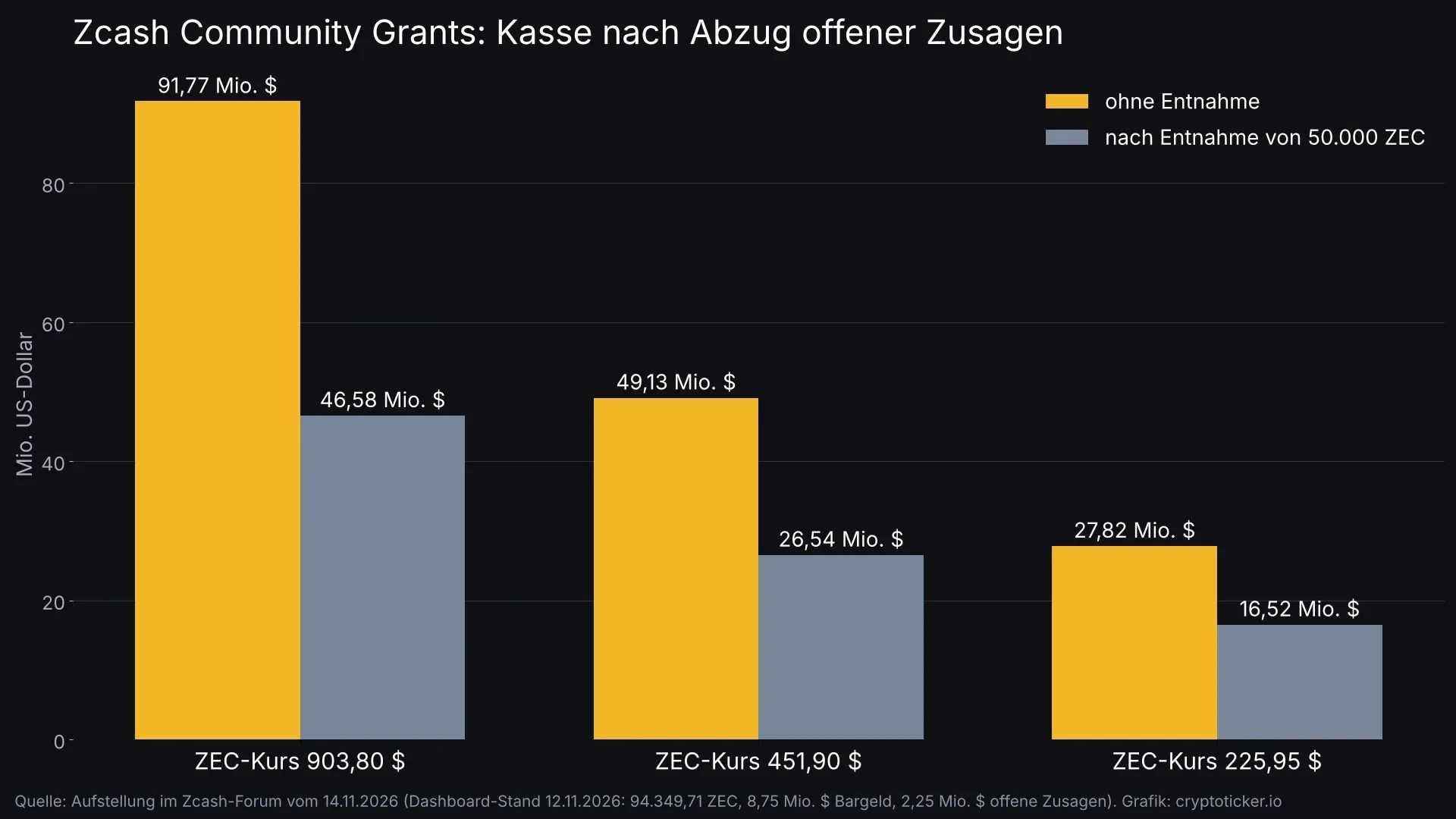
Zcash Community Grants, or ZCG, is an independent committee that awards grants to developers, wallet teams and other projects in the ecosystem. The vote revolves around its treasury. A breakdown that a forum member posted in the same thread on November 14 gives the holdings according to the dashboard as of November 12: 94,349.71 ZEC and $8.75 million in cash. Grants approved but not yet paid out add up to $2.25 million, leaving $6.50 million in cash free. According to the author, the dashboard is flagged as needing an update.
The breakdown also calculates what would remain without and with the disputed withdrawal of 50,000 ZEC. At the then price of $903.80, after commitments it would be $91.77 million without the withdrawal and $46.58 million after it. At a halved price of $451.90, the figures would be $49.13 million and $26.54 million. According to the breakdown, the withdrawal corresponds to about 53 percent of the reported ZEC holdings. The author stresses that these are comparisons, not forecasts.
For ZEC holders this contains a simple calculation: 50,000 ZEC are worth about $45 million at Sunday's price. If that amount disappears from circulation, supply falls. How much this affects the price cannot be quantified, especially as the coins already sit in a treasury today and are not freely traded.
 Find an exchange for your ZEC
Dev Fund and Network Sustainability Mechanism: the four options for the ZCG treasury
The Dev Fund is the part of the block reward that does not go to miners but finances development. ZCG receives a stream of 8 percent of every block reward from it, and a second stream of 12 percent goes to a pot that holders decide on themselves. The forum breakdown summarises the four options for the ZCG treasury as follows:
- Status quo: the treasury and the 8 percent stream remain until the third halving of the block reward, and new grants continue under the existing rules.
- ZAP: like the status quo, but with an additional review procedure for new grants.
- Future Dev and Legal Defense Fund: 50,000 ZEC go to the Network Sustainability Mechanism, and after activation the 8 percent stream flows into a new lockbox. ZCG continues to award grants from the rest of the treasury.
- Dissolution: new grants end with activation, existing commitments and wind-down costs are set aside, and the rest goes to the future administrator of the lockbox.
The Network Sustainability Mechanism, or NSM, is a mechanism through which ZEC are taken out of circulation. A lockbox is a pot locked on the blockchain from which money flows only once a defined procedure exists for it. All four options leave the holders' 12 percent stream unchanged. Under the organisers' rules, voters may approve several proposals as long as they find each of those outcomes acceptable.
Block time from 25 to 20 seconds: the dispute over NU 7.1
Besides the funding, a technical question is on the table. The NU7 upgrade cut the interval between two blocks from 75 to 25 seconds. On November 8, a forum participant named ValarDragon argued for including a further reduction to 20 seconds in the poll. His reasoning: the change is technically ready and would give all users faster confirmations.
There is clear opposition to the pace. Daira-Emma Hopwood, editor of the Zcash Improvement Proposals (ZIPs), wrote on November 14 that the step from 75 to 25 seconds had been risky and that NU7 would have needed a few more weeks of preparation. Another forum participant pointed out that a necessary adjustment to the funding streams in NU7 had been noticed only late. The dispute shows that NU 7.1 decides not only about money but also about how fast Zcash wants to change its protocol.
For holders this means that even a clear result at the end of November only sets a process in motion. Weeks pass before an upgrade is activated, and no date for NU 7.1 has been set yet.
Buying ZEC in Europe: MiCA exchange or your own wallet
If you want to buy ZEC, the easiest route in the EU is an exchange licensed under the European crypto regulation MiCA. MiCA is the EU rulebook that subjects crypto service providers to a licensing requirement and supervision. Not every exchange lists Zcash, because as a privacy coin with shielded transactions ZEC is offered by some providers only in restricted form or not at all. Which platforms trade ZEC and at what fees is shown in our comparison of the best crypto exchanges.
For the vote, where you keep your coins is decisive. Coins on an exchange legally belong to you, but the exchange holds the keys, and only those who self-custody can tie their vote to their holdings. The organisers state in the forum which wallets are supported and which snapshot date applies to holdings. Check this before you move coins, because every transfer costs fees and can miss a cut-off date.
Staking does not exist for Zcash, because the blockchain uses proof of work and new coins are created through mining.

Leverage on Zcash: long liquidations around $860
If you trade ZEC with leverage, you should know the liquidation levels. The specialist portal U.Today reported a cluster of leveraged long positions around $860 on Saturday. If the price falls back there, these positions would be forcibly sold, which can accelerate the decline. Sunday showed that the same mechanism also works to the upside.
A worked example shows the risk: with 10x leverage, a price decline of about 10 percent is enough to wipe out the entire collateral of a long position. On Sunday alone, ZEC moved between $804.86 and $927.37, a range of a good 15 percent. With high leverage, this single daily move would already have been enough to liquidate positions in both directions. Leveraged products such as futures and CFDs carry a high risk of loss for retail investors.
Compare MiCA-regulated crypto exchangesZEC levels up and down: $930, $1,000 and $801
On the upside, the intraday high is the first hurdle: on Binance it stood at $930.49 on Sunday. Above that comes the round $1,000 mark, which ZEC broke to the downside on November 10. That day's close of $1,044.95 marks the next zone, where sellers dominated in the previous week.
On the downside, the first support is at $860, where according to U.Today long positions are clustered. Below that is Saturday's low of $801.52. If ZEC falls below this level, the weekend recovery is void. You will find more on the long-term scenarios on our Zcash price prediction page.
The situation remains two-sided. In favour of a further recovery is that the market could read the vote as the end of the funding dispute and that many shorts have already been forced out of the market. Against it are the loss of almost 30 percent over the week, the outflows from the Grayscale fund in the preceding days and an overall market that has not yet found a clear direction after Saturday's slump.
Zcash before the vote: until November 30 your own wallet counts
- Sort out custody: If you want to vote, you need ZEC in your own supported wallet. Suitable devices for long-term storage are shown in the hardware wallet comparison.
- Choose how to buy: Buy ZEC only on an exchange with a MiCA licence that lists Zcash and allows withdrawals to your own wallet. Compare fees and offerings among the best crypto exchanges.
- Record your purchase date: Note the date and price of every purchase. A portfolio tracker from our comparison of crypto tax tools documents date and cost basis automatically.
(As of November 15, 2026. This article is not investment advice. Prices and fee structures change; check the terms with the provider before you buy.)
Frequently asked questions about Zcash
Partner links: some links on this page are partner links. If you become a customer through one of them, we may earn a commission at no extra cost to you. Selection, ratings and ranking are decided independently by our editorial team. Ethics and Independence · Ownership and Funding
Transparency note: This article was produced with the assistance of artificial intelligence and reviewed by our editorial team before publication. All figures and claims were checked against the primary sources linked in the text. The feature image was generated with AI.
For later? Save this article and find it again in your profile.
Related articles
- Zcash falls below $900 as Grayscale's ZCSH fund logs a third straight day of outflows
- Zcash vote from November 16: will 50,000 ZEC leave circulation?
- Zcash drops below $1,000 as Grayscale launches an ad blitz for ZCSH
- $1,003: Zcash loses 16 percent in under two hours and hits its lowest level since September
- Zcash falls almost 8 percent: why developers want 20-second blocks
Which topics should we dive deeper into?
Select what genuinely interests you. Your picks feed directly into our editorial planning.
Crypto news that's actually worth your time.
Weekly. 60 seconds. Carefully curated by our editors: no hype, no promo flood, no spam.

November 8, 2026 3:12 AM
Zcash gives back its NU7 gains: ZEC drops 7.4 percent on liquidations and an ETF outflow
Zcash has fallen 7.4 percent in 24 hours to around $1,250, giving back the rally that followed the NU7 upgrade. Long liquidations, an outflow from the Grayscale ETF and profit-taking hit at the same time.
November 6, 2026 5:11 PM
Zcash after the NU7 upgrade: ZEC climbs 7 percent while the market falls
Zcash's NU7 upgrade has been live since the night of November 6 and cuts block time to 25 seconds. ZEC rose 7 percent the same day while Bitcoin and Ether fell.
November 4, 2026 9:13 PM

Zcash Grants Committee Drops Its 98,000 ZEC Plan: Is the Funding Dispute Over?
Zcash Community Grants will not redirect around 98,000 ZEC into the reserve for mining rewards, while three rival proposals remain open. ZEC is up 5.7 percent, a little over 31 hours before NU7 activates.
November 3, 2026 7:13 AM
Zcash drops 11 percent as a dispute over ZCG grant money precedes the NU7 upgrade
Zcash falls to around $1,135, and on-chain data show one large buyer losing $5.84 million. Behind the move are the dispute over the $124 million ZCG grant pool and the NU7 upgrade in the early hours of November 6.

November 2, 2026 11:19 PM
Zcash falls 7.4 percent ahead of block 3,543,405, the NU7 cut-off for old Sprout funds
Zcash lost 7.4 percent to $1,228.33 on October 30, 2026, making it the biggest loser in the top 25. The protocol deadline matters more than the price: with NU7 at block height 3,543,405, balances left in the old Sprout pool become unusable.
October 23, 2026 1:13 AM
Zcash falls 10.5 percent as block 3,543,405 enters the NU7 document: why the date points to November 6
The deployment document ZIP 259 now carries mainnet height 3,543,405 for the Zcash upgrade NU7, while the project's official upgrade page still lists the height as not set. ZEC loses 10.5 percent on the same day, to $1,206, making it the biggest loser among the 25 largest cryptocurrencies.
October 22, 2026 1:20 AM
Zcash NU7: developers name block 3,543,405, yet the activation height is in no document
Developers have agreed on block 3,543,405 as the NU7 activation height, according to Cointelegraph, but the Zcash upgrade page still lists it as not set on October 21. Our count shows all six NU7 ZIPs carry the status Draft, while ZEC trades at $1,277 and 12.7 percent above its daily low.

October 16, 2026 4:44 AM
Zcash holds $1,073 and takes back 14 percent from the low: where does ZEC stand now?
Zcash fell as far as $1,073.55 on 15 October 2026 and trades at around $1,224 again. Between the daily low and the daily high lay 16.6 percent, a range that decides more about leveraged positions, the holding period and custody than the closing level does.
October 15, 2026 10:25 AM
Zcash drops 13 percent to $1,089, the steepest fall in the top 25
Zcash loses around 13 percent within 24 hours to $1,089.72 and slips below the $1,100 mark. No other of the 25 largest cryptoassets gives up more on the day, while Monero loses just 2.3 percent.
October 13, 2026 7:17 PM
Zcash price slides from $1,315 to $1,185 before the NU7 decision on October 20: the level that decides
Zcash has lost 8.2 percent in 24 hours to $1,184.90 after leveraged long positions worth up to $26 million were force-closed. At the same time the developers decide on October 20 on the activation height of the NU7 upgrade.
October 12, 2026 10:31 AM
$1,332: Zcash is the only one of the ten largest coins with a weekly gain
Zcash stands at around $1,332, a good eight percent above the previous day. Among the ten largest cryptocurrencies, ZEC is the only one up over seven days. Two dates in October and November decide what holders have to settle beforehand.

October 10, 2026 10:44 AM
Top 3 Coins to Watch Next Week: These Altcoins Could Explode
Twelve of the top 17 coins closed the week in the red. These three didn't. Here are the altcoins to watch next week and the catalysts behind them.
October 1, 2026 1:34 AM

Shorting Quant: Where QNT Can Be Traded After Its Sixfold Run and What It Costs
Quant has almost sextupled within a week. Anyone wanting to bet on falling prices will find QNT futures on seven large exchanges, but is currently paying daily fees to the buyers. The routes, the costs and the biggest risk at a glance.
September 29, 2026 1:33 AM

Zcash falls 8.5 percent as open interest shrinks 13.5 percent: the level that decides
Zcash trades at around $1,464 on September 28, 2026, 8.5 percent below the previous day. Our own measurement of open interest on OKX shows a fall of 13.5 percent in 24 hours, so more leverage unwinding than price loss.
September 22, 2026 4:12 AM
Open Interest Climbs After the Short Squeeze: Why the Longs Are Paying Now
The short squeeze of September 21 wiped out $648 million in bearish bets, yet open interest rose instead of falling. A survey of our own across four exchanges shows the funding rate is positive on 24 of the 25 largest bitcoin perpetuals.
September 21, 2026 10:24 PM

Four of the Five Largest Coins at a Three-Month High: Only XRP Is Missing
Bitcoin, Ethereum, Solana and BNB trade above every hourly price of the past 90 days, while XRP sits almost ten percent below. Measured against the hourly series rather than sentiment: which highs are real, which exist only in daily closes, and what a $648 million short squeeze has to do with it.
September 21, 2026 10:40 AM
Bitcoin Price Explodes Past $84,000: Here Is What Is Driving BTC
Bitcoin just ripped through months of resistance in a single session. Here are the real reasons behind the BTC rally and the level that matters next.
September 20, 2026 4:13 AM
Zcash Above $1,500: What ZEC Holders Should Check on Tax and Custody
Zcash rose above $1,500 on September 19 for the first time since 2016 and, after an intraday high of $1,590.80, trades back at around $1,474. For German holders three questions hang on that jump: the one-year holding period, the planned year-end cut-off and the EU anti-money-laundering regulation from July 2027.
September 19, 2026 10:17 AM
Trump's Crypto Empire Just Killed the Clarity Act, But Bitcoin Ripped Past $80,000 Anyway
The Clarity Act is dead and crypto insiders are blaming Trump's own coins. Bitcoin shrugged it off and squeezed past $80,000. Here is what actually changed.
September 18, 2026 9:15 PM
Ethereum Breaks Through the $2,600 Mark: What Is Behind the Short Squeeze and What to Check Now
Ethereum rises almost 7 percent to $2,616 and clears the mark it failed at only days ago. Short positions worth $85 million were forcibly closed in the process. What that reveals about the rally and what you should check now.
September 15, 2026 9:20 AM
Crypto Price Today: Bitcoin Stuck Near $77,000 as the Fed and the CLARITY Act Collide
Crypto prices barely moved today, but two events this week decide the next leg: the Senate CLARITY Act vote and a Fed meeting priced for a rate hike.
September 5, 2026 4:23 PM
Zcash Vote: Who Is Allowed to Take Part and How You Cast Your Vote
A vote on the scope of the next network upgrade, NU7, has been running at Zcash since 25 August, and who may have a say was settled before it started: a snapshot at mainnet block height 3,459,350 decided it. This piece explains the three conditions your ZEC had to meet on that date, which wallets you vote with until 14 September, and why the result still does not change the protocol.
August 24, 2026 12:19 AM
Is Zcash a Good Buy at Current Prices?
Zcash has given back part of its September advance and now sits just above its 50-day average. We look at what the trend, the RSI and the turnover actually support, and under which conditions the case for buying ZEC breaks down.
August 23, 2026 7:27 AM

Zcash Vote on the Halving: What the August 24 Cut-Off Meant for ZEC Holders
Recap as of September 27, 2026: Zcash had scheduled a coin holder vote from August 25, 2026 on whether to replace the halving with a smooth issuance curve. Only holders of shielded ZEC in the Ironwood pool at the August 24 cut-off were eligible. This article describes the situation before that date.
July 10, 2026 3:04 PM
Zcash Surges 8% as the Ironwood Upgrade Reignites Privacy-Coin Hype
Zcash is up more than 8% today and back above $500. Here is what is driving the ZEC rally and where analysts see the price heading next.

More from CryptoTicker