
Optimizely hack: malicious code on Ledger, IKEA and BBC websites swapped copied wallet addresses
Through a flaw at Optimizely, malicious code ran on the websites of 178 organisations on November 16, among them Ledger, IKEA and Zoom. The script replaced copied wallet addresses and skimmed card details.

Which topics should we dive deeper into?
Select what genuinely interests you. Your picks feed directly into our editorial planning.
Crypto news that's actually worth your time.
Weekly. 60 seconds. Carefully curated by our editors: no hype, no promo flood, no spam.
Key points
- Through a flaw at the testing platform Optimizely, malicious code ran on the websites of 178 organisations on November 16, 2026, among them Ledger, IKEA, Zoom and the BBC.
- The script replaced copied wallet addresses for Bitcoin, Ethereum, Solana, Tron and five other networks with addresses controlled by the attackers, and it skimmed card details from forms.
- According to Report URI, around $7,150 had reached the attackers' wallets by November 17; all known scripts have been clean since 23:11 UTC on November 16.
If you sent cryptocurrency on Monday, November 16, and copied the recipient address from a big-brand website, check that transaction now. On November 16, 2026, attackers slipped malicious code into the scripts of Optimizely, an A/B testing tool that many large companies load on every page. Security researcher Scott Helme of Report URI counted 188 infected scripts across 178 organisations. The sites themselves were not hacked: the code arrived through a trusted third-party script that the operators embed voluntarily.
Optimizely hack: what happened on 178 websites on November 16
Optimizely Web Experimentation lets companies test variants of a page against each other. To do so, every page loads a small JavaScript program from the provider's servers, known as a snippet. The attackers wrote their own code into that snippet, and it was then delivered through Optimizely's regular network. Report URI first saw the infection, according to its analysis, at 04:21 UTC in the BBC's snippet; Zoom's script followed at 11:20 UTC.
Over the course of the day the attacker rebuilt the malware 26 times. A card skimmer was added at 13:43 UTC, and an attack on iPhones and iPads between 17:13 and 17:57 UTC. In a sample of 1,611 Optimizely snippets, Report URI found 186 infected files that evening. Between 20:40 and 21:10 UTC several operators cleaned up at the same time, Ledger among them. By 23:11 UTC all known files were clean. The figure of 178 organisations is a lower bound, because only the snippets Report URI found in time were checked.
Optimizely confirmed the attack to Cointelegraph. A spokesperson said an unauthorised party had exploited a vulnerability in the login path for Experimentation accounts to write malicious code into some customer projects:
"We have blocked access through the vulnerable path and rolled out a fix. We have removed the injected code from the affected projects."
Optimizely spokesperson to Cointelegraph, November 16, 2026 (source)
How the attacker obtained write access to so many independent customer projects is still unclear, according to Report URI.
 Find a regulated crypto exchange with a MiCA licence
Wallet address swap: how the script tried to divert crypto transfers
At the heart of the attack is a so-called clipper: malware that silently replaces a copied wallet address with one belonging to the attacker. Anyone who then pastes it into a wallet or an exchange sends the money to the wrong party, and a blockchain transfer cannot be reversed. How such attacks work in general is explained in our guide to the clipboard address swap.
According to Report URI, the Optimizely script went further than an ordinary clipper. It replaced addresses for Bitcoin, Ethereum and other EVM networks, Tron, Solana, TON, Litecoin, Bitcoin Cash and Dogecoin not only in the clipboard but also in the visible page content, in forms, in outgoing requests and in the iOS share menu. An address displayed on the page itself could therefore already be wrong before anyone copied it.
Three further functions came on top. The script read card numbers, expiry dates and security codes from forms on the page; according to the security firm StepSecurity, it could not reach payment fields embedded in windows of an external payment service. It sent the page address, readable cookies and a screenshot to a server run by the attackers. On iPhones and iPads it also loaded the exploit kits Coruna for iOS 13 to 17 and DarkSword for iOS 18.
Ledger, IKEA, Zattoo: which websites were affected
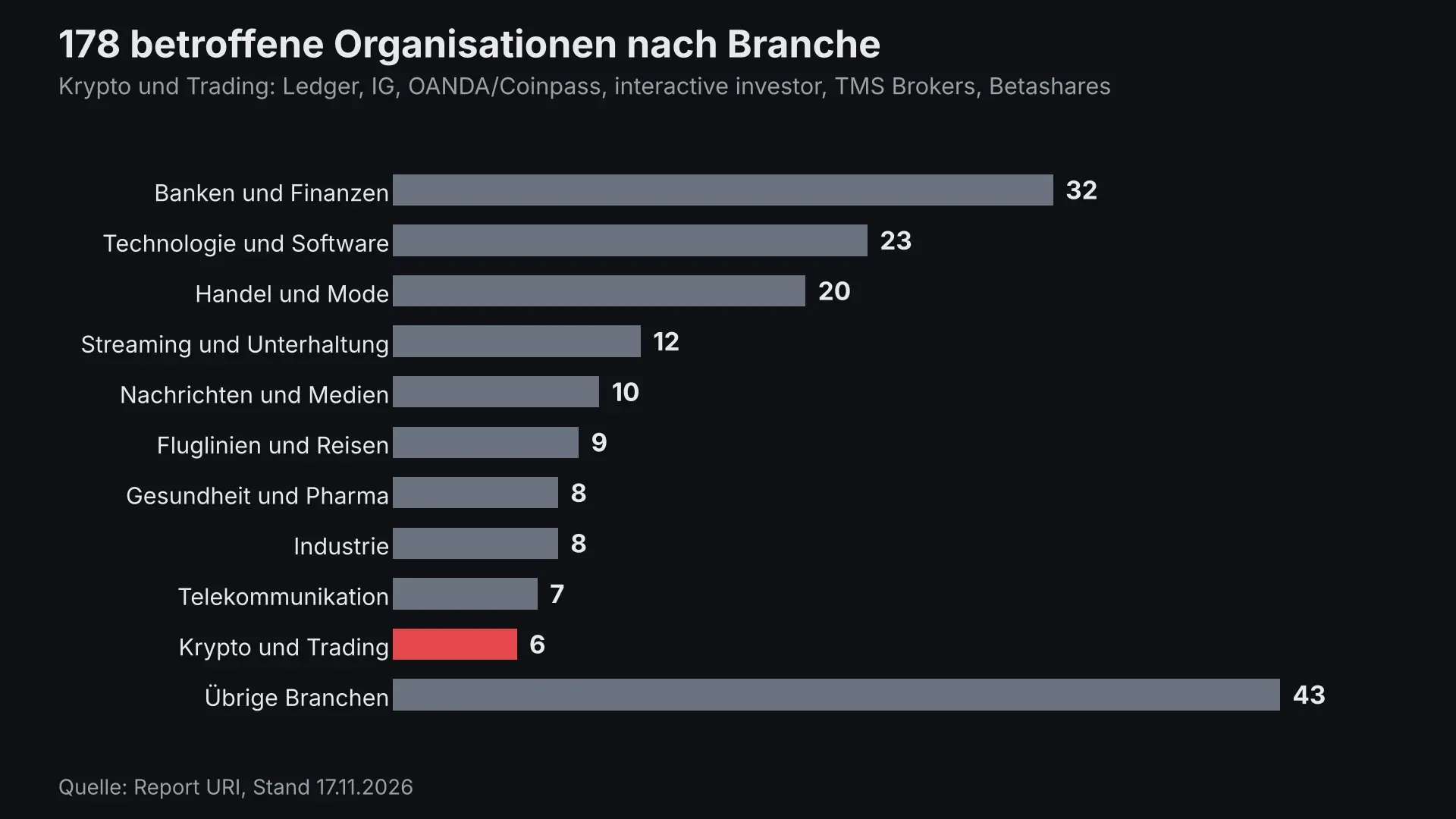
Report URI's list ranges from banks and airlines to streaming services. For users in Germany these names matter most: Ledger, the hardware wallet maker, IKEA, Zoom, ASOS, Salesforce, the BBC and CNN, the streaming service Zattoo, WOW from Sky Deutschland, Vaillant Deutschland, Transavia and Air France-KLM, Heineken, and the gambling sites PokerStars and Betsson. From the trading world, Report URI lists the brokers IG, OANDA with Coinpass, interactive investor and TMS Brokers alongside Ledger.
At Ledger the attack hit the website, not the devices or the Ledger Live software. According to Cointelegraph, Ledger's snippet was clean by around 20:41 UTC. Cointelegraph asked Ledger for comment; the report does not mention a reply. A hardware wallet shows the recipient address on its own display, and that comparison is precisely the protection against an address swap in the browser.
How to protect yourself from address swaps via third-party website scripts
What happened: On November 16, 2026, between 04:21 and 23:11 UTC, malicious code ran in the Optimizely snippets of at least 178 organisations. It swapped wallet addresses, skimmed card data and attacked iPhones. According to Report URI, the attackers' wallets had received around $7,150 by November 17.
Are you affected? You may be affected if, on November 16, you visited one of the sites named and copied a wallet address there, entered a card number, or opened the site on an iPhone or iPad running iOS 18 or older. If you did not visit any of these sites that day, this attack did not affect you. The full list is in the Report URI write-up.
- Check transfers from November 16: In your wallet or a block explorer, compare the full recipient address of every crypto transaction from November 16 with the address you meant to send to.
- Confirm the address on the device: For every transfer, check the address on your hardware wallet's display character by character, not just the beginning and the end.
- Use the address book instead of copying: Save frequent recipients in your wallet's address book and send a small test amount first to any new address.
- Update your iPhone: Install at least iOS 18.7.3 or iOS 26.3 on iPhone and iPad, as Report URI advises visitors of the affected sites.
- Watch your card statements: If you paid by card on one of the sites on November 16, check your transactions and have the card blocked if you see unknown charges.
The basics of safe custody are covered in our guide on how to store crypto safely, and the matching devices are compared in our hardware wallet comparison.
Optimizely hack: around $7,150 stolen despite millions of visitors
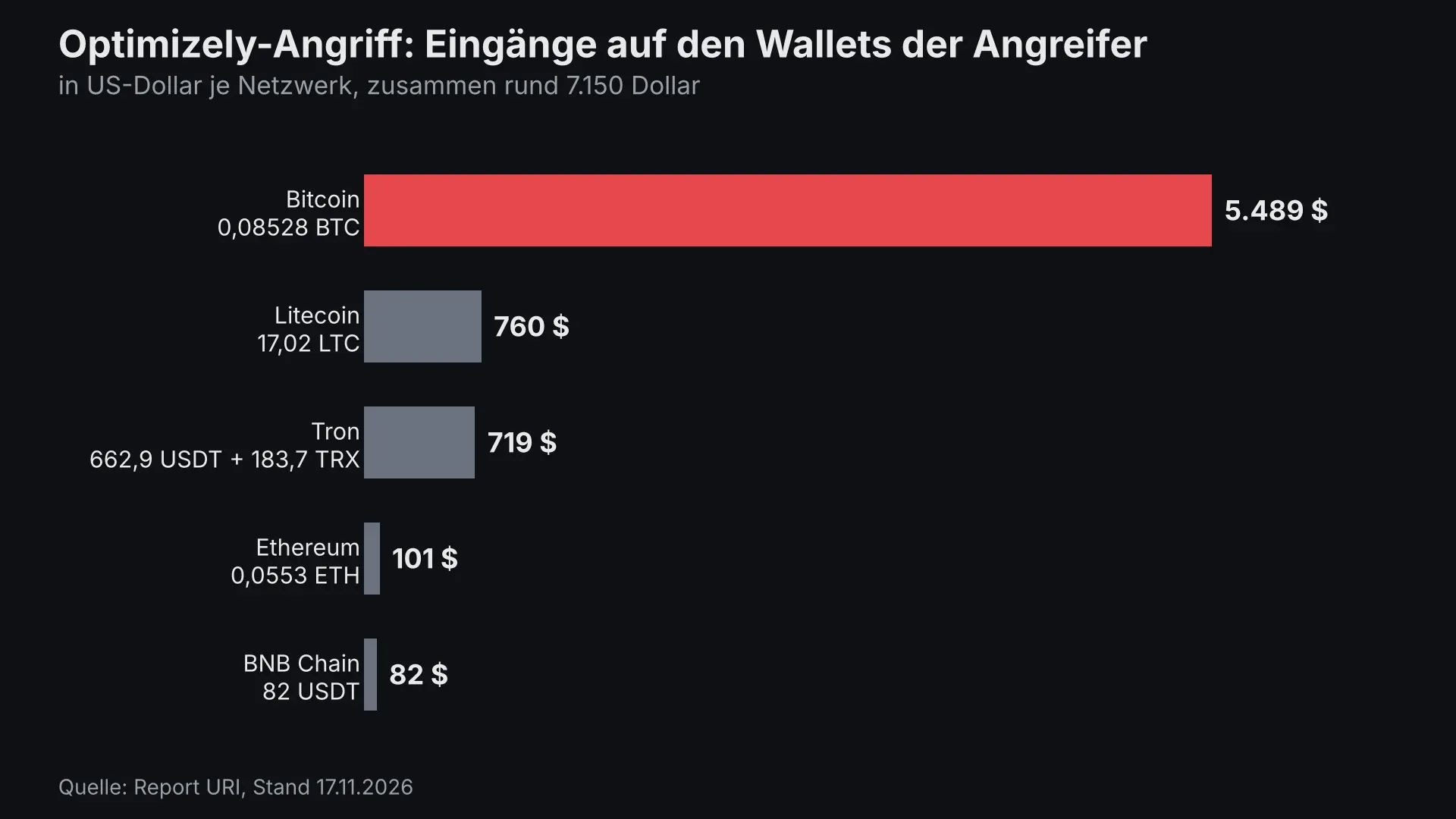
Measured against the reach of the sites, the direct damage stayed small. By November 17, Report URI counted on the attackers' wallets 0.08528 BTC from five payments (around $5,489), 17.02 LTC (around $760), 662.9 USDT and 183.7 TRX on Tron (around $719), 0.0553 ETH (around $101) and 82 USDT on BNB Chain. StepSecurity arrived at around $6,600, Cointelegraph at roughly $7,100 on Monday. Alex Thorn of Galaxy Digital estimates, according to Cointelegraph, that victims sent only about $2,300; the rest came mostly from the attacker's own transfers.
The route is more dangerous than the sum. A single compromised third-party script was enough to run code on sites with millions of daily visitors, without the operators themselves being attacked. If you manage crypto through the browser, trust the display on your own device rather than the website. For wallets in the browser or on your phone, our software wallet comparison shows which providers present transactions clearly before you sign. More on this week's security incidents is in our report on the Trezor data leak at shipping partner Skladon.
(As of November 17, 2026. This article is not investment advice. Prices and fee structures change; check the terms with the provider before you buy.)
 Compare hardware wallets with their own display
Partner links: some links on this page are partner links. If you become a customer through one of them, we may earn a commission at no extra cost to you. Selection, ratings and ranking are decided independently by our editorial team. Ethics and Independence · Ownership and Funding
Researched and compiled with AI. Before an article goes live, automated systems check the source links and hold back quotes and attributions without a verified source. Responsible editor: Dennis Weidner. The feature image was generated with AI. How we use AI
For later? Save this article and find it again in your profile.
Related articles
- Chainflip hack tops $12 million: vaults drained with a suspected copy of the signing key
- FaceStealer: FBI warns of fake Zoom calls that drain crypto wallets
- Crypto news: Chainstack data breach exposes customer data, node credentials treated as compromised
- Phantom wallet setup: twelve words decide the fate of your Solana coins
- Binance hack: the attack began with a fake job interview
Which topics should we dive deeper into?
Select what genuinely interests you. Your picks feed directly into our editorial planning.
Crypto news that's actually worth your time.
Weekly. 60 seconds. Carefully curated by our editors: no hype, no promo flood, no spam.

November 3, 2026 7:48 AM

Name.com domains hijacked: drainer on twelve DeFi sites, approvals from October 31 should be revoked
Attackers redirected the DNS records of at least twelve DeFi sites at registrar Name.com during the night to October 31 and sent visitors to copies running Step Drainer. The damage is between $138,000 and $202,000; anyone who signed there should revoke their approvals now.
November 3, 2026 1:58 AM

Crypto Hack News: Every Attack Since the Binance Hack and How to Stay Safe
Binance, Mercado Bitcoin, BTCPay Server, a WordPress plugin and hijacked WhatsApp accounts: since 29 October hardly a day has passed without a crypto hack. Every case with its status, the loss and the steps that keep you safe now.
November 2, 2026 11:13 PM

Mercado Bitcoin halts withdrawals after more than $46 million drained in attack
Mercado Bitcoin has confirmed a cyberattack and suspended all deposits and withdrawals; according to Cointelegraph, more than $46 million flowed out. What is known about the attack path and the frozen funds, and how to shield your holdings from the fallout of an exchange hack.
November 2, 2026 9:43 PM
How to store crypto safely: protect yourself from hacks like the one at Binance
After the $6.3 billion hack at Binance: how to store your cryptocurrencies safely. Hardware wallets compared, wallet scanners such as MetaMask Security Alerts, the key settings on your exchange account and a seven-step checklist.
November 2, 2026 9:29 PM

Polymarket attack via a third-party provider: what users should watch now
A compromised third-party provider enabled unauthorized withdrawals of around $2.65 million at Polymarket, and trading was temporarily switched to cancel-only. The company has promised full reimbursement, but the weak point lies in the access layers around the platform.
November 2, 2026 9:18 AM
THORChain halts Bitcoin and Ether swaps: Binance loot stalls, RUNE down 18 percent
An Ethereum reorg has halted swaps on ten blockchains at THORChain, and Bitcoin, Ether and Solana remain blocked. That also stalls a route used to launder the loot from the Binance hack, and the RUNE price is down more than 18 percent.

November 2, 2026 8:23 AM
BTCPay Server Hack: Bitcoin Hot Wallets Drained, Shut Your Server Down Now
BTCPay Server warns of swept Bitcoin hot wallets on older installs and tells operators to shut down. What happened, who is affected and what to do now.
November 2, 2026 12:27 AM

Tampered hardware wallet bought in a store: your rights as a buyer under German law
On October 28, Singapore police found malicious hardware components in hardware wallets sold in stores, with losses of around 3.5 million Singapore dollars. What German sales law gives you against the retailer, and why it does not replace the lost coins.
October 30, 2026 3:44 PM

$6.5 billion in October: the infrastructure failed, not the smart contract
An in-house count of DefiLlama's hack register for October 2026 finds 32 incidents with $6.5 billion in losses. 99.5 percent of that flowed out through compromised infrastructure, while smart contract flaws cost less than $16 million.
October 29, 2026 10:40 PM
Binance Withdrawals After the Hack: Solana and XRP Paused, Bitcoin and Ethereum Open
Binance has confirmed the hack: co-founder Yi He says the exchange will cover all losses, and deposits and withdrawals are temporarily suspended. What it means for users, which networks were already paused and what to watch out for now.
October 27, 2026 12:48 PM
Bloom trading bot: 9,408 SOL drained, what to watch now
The Telegram trading bot Bloom reports an outflow of 9,408 SOL from 49 addresses and points to a flaw in a third-party module. The provider promises reimbursement in full; the decisive question about the key remains open.
October 25, 2026 12:35 PM
Private key and public key: 256 bits decide who owns your coins
A private key is a secret number with 78 digits, and the public key can be calculated from it, while the way back cannot. Signature, seed and address all hang on it, and at an exchange or in your own wallet this single value decides who owns the coins.
October 22, 2026 4:17 PM
Railway hack hits crypto bots and wallets: what to check and replace now
US host Railway reports possible access to its customers' secrets. For crypto bots and wallets that is particularly dangerous: analysts already count outflows of around $371,000.
October 19, 2026 1:14 AM

Qubic halts its mainnet after 1,404 wallets are drained: the seed was the weak point
An attacker drained 1,404 Qubic wallets on the night of October 18, roughly $1.3 million. The protocol was not to blame: seed generation in the browser supplied too little randomness.
October 18, 2026 4:18 AM
Trezor cuts its authorized dealers: the authorizations end on January 1, 2027
After the supply chain attack on Ledger devices, Trezor is shrinking its dealer network and ending the authorizations on January 1, 2027. Until then, dropped partners may sell down their remaining stock, so the whole Christmas season still falls under the old list.
October 12, 2026 1:42 AM
Bitget Wallet is not the exchange: one of two required key shares sits on Bitget's server
The attack on the Bitget exchange of September 24, 2026 hit the venue's hot and warm wallets, not the keys in users' wallets. What matters all the same is which variant you run: in the keyless wallet every signature needs a key share from the provider's server.
October 11, 2026 4:50 AM
90 Crypto Kidnappings and Robberies in 7 Months: Why France Is the Most Dangerous Country for Bitcoin Holders
France logged 90 crypto kidnappings, extortions and violent thefts this year, one every 2.5 days. Leaked tax data is to blame. Here is how to protect yourself.
October 9, 2026 5:36 PM
Ledger Hack? $86 Million Drained: What Is Behind the Tampered Wallets From Southeast Asia
Since Friday, Ledger users in Southeast Asia have been reporting empty wallets, and analysts count more than $86 million. Ledger has halted the reseller CryptoBilis. An implant inside the device reportedly reads the seed phrase. What is known, what CZ advises and what you should do now.
October 5, 2026 1:29 AM

Chainalysis attributes $387 million from the Bitget hack to North Korea: what matters now for investors in Germany
The analytics firm Chainalysis attributes the theft of around $387 million at Bitget to actors with ties to the DPRK and puts the annual total above one billion dollars. What that means for custody, choice of exchange and record-keeping in Germany.
October 2, 2026 7:16 AM

$1.26 Billion in Three Months: Crypto Hacks Hit Their 2026 High
The security firm CertiK counts around $1.26 billion in damage from 247 incidents for the third quarter of 2026. September was the worst month of the year with 99 cases, and this is the background and what it means for your custody.
October 2, 2026 4:32 AM
NEAR Intents halts withdrawals after a $3.8 million exploit: here are the reasons
NEAR Intents confirms an exploit of more than $3.8 million and holds deposits and withdrawals on eleven networks. Reimbursement is promised, a date for it is not.
September 3, 2026 10:21 AM
Bitcoin Lost in a Wallet Hack: What Tax Applies in Austria?
Bitcoin lost to hackers? In Austria, the theft of privately held coins generally does not create a capital loss you can use for tax. Only a later payout can change that.
September 1, 2026 7:27 AM

Clipboard Attack: How Malware Swaps the Wallet Address You Copied
A clipper replaces the receiving address between copying and pasting with the attacker’s, and your wallet’s checksum notices nothing. What Microsoft and the Federal Office for Cybersecurity have documented, and which check really makes the attack come to nothing.
August 23, 2026 1:16 PM
Address Poisoning: Why Seven of Forty Characters Were Enough to Divert $2 Million
A fake wallet address matched the real one in just seven of forty characters and still intercepted 2 million USDC. Our own count of the affected wallet shows that a third of all counterparties in its history belong to such look-alikes.
August 13, 2026 4:59 PM
Trezor Data Breach: First 13,689 Customers, Then Roughly 67,000 More Exposed
A breach at Trezor shipping partner ShipMonk exposed names, phone numbers and home addresses of 13,689 customers in August; in September Trezor reported roughly 67,000 more in the US. Devices are safe, phishing risk is not.

More from CryptoTicker