
OKX Fees: Trading, Futures and Withdrawal Fees by Region
OKX charges 0.08 percent maker and 0.10 percent taker on spot and 0.02 or 0.05 percent on futures. All fee tiers, the rates in Europe, the US and Australia, withdrawal, SEPA and card fees, and a comparison with Bitget, Kraken and Coinbase.


Which topics should we dive deeper into?
Select what genuinely interests you. Your picks feed directly into our editorial planning.
Crypto news that's actually worth your time.
Weekly. 60 seconds. Carefully curated by our editors: no hype, no promo flood, no spam.
OKX fees start at 0.08 percent maker and 0.10 percent taker per spot trade and 0.02 percent maker and 0.05 percent taker on futures for a regular user, according to the OKX fee schedule on 7 November 2026. The same trading fees apply at OKX Europe once you have opened the derivatives account; regional platforms run their own schedule, for example 0.35 percent taker in the United States and 0.70 percent in Australia. For a spot purchase of 1,000 USDT at market price, that means 1 USDT in fees at the regular level.
OKX fees: the key facts
- Spot: 0.08% maker, 0.10% taker for a regular user on the global platform and at OKX Europe with a derivatives account.
- Futures: 0.02% maker, 0.05% taker on perpetual and expiry futures.
- EEA spot-only account: 0.10% maker, 0.20% taker.
- OKX US: 0.20% maker, 0.35% taker for regular users.
- VIP 1: from 100,000 USD in assets or 1,000,000 USD in 30-day spot volume (in euros at OKX Europe), 0.0675% maker and 0.08% taker.
- Deposits: crypto deposits and SEPA euro transfers carry no OKX fee; a crypto withdrawal costs a network fee per coin and network.
This page gives you every number you need to price a trade on OKX, from the OKX trading fees by fee tier to futures, funding, withdrawals, card purchases and Convert. Security, licences and the product range are covered in our OKX review.
OKX trading fees on spot: maker and taker fees by fee tier
Spot trading fees apply when you buy or sell crypto in the order book, for example BTC against USDT. OKX sorts every account into a fee tier by its total assets or its 30-day trading volume, and the higher of the two decides. A maker fee applies to a limit order that waits in the order book; a taker fee applies to an order that executes immediately against an existing order, such as a market order.
| Fee tier | Assets (USD) | or 30-day trading volume (USD) | Maker fee | Taker fee |
|---|---|---|---|---|
| Regular user | below 100,000 | below 1,000,000 | 0.08% | 0.10% |
| VIP 1 | from 100,000 | from 1,000,000 | 0.0675% | 0.08% |
| VIP 2 | from 200,000 | from 5,000,000 | 0.06% | 0.07% |
| VIP 3 | from 2,000,000 | from 10,000,000 | 0.055% | 0.065% |
| VIP 4 | from 5,000,000 | from 20,000,000 | 0.03% | 0.045% |
| VIP 5 | from 20,000,000 | from 100,000,000 | 0.025% | 0.035% |
From VIP 6 the maker fee falls to zero, and from VIP 7 OKX pays a small rebate on maker orders, up to 0.005 percent at VIP 9. OKX Europe uses the same thresholds in euros. The fee schedule lists a few zero-fee trading pairs: on the global platform USDC/USDT and PYUSD/USDT trade at 0 percent for both maker and taker, in the EEA USDC/EUR and three pairs in Polish zloty. Zero-fee pairs don’t count toward your 30-day trading volume. A small group of special pairs follows its own schedule, starting at 0.10 percent maker and 0.15 percent taker. OKX sets the fee tier of a main account from the 30-day trading volume and the daily asset snapshot of the main account and all its sub-accounts, and the sub-accounts share that tier.
OKX takes the fee from the trade itself. According to its trading fee rules, a buy is charged in the crypto you receive and a sale in the proceeds: if you buy 1 BTC at market price as a regular user, you receive 0.999 BTC. OKB holdings don’t change the rate, and OKX charges no fee for opening or keeping an account. Your current VIP level and 30-day trading volume appear under Assets and “My trading fees” on the web, and OKX updates fee tiers once a day.
OKX margin trading fees
Margin trading on OKX uses the same maker and taker fees as regular spot trading, according to its trading fee rules. On top comes interest on the borrowed amount, which OKX Europe lists as the rollover rate on its fee page. Borrowed funds multiply gains and losses alike, so margin suits only traders who can carry a total loss of the stake.
OKX fees by region: why your country sets the rate
OKX runs regional platforms, and each one publishes its own fee schedule. The trading pair and the order type stay the same, but OKX fees vary depending on the country you are registered in, and so do the spot fees of a regular user.
| Platform | Maker fee | Taker fee | Source, 7 November 2026 |
|---|---|---|---|
| OKX global | 0.08% | 0.10% | OKX fee schedule |
| OKX Europe, spot and derivatives account | 0.08% | 0.10% | OKX Europe fees |
| OKX Europe, spot-only account | 0.10% | 0.20% | OKX Europe fees |
| OKX Singapore | 0.10% | 0.20% | OKX Singapore fees |
| OKX US | 0.20% | 0.35% | OKX US fees |
| OKX UAE | 0.40% | 0.60% | OKX UAE fees |
| OKX Australia | 0.70% | 0.70% | OKX Australia fees |
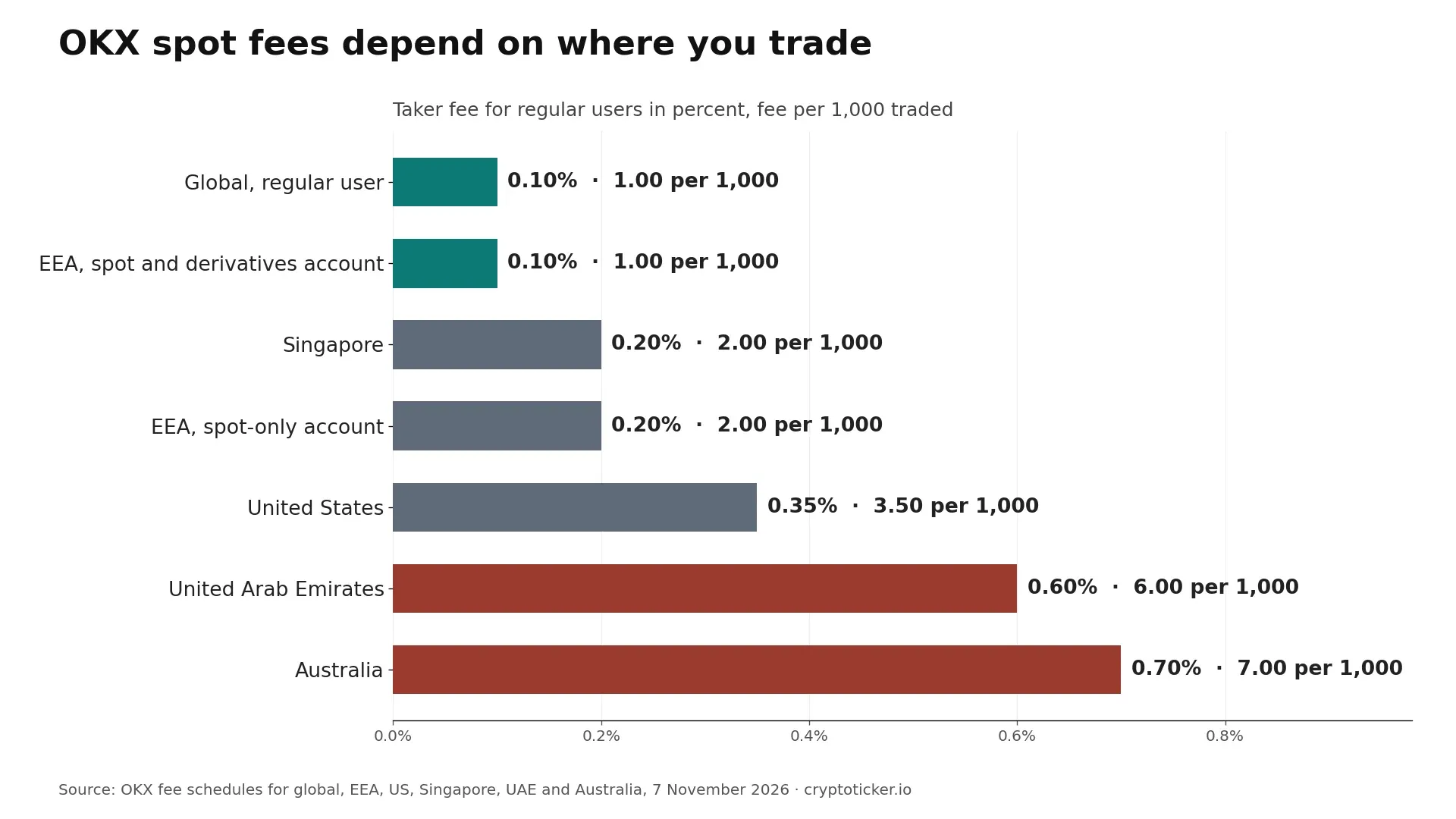
OKX US: the US schedule covers spot trading and sets lower thresholds for a higher VIP tier. VIP 1 starts at 100,000 USD in assets or 100,000 USD in 30-day trading volume and costs 0.10 percent maker and 0.20 percent taker; VIP 2 from 250,000 USD volume costs 0.075 and 0.15 percent. An active US trader therefore reaches the lower rates far sooner than on the global platform.
OKX Australia: the Australian schedule lists spot trading at 0.70 percent for regular users and drops to 0.45 percent maker and 0.50 percent taker at VIP 1, from 150,000 AUD in assets or 200,000 AUD in 30-day volume. Card purchases in Australian dollars carry no card fee, see the card section below.
OKX Europe fees: spot-only account or derivatives account
In the European Economic Area, OKX operates through OKX Europe Limited, which holds a MiCA licence in Malta. Here the spot fee depends on one setting: whether you have opened the derivatives account that OKX calls X-Perps. OKX explains the two schedules in its spot fee comparison; the current rates come from the fee page.
| Fee tier (EUR) | Spot-only account, maker / taker | With derivatives account, maker / taker |
|---|---|---|
| Regular user | 0.10% / 0.20% | 0.08% / 0.10% |
| VIP 1, from 100,000 assets or 1,000,000 volume | 0.09% / 0.18% | 0.0675% / 0.08% |
| VIP 2, from 200,000 assets or 5,000,000 volume | 0.08% / 0.16% | 0.06% / 0.07% |
| VIP 3, from 2,000,000 assets or 10,000,000 volume | 0.06% / 0.14% | 0.055% / 0.065% |
A market purchase of 1,000 euros of Bitcoin therefore costs 2 euros on a spot-only account and 1 euro with the derivatives account. The derivatives account gives access to leveraged perpetual futures, which carry a high risk of loss; open it because you understand those products, not for the spot discount alone. What OKX Europe offers beyond fees is described in our OKX Europe guide.
 Crypto exchanges compared
OKX futures fees: maker and taker fees by fee tier
OKX futures fees are 0.02 percent maker and 0.05 percent taker at the regular level for perpetual and expiry futures, on the global platform and for X-Perps at OKX Europe alike. The taker rate is two and a half times the maker rate, so a limit order that waits in the order book clearly beats a market order that should execute immediately.
| Fee tier | Assets (USD) | or 30-day futures volume (USD) | Maker fee | Taker fee |
|---|---|---|---|---|
| Regular user | below 100,000 | below 5,000,000 | 0.02% | 0.05% |
| VIP 1 | from 100,000 | from 5,000,000 | 0.016% | 0.045% |
| VIP 2 | from 200,000 | from 10,000,000 | 0.015% | 0.036% |
| VIP 3 | from 2,000,000 | from 50,000,000 | 0.01% | 0.028% |
| VIP 4 | from 5,000,000 | from 200,000,000 | 0.008% | 0.027% |
| VIP 5 | from 20,000,000 | from 600,000,000 | 0.005% | 0.026% |
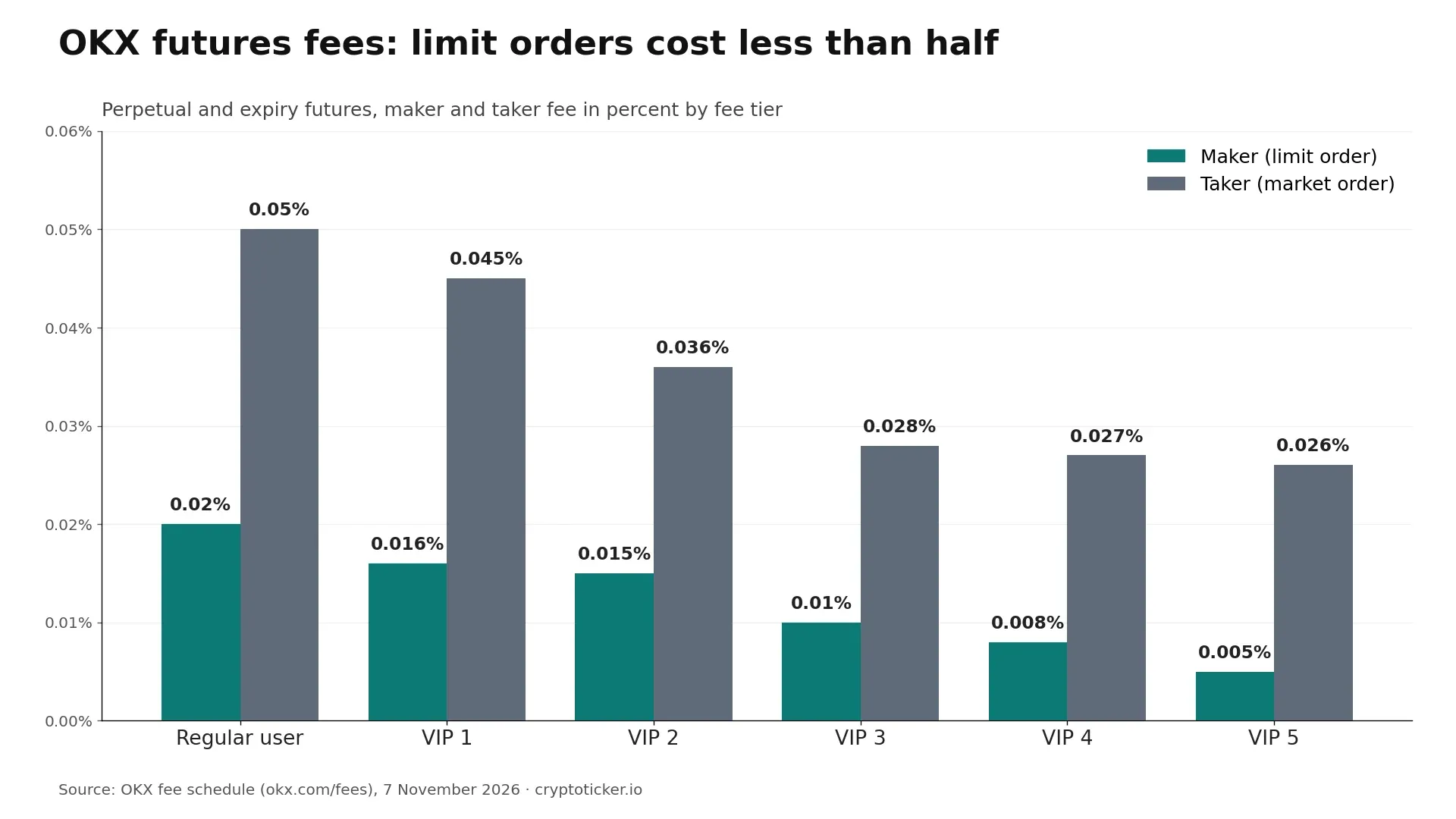
OKX charges the same rate to open and to close a position, always on the executed size. Its trading fee rules name three other costs on futures contracts: funding fees on perpetuals, a forced liquidation fee at the taker rate of your tier, and an expiry settlement fee of 0.01 percent on expiry futures. Adjusting leverage or adding margin costs nothing on its own.
How OKX calculates futures fees: contract size and face value
On USDT-margined futures contracts, OKX calculates the fee as fee rate × (number of contracts × contract multiplier × contract size × fill price). The face value, or contract size, is the amount of the underlying asset in one contract: 0.01 BTC on the BTC-USDT perpetual. Face value × number of contracts gives the position size.
OKX’s own example: 100 BTCUSDT contracts equal 1 BTC. At a BTC price of 20,000 USDT, a market order costs 0.05% × (100 × 1 × 0.01 × 20,000) = 10 USDT, a limit order 4 USDT. Opened with 10x leverage, the trader puts up only 2,000 USDT of margin, but the fee is still charged on the full fill value of 20,000 USDT.
OKX options fees and the exercise fee
For options trading, the options trading fee is 0.03 percent maker and taker at the regular level. An exercise fee applies only to options that are exercised, at most 0.02 percent of the underlying asset amount, and day options carry no exercise fee. Futures and options use leverage and can lose a stake within hours. For readers in Australia, the futures numbers on this page are information only; OKX’s Australian fee schedule centres on spot trading.
OKX funding fees on perpetual futures
Perpetual futures carry a funding fee on top of the trading fee. According to OKX’s funding fee mechanism, the fee is settled every eight hours at 00:00, 08:00 and 16:00 UTC by default, and every one, two or four hours on some contracts. You only pay or receive it if you hold a position at the settlement time, and OKX may adjust the settlement times to market conditions.
- Formula: funding fee = position value × funding rate; on USDT-margined futures the position value is number of contracts × contract size × contract multiplier × mark price.
- Positive funding rate: long traders pay short traders. Negative funding rate: short traders pay long traders.
- Who receives it: the other side of the market. OKX settles the transfer between long and short traders and charges no service fee on it.
- Starting point: the interest component is 0.03 percent a day, or 0.01 percent per eight-hour settlement; the premium of the futures price over the index moves the rate up or down.
Example: a long position worth 10,000 USDT at a funding rate of 0.01 percent pays 1 USDT per settlement, or 3 USDT a day at three settlements. Close the position before the next settlement and no funding payment applies. In a heated market the rate can be many times higher, so check it on the contract page before you hold a position overnight.
What an OKX trade costs: worked examples
The tables use the regular level, the most common case for a new OKX account. The first rows assume one spot purchase of 1,000 a month.
| Example | Fee rate | Fee per trade | Per year |
|---|---|---|---|
| Market buy of 1,000 USDT, global or EEA with derivatives account | 0.10% | 1.00 USDT | 12.00 USDT |
| The same as a limit order (maker) | 0.08% | 0.80 USDT | 9.60 USDT |
| Market buy of 1,000 EUR, EEA spot-only account | 0.20% | 2.00 EUR | 24.00 EUR |
| Market buy of 1,000 USD on OKX US | 0.35% | 3.50 USD | 42.00 USD |
| Card purchase of 1,000 EUR, card fee only | 1.99% | 19.90 EUR | 238.80 EUR |
The gap between the cheapest and the most expensive route is wide: a monthly saver who pays by card spends about 25 times as much in fees as one who sends euros by SEPA and buys with a limit order.
| Futures position value 10,000 USDT, regular level | Open | Close | Round trip |
|---|---|---|---|
| Market orders (taker 0.05%) | 5 USDT | 5 USDT | 10 USDT |
| Limit orders (maker 0.02%) | 2 USDT | 2 USDT | 4 USDT |
The fee is charged on the position size, not on your margin. Leverage doesn’t change the rate, but it makes the position and with it the fee larger than your own stake.
OKX fees compared with Bitget, Kraken and Coinbase
Among these four crypto exchanges, OKX charges the lowest maker fee on spot at the entry level, and its futures taker fee is 0.01 percentage points below Bitget’s. Bitget matches the OKX taker rate on spot once you pay its fees in BGB. Kraken and Coinbase price a standard purchase far higher.
| Exchange | Spot at the entry level | Futures maker / taker | Source |
|---|---|---|---|
| OKX | 0.08% maker, 0.10% taker | 0.02% / 0.05% | OKX fee schedule, 7 November 2026 |
| Bitget | 0.1% maker and taker, 0.08% with BGB | 0.02% / 0.06% | Our Bitget fees page, 6 November 2026 |
| Kraken | Kraken Pro 0.40% maker, 0.80% taker; Instant Buy 1% plus spread | see review | Our Kraken fees review, 20 September 2026 |
| Coinbase | Simple buy: fee in the preview, up to 1.875% depending on payment method, plus spread; limit orders 1% execution fee | see review | Our Coinbase fees page, 20 September 2026 |
For a 1,000 USDT market purchase that means 1 USDT on OKX and on Bitget, 0.80 USDT on Bitget with BGB, and 8 euros on 1,000 euros as a taker on Kraken Pro. How the exchanges compare beyond trading costs, from coins to security, is in our Bitget vs OKX, Kraken vs OKX and Binance vs OKX comparisons and in the crypto exchange comparison.
Regulated crypto exchanges comparedOKX withdrawal fees and deposit fees for crypto
Crypto deposits on OKX are free: according to OKX’s help page on deposit and withdrawal fees, the sender pays the network fee and you pay nothing to receive. Each withdrawal costs a network fee that depends on the coin and the network you choose. OKX adjusts it to network congestion, and the exact fee appears on the withdrawal page before you confirm.
| Coin and network | Withdrawal fee |
|---|---|
| USDT on Tron (TRC20) | 2 USDT |
| USDT on Ethereum (ERC20) | 0.4 USDT |
| USDT on Solana | 0.25 USDT |
| USDT on TON | 0.029 USDT |
| USDT on Arbitrum One (USDT0) | 0.0032 USDT |
| BTC on the Bitcoin network | 0.000015 BTC |
| ETH on Ethereum (ERC20) | 0.00013 ETH |
| USDC on Solana | 0.25 USDC |
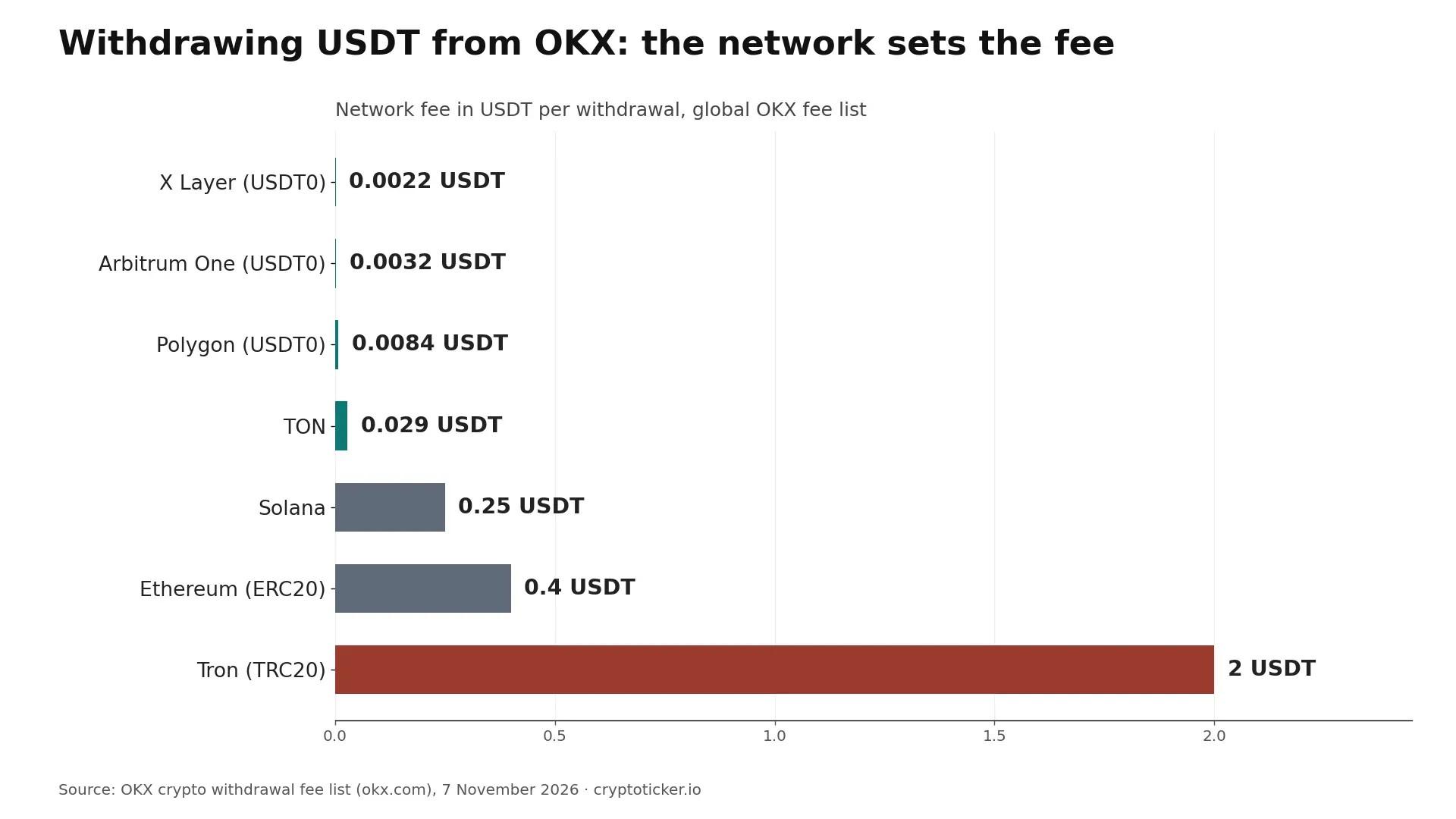
The values come from the global crypto withdrawal fee list on 7 November 2026. The minimum USDT withdrawal is 2 USDT on most networks and 10 USDT on Tron; for Bitcoin it is 0.0001 BTC. OKX Europe lists USDC and EURC as its stablecoins: USDC costs 0.58 USDC on Ethereum, 0.25 on Solana and 0.005 on Arbitrum One, EURC 0.22 EURC on Ethereum, according to the OKX Europe withdrawal list.
Compared with Bitget, OKX is cheaper on Ethereum (0.4 against 2 USDT) and Solana (0.25 against 0.5 USDT), Bitget on Tron (1.5 against 2 USDT). For Tether (USDT), OKX charges the fee in USDT itself, so you need no TRX on Tron or SOL on Solana to pay it. Choose the network that the receiving wallet or exchange supports; a transfer on the wrong network can be lost. A regular user can withdraw crypto worth up to 10,000,000 USD in 24 hours, and the OKX withdrawal limit rises with the VIP tier up to 80,000,000 USD.
OKX fees for euro deposits and withdrawals by SEPA
OKX charges nothing for euro transfers by SEPA in either direction, according to its help pages on SEPA deposits and SEPA withdrawals. Your own bank may still charge for the transfer.
- SEPA Instant: euros arrive within seconds, around the clock, up to 100,000 euros per transfer.
- SEPA standard: one to two business days, during banking hours.
- Withdrawals: generally instant or within two business days. For the first withdrawal, OKX verifies the receiving account through a deposit from that same account.
- Who can use it: euro bank transfers are available to customers resident in the EEA, from an account in their own name.
OKX fees for buying with a card and for Convert
Buying crypto with a debit or credit card is the convenient route and the most expensive one. OKX lists the card fee by currency in its help article on buying with debit and credit cards:
| Card currency | Card fee |
|---|---|
| EUR | 1.99% |
| USD | 2.49% |
| SGD | 2.49% |
| AUD | 0% |
| AED | 3.00% |
In the US and Singapore, OKX accepts debit cards. If your bank treats a credit card payment as a cash advance, it may add its own fee on top.
Convert shows no separate fee line. According to OKX’s Convert explainer, you accept a quoted price that includes a spread, which depends on the size of the conversion, volatility and the available liquidity. The same applies to express Buy and Sell. Compare the amount in the preview with the spot price of the same asset; for larger amounts, a limit order in spot trading is usually the cheaper and more transparent route. P2P trades carry no trading fee and don’t count toward your trading volume.
How to reduce trading fees on OKX
Five levers lower OKX fees without any trading volume:
- Limit orders instead of taker orders: as a maker you pay 0.08 instead of 0.10 percent on spot and 0.02 instead of 0.05 percent on futures.
- Account type in the EEA: with the derivatives account, the spot taker fee falls from 0.20 to 0.10 percent.
- SEPA instead of a card: a 1,000 euro card purchase costs 19.90 euros in card fees, a SEPA deposit nothing.
- Cheap networks: USDT on Arbitrum One, TON or X Layer costs between a fraction of a cent and three cents, on Tron 2 USDT.
- Zero-fee pairs: switch between stablecoins on USDC/USDT, or USDC/EUR in the EEA, at 0 percent.
Beyond that, a higher VIP status follows from qualifying balances or 30-day trading volume. If you are new to OKX and live in the EEA, you can open an account through our OKX partner link and start with spot trading. Our OKX promo code page lists the code 45934865 and up to €400 in welcome rewards for new users in the EEA, as of 26 October 2026. We receive a commission if you open an account through this link.
Are OKX fees low? Our assessment
With 0.08 and 0.10 percent on spot and 0.02 and 0.05 percent on futures, OKX’s global rates sit at the low end of the comparison above: its maker fee undercuts Bitget’s standard rate, and only Bitget with BGB charges less as a taker. The lowest effective trading costs on OKX come from a SEPA deposit, a limit order and a withdrawal on a low-cost network. Your region and account type decide the rest: an EEA customer with the derivatives account pays the global rate, a US customer 0.35 percent taker, an Australian customer 0.70 percent. If you live in the EU, an exchange with a MiCA licence is the right choice; OKX Europe holds one, and further licensed options with their fees are in our comparison of regulated crypto exchanges.
Fees and VIP thresholds change with the fee schedule, so the tables here show the state of 7 November 2026; your own rate appears in your OKX account. Crypto prices can move sharply, and leveraged products can wipe out a stake within hours. This article is not investment advice.
FAQ: OKX fees
Transparency note: This article was produced with the assistance of artificial intelligence and reviewed by our editorial team before publication. All figures and claims were checked against the primary sources linked in the text. The feature image was generated with AI.
Related articles
- Bitget Fees: Spot, Futures and How BGB Lowers Them
- Crypto Exchange: How to use Bitget Exchange?
- Binance fees: 0.1 percent to trade, and one drawback compared with MiCA-licensed exchanges
- Bitpanda fees from 0.99 to 2.49 percent: what is behind it
- How to Short Bitcoin in the Crash: Step by Step on Bitget and OKX
Which topics should we dive deeper into?
Select what genuinely interests you. Your picks feed directly into our editorial planning.
Crypto news that's actually worth your time.
Weekly. 60 seconds. Carefully curated by our editors: no hype, no promo flood, no spam.

August 20, 2026 1:17 AM
Crypto Withdrawal Fees: What Moving Coins to Your Own Wallet Really Costs
We measured the withdrawal fees for 475 assets on August 17, 2026 and set them against the actual network fee. For Bitcoin, the exchange charged eight to sixteen times what a transaction cost in the same minute.

March 13, 2025 11:00 PM
OKX Event in Malta: A New Contender for Crypto in Europe
OKX celebrated a major milestone at Fort Manoel in Malta, announcing its full MiCA and MIFID2 licenses and plans to expand compliant crypto trading across Europe.
September 12, 2026 4:31 AM

After the BitMEX Closure on September 23: How to Check Whether Your Remaining Balance Can Be Withdrawn at All
As of September 27, 2026: trading on BitMEX ended for good on September 23 at 04:00 UTC. According to the operator, withdrawals remain possible via the website, and an account fee of 1 percent a year, or at least $50, applies to remaining balances. Our own review of the wallet interface on September 11 showed that on 14 of 62 withdrawal routes the network fee reached or exceeded the minimum amount.

June 17, 2024 10:59 AM
TOP 3 DEX for June 2024
What are the best DEXs to use in 2024? Here are the top 3 for June 2024!
December 6, 2025 11:00 PM

OKX Christmas Calendar: Earn Up to €150 in BTC: Daily Rewards for Every Crypto User
OKX launches its Christmas Calendar Campaign with daily BTC rewards. Users can earn up to €150 — and new users up to €172 — by completing simple tasks.
August 16, 2023 7:46 PM
Crypto News: Coinbase Approved for Crypto Futures Trading in US
Crypto News: Coinbase has recently received the green light to delve into the futures market within the United States.
December 6, 2025 11:00 PM

Bitget Stock Futures Break Through $10 Billion as Global Traders Rush Into Tokenized Equities
Bitget, the world’s largest Universal Exchange (UEX), today announced that its US stock futures have surpassed $10 billion in cumulative trading volume.

February 4, 2019 11:00 PM

Kraken Acquires Crypto Facilities
Cryptocurrency exchange services provider Kraken has formally acquired crypto derivatives trading platform and index provider, Crypto Facilities, in a nine-figure deal, reported Fortune. After this acquisition, some Kraken users can obtain both spot and futures dealing. The firm also has […]

September 20, 2026 7:20 PM
Coinbase Fees: What a Purchase Really Costs, and Where the Spread Is Hidden
The fee Coinbase shows you before a purchase is not the whole price. Alongside it sits the spread, built into the rate, and limit orders add another percent on top. We read the current terms at the source and show the four places where the exchange earns.
April 8, 2026 11:46 PM
BXB Market Review 2026: Platform, Pricing, and What Traders Should Know
Considering using BXB Market? Here's a detailed look at their platform, account tiers, spread discounts, and trading conditions as of 2026.
October 14, 2026 1:21 AM
BNB zero fees for USDC and USD1 until October 31: what changes for investors in Germany
On the BNB Smart Chain, withdrawals and wallet transfers in USDC, USD1 and U cost no gas until October 31. The 37th auto-burn is also due, and total supply still sits 33.16 million tokens above the target of 100 million.
October 10, 2026 7:40 PM

Decentralised Crypto Exchanges (DEX): Network Fee Against Pool Fee, and Why Custody Decides
On Ethereum a swap through a decentralised exchange currently costs three to five cents in network fees, while the fee for the liquidity pool runs between 0.01 and 1.00 percent depending on the pair. That leaves both routes level on cost, and what comes afterwards decides: custody, supervision and records.
October 2, 2026 4:18 AM
AVAX withdrawals: C-Chain vs X-Chain, and which address yours needs
Avalanche runs three blockchains, and only the C-Chain carries tokens, smart contracts and DeFi. This guide shows how to recognise a C-Chain address, what a transfer costs and how to trace it in Snowtrace.
August 22, 2026 1:27 PM
Binance Delists ICX, SCRT and STORJ: From August 21, One Door Closes After Another
Binance removes ICON, Secret and Storj from spot trading on September 3, 2026 at 03:00 UTC. The wind-down starts on August 21 with margin and direct purchase, and ICX holders face a second deadline through the ICON shutdown.
August 22, 2026 4:30 AM
Setting Crypto Order Types Correctly: Market, Limit and Stop-Loss Compared
A market order buys immediately, a limit order only at your price, and a stop-loss triggers only at a set level. This guide shows which order type fits which situation, and where spread, slippage and the fee model shift your entry price.
April 15, 2026 8:44 PM

TradeEU Global Review 2026: What Traders Should Know Before Signing Up
Is TradeEU Global the right broker for you? We tested the platform, compared account tiers, and reviewed the full trading experience for 2026.
September 29, 2024 8:01 PM
Cheapest Way to Buy Bitcoin Today
With Bitcoin trading above $60K, the opportunity to invest is now. Why do experts predict it could still reach $100K and how can you easily buy Bitcoin?
May 22, 2024 7:27 PM
SEC 'APPROVES' Ethereum Spot ETF: Will It Happen TOMORROW?
May 23rd is the anticipated day for SEC to announce its decision concerning ETH spot ETF. In less than 24 hours, an approval, rejection, or postponement will be among the top headlines, but what do analysts foresee?
October 13, 2025 12:09 AM
OKX Launches Bot Trading Promo With Loss Protection
OKX introduces a limited-time offer for new users to try trading bots risk-free. Get USDC back if your bot makes a loss and earn token rewards while trading.
June 4, 2025 11:00 PM
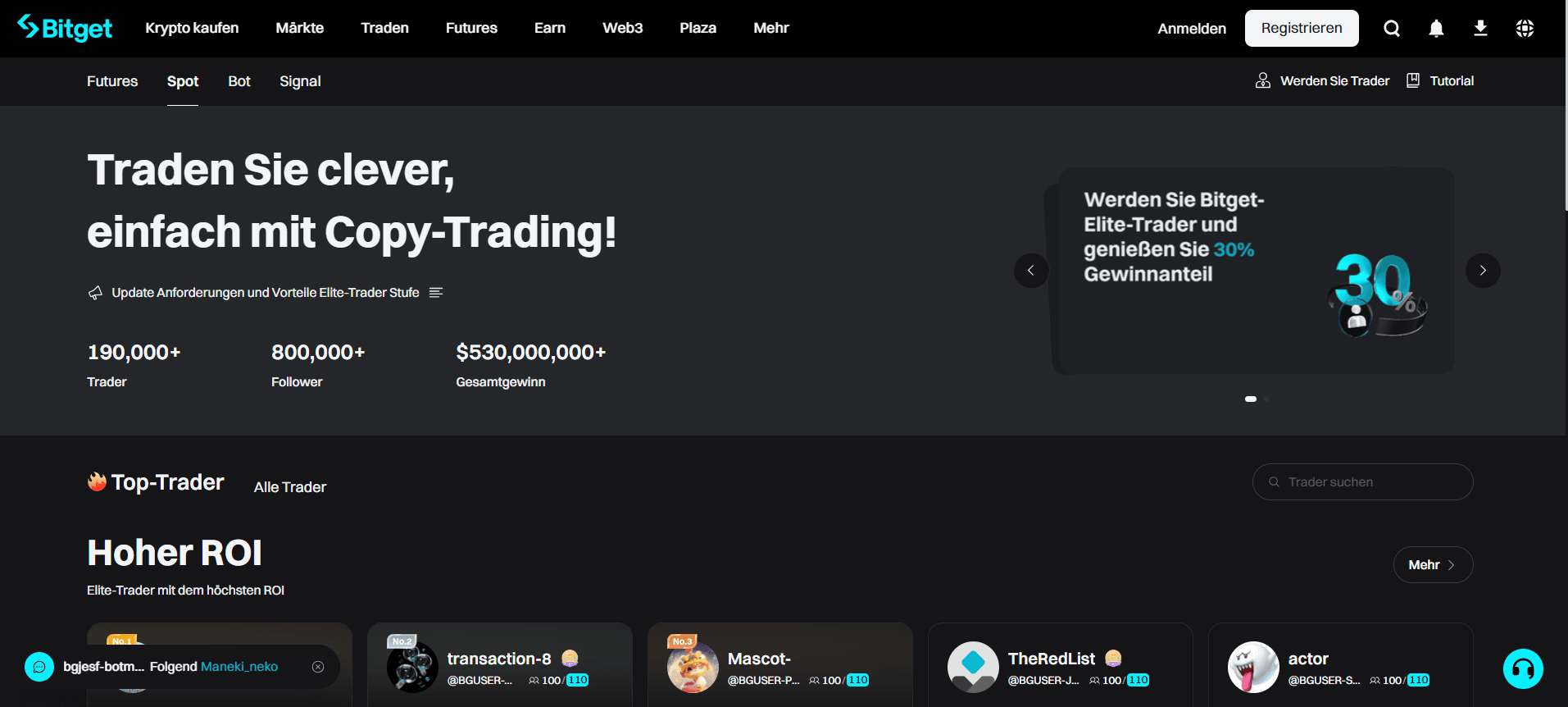
Bitget Copy Trading: How to Follow Successful Crypto Traders Step-by-Step
Bitget copy trading automatically mirrors successful traders' strategies. Here's a guide showing you step-by-step the setup, benefits, risks, and tips for choosing the right traders to copy.
November 15, 2025 11:00 PM

OKX Transfer Days: Earn Up to €1,000 in Bitcoin by Moving Your Assets to OKX
OKX launches “Transfer Days” — a limited-time promotion where users can earn up to €1,000 in bitcoin by transferring funds or crypto. Here’s how to join.
May 26, 2025 11:00 PM
Inside Bitget: How COO Vugar Usi Zade Is Shaping the Future of Crypto Trading
From Bitget Seed and AI-powered tools to regulatory strategy and mass adoption, COO Vugar Usi Zade reveals how Bitget is building the next era of crypto trading.
November 4, 2026 7:20 AM
Crypto futures in the EU: six licensed exchanges compared, all capped at 10x
As a retail trader in Germany, you can trade crypto futures legally on six exchanges with an EU licence, all capped at 10x leverage for retail clients. The comparison covers contract design, fees, collateral and what ESMA's February statement changes for you.

More from CryptoTicker