
Bitget Fees: Spot, Futures and How BGB Lowers Them
Bitget charges 0.1 percent on spot and 0.02 or 0.06 percent on futures. All VIP levels, the BGB discount, funding and withdrawal fees, copy trading costs and a comparison with Bybit and OKX Australia.

Which topics should we dive deeper into?
Select what genuinely interests you. Your picks feed directly into our editorial planning.
Crypto news that's actually worth your time.
Weekly. 60 seconds. Carefully curated by our editors: no hype, no promo flood, no spam.
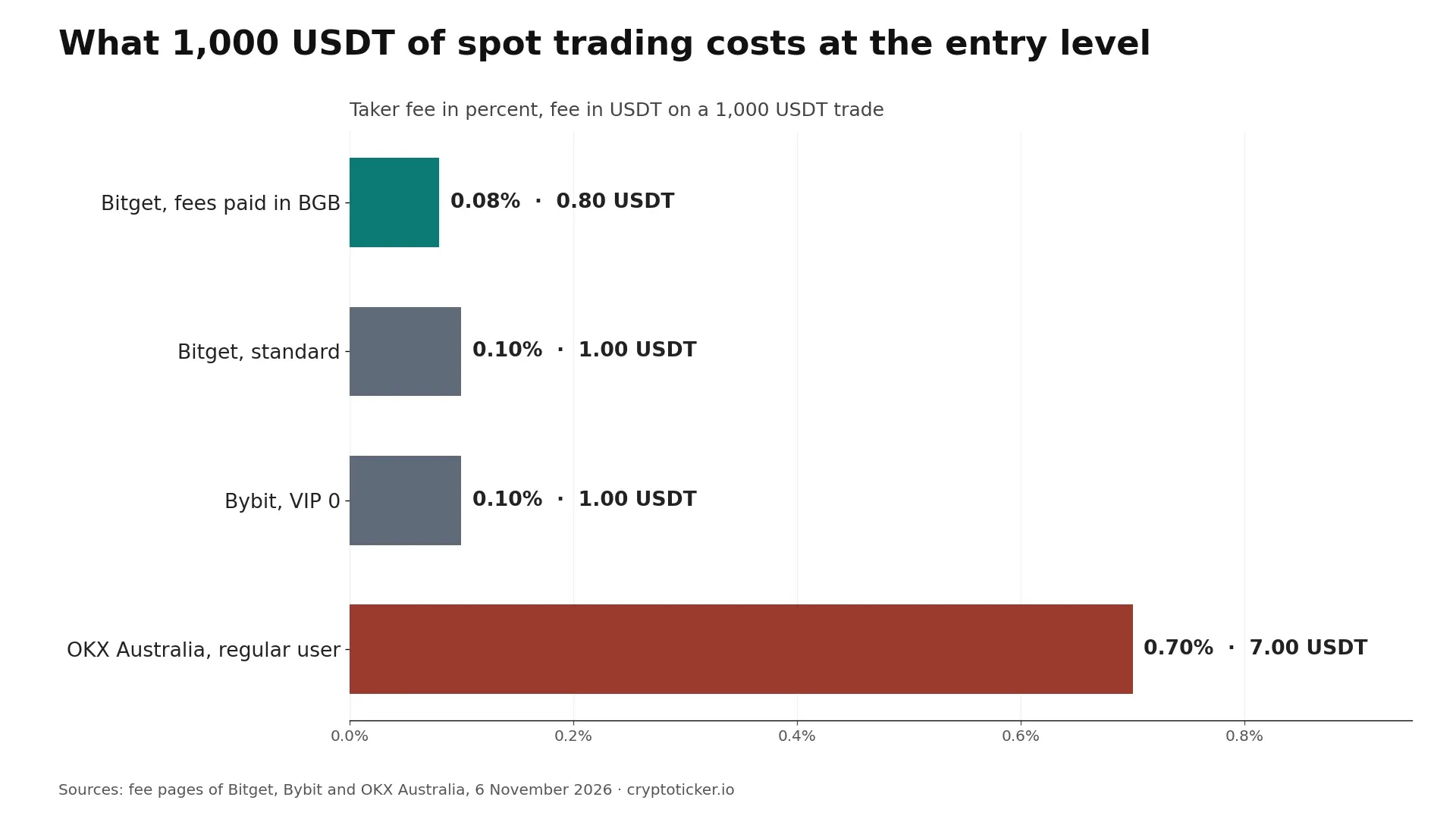
Bitget charges 0.1 percent per spot trade for maker and taker orders and 0.02 percent maker and 0.06 percent taker on USDT-M futures, according to its fee schedule on 6 November 2026. If you pay spot fees in BGB, Bitget’s own token, they fall by 20 percent to 0.08 percent. Higher VIP levels, based on your 30-day volume or your balances, lower both tables further. For a standard spot purchase of 1,000 USDT, that means 1 USDT in fees, or 0.80 USDT with BGB.
Bitget fees: the key facts
- Spot: 0.1% maker and taker, 0.08% with BGB.
- USDT-M futures: 0.02% maker, 0.06% taker at the standard level.
- VIP 1: from 500,000 USDT spot volume in 30 days, 0.08% spot, 0.064% with BGB.
- Compared: Bybit charges the same 0.1% on spot; OKX Australia lists 0.70% for regular users.
- Your own rate: shown in the fee overview after you log in.
This page gives you every number you need to price a trade on Bitget, from the Bitget trading fees to funding, withdrawals and copy trading. Features, security and the countries Bitget serves are covered in our Bitget review.
Bitget spot trading fees by VIP level
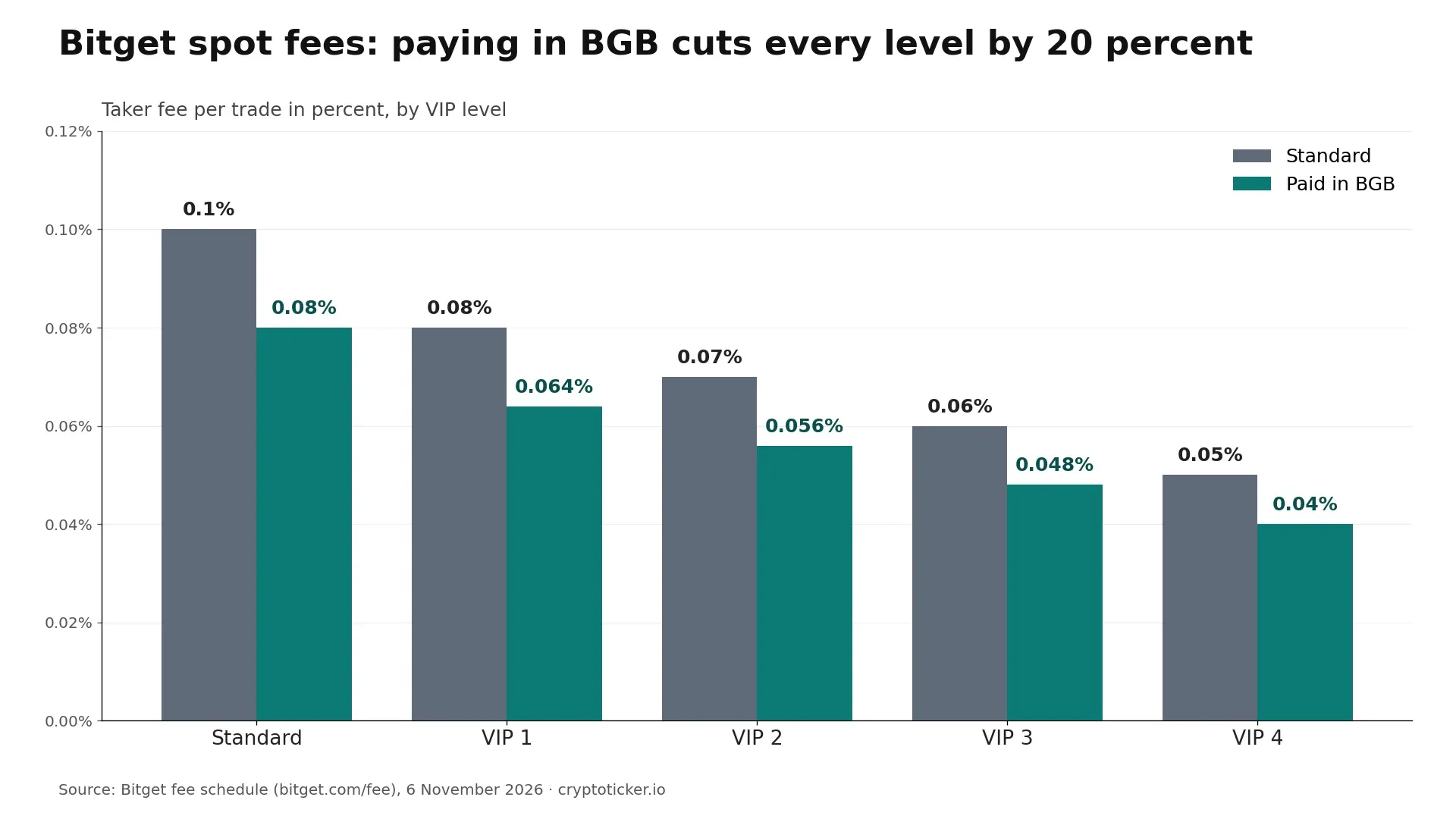
Spot trading fees apply when you buy or sell coins directly in spot trading, for example BTC against USDT. Bitget sets them by VIP level, and every level has a second column for payment in BGB.
| VIP level | 30-day spot volume | Maker / taker | With BGB |
|---|---|---|---|
| Standard | any | 0.1% / 0.1% | 0.08% / 0.08% |
| VIP 1 | from 500,000 USDT | 0.08% / 0.08% | 0.064% / 0.064% |
| VIP 2 | from 2,000,000 USDT | 0.065% / 0.07% | 0.052% / 0.056% |
| VIP 3 | from 8,000,000 USDT | 0.05% / 0.06% | 0.04% / 0.048% |
| VIP 4 | from 30,000,000 USDT | 0.04% / 0.05% | 0.032% / 0.04% |
Instead of the trading volume, a balance or your BGB holdings can qualify you for a VIP status: Bitget lists daily balance, 30-day asset balance and 30-day BGB balance as alternatives. VIP 1 starts, for example, at a 30,000 USDT balance or 12,533 BGB.
Bitget assigns the highest level you qualify for across spot volume, futures volume and the balance criteria, and it updates VIP levels every day at 9:00 AM (UTC+8). Sub-accounts inherit the fee rates of the main account.
Bitget futures fees: maker and taker fees by VIP level
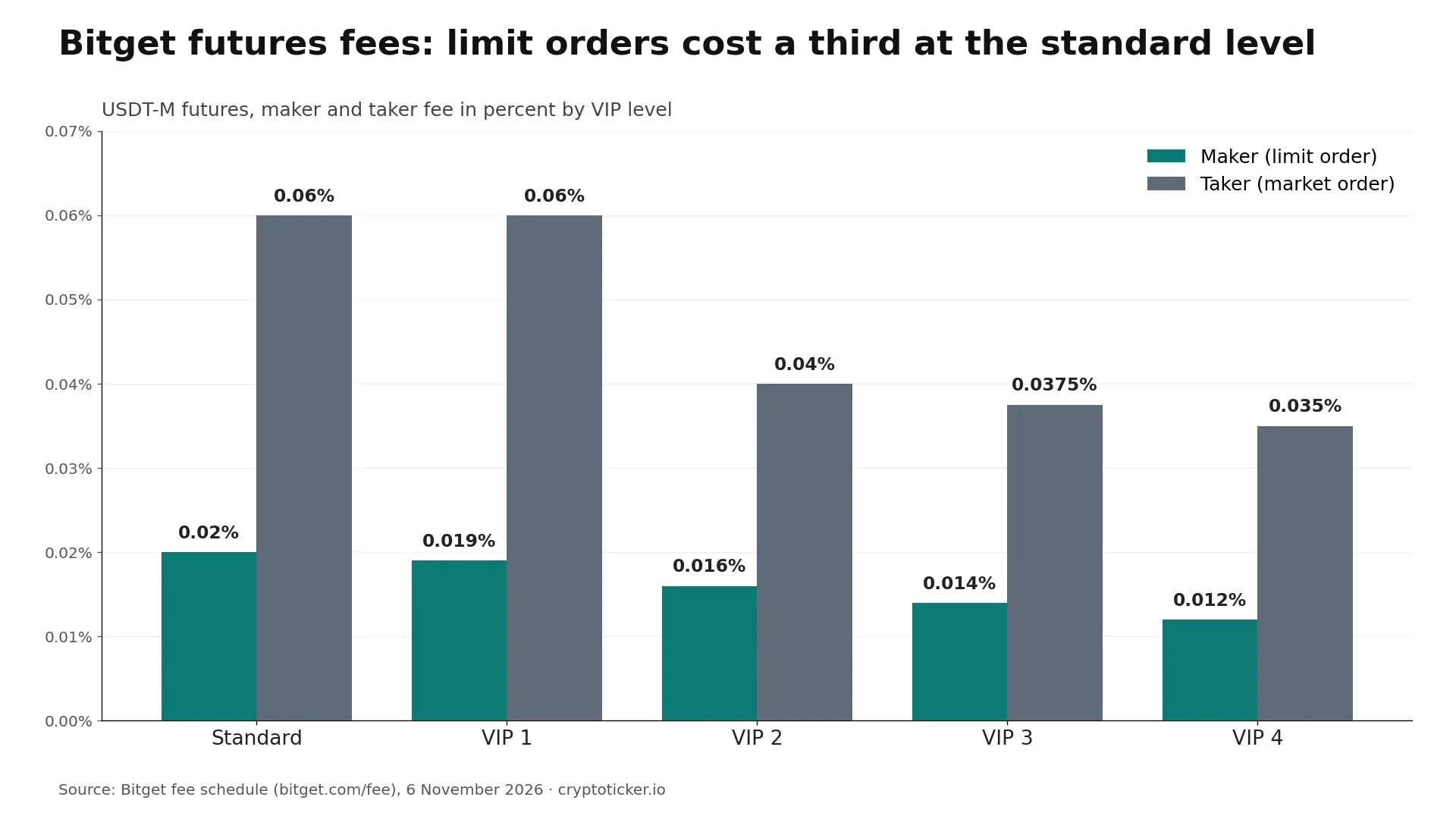
For USDT-M, Coin-M and USDC-M futures, Bitget charges the same rates. The taker fee is three times the maker fee at the standard level, so limit orders that wait in the order book are clearly cheaper than market orders.
| VIP level | 30-day futures volume | Maker / taker |
|---|---|---|
| Standard | any | 0.02% / 0.06% |
| VIP 1 | from 5,000,000 USDT | 0.019% / 0.06% |
| VIP 2 | from 10,000,000 USDT | 0.016% / 0.04% |
| VIP 3 | from 20,000,000 USDT | 0.014% / 0.0375% |
| VIP 4 | from 50,000,000 USDT | 0.012% / 0.035% |
On top of trading fees, futures positions pay or receive a funding fee every few hours, depending on the market. Leverage multiplies gains and losses alike. In Australia, ASIC has warned investors that Bitget’s crypto futures are not licensed there; Australians stick to spot.
 Crypto exchanges compared
How BGB lowers your Bitget fees
BGB is Bitget’s exchange token. If you pay spot fees in BGB, Bitget applies a 20 percent discount at every VIP level. The fee schedule shows the discount for spot only; the futures table has no BGB column.
The discount is a fixed percentage, so it pays off most for frequent traders. Keep in mind that BGB itself moves in price: the saving is measured in percent of the trade, the BGB you hold for it can gain or lose value.
What a Bitget trade really costs: three examples
The table uses the standard level and taker orders, the most common case for a new account.
| Example | Fee rate | Fee per trade | Per year |
|---|---|---|---|
| Spot purchase of 1,000 USDT, once a month | 0.1% | 1.00 USDT | 12.00 USDT |
| The same with BGB | 0.08% | 0.80 USDT | 9.60 USDT |
| Ten spot trades of 1,000 USDT a month, with BGB | 0.08% | 0.80 USDT | 96.00 USDT |
BGB saves the monthly buyer 2.40 USDT a year; the active trader in row three saves 24 USDT a year against the standard rate. For a long-term buyer, the spread and the network fee of a withdrawal often matter more than the trading fee itself.
What a Bitget futures trade costs: open and close
On futures you pay the fee twice, when you open and when you close the position, and it is charged on the position value, not on your margin. Leverage therefore does not change the fee rate, but it makes the position and with it the fee larger than your own stake.
| Position value 10,000 USDT, standard level | Open | Close | Round trip |
|---|---|---|---|
| Market orders (taker 0.06%) | 6 USDT | 6 USDT | 12 USDT |
| Limit orders (maker 0.02%) | 2 USDT | 2 USDT | 4 USDT |
Bitget funding fees: how they are calculated
Perpetual futures carry a funding fee on top of the trading fee, and its size follows the funding rate. According to Bitget’s funding rate guide, it is settled every eight hours, at 8:00, 16:00 and 0:00 (UTC+8), and for some contracts every two or four hours. You only pay or receive it if you hold a position at the settlement time.
- Formula: funding fee = position value × funding rate.
- Positive rate: long positions pay short position holders. Negative rate: shorts pay longs.
- Who receives it: the other side of the market, not Bitget; the exchange only settles the transfer.
Example: a long position worth 10,000 USDT at a funding rate of 0.01 percent pays 1 USDT per settlement, so 3 USDT a day at three settlements. In a hot market the funding rate can be many times higher, so check it on the contract page before you hold a position overnight.
Bitget fees for tokenized stocks
Bitget also lists tokenized US stocks. Their spot fee is half the crypto rate: 0.05 percent maker and taker at the standard level, 0.04 percent with BGB, according to the same fee schedule. Stock perpetuals, futures on share prices, follow the regular futures table with 0.02 percent maker and 0.06 percent taker.
| Product | Maker / taker | With BGB |
|---|---|---|
| Crypto spot | 0.1% / 0.1% | 0.08% / 0.08% |
| Tokenized stocks, spot | 0.05% / 0.05% | 0.04% / 0.04% |
| Crypto and stock futures | 0.02% / 0.06% | – |
Which shares are available and how the tokens work differs by country, so check the stock list in your account before you plan a purchase.
Bitget fees compared with Bybit and OKX
At the entry level, Bitget and Bybit charge the same on spot. On futures, Bybit’s taker fee is slightly lower. OKX’s fees depend on the region: its Australian site lists far higher spot rates for regular users, so Australians pay seven times Bitget’s standard rate there.
| Exchange | Spot maker / taker | Futures maker / taker | Source, 6 November 2026 |
|---|---|---|---|
| Bitget | 0.1% / 0.1% (0.08% with BGB) | 0.02% / 0.06% | Bitget fee schedule |
| Bybit | 0.1% / 0.1% | 0.02% / 0.055% | Bybit fee structure |
| OKX Australia | 0.70% / 0.70% | – | OKX Australia fees |
How the exchanges compare beyond fees, from coins to security, is in our Bitget vs OKX comparison and the crypto exchange comparison.
Regulated crypto exchanges comparedBitget withdrawal fees and deposit fees
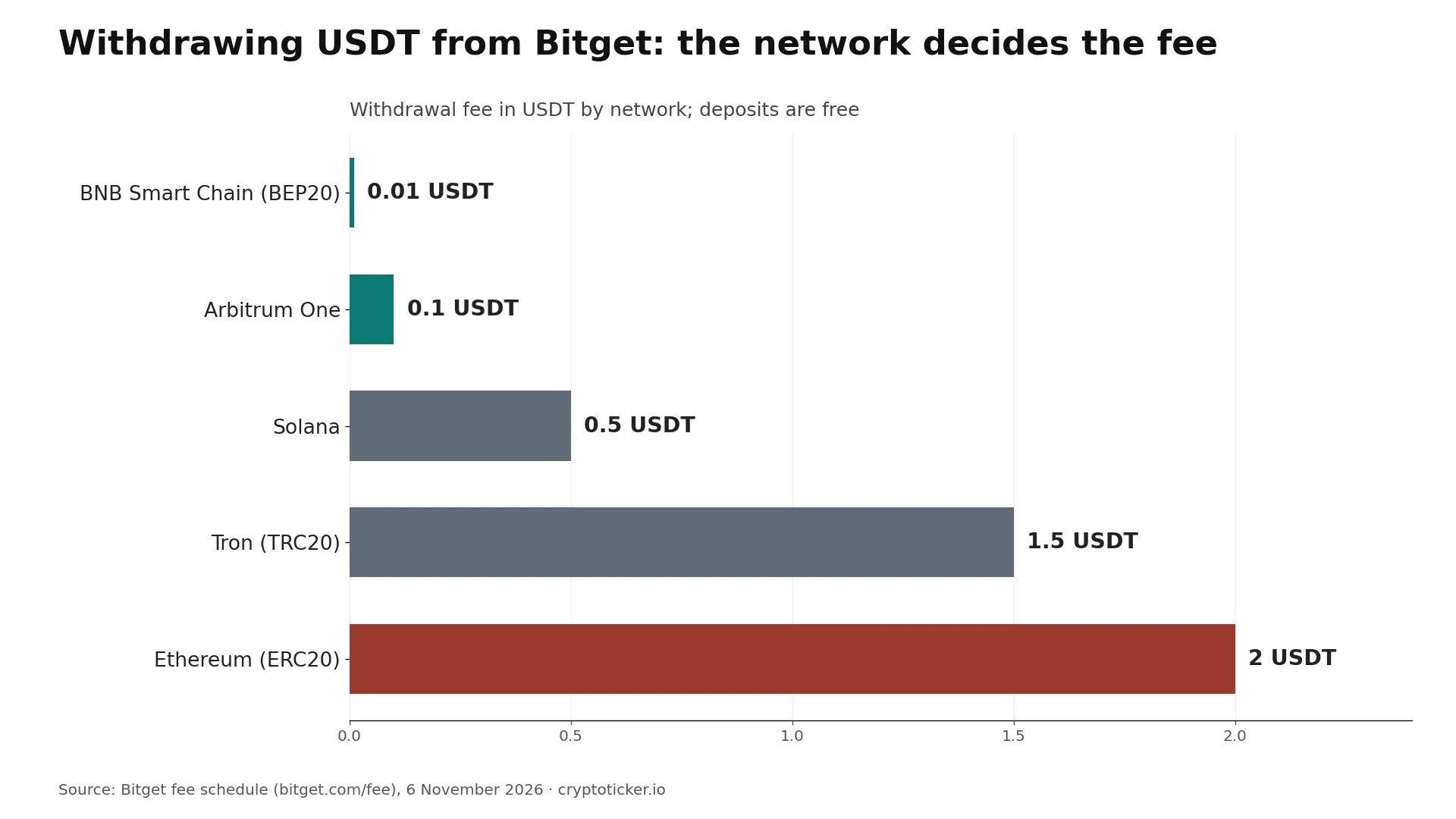
Crypto deposits on Bitget are free: the fee schedule shows a deposit fee of 0 for every coin listed. Withdrawal fees depend on the coin and the network you choose, and the cheap networks cost a fraction of the expensive ones.
| Coin and network | Withdrawal fee |
|---|---|
| USDT on BNB Smart Chain (BEP20) | 0.01 USDT |
| USDT on Arbitrum One | 0.1 USDT |
| USDT on Solana | 0.5 USDT |
| USDT on Tron (TRC20) | 1.5 USDT |
| USDT on Ethereum (ERC20) | 2 USDT |
| BTC on the Bitcoin network | 0.00002 BTC |
| ETH on Ethereum | 0.00004472 ETH |
The minimum USDT withdrawal is 5 USDT on every network (fee schedule, 6 November 2026). Choose the network that the receiving wallet or exchange supports; a transfer on the wrong network can be lost. If you buy crypto with a card or another payment method through “Buy crypto”, the payment provider may add its own fee, which the order screen shows before you confirm.
Bitget copy trading fees and trading bots
In copy trading you pay the normal trading fees of every copied trade, funding fees on copied futures, and a profit-sharing fee to the lead trader. Bitget’s product fees FAQ puts it at typically 10 to 20 percent of realized profit, set by each lead trader and shown on the trader’s profile. Self-configured bots such as Spot Grid and Futures Grid have no subscription fee; only the trading fee of each order applies. How to choose a lead trader is in our Bitget copy trading guide.
Does Bitget have hidden fees?
Bitget publishes its fee schedule openly, and the costs that are easy to overlook are not Bitget fees in the narrow sense:
- Spread: the gap between buy and sell price, small on BTC/USDT, larger on thin markets.
- Network fees on withdrawals, see the table above.
- Funding fees on perpetual futures held over a settlement time.
- Third-party fees when you pay with a card or another payment method.
Adding these to the trading fee gives the effective trading costs of a trade. For a long-term buyer, the spread and the withdrawal network often weigh more than the 0.1 percent itself.
Bitget fee vouchers from the welcome pack
New accounts can lower their costs further with vouchers. Bitget’s welcome pack, advertised at up to 6,200 USDT on 6 November 2026, consists of vouchers in the Coupons Center, among them fee rebate vouchers that offset trading fees. According to Bitget’s voucher guide, they have an expiry date, are used before your own balance and cannot be withdrawn. Bitget describes fee rebate vouchers as a tool for futures traders, so check the product before you count on them.
The vouchers come with the sign-up, so the referral code matters at that moment: our page on the Bitget referral code explains how to enter 94qs and which tasks unlock the rewards.
How to check your own Bitget fee rate
The public table shows the standard rates. Your own rate, including a VIP level or a campaign discount, appears in the “Fee overview” at the top of the fee page once you are logged in.
- Spot traders: pay fees in BGB if you already hold BGB.
- Futures traders: use limit orders where you can; at the standard level the maker fee is a third of the taker fee.
- Everyone: check the network fee before a withdrawal, on small amounts it can exceed the trading fee.
Is Bitget cheap? Our assessment
With 0.1 percent on spot and 0.02 and 0.06 percent on futures, Bitget sits at the level of the large international exchanges, and BGB brings spot fees below that. For Australian customers, Bitget is clearly cheaper on spot than OKX’s local offer. If you live in the EU, choose an exchange with a MiCA licence; licensed options with their fees are in our comparison of regulated crypto exchanges.
Fees and VIP thresholds change with Bitget’s promotions, so the table here shows the state of 6 November 2026. Crypto prices can move sharply, and leveraged products can wipe out a stake within hours. This article is not investment advice.
FAQ: Bitget fees
Transparency note: This article was produced with the assistance of artificial intelligence and reviewed by our editorial team before publication. All figures and claims were checked against the primary sources linked in the text. The feature image was generated with AI.
Related articles
- OKX Fees: Trading, Futures and Withdrawal Fees by Region
- Crypto Exchange: How to use Bitget Exchange?
- Binance fees: 0.1 percent to trade, and one drawback compared with MiCA-licensed exchanges
- BGB Price Prediction: Bitget Token Price UP by more than 25%
- BGB News: Bitget Token Reaches New ATH Amid Market Momentum
Which topics should we dive deeper into?
Select what genuinely interests you. Your picks feed directly into our editorial planning.
Crypto news that's actually worth your time.
Weekly. 60 seconds. Carefully curated by our editors: no hype, no promo flood, no spam.

December 16, 2024 11:00 PM
Bitget Token (BGB) Surges to New All-Time High with $4 Price Target in Sight
Bitget Token (BGB) achieves a new all-time high (ATH) of $3.96, marking a 178.96% increase in a month. With bullish sentiment, market expansion, and key partnerships, BGB is set to target the $4 milestone.
June 17, 2024 10:59 AM
TOP 3 DEX for June 2024
What are the best DEXs to use in 2024? Here are the top 3 for June 2024!

December 6, 2025 11:00 PM

Bitget Stock Futures Break Through $10 Billion as Global Traders Rush Into Tokenized Equities
Bitget, the world’s largest Universal Exchange (UEX), today announced that its US stock futures have surpassed $10 billion in cumulative trading volume.

October 1, 2026 7:15 PM
Bitpanda fees from 0.99 to 2.49 percent: what is behind it
Bitpanda assigns every coin to one of four price tiers, from 0.99 percent for Bitcoin to 2.49 percent for small caps. What 100 euros costs in and out, why the spread is missing from the mandatory document, and where 0.25 percent is enough under the same roof.

February 4, 2019 11:00 PM

Kraken Acquires Crypto Facilities
Cryptocurrency exchange services provider Kraken has formally acquired crypto derivatives trading platform and index provider, Crypto Facilities, in a nine-figure deal, reported Fortune. After this acquisition, some Kraken users can obtain both spot and futures dealing. The firm also has […]

September 20, 2026 7:20 PM

Coinbase Fees: What a Purchase Really Costs, and Where the Spread Is Hidden
The fee Coinbase shows you before a purchase is not the whole price. Alongside it sits the spread, built into the rate, and limit orders add another percent on top. We read the current terms at the source and show the four places where the exchange earns.
February 18, 2024 11:00 PM
Bitget Token: How High Will the BGB Price Go?
This article is all about the BGB price analysis and What is BGB token. Let's take a look at this in more detail.
April 8, 2026 11:46 PM
BXB Market Review 2026: Platform, Pricing, and What Traders Should Know
Considering using BXB Market? Here's a detailed look at their platform, account tiers, spread discounts, and trading conditions as of 2026.
October 10, 2026 7:40 PM

Decentralised Crypto Exchanges (DEX): Network Fee Against Pool Fee, and Why Custody Decides
On Ethereum a swap through a decentralised exchange currently costs three to five cents in network fees, while the fee for the liquidity pool runs between 0.01 and 1.00 percent depending on the pair. That leaves both routes level on cost, and what comes afterwards decides: custody, supervision and records.
August 22, 2026 4:30 AM
Setting Crypto Order Types Correctly: Market, Limit and Stop-Loss Compared
A market order buys immediately, a limit order only at your price, and a stop-loss triggers only at a set level. This guide shows which order type fits which situation, and where spread, slippage and the fee model shift your entry price.
September 29, 2024 8:01 PM
Cheapest Way to Buy Bitcoin Today
With Bitcoin trading above $60K, the opportunity to invest is now. Why do experts predict it could still reach $100K and how can you easily buy Bitcoin?
May 22, 2024 7:27 PM
SEC 'APPROVES' Ethereum Spot ETF: Will It Happen TOMORROW?
May 23rd is the anticipated day for SEC to announce its decision concerning ETH spot ETF. In less than 24 hours, an approval, rejection, or postponement will be among the top headlines, but what do analysts foresee?
April 1, 2024 11:00 PM

Bitget Token: How High Can the BGB Price Go?
In this article, we'll delve deeper into the BGB price prediction and explore what exactly the BGB token is all about.

March 22, 2023 1:44 AM
The Top Crypto Exchanges to Consider in 2023
Looking for the best crypto exchanges to use in 2023? Read our article for a list of the top exchanges, including Binance, Coinbase, and Bybit. Learn about their features, fees, security measures, and more.
June 4, 2025 11:00 PM
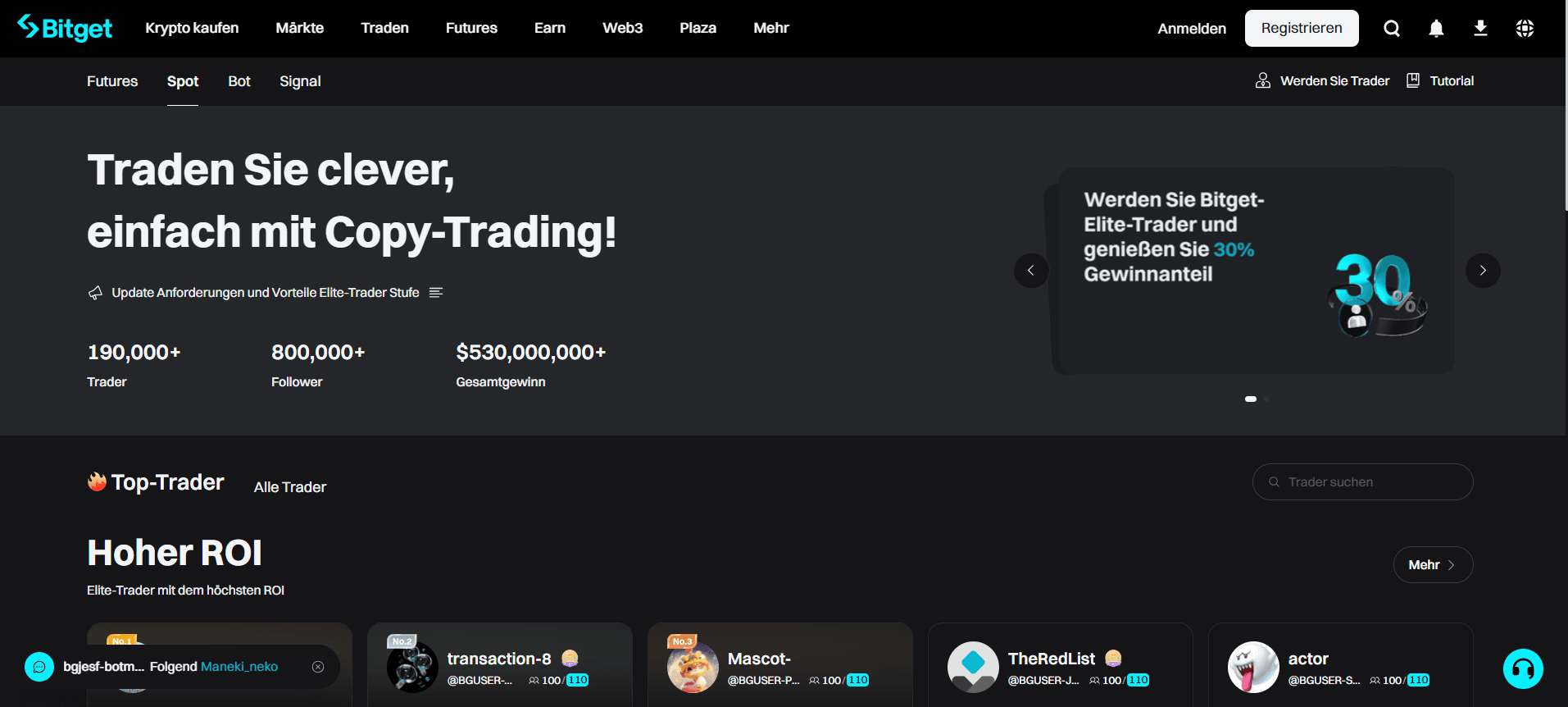
Bitget Copy Trading: How to Follow Successful Crypto Traders Step-by-Step
Bitget copy trading automatically mirrors successful traders' strategies. Here's a guide showing you step-by-step the setup, benefits, risks, and tips for choosing the right traders to copy.
May 26, 2025 11:00 PM
Inside Bitget: How COO Vugar Usi Zade Is Shaping the Future of Crypto Trading
From Bitget Seed and AI-powered tools to regulatory strategy and mass adoption, COO Vugar Usi Zade reveals how Bitget is building the next era of crypto trading.
December 22, 2025 11:00 PM

Bitget Launches Gold, Forex and Commodities Markets for Crypto Users
Bitget announced the launch of a new cross-market feature that gives crypto users direct access to global forex, metals, commodities, indices, and stock CFDs using USDT as margin.
August 18, 2026 4:35 PM

Crypto Cards in Everyday Use: What Bitpanda, Crypto.com and Nexo Cost
At the cash machine, on holiday and at the weekend you find out whether a crypto card pays off. Four everyday cases with the terms of Bitpanda, Crypto.com and Nexo, as of 22 October 2026.
January 10, 2025 11:00 PM
Bitget Token Price Surge amid Market Downturn: New 2025 BGB ATH?
In this week's turbulent crypto market taken by downward pressure, BGB made it the top gainer with an impressive price surge. Will it end the week with a new ATH in 2025?
November 7, 2026 6:59 PM
Bitget Referral Code 94qs: Sign-Up Bonus and How to Use It
The Bitget referral code is 94qs. Where to enter it, how to unlock the welcome rewards of up to 6,200 USDT, which countries it works in and how to pay less in trading fees.
June 25, 2024 11:00 PM
How to Buy Bitcoin on Bitget: A Step-by-Step Guide
Want to buy Bitcoin and still confused about which platform to use? Look no further! Check Bitget, and this full guide, step by step...
February 24, 2025 12:51 PM
Top 5 Reasons Why Backpack Crypto Exchange is Crushing It
Whether you're a beginner looking for a seamless entry into trading or an advanced user seeking innovative financial products, Backpack has something for everyone.
January 6, 2025 11:00 PM

Bitget's BGB Token: 1364% growth in 2024, promising 2025 ahead
BGB price prediction: Rising from $0.5794 on January 1st to a peak of $8.4851 on December 27th, BGB achieved an extraordinary 1364% increase.
More from CryptoTicker