
30 percent follow finfluencers on crypto: “Investing in memecoins is in fact comparable to placing a bet in a game of chance”
BaFin polled 1,000 German crypto investors and measured for the first time how strongly finfluencers shape their purchases. The figures show what gives a paid tip away and at which point it becomes most expensive.





Which topics should we dive deeper into?
Select what genuinely interests you. Your picks feed directly into our editorial planning.
Crypto news that's actually worth your time.
Weekly. 60 seconds. Carefully curated by our editors: no hype, no promo flood, no spam.
A finfluencer is someone who talks about investing on social media and recommends individual products while doing so. Whether a crypto tip of that kind has been paid for shows up in three places: in the disclosure as advertising or a paid promotion, in affiliate links and discount codes that lead to one particular exchange, and in the pattern of the pitch, which works on urgency and peer pressure. How often that lands in Germany is something the financial regulator BaFin has had in hard numbers since October 1.
Of the 1,000 crypto investors assessed, roughly half pay attention to recommendations from finfluencers. Thirty percent have acted on them when investing. And around 40 percent were not aware that finfluencers are often paid for their recommendations. That is the core of the finding: the recommendation itself is not the problem, the invisible consideration behind it is.
The BaFin survey in numbers: 4,340 respondents, 1,000 crypto investors assessed
A market research institute surveyed 4,340 people aged 18 to 59 on behalf of BaFin. The fieldwork ran online in late March and early April 2026. The answers assessed were those of the 1,000 respondents who held crypto-assets at the time or had held them in the years before. The results appear in the regulator's specialist article, “Soziale Medien treiben Kryptoinvestments”.
What gets held is mostly the obvious. Seventy-nine percent of this group had bought Bitcoin at some point, 39 percent Ether. The assets were used predominantly as an investment. On motives, 39 percent said they had wanted to “try something new”, while 30 percent each cited the prospect of high returns and the wish for a small allocation in their portfolio.
That mix matters for understanding the rest. Someone who gets in out of curiosity, with no firm expectation of the product, tends to choose on the basis of whatever crosses their path. That is exactly where recommendations do their work.
How to spot a paid crypto tip: disclosure, affiliate link, discount code
A paid recommendation online usually takes one of two forms. Either the sender receives a fixed fee for a post, in which case that post has to be labelled as advertising or a paid promotion under German media law. Or they receive a share of the revenue when you open an account through their link and trade. This second form is called an affiliate or partner link: a link with an identifier attached, by which the exchange recognises who sent you.
Four features can be checked without any prior knowledge. First, a note such as “advertising”, “ad” or “paid partnership”, often small at the start or right at the end of a post. Second, a link with an identifier after the question mark, frequently carrying abbreviations such as “ref” or “partner”. Third, a discount or voucher code that runs under the sender's name. Fourth, a bonus promise tied to a minimum deposit.
None of these features makes a recommendation wrong by itself. Advertising is allowed to advertise, but it does tell you that the sender has a commercial interest of their own in your decision, and that belongs in your assessment. If you are looking for a trading venue anyway, the comparison of regulated crypto exchanges is the more sober route there than a code from a video.
35 percent bought because the finfluencer called the right moment
BaFin also asked what made the recommendation convincing. Among those who acted on a finfluencer recommendation, 35 percent invested because the claim was that now was the right moment. That is the most frequent reason in the entire survey.
The sentence “now is the right moment” has a property that makes it so usable for advertising: it cannot be verified at the moment it is made. Whether an entry point was good only becomes visible later, and whoever calls it carries no risk if they are wrong. A verifiable statement would look different and would name a quantity you can recalculate, such as a trading volume, a flow of funds or a date in the protocol.
From that follows a simple counter-move: take the claim and find the number for it yourself. Trading volume, inflows and outflows at exchanges or the distribution of holdings are available in freely accessible data tools; which of them does what is set out in the comparison of analytics platforms. If you find no number for the claim, you already have your answer.

FOMO as a sales argument: 29 percent followed the reference to the majority
The second most frequent reason was the reference to everyone else. Twenty-nine percent of this group bought because, according to the finfluencer, many others were doing so at the time. BaFin uses the English term for this in its assessment: fear of missing out, or FOMO for short.
FOMO says nothing about the crypto-asset itself. The claim describes the behaviour of other people; it can be accurate and still leave open whether the price is worth the risk. On top of that, the claim that a lot of people are buying right now is hard to verify for small tokens, because a few large addresses can generate a trading volume that looks like broad demand.
Both findings together describe the same mechanism from two directions: urgency and crowd. Anyone who hears either one in a recommendation has a reason to let a day pass before acting.
 Find a crypto exchange with an EU licence
Memecoins and gambling: what BaFin's consumer protection staff say word for word
Nineteen percent of the crypto investors surveyed have bought memecoins at some point. Among the motives they named were “fun” and “having a punt”. A memecoin is a token with no use of its own and no promise of yield, whose price results purely from demand.
The regulator's assessment is blunt. “Investing in memecoins is in fact comparable to placing a bet in a game of chance,” says BaFin consumer protection expert Dr Markus Nielsen; memecoins are therefore particularly risky. Consumer protection officer Christian Bock places the whole market in context: “Consumer interest in crypto-assets is rising,” he says, “yet most of these assets are highly speculative.” Price movements, he adds, are tied neither to a particular currency nor to a tangible asset, and with memecoins there is also no cap on supply.
For a German supervisory authority to compare an asset class with gambling is notable, and it links the finding explicitly to the subject of this article: with memecoins in particular, the danger is especially great that finfluencers move the price by talking an asset up excessively or talking it down. The leverage here is greater than with large assets, because little capital is enough to shift the price.
Concentration risk in the portfolio: 27 percent hold more than a fifth of their wealth in crypto-assets
One figure from the survey can be applied directly to your own portfolio. Twenty-seven percent of respondents said they had invested more than 20 percent of their wealth in digital assets. For 5 percent it was more than half.
The technical term for this is concentration risk: a single building block in a portfolio is so large that its performance determines the overall result. In an asset class that swings by double digits within a few days, that share decides whether a setback is merely annoying or existential. The regulator names no upper limit for it, and there is no official one either. The figure still works as a yardstick: if your own share sits well above what you could stomach losing, that is a finding in its own right, independent of any recommendation.
The connection to the rest of the survey is plain. Anyone who settles their position size in the moment of enthusiasm settles it according to that enthusiasm. Anyone who settles it beforehand already has an answer ready for the next tip.
Five features to check before acting on any crypto tip from social media
The findings of the survey boil down to a short routine that runs before a purchase and takes a few minutes.
- Look for the disclosure. Does it say “advertising”, “ad” or “paid partnership” anywhere? Look in the description under the video and in the first comment as well, because that is where it tends to be parked.
- Take the link apart. Does the recommendation run through an identifier or a code? Then money flows to the sender when you open your account.
- Look into the provider. Does the platform named hold a licence for this business in Germany? BaFin maintains a public company database for exactly this, and it publishes warnings about unauthorised providers on an ongoing basis.
- Find a second source. Does the central claim also appear somewhere that gains nothing from your buying? If nothing turns up, it remains a single opinion.
- Set the position size beforehand. Decide the amount before you finish listening to the recommendation, and stick to it. This is the only point on the list that nobody but you can influence.
This routine is no substitute for your own view of a crypto-asset; it only separates the question of whether something is a good investment from the question of who earns money when you buy it, and the second question was not on the radar at all for 40 percent of respondents.

Holding period and tax: what an impulse purchase after a finfluencer tip triggers with the tax office
One point does not come up in the survey and yet belongs to every spontaneous purchase. In Germany, transactions in crypto-assets held as private assets count as private disposal transactions under Section 23(1) sentence 1 number 2 of the Income Tax Act (Einkommensteuergesetz). If you sell at a profit within one year of buying, that profit is taxable; after a holding period of one year it is not. A threshold of 1,000 euros applies to the total of all private disposal transactions in a year. Threshold means that once it is exceeded, the entire gain is taxable, and not only the part above it.
Two things follow from this for a purchase made after a tip. First, the one-year period for this specific position begins on this specific day, regardless of how long you have already held the same cryptocurrency. Second, a quick resale, which the same dynamic of urgency and peer pressure frequently leads to, is the least favourable case for tax purposes. Someone who buys and sells three weeks later in disappointment has a taxable event if there is a gain and documentation work if there is a loss.
In practice that means recording the purchase date, quantity and price, and doing so on the day of the purchase. It costs a minute and saves back-calculating across several exchanges if there is ever any doubt. Individual tax questions belong in the hands of a tax adviser; this section is no substitute for advice.
 Analytics platforms: check the numbers yourself
MiCA, BaFin and advertising: which rules apply to finfluencers today and which ones ESMA wants
Since the European crypto regulation MiCA came into force, providers of crypto services in the EU need a licence, and their marketing communications have to be identifiable as such, fair and not misleading. These duties are addressed to the providers. An independent sender on social media who is not a service provider does not automatically fall under them, and that is exactly where the gap sits that the BaFin figures describe. Which obligations the regulation sets out in detail is covered in our overview of the MiCA licensing requirements for crypto companies.
The European securities regulator ESMA wants to change that. In its opinion on the review of MiCA, which reached the EU Commission at the end of September, it explicitly calls for “stricter rules for the marketing of crypto-assets, particularly when they are promoted by influencers and third parties”. Which six changes the authority proposes in total we have broken down in our article on the ESMA opinion on MiCA.
Between a demand and applicable law lies a legislative procedure that runs for months. Until then the labelling requirement from media law remains the most important lever, and its enforcement depends on someone noticing the missing disclosure. That is what makes the survey finding so uncomfortable: a protection that rests on recognition by the audience comes to nothing for 40 percent of that audience.
Two authorities have thus marked the same spot within two days, one with a demand from Paris, the other with figures from Germany.
Finfluencer tips: the key points for your decision
The survey describes the normal case: around half of the crypto investors surveyed pay attention to recommendations from social media, and two in five do not know the business model behind them. Three steps turn that into something manageable.
- Separate the recommendation from the trading venue. Decide first whether a crypto-asset convinces you, and choose the platform separately afterwards. A look at the comparison of regulated crypto exchanges shows which providers hold a licence in the EU.
- Get the number behind the claim. Every statement about timing or demand can be cross-checked. Which analytics platforms disclose volume, inflows and the distribution of holdings is set out in the comparison.
- Document on the day of purchase. Record the date, quantity and price so the holding period can be proven later. Tools for this are in the comparison of crypto tax software and portfolio trackers.
(As of October 7, 2026. This article is not investment advice. Prices and fee structures change; check the terms with the provider before you buy.)
Frequently asked questions about finfluencers and crypto
Transparency note: This article was produced with the assistance of artificial intelligence and reviewed by our editorial team before publication. All figures and claims were checked against the primary sources linked in the text. The feature image was generated with AI.
Related articles
- BaFin Crypto Knowledge Survey: Four Assumptions Owners Believe Are True
- Five of nine BaFin warnings cite the Crypto Markets Supervision Act: "This is a case of identity misuse"
- BaFin Warning Over Identity Misuse: When a Crypto Platform Borrows a Real German Company's Name
- BaFin Warnings 2026: 24 Crypto Platform Series With 639 Domains, and How to Check Your Provider
- BaFin warns over nova-c-solutions.com: What is behind a genuine registration number
Which topics should we dive deeper into?
Select what genuinely interests you. Your picks feed directly into our editorial planning.
Crypto news that's actually worth your time.
Weekly. 60 seconds. Carefully curated by our editors: no hype, no promo flood, no spam.

August 11, 2026 9:18 AM

Your Crypto Exchange Is Telling You to Withdraw: How to Spot Phishing After the MiCA Deadline
Unauthorised crypto providers now have to tell their EU customers to withdraw, which leaves fraudsters an easy run with faked requests. Here is how to check in two minutes whether the message is genuine.
October 1, 2026 7:32 AM

Starting a crypto company in Germany: legal form, BaFin licence and capital
Setting up a crypto company in Germany: which business models need BaFin authorisation under MiCA, GmbH or UG, how much capital is required and where public support is available.
August 21, 2026 10:27 AM

Complaining About a Crypto Exchange: the Deadlines Article 71 MiCAR Sets and Why BaFin Will Not Decide Your Case
Authorised crypto providers have to run a formal complaints procedure, and Delegated Regulation (EU) 2025/294 sets a hard limit of two months for it. Our own analysis of the ESMA list shows at the same time that no complaints link is on file for Germany to this day.
October 16, 2026 4:15 AM

241 scam sites taken offline, the recovery scam lives on: what to check now
The Brooklyn District Attorney and the FBI shut down a fraud network of 241 websites and 112 servers on 14 October 2026; the second stage of the scheme was a purported recovery service. Five days earlier, German regulator BaFin had warned about exactly this pattern at a purported bank.
October 13, 2026 10:37 PM

ESMA will supervise only 10 to 15 of 360 crypto firms: your exchange stays with its home regulator
On October 9, 2026 EU finance ministers agreed to place only the largest crypto service providers under direct ESMA supervision. For the vast majority of the roughly 360 authorised firms, the national authority stays in charge, in Germany BaFin.
October 6, 2026 7:35 PM

CFTC Opens a 60-Day Consultation on Leveraged Crypto Trading: “The American People Deserve Clarity, Reliability and Consumer Protection”
The US futures regulator CFTC published a 109-page paper on leveraged crypto trading on October 5, 2026. It is a consultation with a 60-day comment period, not a finished rule, and for investors in Germany MiCA and the BaFin general administrative act remain decisive.
September 22, 2026 1:15 AM

Memecoin Rally: Why Memecoins Are Rising and What to Check Before You Buy
The memecoin sector stands 9.01 percent higher, the overall market only 2.90 percent. The arithmetic behind it shows that two tokens carry three quarters of the move and that the sector has no occasion of its own.

September 19, 2026 7:17 AM

Chainlink Jumps Above $12: What LINK Holders Should Check Now
Chainlink trades at $12.34, 7.4 percent higher than yesterday. What part of the move is the broad market rally, what Chainlink itself contributes, and the three things you should check as a LINK holder.
August 19, 2026 10:26 PM

EU warning list for crypto providers: 167 entries, 165 of them from Italy, none from BaFin
ESMA maintains a Europe-wide register of non-compliant crypto providers. We counted it on August 16, 2026 and called up every web address stored in it. Three of 30 supervisory authorities supply any entries at all, and BaFin is not among them.
August 19, 2026 10:37 AM

Who Regulates Crypto in the US? CFTC and SEC Compared
On 20 August 2026 the new innovation advisory committee of the US derivatives regulator CFTC meets for the first time, staffed with the chief executives of Coinbase, Kraken, Gemini and Ripple. What separates the two US agencies, and why MiCA and BaFin still count for your portfolio.
September 30, 2026 10:40 PM

ESMA Calls for Advertising Rules on Crypto Influencers: Six Changes Now Sitting With the EU Commission
The EU securities watchdog filed its response to the MiCA review on the final day of the consultation. Among the demands are disclosure on staking, a licensable DeFi gateway and the power to freeze crypto assets.
September 1, 2026 4:12 AM

USDT cashback and 7 percent on stablecoins: what the MiCA interest ban means for you
A new payment card advertises up to 10 percent cashback in USDT and up to 7 percent a year on the balance. Article 50 MiCAR explains why a provider licensed in the EU is not allowed to pay you exactly that.

October 12, 2018 1:52 AM

Faunus Affiliate Network Hosts The Second Crypto Affiliate & Marketing Conference
Following the success of CRAC 2017, the event is to gather ad networks, crypto trading brokers, gambling operators, ICO founders, exchanges, cryptocurrency developers and affiliates in Prague once more. Prague, Czech Republic, 23rd-24th of April 2018 – Crypto Affiliate & […]
April 17, 2024 8:08 PM

Rise in Innovative Marketing: Crypto Sponsorships in Sports
Crypto sponsorships are transforming sports marketing, revolutionizing fan engagement, and reshaping traditional strategies in the sporting industry.
September 19, 2026 4:11 PM

MiCA Consultation Closes September 30: What to Check and Submit Before Then
The European Commission is reviewing the MiCA crypto regulation and will accept submissions until September 30, 2026 at 23:59 CEST. Staking, DeFi, lending, stablecoins and custody are all under examination, and you can take part without a lawyer.
August 6, 2026 3:05 PM
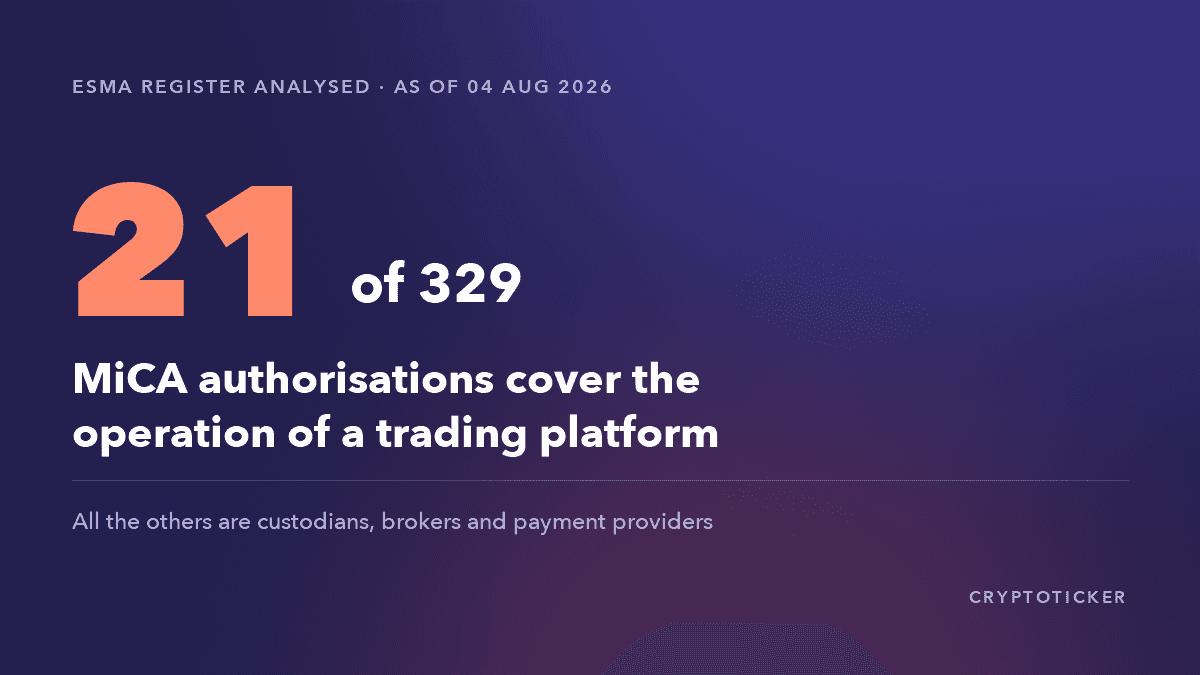
MiCA Register 2026: Only 21 of 329 Licences Are Real Exchanges
ESMA publishes the register of MiCA-authorised providers as an open file. We worked through all of it — and the result is not what the phrase “licensed crypto exchange” suggests.

June 30, 2026 11:20 PM

How to Switch from Binance to a MiCA Regulated Crypto Exchange
Binance is winding down EU services after missing the MiCA deadline. Here's why it's happening and how to move your funds to a regulated platform safely.
July 2, 2026 8:59 PM
Binance Is Out of the EU: How to Move to a MiCA-Regulated Exchange
Binance has left the EU market. Which exchanges hold a MiCA licence, how to verify an authorisation is real, and how to move your holdings across step by step.
September 12, 2026 7:13 AM

BaFin Warnings in September: How to Check in Three Minutes Whether a Crypto Provider Holds Authorisation
Twelve consumer notices in ten days, five of them on crypto-asset services and two with the entry point in WhatsApp or Telegram. We evaluated all twelve notices ourselves and show the check that takes you three minutes.
August 20, 2026 10:24 PM

MiCA Review: What the European Commission Could Change About the EU Crypto Rules
The European Commission has reopened MiCA for review after barely two years and is asking 86 questions covering the stablecoin interest ban, staking, lending and DeFi. Brussels is taking responses until September 30, 2026.
June 17, 2026 7:21 PM
Binance EU Access at Risk: What MiCA Could Mean for BNB and Crypto Users
Binance is facing one of its biggest regulatory tests in Europe as the MiCA deadline approaches. Could this put BNB and EU crypto users under pressure?
July 7, 2025 8:12 PM

BIG Crypto News: EU Approves 14 Stablecoin Issuers Under MiCA
Six months into the MiCA rollout, Europe’s crypto regulatory landscape is taking shape. From authorized stablecoin issuers to licensed crypto service providers, here’s the full July 2025 update.
October 21, 2026 2:13 PM

Crypto lending under MiCA: BTCS Strategy Advisor Wojciech Kaszycki on the EBA's plans
The EBA wants crypto lending and access to DeFi brought under MiCA. Wojciech Kaszycki, Strategy Advisor at BTCS S.A., explains in this interview which part of the market stays in the EU and where the rules reach their limit.
September 29, 2026 10:33 AM
ESMA puts reverse solicitation on its 2027 watch list: what investors need to know about exchanges without an EU licence
ESMA presented its work programme for 2027 on September 28, 2026 and made reverse solicitation a supervisory priority. What that means if your coins sit with a provider without EU authorisation, and which three steps make sense now.
July 10, 2026 10:30 AM
Binance Reveals Where Its EU Users Went After MiCA
Binance just revealed where most departing EU users moved their crypto after MiCA — and the answer is raising hard questions about the new rulebook.

More from CryptoTicker