
Starting a crypto company in Germany: legal form, BaFin licence and capital
Setting up a crypto company in Germany: which business models need BaFin authorisation under MiCA, GmbH or UG, how much capital is required and where public support is available.



Which topics should we dive deeper into?
Select what genuinely interests you. Your picks feed directly into our editorial planning.
Crypto news that's actually worth your time.
Weekly. 60 seconds. Carefully curated by our editors: no hype, no promo flood, no spam.
 Compare MiCA-regulated crypto exchanges
In brief: in Germany you will usually set up a crypto company as a GmbH or a UG. What decides the matter, though, is not the legal form but the business model: anyone who holds, exchanges or arranges crypto-assets for others has needed authorisation from BaFin since MiCA, plus minimum capital of 50,000 to 150,000 euros depending on the service. Anyone offering software, analytics or content generally gets by without a licence. This guide sets out the steps in the right order.
Step 1: establish whether your business model requires authorisation
Before you call a notary, one question belongs settled: are you providing crypto-asset services within the meaning of the EU regulation MiCA? Those include, among others, the custody of crypto-assets for clients, operating a trading platform, exchanging against the euro or other crypto-assets, the execution and reception of orders, and advice and portfolio management.
If that is the case, you need authorisation as a crypto-asset service provider, CASP for short. In Germany it is granted by BaFin on the basis of MiCA and the German Crypto Markets Supervision Act. The transition periods for existing providers have now expired in all EU member states. Whoever is authorised appears in ESMA's public register; what that looks like in practice is shown by the list of authorised providers, and even banks such as the Volksbanken are having their crypto custody approved.
No authorisation is generally needed by anyone who merely supplies software, such as a non-custodial wallet, an analytics tool, development services or a crypto news outlet. The line is fine in the individual case. When in doubt, an enquiry to BaFin or to a specialist law firm pays off before the first client money flows.
Step 2: choose the right legal form
For crypto start-ups, two legal forms almost always come into question, because they limit liability to the company's assets:
| GmbH | UG (limited liability) | |
|---|---|---|
| Minimum capital | 25,000 euros, of which at least 12,500 euros paid in at formation | from 1 euro, a quarter of profits must be retained |
| Standing with banks and partners | high | lower, often follow-up questions |
| Suitable for | business models requiring authorisation, investor rounds | software, media, a first test phase |
| Formation | by notarial deed, video conference possible | by notarial deed, video conference possible |
Anyone who needs BaFin authorisation starts in practice with a GmbH, because the minimum capital required by the supervisor lies above that of a UG in any case. How the formation runs step by step, from articles of association to the commercial register, is explained in the Gründerfreunde guide to forming a GmbH. For a smaller start there is also a guide there on how to form a UG. Anyone needing a ready-made company quickly can alternatively buy a shelf company.
Step 3: plan capital and the supervisor's requirements

MiCA tiers the minimum capital by type of service:
- 50,000 euros for services such as the reception and transmission of orders, advice, portfolio management or the placing of crypto-assets,
- 125,000 euros where crypto-assets are additionally held for clients or exchanged against money or other crypto-assets,
- 150,000 euros for operating a trading platform.
On top of that come requirements that often cost more than the capital itself: management that is both reliable and professionally qualified, a seat with genuine management in the EU, anti-money-laundering rules, a complaints procedure, IT security under the EU regulation DORA, and the segregated custody of client funds. Allow several months for the authorisation application.
Step 4: issue a token only with a white paper
Many crypto start-ups want a token of their own sooner or later. MiCA applies to that as well: anyone offering crypto-assets to the public has to draw up a white paper and submit it to the supervisor. If the token is a security, securities law applies instead of MiCA. The difference between an ICO and a security token, and what is permitted today, is explained in our guide What is an ICO? What is a security token?
Step 5: bank account, bookkeeping and taxes
Getting a business account is often harder for crypto firms than the formation itself. Banks examine the origin of funds and the business model closely. A clean business plan helps, as does a concept for anti-money-laundering and, where necessary, evidence of BaFin authorisation or of a pending application.
On tax, the position is this: if a GmbH holds crypto-assets, there is no one-year speculation period as there is for private individuals. Gains on a sale are subject to corporation tax and trade tax, together around 30 percent depending on the municipality. Settle the accounting treatment of crypto-assets early with a tax firm that knows the field.
Step 6: use financing and public support
For the first phase the same routes come into question as for any other start-up: equity, business angels, venture capital and public funding. An overview of the funders and what they look for is given in the Gründerfreunde guide to start-up financing. Anyone founding a business while unemployed can apply for a start-up grant. And anyone wanting to test a new business model under supervision should know the options offered by living labs and regulatory sandboxes.
Checklist: setting up a crypto company in Germany
- Test the business model against the MiCA services; when in doubt, ask BaFin or a specialist lawyer.
- Choose the legal form: a GmbH where authorisation is required, otherwise a GmbH or a UG.
- Budget minimum capital and staff for management, anti-money-laundering and IT security.
- Formation before a notary, entry in the commercial register, business registration.
- File the authorisation application with BaFin before client business starts.
- Find a business account and a tax firm with crypto experience.
- Issue a token only with a MiCA white paper, or as a security with a prospectus.
Frequently asked questions
Do I always need a BaFin licence for a crypto start-up?
No. What requires authorisation are crypto-asset services for clients, such as custody, exchange, a trading platform or the reception of orders. Pure software, analytics tools or media offerings generally need no authorisation.
How much capital do I need for a MiCA licence?
Depending on the service, minimum capital of 50,000, 125,000 or 150,000 euros, plus funds for staff, compliance and IT security.
Is a UG enough for a crypto start-up?
For models outside the authorisation requirement, yes. Anyone who needs BaFin authorisation is better off starting with a GmbH, because the capital required is higher than a UG's in any case.
Note: Gründerfreunde, like cryptoticker, belongs to the group of companies owned by Dennis Weidner. This guide is no substitute for legal or tax advice.
Transparency note: This article was produced with the assistance of artificial intelligence and reviewed by our editorial team before publication. All figures and claims were checked against the primary sources linked in the text.
Related articles
- South Korea blocks 27 unregistered exchanges, KuCoin and MEXC are on the list
- BaFin Crypto Knowledge Survey: Four Assumptions Owners Believe Are True
- Five of nine BaFin warnings cite the Crypto Markets Supervision Act: "This is a case of identity misuse"
- ESMA puts reverse solicitation on its 2027 watch list: what investors need to know about exchanges without an EU licence
- Hester Peirce Leaves the SEC: What Now Applies to Your Custody in Germany
Which topics should we dive deeper into?
Select what genuinely interests you. Your picks feed directly into our editorial planning.
Crypto news that's actually worth your time.
Weekly. 60 seconds. Carefully curated by our editors: no hype, no promo flood, no spam.

August 6, 2026 3:05 PM
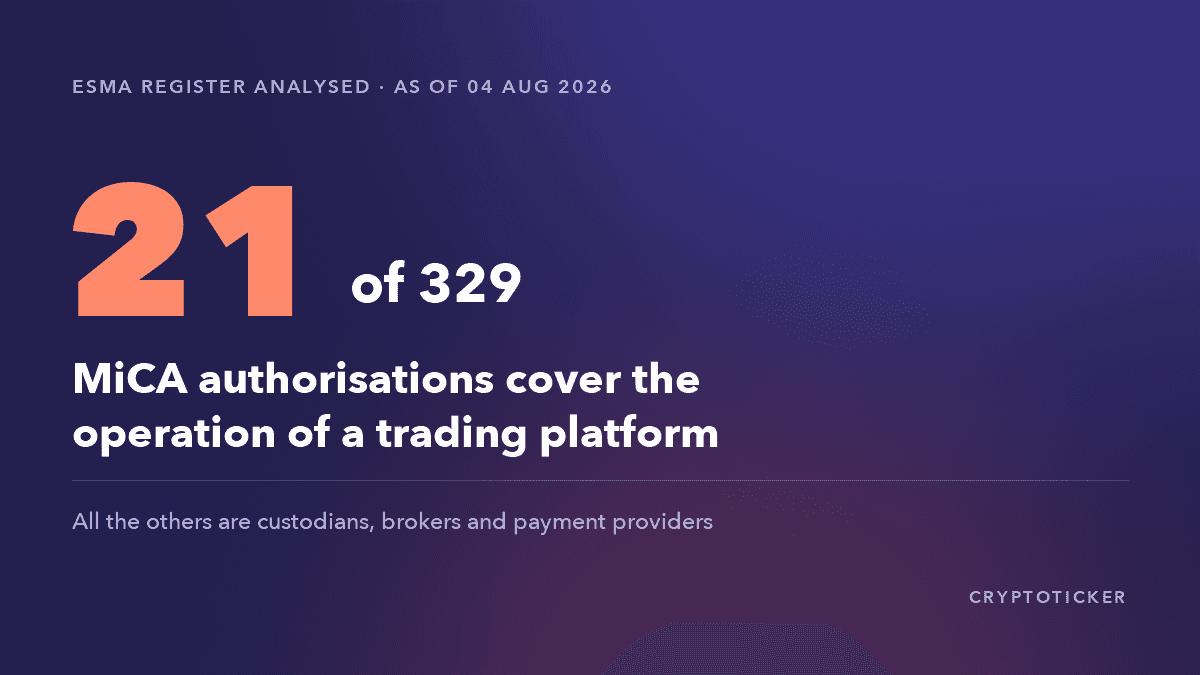
MiCA Register 2026: Only 21 of 329 Licences Are Real Exchanges
ESMA publishes the register of MiCA-authorised providers as an open file. We worked through all of it — and the result is not what the phrase “licensed crypto exchange” suggests.

July 2, 2026 8:59 PM
Binance Is Out of the EU: How to Move to a MiCA-Regulated Exchange
Binance has left the EU market. Which exchanges hold a MiCA licence, how to verify an authorisation is real, and how to move your holdings across step by step.
September 12, 2026 7:13 AM

BaFin Warnings in September: How to Check in Three Minutes Whether a Crypto Provider Holds Authorisation
Twelve consumer notices in ten days, five of them on crypto-asset services and two with the entry point in WhatsApp or Telegram. We evaluated all twelve notices ourselves and show the check that takes you three minutes.
September 29, 2026 1:15 AM
BaFin warns over nova-c-solutions.com: What is behind a genuine registration number
The BaFin has warned about a website offering crypto-asset services without authorisation and speaks of a presumed identity theft at the expense of a real US company. The case shows why the advice to look a provider up in the register does not carry on its own.

September 27, 2026 1:17 PM
Dogecoin Price: What to Check on Holding Period and Custody Before the Year End
The Dogecoin price stands at $0.0977 on September 27, 2026 and has barely moved in a day. That calm is exactly the moment to work through the holding period, the reporting duty from 2026 and custody without any time pressure.
August 11, 2026 9:18 AM
Your Crypto Exchange Is Telling You to Withdraw: How to Spot Phishing After the MiCA Deadline
Unauthorised crypto providers now have to tell their EU customers to withdraw, which leaves fraudsters an easy run with faked requests. Here is how to check in two minutes whether the message is genuine.
September 29, 2026 10:40 AM
“We have created the essential conditions …”: bitcoin.de has stood still for three months, the MiCAR licence is missing
Bitcoin Group SE published its half-year report on September 29, 2026: trading on bitcoin.de has been idle since the end of June because the MiCAR authorisation is missing. The new platform is finished, but no launch date is set.
September 26, 2026 4:21 AM
Operation Herakles disconnects 13,888 phone numbers: what to check on crypto investment calls
Six authorities have disconnected 13,888 phone numbers used by investment fraudsters to call their victims in Operation Herakles, 9,304 of them in the past three months alone. What the Federal Network Agency now requires of telecoms providers and which three checks protect you from the scheme.
September 24, 2026 1:13 AM

Solana DEX Trades Overtake the NYSE: What to Check on Swaps, Tax and Oversight
Solana's decentralised exchanges settled roughly 208 million trades in a single week and overtook the New York Stock Exchange for the first time. The figure is real, but it measures something other than the comparison suggests, and for German investors it carries tax duties that no provider takes on.
September 15, 2026 4:12 AM
Using Hyperliquid from Germany: What Applies to Your Funds Without a MiCA Licence
Hyperliquid is not entered in any EU register as an authorised crypto-asset service provider, and for perpetual futures a MiCA licence would be the wrong paperwork anyway. Here is what that means in concrete terms for your funds, your keys and your tax return.
September 13, 2026 1:13 PM
Sparkasse Crypto Custody: Why You Get No Key to Your Bitcoin and What to Check First
From October, Sparkasse customers are to be able to buy Bitcoin and Ether inside their own banking app, with DekaBank acting as custodian. What you get is a custody position rather than a private key. What that means in practice and what you should settle before your first purchase.
August 15, 2026 9:31 PM
Crypto Exchange Shutting Down: What to Do Before the Deadline Passes
Binance, BitMart, Luno and Revolut have ended or cut back their European business within seven weeks. This guide shows which deadline expires first, how a forced sale is treated for tax, and what to secure before the account closes.
October 16, 2026 1:35 PM

Kraken parent Payward buys Saldo Bank: the first crypto firm with a bank of its own in the EU
Payward, the parent of Kraken, agreed on October 14 to buy the Lithuanian Saldo Bank and would be the first crypto firm with a bank of its own in the EU. What is established, what stays open until the planned completion in 2027 and what may change for the protection of your euros.
October 16, 2026 4:15 AM
241 scam sites taken offline, the recovery scam lives on: what to check now
The Brooklyn District Attorney and the FBI shut down a fraud network of 241 websites and 112 servers on 14 October 2026; the second stage of the scheme was a purported recovery service. Five days earlier, German regulator BaFin had warned about exactly this pattern at a purported bank.
October 13, 2026 10:37 PM
ESMA will supervise only 10 to 15 of 360 crypto firms: your exchange stays with its home regulator
On October 9, 2026 EU finance ministers agreed to place only the largest crypto service providers under direct ESMA supervision. For the vast majority of the roughly 360 authorised firms, the national authority stays in charge, in Germany BaFin.

September 24, 2026 10:12 AM

XRP Falls 9.7 Percent: What to Check on Holding Period and Buying Route
XRP is down around 9.7 percent on the morning of September 24, twice as much as the typical large crypto asset. Our count of 18 coins shows who the pullback hits and which three things hold true regardless of the price.
September 6, 2026 10:20 PM
Bison App: a 1.25 Percent Spread, 27 Percent of the Staking Rewards and Trading Without an Order Book
The crypto app of Boerse Stuttgart advertises freedom from fees. You pay through the spread instead. What the licences actually cover, why there is no order book, and why the tax report loses its value once you transfer coins out.
October 7, 2026 10:41 AM

Three routes and no dates: the BaFin refuses bitcoin.de the MiCAR licence, futurum bank AG keeps holding customer assets
The BaFin has refused futurum bank AG the MiCAR authorisation, and with it the previous forbearance for bitcoin.de ends. What the mandatory disclosure says about your balance, which three routes the company names and which records you should secure now.
September 25, 2026 7:24 PM

Bitcoin Forecast: What to Check on Levels, Holding Period and Buying Route Before the Quarter Ends
Bitcoin stands at $83,877 at 16:40 UTC on September 25, 2026, and the measured volatility of the past 30 days spans a band of $73,600 to $94,200 for the coming month. More important than that band before the quarter ends are three checks: holding period, buying route under MiCA and the reporting duty in force since January 2026.
September 13, 2026 4:33 AM
Your Volksbank's Crypto Licence: Why You Have to Check Custody Separately
14 of the 16 newest CASP entries in the ESMA register were German cooperative banks, and each one carries order execution only. Our count of the BaFin database shows that not one of the 21 cooperative institutions is registered as a crypto custodian.
August 21, 2026 4:27 PM
Wallet App Without BaFin Authorisation: When Holding Crypto-Assets Requires a Licence
On 19 August 2026 BaFin published two consumer notices on wallet offerings. Who controls the means of access decides whether an authorisation is needed.
October 16, 2026 4:34 AM
25 cents to trade, 1.31 euros to withdraw: the Bitvavo fees on 100 euros of Bitcoin
The trading fee is the smallest of four cost items: on 100 euros the purchase costs 25 cents, while moving Bitcoin to your own wallet costs 1.31 euros. We recorded every item separately on 15 October 2026 and measured the spreads of the four largest euro pairs ourselves.
October 12, 2026 4:16 AM
Binance fees: 0.1 percent to trade, and one drawback compared with MiCA-licensed exchanges
Binance charges 0.1 percent in spot trading and 0.02 and 0.05 percent in derivatives. Since July 1, 2026 the exchange has lacked the MiCA authorisation for the EU, which leaves the fee table answering only half the question German investors are asking.
October 11, 2026 10:39 PM
Buying Dogecoin: instant buy at one percent or the order book at 0.8?
Seven cents per €100 separated the best asks of three authorised exchanges on Sunday evening. Between instant buy and order book at the same provider lie 75 cents.
October 5, 2026 4:42 PM

deBridge DBR: 618 million tokens come free on October 17, ten trading days of turnover at once
At deBridge the lock-up on 618.3 million DBR ends on October 17, 2026, the eighth quarterly tranche since the token launch. This piece sets the tranche against daily turnover, shows the six pots behind it and places trading and tax for investors in Germany.
September 25, 2026 4:11 AM
Bitget Pauses Withdrawals: Where Existing Customers in Europe Stand
Bitget reports unauthorised outflows of around $351.6 million (later revised to $387.5 million) and has suspended withdrawals. For existing customers in Europe, that closes the one route MiCA had left them.
September 24, 2026 10:11 PM
Bitcoin Price Prediction: What to Check on Levels, Holding Period and Leverage Before the October 28 Rate Decision
Bitcoin is trading at around $83,800, a third below its October 2025 high, while the sentiment index reads greed. Which dates, levels and deadlines over the coming weeks really decide your net gain, and which of them you steer yourself.
More from CryptoTicker