
Three routes and no dates: the BaFin refuses bitcoin.de the MiCAR licence, futurum bank AG keeps holding customer assets
The BaFin has refused futurum bank AG the MiCAR authorisation, and with it the previous forbearance for bitcoin.de ends. What the mandatory disclosure says about your balance, which three routes the company names and which records you should secure now.




Which topics should we dive deeper into?
Select what genuinely interests you. Your picks feed directly into our editorial planning.
Crypto news that's actually worth your time.
Weekly. 60 seconds. Carefully curated by our editors: no hype, no promo flood, no spam.
If you hold crypto assets at bitcoin.de, the short answer is this: on the operator's own account your balance is still there, but you cannot trade with it for the time being. The German Federal Financial Supervisory Authority (BaFin) has refused futurum bank AG, the operator of bitcoin.de, authorisation as a provider of crypto-asset services. The parent company Bitcoin Group SE announced this on Tuesday, October 6, in a mandatory disclosure, stating at the same time that customers' assets would continue to be held securely until their transfer to an alternative regulated custodian and that all customer claims would remain unaffected.
An ongoing procedure has thereby turned into a decision. At the end of September the position was still that the application sat with the supervisor and the platform was waiting for the permission; we wrote about that on September 29. This piece sets out what the refusal triggers in practice: what happens to your balance, which routes Bitcoin Group SE itself names, what a change of custodian means for your holding period, and how you can tell at another exchange whether it holds the permission that has just been refused here.
The BaFin refuses the MiCAR authorisation, and the forbearance ends with it
MiCAR is the European regulation on markets in crypto-assets, Regulation (EU) 2023/1114; it sets out who may offer crypto-asset services commercially in the European Union and which duties come with that. A crypto-asset service is any commercial activity involving other people's crypto assets, from exchange through trading venue to custody. Whoever offers one needs authorisation from the competent supervisor; in Germany that is the BaFin.
It is precisely that authorisation the authority has refused futurum bank AG. The Bitcoin Group SE disclosure contains the sentence that changes the situation: with it, the previous forbearance of the provision of crypto-asset services by futurum bank AG no longer exists either. Forbearance is the supervisor's tacit acceptance of an activity while a procedure is running. It is not a permission, and the forbearance ends as soon as the procedure is decided.
The company itself relays the reasoning. In the BaFin's view, according to the disclosure, the current degree of progress on implementation and operationalisation, and the further progress achievable in the short term, were insufficient, making a refusal of authorisation unavoidable at this point. Moritz Eckert, chief executive of Bitcoin Group SE, calls the decision a setback in the same disclosure, considers it wrong on the substance and points out that the implementation of the required points had already been advanced. That account comes from the company affected; no public reasoning of its own from the supervisor on the matter is available.
Important for placing this: a refused authorisation is an administrative decision about requirements on organisation, processes and documentation. It says nothing about a company's solvency and nothing about the existence of customer claims.
The wording on custody: customer assets secured, claims unaffected
For you as a customer, everything hangs on two sentences of the mandatory disclosure. The first: futurum bank AG continues to hold customers' assets securely until their transfer to the alternative regulated custodian. The second: all customer claims remain unaffected. Both sentences appear in a publication by a listed company, which stands behind their content.
Custody here means that a service provider holds the keys to your crypto assets and manages them for you, while the assets are economically yours. It is precisely that separation between holding and being entitled which explains why the disclosure makes two separate commitments: one on custody and one on claims.
What the disclosure does not say is at least as important. A date for the transfer to the alternative custodian is not stated there, the future custodian is not named, and on the question of whether and from when withdrawals are possible there is not a sentence. All that is announced is that futurum bank AG will inform customers on its own website in the near future about the specific arrangements, the steps required of customers and the timetable. Anyone planning a withdrawal today therefore has an assurance about existence, but no date.
From marketplace to broker: the chronology since June 12
The refusal hits a platform that has not been running normally for months. According to the trade publication Cointelegraph, trading at bitcoin.de has been largely suspended since June 12. Behind it is a rebuild: the original marketplace, on which buyers and sellers were brought together directly, was to become a broker model, with more than a hundred crypto assets, with swap functions and with staking. The launch was scheduled for the end of June and was postponed because the authorisation was missing.
In a statement in August, according to the same report, the customers' holdings had already been moved to a new custody infrastructure and the old trading system had been switched off. That explains why holdings and trading are two different things here: the assets sit in a new environment, only the marketplace on top of it is missing. How the standstill began, we set out in August, and what the shareholder meeting at the end of August produced on it is covered in a separate piece.
The order of magnitude makes the situation relevant: Bitcoin Group SE states more than 1,100,000 registered users for bitcoin.de and an operating history of over ten years. By its own account, the holding owns 100 percent of futurum bank AG and 50 percent of Sineus Financial Services GmbH, an investment firm supervised by the BaFin. Anyone affected here is therefore not part of a niche but of one of the best-known addresses in the German crypto market.
 Compare MiCA-regulated crypto exchanges
Crypto assets are not deposits: deposit insurance does not apply here
One expectation dissolves at this point. The statutory deposit guarantee protects money in an account up to 100,000 euros per customer and institution. Crypto assets, however, are not deposits but assets held in custody, and there is no deposit guarantee for crypto balances in Germany; we described that on October 4 in our overview of the Crypto Markets Supervision Act.
A different principle takes the place of deposit insurance: the segregation of holdings. Crypto assets held in custody are to be kept separate from the service provider's own assets, and the Crypto Markets Supervision Act regulates in Section 45 how crypto assets held in custody are allocated in an insolvency. That is a general rule for every custodian in Germany. It is expressly not a statement about futurum bank AG; on its own situation, Bitcoin Group SE states that all customer claims remain unaffected.
In practice that means the protection of your balance here does not hang on a guarantee fund, but on the holdings being kept cleanly segregated and transferred correctly. That is why the announced move to a regulated custodian is the decisive event of the coming weeks, and why it is worth reading the official announcements on it.
Objection, new application, cooperation: the three routes of Bitcoin Group SE
The disclosure names three routes, and none of them carries a date. The first is the objection, the formal appeal against an administrative act lodged with the authority that issued it. The company writes that it is reviewing the decision and has the opportunity to object. A deadline for that is not stated in the disclosure; anyone naming a concrete deadline is not reading it from this source.
The second route is a renewed application for MiCAR authorisation at a later point. The third is the one the company says it is currently pursuing: a cooperation agreement with regulated German companies, one for trading and one for custody, so that trading becomes possible again through the technically renewed bitcoin.de app. The time horizon the disclosure gives for that reads: within the next few weeks.
For you, the combination of three routes and zero dates means above all one thing: there is no predictability at present. Anyone who depends on being able to trade at a particular moment should not tie that part of their holdings to an assurance without a date. Anyone who can leave things sitting has, going by the wording of the disclosure, no cause for hasty decisions.

What a change of custodian triggers for the holding period and documentation
For crypto assets held privately, a one-year holding period applies in Germany under Section 23 of the Income Tax Act: if more than twelve months lie between acquisition and disposal, a gain from the private disposal stays tax-free. Within the year the tax liability applies, and the proof of the acquisition date and acquisition cost lies with you, not with the platform.
What a transfer to another custodian triggers in tax terms depends on the specific arrangements, which futurum bank AG has not yet published. As long as those conditions are open, any blanket statement on it is unserious. What holds up is the preparation: pull a complete export of your transactions now, while access to the account exists, secure the account statements and trading records, and note the holding per crypto asset with a date. If the custodian changes later, you will have the earlier position in black and white.
The second part of the preparation concerns custody itself. A hardware wallet is a device that keeps your private keys offline, so that no service provider stands between you and your crypto assets. Anyone holding part of their stock for the long term can remove exactly that part from dependence on authorisation procedures; a market comparison is in our overview of hardware wallets. The price for it is personal responsibility: whoever loses the key loses the coins, and nobody can retrieve them.
 Compare the best hardware wallets
Transitional permission, the KMAG and the company database: the frame around the decision
MiCAR applies directly throughout the European Union, but it contains no German procedural rules. That gap is closed by the Crypto Markets Supervision Act, KMAG for short: it is the German implementation of the MiCA regulation, entered into force as Article 1 of the Financial Market Digitalisation Act and replaced the crypto rules in the Banking Act, where they had until then been treated as crypto custody business.
Decisive for understanding the present case is the transitional permission: under Section 50 of the KMAG, providers already in the market were allowed to keep working at first while they applied for the new authorisation. That transitional permission expired on December 31, 2025. Since then there has been no grey area left for crypto providers in Germany, and that is exactly why the forbearance mentioned in the disclosure was the last thing the operation could rest on. The duties an authorisation brings with it in detail we have set out separately in our overview of the MiCA obligations.
Anyone wanting to complain about the relationship between customer and provider will also find the route in the regulation: which deadlines apply to a complaints procedure and when the supervisor is brought in, we explained in August.
How a MiCAR authorisation becomes visible at another exchange
The case supplies a test question that reaches beyond bitcoin.de: does the provider holding your money and your coins actually have the permission, or is it merely applying for one? Two registers answer that. The BaFin's company database is the official register of authorisations granted in Germany; the public register of the European securities supervisor ESMA lists the authorised providers of crypto-asset services across the whole union. If a provider is not in there, that is not a detail but the answer.
Two qualifications belong with it. First, an entry says nothing about price losses: an authorisation covers supervision, capital and organisational requirements, it is no guarantee for your money and no promise of rising prices. Second, websites keep turning up that advertise with genuine register numbers belonging to other companies; a cross-check is therefore only worth anything via the name, the address and the domain together. Which venues in Germany can show a permission and how they differ on fees and selection is shown by our comparison of regulated crypto exchanges.
A note of our own on the market environment: Bitcoin and the large altcoins carry on moving independently of this procedure. The refusal concerns access through one particular provider, not the crypto assets themselves.
bitcoin.de: Your next three steps
- Secure the holding and the history while access stands. Export transactions, acquisition data and the account statement and file them separately from the platform. Tools that log exactly that permanently are in our comparison of tax and portfolio tools.
- Wait for official announcements and ignore third parties. Bitcoin Group SE has announced that it will publish the timetable and the required steps on its own website. In situations like this, supposed helpers typically get in touch by email, telephone or messenger; nobody reputable asks for your seed or requests an advance payment to recover funds. If you need an alternative venue, pick it from the comparison of regulated crypto exchanges and look up the register entry yourself.
- Take the long-term part out of third-party custody. What you intend to hold for years anyway does not belong on a trading venue. Which devices are candidates for that and how they differ is set out in the hardware wallet comparison.
(As of October 7, 2026. This article is not investment advice. Prices and fee structures change; check the terms with the provider before you buy.)
Frequently asked questions about bitcoin.de
Transparency note: This article was produced with the assistance of artificial intelligence and reviewed by our editorial team before publication. All figures and claims were checked against the primary sources linked in the text. The feature image was generated with AI.
More on Bitcoin: All Bitcoin news at a glance
Related articles
- “We have created the essential conditions …”: bitcoin.de has stood still for three months, the MiCAR licence is missing
- bitcoin.de Stands Still: What the August 28 Shareholder Meeting Means for Your Balance
- The bitcoin.de Trading Halt: An Assessment of What the Standstill Means for Your Balance
- Your Crypto Exchange Is Telling You to Withdraw: How to Spot Phishing After the MiCA Deadline
- BaFin Crypto Knowledge Survey: Four Assumptions Owners Believe Are True
Which topics should we dive deeper into?
Select what genuinely interests you. Your picks feed directly into our editorial planning.
Crypto news that's actually worth your time.
Weekly. 60 seconds. Carefully curated by our editors: no hype, no promo flood, no spam.

October 16, 2026 1:35 PM

Kraken parent Payward buys Saldo Bank: the first crypto firm with a bank of its own in the EU
Payward, the parent of Kraken, agreed on October 14 to buy the Lithuanian Saldo Bank and would be the first crypto firm with a bank of its own in the EU. What is established, what stays open until the planned completion in 2027 and what may change for the protection of your euros.
August 21, 2026 4:27 PM

Wallet App Without BaFin Authorisation: When Holding Crypto-Assets Requires a Licence
On 19 August 2026 BaFin published two consumer notices on wallet offerings. Who controls the means of access decides whether an authorisation is needed.

October 12, 2026 6:50 PM
Kraken Lands Full Dubai Licence: Dirham Trading Goes Live for UAE Crypto Investors
Kraken has won full VARA approval in Dubai, clearing the way for dirham trading, margin, staking and tokenized stocks. Here is what UAE traders get.
July 2, 2026 8:59 PM
Binance Is Out of the EU: How to Move to a MiCA-Regulated Exchange
Binance has left the EU market. Which exchanges hold a MiCA licence, how to verify an authorisation is real, and how to move your holdings across step by step.
September 16, 2026 7:39 PM
Deutsche Bank to Custody Bitcoin and Ether: Why Retail Clients Are Missing and What to Check in Your Own Custody
Deutsche Bank will custody Bitcoin, Ether and three stablecoins, but addresses corporates and institutions only. What the launch under supervisory reservation means, and the four questions you should put to any custody arrangement.
September 13, 2026 1:13 PM
Sparkasse Crypto Custody: Why You Get No Key to Your Bitcoin and What to Check First
From October, Sparkasse customers are to be able to buy Bitcoin and Ether inside their own banking app, with DekaBank acting as custodian. What you get is a custody position rather than a private key. What that means in practice and what you should settle before your first purchase.
August 6, 2026 3:05 PM
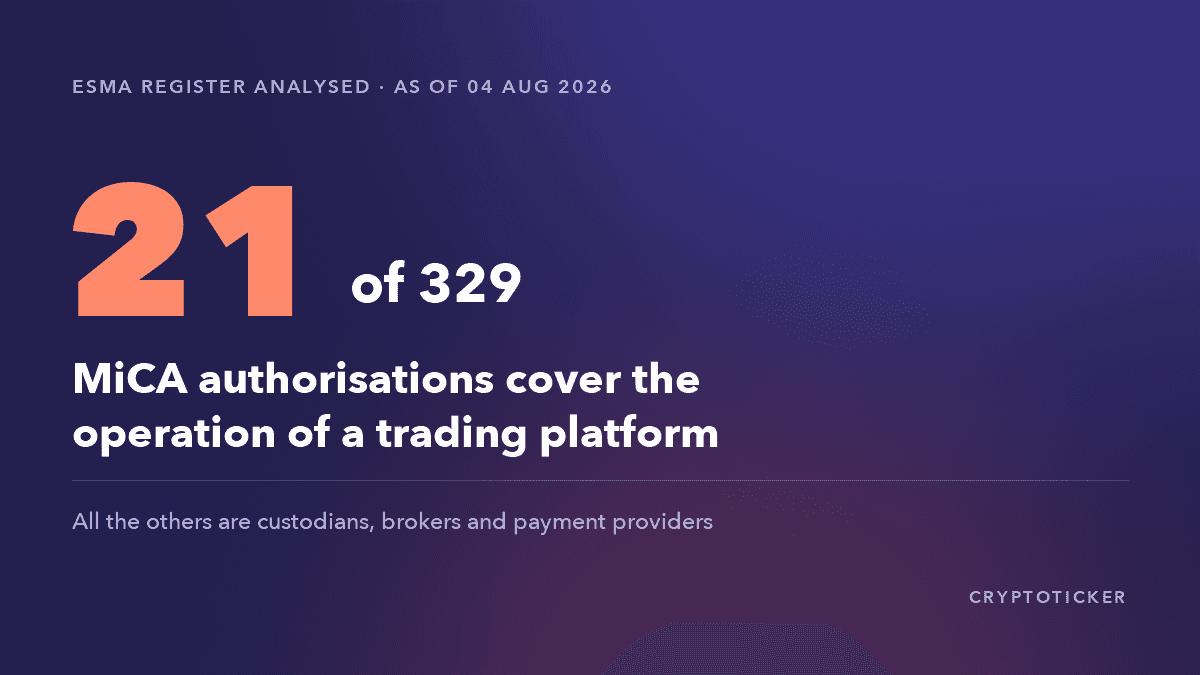
MiCA Register 2026: Only 21 of 329 Licences Are Real Exchanges
ESMA publishes the register of MiCA-authorised providers as an open file. We worked through all of it — and the result is not what the phrase “licensed crypto exchange” suggests.
October 14, 2026 1:29 AM
South Korea blocks 27 unregistered exchanges, KuCoin and MEXC are on the list
South Korea's anti-money-laundering unit blocked access to 27 websites of unregistered foreign exchanges on October 13, 2026, KuCoin, MEXC and BingX among them. In Germany the grandfathering for legacy providers lapsed back on December 31, 2025, and at KuCoin a granted EU licence stands against an order that still prohibits the commencement of business.
June 26, 2026 5:35 PM
Binance Is Leaving the EU on July 1 — What It Means for Your Funds
Binance will stop serving EU customers from July 1 after failing to secure a MiCA licence. Here's what it means for your funds and your next move.
October 1, 2026 7:32 AM
Starting a crypto company in Germany: legal form, BaFin licence and capital
Setting up a crypto company in Germany: which business models need BaFin authorisation under MiCA, GmbH or UG, how much capital is required and where public support is available.
September 26, 2026 4:21 AM
Operation Herakles disconnects 13,888 phone numbers: what to check on crypto investment calls
Six authorities have disconnected 13,888 phone numbers used by investment fraudsters to call their victims in Operation Herakles, 9,304 of them in the past three months alone. What the Federal Network Agency now requires of telecoms providers and which three checks protect you from the scheme.

June 30, 2026 11:20 PM

How to Switch from Binance to a MiCA Regulated Crypto Exchange
Binance is winding down EU services after missing the MiCA deadline. Here's why it's happening and how to move your funds to a regulated platform safely.
September 29, 2026 10:33 AM
ESMA puts reverse solicitation on its 2027 watch list: what investors need to know about exchanges without an EU licence
ESMA presented its work programme for 2027 on September 28, 2026 and made reverse solicitation a supervisory priority. What that means if your coins sit with a provider without EU authorisation, and which three steps make sense now.
October 16, 2026 4:15 AM
241 scam sites taken offline, the recovery scam lives on: what to check now
The Brooklyn District Attorney and the FBI shut down a fraud network of 241 websites and 112 servers on 14 October 2026; the second stage of the scheme was a purported recovery service. Five days earlier, German regulator BaFin had warned about exactly this pattern at a purported bank.
September 13, 2026 4:33 AM
Your Volksbank's Crypto Licence: Why You Have to Check Custody Separately
14 of the 16 newest CASP entries in the ESMA register were German cooperative banks, and each one carries order execution only. Our count of the BaFin database shows that not one of the 21 cooperative institutions is registered as a crypto custodian.
September 1, 2026 4:12 AM

USDT cashback and 7 percent on stablecoins: what the MiCA interest ban means for you
A new payment card advertises up to 10 percent cashback in USDT and up to 7 percent a year on the balance. Article 50 MiCAR explains why a provider licensed in the EU is not allowed to pay you exactly that.
September 10, 2026 1:21 AM

Crypto Exchanges Head to Head: Which Pairing Is Cheaper Where
Before opening an account, the question is rarely which exchange is best overall, but whether it should be this one or that one. This article sorts through the most searched head-to-heads, puts the cost per 1,000 euros side by side and explains the most expensive mix-up: one provider with two interfaces and a factor of seventeen between them.
September 8, 2026 7:23 AM
Compensation After an Exchange Hack: What Twelve Crypto Providers Really Promise German Customers
After $322 million in losses in a single September week, the question is who replaces stolen coins. On September 8, 2026 we retrieved the security and legal pages of twelve providers and evaluated what is promised there.
October 19, 2026 7:51 AM

Euro balances on a crypto exchange: what to watch after the ESMA answer on MiCA article 70
The European securities regulator ESMA spelled out on October 16, 2026 where a crypto asset service provider may hold your euro balance. A payment service provider without a banking licence is only a staging post of at most one business day.
October 5, 2026 1:15 AM

Five of nine BaFin warnings cite the Crypto Markets Supervision Act: "This is a case of identity misuse"
Within four days at the end of September, BaFin publicly named nine providers, five of them over unauthorised crypto-asset services. Behind the warnings stands the Crypto Markets Supervision Act, and since the transitional period ran out there is no grey area left for crypto providers in Germany.
September 12, 2026 7:13 AM

BaFin Warnings in September: How to Check in Three Minutes Whether a Crypto Provider Holds Authorisation
Twelve consumer notices in ten days, five of them on crypto-asset services and two with the entry point in WhatsApp or Telegram. We evaluated all twelve notices ourselves and show the check that takes you three minutes.
September 24, 2026 10:29 AM

Bank Closed Your Account Over Crypto: Your Rights and the Route to a Replacement Account
After a withdrawal from a crypto exchange, banks repeatedly end the banking relationship, usually without giving a reason. What the German Payment Accounts Act guarantees you anyway, which notice period applies, and in what order you approach the supervisor, arbitration and the courts.
August 30, 2026 10:38 PM

Crypto Cards: Where Your Card Balance Really Sits and What the August 28 Solana Exploit Reveals About It
An attack on a card balance contract on Solana took the loaded balance from 1,685 users while their wallets stayed untouched. The case shows why it matters whether your crypto card holds funds as e-money at a licensed institution or in a smart contract.
September 29, 2026 1:15 AM

BaFin warns over nova-c-solutions.com: What is behind a genuine registration number
The BaFin has warned about a website offering crypto-asset services without authorisation and speaks of a presumed identity theft at the expense of a real US company. The case shows why the advice to look a provider up in the register does not carry on its own.
August 21, 2026 10:27 AM

Complaining About a Crypto Exchange: the Deadlines Article 71 MiCAR Sets and Why BaFin Will Not Decide Your Case
Authorised crypto providers have to run a formal complaints procedure, and Delegated Regulation (EU) 2025/294 sets a hard limit of two months for it. Our own analysis of the ESMA list shows at the same time that no complaints link is on file for Germany to this day.
August 15, 2026 9:31 PM
Crypto Exchange Shutting Down: What to Do Before the Deadline Passes
Binance, BitMart, Luno and Revolut have ended or cut back their European business within seven weeks. This guide shows which deadline expires first, how a forced sale is treated for tax, and what to secure before the account closes.

October 21, 2026 10:36 AM

LEO Token ranks 18th but moves just $150,000 a day: what that means for your exit
LEO Token is number 18 on the crypto market by market value, yet moves only around $150,000 a day, and 90 percent of that at a single venue. What this means for the route out, your provider's authorisation and the holding period.
More from CryptoTicker