
bitcoin.de Stands Still: What the August 28 Shareholder Meeting Means for Your Balance
Trading and deposits at bitcoin.de have been suspended since June 12, while withdrawals continue to run according to the operator. On August 28, Bitcoin Group SE holds its annual general meeting: what the date changes for your balance, and how to tell whether the platform is coming back.




Which topics should we dive deeper into?
Select what genuinely interests you. Your picks feed directly into our editorial planning.
Crypto news that's actually worth your time.
Weekly. 60 seconds. Carefully curated by our editors: no hype, no promo flood, no spam.
Your balance at bitcoin.de can still be withdrawn, according to the operator. Trading there has been unavailable since June 12, 2026, and so have deposits. On August 28, 2026, Bitcoin Group SE, the marketplace's parent company, holds its annual general meeting in Herford. It is the first firmly dated occasion since the standstill began at which the management board has to answer to shareholders.
This piece addresses the question that has been sitting in the forums for weeks: what does August 28 change for your balance, and how can you tell for yourself whether the platform is coming back? We have already published an assessment of what the trading halt means for your balance. Two things have been added since: a status report from the operator dated August 20, and the date of the general meeting.
Why trading at bitcoin.de has been suspended since June 12
The sequence is well documented. Since June 12, 2026, trading and deposits on bitcoin.de have been suspended. It was announced as a temporary pause until July 1, 2026, the day the rebuilt platform was due to go live. That date passed without a replacement.
The rebuild itself is no minor operation. The operator is moving bitcoin.de from its previous peer-to-peer marketplace model to a conventional trading architecture. A peer-to-peer marketplace is a venue on which two customers deal directly with one another and the operator merely brokers and settles; on an order-book exchange, by contrast, the venue itself steps between the parties. Alongside this, the company says, come a redesigned website, trading apps for iOS and Android, and a range extended to more than 100 cryptocurrencies.
According to the reports available, more than a million registered accounts are affected by the pause. bitcoin.de is Germany's oldest Bitcoin marketplace and launched in 2011. That is why this standstill affects more people in Germany than most news about international trading venues.
What the August 20 status report actually says
On August 20, 2026, the operator published a detailed status report with an FAQ, the first since the end of June. The key statements, each of them a company assertion:
- The technical development of the new trading infrastructure, including website and trading app, is complete and has been successfully tested.
- The launch has been postponed because the regulatory procedure connected with MiCAR licensing has not yet concluded. The company says it wants to avoid legal and operational uncertainty for customers and business partners.
- A binding date cannot be given, because the further timetable depends on the conclusion of that procedure.
- Withdrawals remain fully available and are processed under the existing procedures. Only trading and deposits are paused.
- Customer holdings have already been migrated to the new infrastructure in the course of preparations, and the previous trading system has been shut down. Reactivating the old system at short notice is not readily feasible, technically or operationally.
The last point is the most important and, so far, the least noticed in German coverage. It answers the question of why the operator does not simply let trading continue on the old platform until authorisation arrives: on the company's own account, that old platform no longer exists in operational form.
On custody itself, the operator states that customer balances are held separately from company assets and audited annually. That is a company statement rather than a finding by a supervisory authority, and you should read it as such.

What the Bitcoin Group SE annual general meeting on August 28 changes
The financial calendar of Bitcoin Group SE contains exactly one further dated event for the 2026 financial year: the annual general meeting on August 28, 2026 in Herford. The 2026 half-year report is entered there as "September 2026" with no day given, and is therefore useless as a marker.
An annual general meeting is the yearly gathering of a stock corporation's shareholders, at which the management and supervisory boards render account and shareholders vote on discharge, the use of profits and constitutional matters. For you as a customer of the marketplace, one aspect matters above all: shareholders have a right to information under section 131 of the German Stock Corporation Act. Questions about the trading halt, which the company has so far answered only in writing and in general terms, have to be answered orally there, insofar as they are necessary to assess an item on the agenda.
What August 28 does not change for your balance: it is no cut-off date at which a deadline expires, no date by which you would have to have done something, and no announced resumption of trading. Anyone telling you otherwise has not read the financial calendar. The date is an information event, and nothing is required of you on it.
In practical terms: in the days after August 28, the likelihood is higher than usual that firm statements about the timetable will become public. Shareholders regularly report from annual general meetings, and listed companies publish price-sensitive news through ad-hoc announcements and corporate news in the investor relations section of their own website.
Can you still withdraw your balance from bitcoin.de?
On the operator's account, yes, and without any change. Withdrawals of balances and transfers of crypto assets to an external address continue to run under the existing procedures, according to the company. Active trading and new deposits are what has been suspended.
If you want to check this for yourself, proceed in this order:
- Call up your account balance and holdings overview. Note the date, the time and the exact amounts, ideally with a screenshot. That is your evidence should something fail to add up later.
- Initiate a small test withdrawal. An amount whose loss would not hurt tells you more about the actual state of settlement than any press release. Factor in the network fee before you settle on the amount.
- Measure how long it takes. Record how long the withdrawal actually needs. A wide deviation from your earlier experience is a signal to weigh in your further decision.
- Only then decide about the rest. A working test withdrawal is the basis for the question of whether you pull out your full holding.
One security point that counts for a great deal in this situation: around any platform with disrupted operations, forged emails tend to appear urging an "immediate withdrawal" and leading to rebuilt login pages. Do not click such prompts; type the address yourself. How to recognise this ploy is something we took apart using the example of phishing after the MiCA deadline.
MiCAR authorisation explained: why an existing licence is not automatically enough
MiCAR is the European regulation on markets in crypto-assets. Since the transitional periods ended, the regulation requires providers of crypto-asset services in the EU to hold their own authorisation as a CASP, a crypto-asset service provider. The transitional period in Germany expired on December 31, 2025; EU-wide it ran until July 1, 2026 at the latest.
Correction (September 30, 2026): An earlier version gave July 1, 2026 as the end of the transition period without the German rule. Under Article 143(3) MiCA (Regulation (EU) 2023/1114), the transitional regime applied EU-wide until July 1, 2026 at the latest, and member states could shorten it. Germany did: under section 50(2) no. 3 of the German Crypto Markets Supervision Act (KMAG), the continued authorisation expired on December 31, 2025 at the latest.
Why an existing financial supervisory licence does not automatically suffice comes down to legal form. CRR credit institutions, meaning conventional banks, may provide all crypto-asset services under Article 60(1) MiCAR if they notify the supervisor in good time. For investment firms under the German Investment Firm Act, by contrast, only Article 60(3) applies: they are permitted solely those crypto-asset services which correspond to the investment services they are already licensed for. Anything beyond that requires full authorisation under Article 63.
futurum bank AG, which operates bitcoin.de, is listed in BaFin's company database as an investment firm, despite the word "bank" in its corporate name. The company itself writes in its 2025 annual report, published on June 26, 2026, that the subsidiary is "currently in the MICAR licensing procedure". A procedure under way is no value judgement on the applicant; it is an administrative process with an open outcome and no statutory guaranteed duration.
This hurdle affects more than one provider. Our analysis of the European register shows that only a small share of the authorisations granted at the time went to trading platforms: 21 of 329 authorisations were trading platforms. Anyone looking for an alternative today should therefore look specifically at the regulated crypto exchanges holding European authorisation rather than relying on advertising claims.
How to tell whether a trading platform is coming back
There is no guarantee on the question of whether it returns, but there are verifiable signals. You can observe these five yourself, without depending on rumour:
- The public authorisation register. The European securities supervisor maintains a register of authorised crypto-asset service providers. Once the operator appears there, the decisive hurdle has been cleared. Until then, its absence says only that the procedure is still running.
- The financial calendar and ad-hoc announcements. Listed companies must publish price-sensitive facts without delay. An authorisation granted would be such a fact.
- The withdrawal function. As long as withdrawals go through reliably and in the usual time, settlement is working. Should they slow down without explanation, that is the clearest change you can measure at all from the outside.
- The frequency of communication. Almost two months passed between the annual report at the end of June and the status report on August 20 without any company statement. If the cadence becomes tighter and more concrete, that points to movement.
- Concrete dates rather than statements of intent. "As soon as the procedure has concluded" is no statement about timing. A calendar date is one.
For the sake of completeness, the economic picture includes one figure from the 2025 annual report as it was reported in the trade press: on revenue of 10.0 million euros, operating profit on an EBITDA basis fell from 1.8 to 0.5 million euros, and the bottom line showed a net loss for the year of 1.3 million euros after a profit in the prior year. This follows from the investment in the platform rebuild and says nothing in itself about the safety of customer holdings, which the company states are held separately. We are not evaluating these figures here; we are naming them so that you know them.
Self-custody instead of waiting: when moving to a hardware wallet makes sense
Self-custody means that you control the private keys to your coins yourself and no service provider stands between you and your holding. A hardware wallet is a device that stores those keys offline and signs transactions without releasing the key to the computer.
The bitcoin.de case demonstrates what the opposite looks like. Trading and deposits can be switched off from outside, resumption can depend on an administrative procedure, and the scheduling then no longer rests with the customer. Anyone holding their own assets is independent of that chain. The suitable devices, along with the effort of setting them up, are in the hardware wallet comparison.
Honesty requires the other side too: self-custody shifts the risk, it does not remove it. A lost recovery phrase means definitive loss, and nobody can reset it for you. If you do not trust yourself with that, an authorised custodian is the more honest choice than a half-understood do-it-yourself arrangement. My assessment: for holdings you have no intention of trading over the coming months anyway, the advantage of self-custody clearly outweighs the drawbacks.
 Regulated crypto exchanges compared
Switching crypto exchange: what to look for in a regulated provider
If you would rather not wait for an indefinite launch date, switching is the obvious alternative. Three checks that come before the fee table:
Look up the authorisation in the register
Do not rely on the word "regulated" on the home page. Check the corporate name in the public register of authorised providers. Note whether this is a full authorisation or merely a notification by a credit institution, because the scope of permitted services differs.
Understand the custody model
Ask whether your coins sit in omnibus custody, meaning together with those of other customers in a single holding, or are allocated separately, and who acts as custodian. At several large providers, the custodian is a different company from the one you hold the account with.
Test the withdrawal routes beforehand
Before you transfer a larger holding, check whether the new provider permits withdrawals to an external address at all. There are houses that offer trading but restrict transfers out to your own wallet. An overview of providers and their terms is in our crypto exchange comparison.
Tax on switching: what a transfer between your own wallets triggers
The good news first: transferring coins between two wallets that both belong to you is not a disposal under the tax administration's view in Germany. No taxable gain arises, and the holding period continues to run rather than starting afresh.
The qualification that goes with it: you have to carry the acquisition data across, meaning the date of purchase, acquisition costs and quantity for each position. If your previous provider at some point stops supplying a history, proving your position to the tax office becomes laborious. Every switch therefore includes this one step: pull the complete transaction export while you still have access, and store it outside the platform.
For ongoing documentation and the later tax return, the best choice is a tool that consolidates several addresses and trading venues. Which ones manage that is set out in the comparison of crypto tax tools and portfolio trackers. Note as well that network fees arise on a transfer and fluctuate considerably depending on how busy the chain is.
Checking your bitcoin.de balance: what to take away
- August 28 is an information event, not a deadline. You do not have to have anything done by then. What makes sense is to follow the investor relations page and the company's ad-hoc announcements in the days afterwards, because firm dates would appear there first. If you want to trade in the meantime, you will find authorised alternatives in the comparison of regulated crypto exchanges.
- Test your access with a small withdrawal before you decide about the rest. Record holdings and processing times. A working withdrawal is the most meaningful signal available to you from outside. If you then want to move into self-custody, the hardware wallet comparison is the next step.
- Secure your transaction history while you still have access. A transfer between your own wallets triggers no tax, but without acquisition data the later return becomes onerous. A tool from the comparison of crypto tax tools takes over the consolidation.
For further reading, the primary sources are the annual general meeting section of Bitcoin Group SE, with the date, invitation and agenda, and the operator's status report of August 20, 2026.
(As of August 25, 2026. This article is not investment advice. Prices and fee structures change; check the terms with the provider before you buy.)
Transparency note: This article was produced with the assistance of artificial intelligence and reviewed by our editorial team before publication. All figures and claims were checked against the primary sources linked in the text. The feature image was generated with AI.
More on Bitcoin: All Bitcoin news at a glance
Related articles
- “We have created the essential conditions …”: bitcoin.de has stood still for three months, the MiCAR licence is missing
- The bitcoin.de Trading Halt: An Assessment of What the Standstill Means for Your Balance
- Three routes and no dates: the BaFin refuses bitcoin.de the MiCAR licence, futurum bank AG keeps holding customer assets
- Sparkasse Crypto Custody: Why You Get No Key to Your Bitcoin and What to Check First
- Top 3 Methods To Withdraw Bitcoin to Bank Account
Which topics should we dive deeper into?
Select what genuinely interests you. Your picks feed directly into our editorial planning.
Crypto news that's actually worth your time.
Weekly. 60 seconds. Carefully curated by our editors: no hype, no promo flood, no spam.

May 26, 2025 11:00 PM
Inside Bitget: How COO Vugar Usi Zade Is Shaping the Future of Crypto Trading
From Bitget Seed and AI-powered tools to regulatory strategy and mass adoption, COO Vugar Usi Zade reveals how Bitget is building the next era of crypto trading.

September 3, 2026 11:37 AM

Standard Chartered Just Opened Institutional Bitcoin Trading in the UAE
Standard Chartered launches institutional Bitcoin and Ether spot trading in the UAE. Here is what it means for BTC and ETH prices right now.

September 10, 2026 4:15 PM
BW-Bank Opens Bitcoin Trading Inside the Securities Account: What to Check Before Your First Buy
Since September 9, 2026, BW-Bank customers have been able to trade ten crypto assets through their securities account, executed and held in custody by Bitpanda. The familiar securities-account setting hides three points you should settle before your first order.
June 7, 2026 11:00 AM
How to Buy Bitcoin with No KYC in 2026: 3 Ways to Do It
Protect your data and maintain privacy. Here are the three most secure ways to buy Bitcoin without identity verification (KYC) in 2026.
April 1, 2025 1:00 PM
BREAKING Crypto News: Bitcoin Hits $500,000 on one Exchange – Traders in Shock!
In a shocking turn of events, Bitcoin has surged to an unbelievable $500,000 on a crypto exchange, sending traders into a frenzy. Is this the beginning of a new era?
October 12, 2026 6:50 PM
Kraken Lands Full Dubai Licence: Dirham Trading Goes Live for UAE Crypto Investors
Kraken has won full VARA approval in Dubai, clearing the way for dirham trading, margin, staking and tokenized stocks. Here is what UAE traders get.
September 16, 2026 7:39 PM
Deutsche Bank to Custody Bitcoin and Ether: Why Retail Clients Are Missing and What to Check in Your Own Custody
Deutsche Bank will custody Bitcoin, Ether and three stablecoins, but addresses corporates and institutions only. What the launch under supervisory reservation means, and the four questions you should put to any custody arrangement.

November 8, 2018 11:23 AM
The Three Easiest Ways To Buy Bitcoin
Buying Bitcoin can be simple and smooth. Users should always remember that they should never expect to make a million dollars overnight.
October 19, 2026 7:34 AM
Germany's savings banks start crypto trading: “When a savings bank starts is for it to decide”
The first German savings banks have switched on crypto trading in the App Sparkasse, with Bitcoin, Ethereum, XRP, Solana and Polygon tradable. There is no nationwide launch date, and the private keys stay in trust at DekaBank.
October 16, 2026 1:35 PM

Kraken parent Payward buys Saldo Bank: the first crypto firm with a bank of its own in the EU
Payward, the parent of Kraken, agreed on October 14 to buy the Lithuanian Saldo Bank and would be the first crypto firm with a bank of its own in the EU. What is established, what stays open until the planned completion in 2027 and what may change for the protection of your euros.
September 22, 2026 4:33 PM
Three of the 25 Largest Coins Have No Euro Pair: How to Check Your Buying Route Before the Order
Our own survey of five trading venues active in the EU, taken on September 22, 2026, shows that three of the 25 largest cryptocurrencies have no euro pair there at all, and four more only one. What that means for your next order and what the detours cost.
April 30, 2023 11:46 PM
How to Buy Bitcoin on eToro?
eToro is now one of the most popular platforms for trading in assets. The trade in cryptocurrencies has been greatly expanded in recent years. Today we will show you step by step guide on how to trade Bitcoin on eToro. […]
December 1, 2022 8:16 PM
Limited Offer: Crypto Bonus up to $30,030 with ByBit, here’s how!
Bybit is a crypto derivatives broker offering a crypto bonus of up to $30,030. Let's see how to take advantage of all the Bybit bonuses.
October 6, 2019 8:12 AM
How to Buy Bitcoin?
There are several ways one can buy bitcoin. Bitcoin is in the news because of its unpredictable prices, everyone is interested in discovering how to buy and sell Bitcoin. As the most common sort of cryptocurrency Bitcoin is now broadly […]
September 26, 2026 4:21 AM
Operation Herakles disconnects 13,888 phone numbers: what to check on crypto investment calls
Six authorities have disconnected 13,888 phone numbers used by investment fraudsters to call their victims in Operation Herakles, 9,304 of them in the past three months alone. What the Federal Network Agency now requires of telecoms providers and which three checks protect you from the scheme.
September 1, 2026 10:13 AM
BaFin Crypto Knowledge Survey: Four Assumptions Owners Believe Are True
BaFin has measured what crypto owners know about their products: 57 percent of the answers were correct, 31 percent wrong. Four false assumptions come up especially often, and each of them changes your own investment decision.

June 30, 2026 11:20 PM
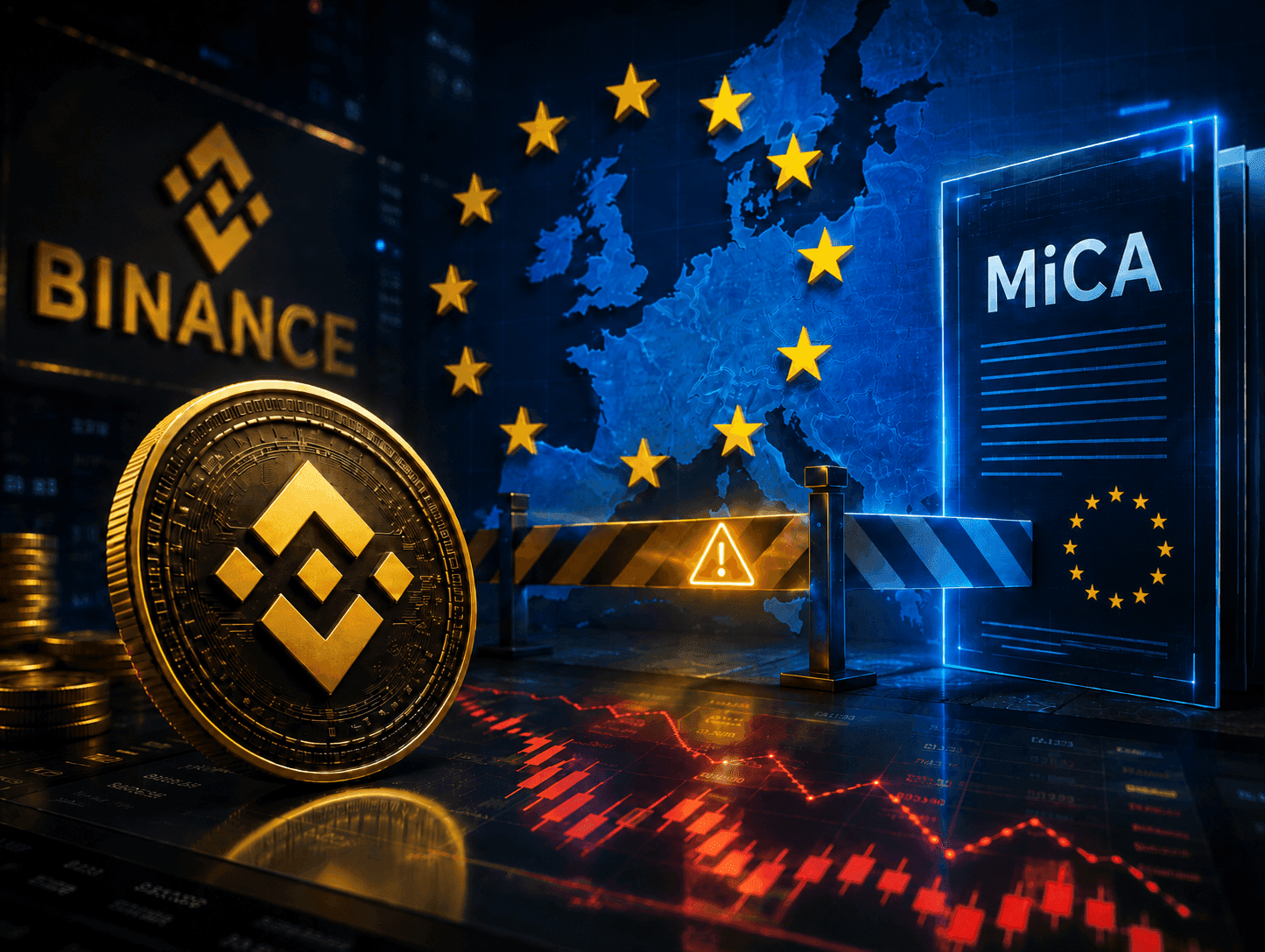
How to Switch from Binance to a MiCA Regulated Crypto Exchange
Binance is winding down EU services after missing the MiCA deadline. Here's why it's happening and how to move your funds to a regulated platform safely.

September 28, 2023 5:36 AM
Kraken’s Growth in Europe
Explore Kraken's latest strides in Europe as they secure crucial licenses in Ireland and Spain. Dive into the implications for EU crypto enthusiasts and Kraken's strategic vision for the future.
August 31, 2023 9:24 AM
Top 5 Bitcoin ETFs You Can’t Afford to Miss!
The most optimal Bitcoin exchange-traded funds provide a pricing exposure. This article is all about the top 5 Bitcoin ETFs.
June 3, 2021 10:31 PM
Easy Guide: How to Buy Bitcoin on Binance!
This article will be the easiest guide on how to Buy Bitcoin on Binance. But before we go over the step-by-step guide, we need to understand some basics.
April 7, 2020 2:31 PM
With Paymium exchange you will be paid for every trade
Starting this week, Paymium, the world’s first bitcoin exchange launched in 2010, introduces negative trading fees. Market makers, i.e., traders who place limit orders, receive a refund of 0.1% on their order size for every transaction. In other words, they […]

October 21, 2026 10:36 AM
LEO Token ranks 18th but moves just $150,000 a day: what that means for your exit
LEO Token is number 18 on the crypto market by market value, yet moves only around $150,000 a day, and 90 percent of that at a single venue. What this means for the route out, your provider's authorisation and the holding period.
October 15, 2026 7:29 AM

17 of 20 top coins down, Ethereum at $2,380: where the sell-off is measured
Ether loses 5.41 percent over 24 hours and falls to a daily low of $2,332.43. Our own count of the 25 largest cryptocurrencies shows how broadly the sell-off really carries.
September 15, 2026 10:12 AM
CoinEx Is Shutting Down: The Deadline to Withdraw Your Balance
Crypto exchange CoinEx is winding down and the withdrawal channel closes on December 22, 2026. Our own measurement on the day of the first wind-down stage shows which 37 currencies cannot be withdrawn right now and why the chain you pick decides a double-digit percentage of your residual balance.
August 19, 2026 10:14 AM
Sparkasse Crypto Trading: An Assessment of the Planned October Launch
The Sparkassen are set to offer crypto trading in their own app from mid-October 2026, built by DekaBank. This assessment separates what is documented from what remains judgement.
February 11, 2025 1:00 PM
Altcoin News: Is Altcoin Season Finally Here? Here’s How to Capitalize on It
Altcoin season might be here as technical indicators are showing positive changes. What is alt season, how to prepare for it, what are the top altcoins to watch, and how to buy altcoins? Here's what you need to know.

More from CryptoTicker