
Crypto Trading Bots: How They Work, What They Cost and When They Pay Off
A crypto trading bot trades around the clock to fixed rules, and every one of those rules costs a fee. This guide works the costs through over twelve months, sets out the German tax position under Section 23 EStG and shows when a provider needs a BaFin licence.




Which topics should we dive deeper into?
Select what genuinely interests you. Your picks feed directly into our editorial planning.
Crypto news that's actually worth your time.
Weekly. 60 seconds. Carefully curated by our editors: no hype, no promo flood, no spam.
A crypto trading bot promises exactly what an investor with a day job cannot deliver: trading around the clock, to fixed rules, without a night shift and without gut feeling. The software does not tire, it does not hesitate and it does not change its mind when the price turns uncomfortable. That is where its appeal lies.
It is also where the problem lies, the one missing from the providers' marketing copy. Every single rule the bot executes costs a trading fee. In Germany, every execution additionally creates a separate taxable event that you must be able to evidence individually at year end. And where a provider actually takes the investment decision off your hands, it becomes a service for which the financial regulator requires a licence.
This piece works through the cost side, sets out the German tax position and shows which regulatory questions you should settle before your first deposit. If you also want to know which providers matter at all in the German market, the current market overview is in our comparison of crypto trading bots.
What a Crypto Trading Bot Technically Is: Rule Set, API Key and Order Routing
A trading bot is a program that places orders through a programming interface, the API of your trading platform. In your exchange account you create an API key, a pair consisting of a public identifier and a secret key, and you grant that key certain rights. The bot logs in with this key, reads prices and account balances and sends buy or sell orders.
What matters is what technically does not happen: your balances never leave the exchange. The bot moves them inside your account between euros and crypto assets. As long as the API key carries no withdrawal right, the software cannot send anything to an external address. This separation is the single most important security mechanism in the whole set-up, and it is also the one most often skipped.
Self-Hosted or as a Subscription Service
Broadly, two operating models can be distinguished. In the first, the software runs on your own machine or on a server you rent; you carry responsibility for updates, outages and key management. In the second, the bot sits with the provider, you rent it monthly, and your API key lives on their infrastructure. The second variant is more convenient and shifts the key risk onto a company whose security level you cannot inspect.
Grid Bot, DCA Bot and Arbitrage Bot: Three Designs With Three Different Market Assumptions
Behind the product names sit only a handful of mechanics. Each of them assumes a particular market condition, and none works when that assumption fails.
The grid bot lays a lattice of buy and sell orders across a price range. If the price falls to a grid line, it buys; if it rises to the next line up, it sells the quantity just bought. What it earns is the distance between two lines. The assumption behind it is that the price oscillates sideways. If the price breaks downwards, the bot sits on a chain of buy positions that are all under water, and the grid logic turns into an averaging-down strategy with no exit.
The DCA bot automates the cost-averaging effect. It buys a fixed amount at fixed intervals, regardless of price. Some variants buy additionally when a position has fallen by a defined percentage. These top-up levels are the real source of risk, because they multiply the capital committed in a falling market.
The arbitrage bot exploits price differences between two venues. It requires you to hold balances on both venues simultaneously, the difference to exceed twice the trading fee, and nobody to be faster than you. All three conditions are hard for private investors to sustain; institutional participants run the same trade with servers sitting next to the matching engine.
Alongside these there are signal bots, which execute third-party trading recommendations automatically, and copy trading services, which mirror another user's positions. In regulatory terms these are the trickiest constructions, because there the decision clearly no longer rests with you.
The Trading Fee Eats the Grid Profit: A Model Calculation Over Twelve Months
The decisive number for any high-frequency bot is not the return but the fee per turnover. A round trip, meaning a purchase plus the matching sale, costs you your exchange's trading fee twice over. The following calculation is this editorial team's own model with disclosed assumptions, not a measurement of a real product: stake €2,000, order size per grid line €100, calculated over 365 days.
| Fee per side | Round trips per day | Fees per year | Share of the stake |
|---|---|---|---|
| 0.10 percent | 4 | €292 | 15 percent |
| 0.10 percent | 8 | €584 | 29 percent |
| 0.10 percent | 20 | €1,460 | 73 percent |
| 0.25 percent | 8 | €1,460 | 73 percent |
| 0.25 percent | 20 | €3,650 | 182 percent |
The figures look absurd, but they are plain multiplication. A grid bot turning over twenty times a day moves roughly €1.46 million of trading volume in a year on a stake of €2,000. You pay the fee on that volume, not on your stake.
From this follows a rule of thumb every grid configuration has to pass: the distance between two grid lines must be greater than twice the trading fee. At 0.10 percent per side the floor is 0.20 percent; at 0.25 percent per side it is 0.50 percent. Configurations with a tight grid and an expensive fee tariff work structurally at a loss, whatever the price happens to do.
With rented bots the subscription fee comes on top. Fifteen euros a month is €180 a year and therefore nine percent of a €2,000 stake; fifty euros a month is €600 and therefore thirty percent. Whoever starts small pays the most in proportional terms. Which fee tariff applies to you at all depends on your trading platform and on your thirty-day volume; switching tariff changes the arithmetic more than any parameter tuning on the bot.
 Crypto exchanges compared
Spread, Slippage and Funding: The Cost Blocks That Appear in No Fee Table
The trading fee is the visible part of the bill. Three further items appear on no price list and only surface in the account statement.
The spread is the difference between the best buy and the best sell price in the order book. Anyone who wants immediate execution pays it on every turnover. On a liquid pair such as bitcoin against the euro it barely registers; on a small altcoin it can exceed the entire grid margin.
Slippage arises when your order is larger than the quantity available at the best price. Execution then walks through several order book levels, and your average price comes out worse than the quoted one. Bots working in thin market phases, at night in European time for instance, regularly meet depleted order books.
Funding concerns you only if your bot works on perpetual futures rather than the spot market. There a balancing payment between the long and short side falls due several times a day. In a longer-lasting trend the more crowded side pays continuously, which slowly erodes a position that is in itself correct.
Add a balance transfer between two platforms, as in arbitrage approaches, and you also pay withdrawal and network fees. The two items are rarely identical: the exchange usually sets its withdrawal flat rate independently of actual network load. They belong in an upfront calculation all the same, because they recur with every transfer.
Why a Good Backtest Proves Little: Overfitting, Survivorship Bias and Data Gaps
Almost every bot provider shows a historical evaluation of its strategy. These evaluations are systematically too optimistic for three reasons.
Overfitting means the parameters were tuned against the past until the result looked convincing. A grid with exactly 1.7 percent spacing and exactly 14 lines is no law of nature but the result of a search across thousands of combinations. On new data a configuration found that way regularly falls back.
Survivorship bias describes the selection of trading pairs. Run a strategy over the coins of recent years and you almost always test it over projects that still exist. The tokens delisted or rendered worthless in the same period are missing from the data set, and so are their losses.
Data gaps arise exactly where it matters. Historical price series do not capture exchange outages, overloaded interfaces or suspended withdrawals. A backtest assumes every order was executed at every point in time. In the hours of a market crash that assumption holds least.
The test becomes more meaningful if you first run a configuration for several weeks in paper trading or with a very small amount and compare the actual execution prices with the expected ones. The difference between the two is the most honest metric you can obtain about your bot.
Every Bot Trade Is a Private Disposal Transaction Under Section 23 EStG
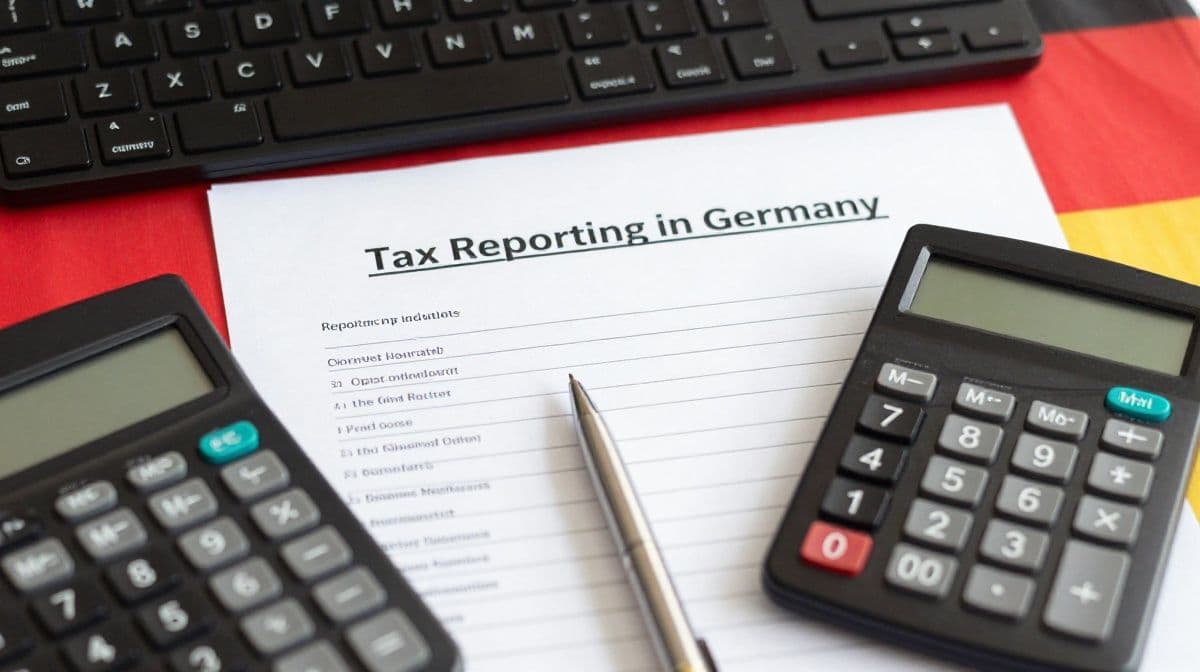
This is the point at which German investors are regularly caught out. Under the case law of the Federal Fiscal Court, crypto assets are economic goods. Sale and exchange therefore fall under the private disposal transactions of Section 23 (1) sentence 1 no. 2 of the German Income Tax Act, provided no more than a year lies between acquisition and disposal.
A bot typically holds positions for hours or days. Practically every gain it produces therefore falls inside the one-year period and is taxable, taxed at your personal income tax rate. The one-year holding period that protects buy-and-hold investors does not, as a rule, apply to automated trading.
The allowance only helps with small amounts: under Section 23 (3) sentence 5 EStG gains remain tax-free if the total gain from all private disposal transactions in a calendar year is below €1,000. That is an exemption threshold, not an allowance. At a gain of €1,000 the full amount is taxable, not only the excess.
A second point is often overlooked: exchanging one crypto asset for another is also a disposal. A bot switching back and forth between two tokens without ever touching euros still creates a tax-relevant event at every step. If you would rather estimate your tax burden in advance, suitable tools are in our comparison of crypto tax tools.
 Crypto tax tools compared
The Record-Keeping Duty From the Finance Ministry Circular Hits Bot Users Harder Than Buy-and-Hold Investors
The Federal Ministry of Finance recast the tax treatment of crypto assets on 6 March 2025, superseding the circular of 10 May 2022. Newly added is a dedicated section on tax return, cooperation and record-keeping duties. For automated trading that is the most consequential part of the entire document in practice.
Under margin number 102 of the circular of 6 March 2025, every private disposal transaction must be traceable individually and on its own terms. Required at minimum are the full name or ticker of the crypto asset, the quantity concerned, the gain stating acquisition cost and disposal proceeds, the time and respective price of purchase and sale, and the holding period. That applies to every single event.
Do the arithmetic for a grid bot. Eight round trips a day make sixteen executions, so across a year roughly 5,800 events subject to documentation from a single bot. By hand that is no longer feasible. This is precisely why the circular refers in margin number 101 to tax reports that appear plausible, while making clear that the tax authority may request the underlying transaction overviews and CSV files.
Process Documentation for Self-Built Software
Anyone meeting accounting or record-keeping duties with dedicated software must, under margin number 98, additionally produce process documentation and observe the principles of immutability and completeness. That primarily concerns the business sphere. Anyone programming their own bot and using its log files as the basis of evidence should nevertheless know the requirement before an audit comes around.
FIFO, Wallet Scope and Loss Offsetting: Three Stumbling Blocks in the Tax Return
Three rules decide whether your statement holds up in the end.
The allocation method. Where individual identification is not possible, the crypto assets of one trading designation acquired first count as disposed of for the purposes of the holding period. For valuation the circular likewise permits the first-in-first-out method for simplicity. A bot continuously mixes old and new holdings; without a clean choice of method it is barely possible afterwards to reconstruct which purchase belongs to which sale.
The wallet scope. The assessment is made per wallet. Within one wallet you must retain the chosen method until all crypto assets of that trading designation there have been fully disposed of. Anyone letting two bots trade the same coin on two exchanges at once is running two separate accounting circles.
Loss offsetting. Under Section 23 (3) sentence 7 EStG, losses from private disposal transactions may be offset only up to the amount of the gains you achieved from private disposal transactions in the same calendar year. A loss year can be offset against neither your salary nor your investment income. What remains possible is carry-back into the immediately preceding year and carry-forward into the following years, in each case again only against gains from the same type of income.
When a Bot Provider Needs a BaFin Licence: Portfolio Management and Signal Provision
The regulatory question turns on a single feature: who takes the investment decision? As long as you set the rules yourself and the software merely executes them, the provider is supplying a tool. As soon as it has its own discretion over someone else's assets, it becomes financial portfolio management, and that requires a licence from BaFin under Section 32 (1) sentence 1 of the German Banking Act.
The regulator classifies platforms for automated portfolio management and investment advice as robo-advice and treats signal provision with automated order execution, meaning signal following and social trading, as a category of its own. Crypto asset services have additionally been subject to the German Crypto Markets Supervision Act since the European market regulation. For you as a user that means a service which automatically mirrors another trader's positions into your account is something different in regulatory terms from a grid you configured yourself.
How to Spot an Unlicensed Bot Platform: BaFin Warnings as a Checking Step
On 4 February 2025 BaFin published a consumer notice on a series of websites advertising an AI-driven trading algorithm for financial instruments and crypto assets. According to the regulator's findings, financial and crypto asset services were being offered there without the required licence. Eighteen addresses are listed with near-identical wording and the same page structure; details of the registered office were missing throughout. The notice is based on Section 37 (4) of the German Banking Act and Section 10 (7) of the Crypto Markets Supervision Act.
The pattern transfers, and it can be checked in a few minutes. Look for complete provider and registered office details in the legal notice, for an entry in the regulator's company database, for a traceable revenue source on the provider's side, for the question of whether your capital is meant to leave the exchange at all, and for return figures that come without a loss scenario. A platform demanding a direct deposit into an account of its own instead of an API connection to your exchange belongs in a different category from a bot. How to query the warning lists of European supervisory authorities systematically is described in our piece on the ESMA warning list for crypto providers.
Securing the API Key: Disable Withdrawal Rights, Set an IP Whitelist, Separate Permissions
If you decide on a bot, the way the key is set up determines your loss exposure. Five settings are the most important.
- Issue the key without withdrawal rights. Trading permissions are enough for any bot; a withdrawal right is needed in no use case.
- Enter an IP whitelist where your exchange offers one. The key then works exclusively from your server's address.
- Use a separate key for every bot. If one service is compromised you block that one specifically and not your entire access.
- Limit the capital deployed to an amount whose total loss would not touch your planning, and move the rest into separate custody.
- Review the list of active keys in your exchange account monthly and delete everything you no longer operate.
A self-hosted bot shifts the risk onto your own server maintenance, a rented one onto the provider's security. Both routes are defensible, as long as the key cannot move money.
Who a Crypto Trading Bot Pays Off For and Who It Remains a Pure Cost Machine For
After the cost, tax and regulatory checks, a narrow field remains in which automation makes sense.
A bot makes sense where you already apply a rule manually and use it only for execution. A DCA bot buying a fixed amount monthly creates few events, incurs low fees and takes the discipline of timing off your hands. The same goes for automatic stop rules that close a position after a defined loss.
It becomes questionable with high-frequency grids on small capital. There the relationship between expected margin and guaranteed fee shifts so far that the exchange earns while you carry the price risk. Before setting up, work out how much trading volume your configuration generates in a year and multiply it by your fee rate. If the result exceeds a realistic return target, the configuration has already been decided before it starts.
And add in the time the tax return costs. A bot generating 5,800 documentation-liable events a year is practically impossible to represent without a transaction analysis tool. Those costs belong in the same calculation as the trading fee.
Crypto Trading Bots: What to Take Away
- Work out the fee before the strategy. Multiply order size, turnovers per day and fee rate out over a year. If the result exceeds your return target, you need a different configuration or a cheaper tariff. The current market overviews are in our comparison of crypto trading bots.
- Check your trading platform's tariff and licence. Your fee rate determines the floor for grid spacing, its authorisation determines your legal protection. You will find both in our comparison of crypto exchanges.
- Settle the documentation before the bot runs. Every turnover is a separate taxable event with an evidence requirement. Set the reporting up at the start rather than in the following year; suitable tools are in our comparison of crypto tax tools.
(As of August 18, 2026. This article is not investment advice. Prices and fee structures change; check the terms with the provider before you buy.)
Transparency note: This article was produced with the assistance of artificial intelligence and reviewed by our editorial team before publication. All figures and claims were checked against the primary sources linked in the text. The feature image was generated with AI.
Related articles
- Crypto AI Trading: How to use Algo Trading to your Advantage
- Bitcoin Robot That Trades for You Making Big Gains, Read On...
- Euro Trading Pairs at Crypto Exchanges: At Coinbase Exchange 34 of 399 Assets Have a Euro Order Book
- Bitget Review 2026: Fees, Safety After the $388M Hack and Who Can Use It
- OKX Launches Bot Trading Promo With Loss Protection
Which topics should we dive deeper into?
Select what genuinely interests you. Your picks feed directly into our editorial planning.
Crypto news that's actually worth your time.
Weekly. 60 seconds. Carefully curated by our editors: no hype, no promo flood, no spam.

March 27, 2026 9:53 PM
OpenClaw AI Trading 2026: Can AI Trading Really Make You Money?
AI trading agents like OpenClaw are trending, but a $441,000 error and a 62% loss by GPT-5 reveal the brutal reality of autonomous crypto bots in 2026.

October 19, 2026 4:15 AM
Crypto FIFO across several exchanges: each wallet counts on its own in Germany
Hold bitcoin on several exchanges and in wallets of your own, and the holding period is calculated per pot, not across the total holding. What paragraph 62 of the BMF guidance orders, and why 31 December 2026 hangs on it.

September 27, 2026 1:17 PM
Dogecoin Price: What to Check on Holding Period and Custody Before the Year End
The Dogecoin price stands at $0.0977 on September 27, 2026 and has barely moved in a day. That calm is exactly the moment to work through the holding period, the reporting duty from 2026 and custody without any time pressure.
September 19, 2026 7:26 AM
Offsetting Crypto Losses Against Share Gains: What Is Really Allowed in Germany
Crypto losses and share gains sit in separate loss buckets in Germany, and there is no offsetting between them. Where the line runs, why crypto derivatives are the exception, and how you can still use losses through carryback and carryforward.
August 16, 2026 6:14 AM
Crypto Credit Card Tax in Germany: Why Every Payment Is a Disposal
Paying with a crypto credit card means disposing of your coins for tax purposes. What that means for the holding period, the exemption threshold and your record-keeping duties, and which card design keeps the effort small.

August 5, 2023 3:09 PM
Comprehensive Guide to Cryptocurrency Trading Bots
Delve into our comprehensive guide to cryptocurrency trading bots. Understand their importance, factors to consider when selecting a bot, and an in-depth analysis of top bots. Amplify your crypto trading potential.
October 6, 2026 10:24 PM

Germany's Crypto Holding Period Before the Petitions Committee on October 12: What Matters Now
The Bundestag's petitions committee debates the crypto holding period on Monday, October 12, 2026, from 12 noon in a public sitting, with federal government representatives on hand for questions. Two days later the cabinet is to decide on the draft bill that removes the one-year period for purchases from 2027.
September 29, 2026 10:40 AM
“We have created the essential conditions …”: bitcoin.de has stood still for three months, the MiCAR licence is missing
Bitcoin Group SE published its half-year report on September 29, 2026: trading on bitcoin.de has been idle since the end of June because the MiCAR authorisation is missing. The new platform is finished, but no launch date is set.
September 25, 2026 10:26 PM
Selling bitcoin privately: the tax in Germany and the records you need
A direct sale to a private individual falls under the same one-year rule as an exchange sale, but there is no tax report to go with it. This guide walks through the calculation, the 1,000 euro threshold and the records the tax office wants to see.
September 24, 2026 1:13 AM

Solana DEX Trades Overtake the NYSE: What to Check on Swaps, Tax and Oversight
Solana's decentralised exchanges settled roughly 208 million trades in a single week and overtook the New York Stock Exchange for the first time. The figure is real, but it measures something other than the comparison suggests, and for German investors it carries tax duties that no provider takes on.
September 8, 2026 10:21 PM
Crypto Holding Period and Grandfathering: Why December 31, 2026 Becomes the Cut-Off in Germany's Draft Bill
A ministerial draft bill from Germany's finance ministry names a cut-off date for the first time: crypto assets acquired after December 31, 2026 are to fall under the flat-rate withholding tax. What that means for legacy holdings, running savings plans and staking income, and why nothing has been decided yet.
September 7, 2026 7:22 AM

German Crypto Holding Period Set to Go After All: A Separate Draft Targets Purchases From 2027
Correction of 8 October 2026: The Income Tax Reform Act 2027, adopted by the German federal cabinet on 2 September, does not cover crypto assets. That did not mean the holding period stays. A separate draft bill from the Federal Ministry of Finance, dated 30 September, would abolish it for anything acquired after 31 December 2026. The cabinet is due to decide on 14 October.
October 16, 2026 4:15 AM
241 scam sites taken offline, the recovery scam lives on: what to check now
The Brooklyn District Attorney and the FBI shut down a fraud network of 241 websites and 112 servers on 14 October 2026; the second stage of the scheme was a purported recovery service. Five days earlier, German regulator BaFin had warned about exactly this pattern at a purported bank.
October 6, 2026 4:32 AM
Bitcoin for a gift card: what paying with crypto means for your holding period
Paying for a gift card with Bitcoin is a sale for tax purposes. What counts as the disposal proceeds, when the twelve-month holding period bites, and the four records the tax office expects.
September 22, 2026 10:13 AM
Circle Lends Against Bitcoin via cirBTC: Why the Wrapper Can Cost You the German Holding Period
Circle launched loans against deposited bitcoin on September 21, 2026. In Germany, the detour through the cirBTC token is very likely a swap, and a swap restarts your one-year holding period.
September 9, 2026 4:13 PM

Bitcoin 29 Percent Below Last Year: Which Crypto Losses You Can Still Use Before the One-Year Holding Period Expires
Nine out of ten major crypto assets trade lower today than exactly twelve months ago, Bitcoin alone by 29.2 percent. We measured the price series ourselves and show why the purchase date alone decides the tax value of your loss.
September 8, 2026 1:19 AM

Germany's Crypto Holding Period: What Happens Now Signing for Petition 201716 Closed on September 15
Recap as of September 27, 2026: the signature period for German parliamentary petition 201716, which asks for the one-year crypto holding period to be preserved, closed on September 15, 2026. This article explains what ended that day, how the petitions committee proceeds and why no investor has to sell because of it.
August 13, 2026 6:18 AM

Revolut Delists USDT: Forced Conversion on August 31, 2026 Counts as a Sale
Revolut is taking USDT off the table on August 31, 2026: purchases have already stopped, deposits are blocked, and anyone who fails to act before the deadline faces an automatic conversion that counts as a sale for tax purposes. This article explains the deadlines, the tax treatment under section 23 of the German Income Tax Act and what you can do now.
August 11, 2026 9:13 PM

Germany's Crypto Holding Period Faces Abolition: What Petition 201716 and the Draft Bill Mean for Your Tax
Petition 201716 calls for the one-year holding period for crypto assets to be kept and will be heard in public by the Bundestag's Petitions Committee on 12 October 2026. Correction of 8 October: the reform was not decided by the cabinet in July. A draft bill of 30 September would end the holding period for crypto acquired after 31 December 2026, and the cabinet is due to take it up on 14 October.
October 9, 2026 7:21 AM
Ethereum savings plan: twelve instalments averaged 1,981 euros, the lump sum 3,318
Twelve monthly instalments of 100 euros in Ether worked out at an average price of 1,981 euros, while a lump sum on the starting day cost 3,318 euros. The twelve-month calculation, the two quirks that set it apart from a Bitcoin savings plan, and the tax consequences of twelve separate purchases a year.

September 24, 2026 10:19 AM

Uniswap Falls 11.8 Percent After a 114 Percent Month: What to Check on Profit Taking, Holding Period and Leverage
UNI lost 11.75 percent on Wednesday morning but is still up 113.85 percent over the month. Anyone realising gains now almost certainly triggers a taxable disposal in Germany.
September 15, 2026 4:12 AM

Using Hyperliquid from Germany: What Applies to Your Funds Without a MiCA Licence
Hyperliquid is not entered in any EU register as an authorised crypto-asset service provider, and for perpetual futures a MiCA licence would be the wrong paperwork anyway. Here is what that means in concrete terms for your funds, your keys and your tax return.
August 19, 2026 10:30 AM

The bitcoin.de Trading Halt: An Assessment of What the Standstill Means for Your Balance
Trading and deposits at bitcoin.de have been suspended since 12 June 2026, and no new start date has been named so far. This assessment separates the documented from the presumed and shows what you can check yourself for your balance today.
September 1, 2026 10:13 AM
BaFin Crypto Knowledge Survey: Four Assumptions Owners Believe Are True
BaFin has measured what crypto owners know about their products: 57 percent of the answers were correct, 31 percent wrong. Four false assumptions come up especially often, and each of them changes your own investment decision.
September 3, 2026 10:32 PM
Crypto Fees at Neobrokers: Why the PFOF Ban Raises Your Stock Costs but Leaves Your Coin Purchase Untouched
Since September 2, N26 charges 0.90 euros per stock order again, while the same provider takes 1.5 to 3.5 percent for a coin purchase. We retrieved and analysed the crypto costs of ten providers ourselves.
August 27, 2026 7:21 AM
Crypto Gains 2026: Why the September 10 Advance Tax Payment Decides Your Interest Bill
The third income tax advance payment falls due on September 10, yet for most crypto investors none was ever set. We checked four provisions in full text and show when the interest period for 2026 starts and how you can shrink it yourself.
More from CryptoTicker