
Bitget Review 2026: Fees, Safety After the $388M Hack and Who Can Use It
Bitget review for October 2026: fees, the $388 million hack, withdrawals, Proof of Reserves and the countries where Bitget cannot be used.


Which topics should we dive deeper into?
Select what genuinely interests you. Your picks feed directly into our editorial planning.
Crypto news that's actually worth your time.
Weekly. 60 seconds. Carefully curated by our editors: no hype, no promo flood, no spam.
Bitget is a crypto exchange founded in 2018 that built its name on futures, copy trading and trading bots. Two events shape any Bitget review in October 2026: on 24 September 2026 attackers stole about $388 million from the exchange's hot and warm wallets, and Bitget still holds no authorisation under the EU's MiCA rules. Bitget says customer balances were never affected, and all withdrawals have been open again since 2 October. This review covers what the platform offers, what trading costs, how the hack unfolded, where the Protection Fund and Proof of Reserves stand now, and who is allowed to use Bitget at all.
Our up-to-date Bitget review covers fees, the proof of reserves, the September 2026 hack and Bitget's licence status in the EU.
Key Takeaways
- Standard fees are 0.1% for spot trades (20% less when fees are paid in BGB) and 0.02% maker and 0.06% taker for futures.
- The September 2026 hack ran through a zero-day flaw in a third-party security product. Chainalysis attributes the theft of $387 million to North Korean actors.
- The Protection Fund absorbed the loss and was back above $300 million on 30 September. The Proof of Reserves snapshot of 29 September shows a 131% reserve ratio.
- Bitget's Terms of Use list the United States, Canada, Germany, France, Austria, Japan, Singapore and Hong Kong, among others, as prohibited countries.
Bitget at a Glance (October 2026)
| Item | Bitget |
|---|---|
| Founded | 2018 |
| Operator under the Terms of Use | BTG Technology Holdings Limited, terms governed by Hong Kong law |
| Registered users | 120 million (company figure) |
| Products | 600+ spot tokens, USDT-M, USDC-M and Coin-M futures, copy trading, bots |
| Spot fee | 0.1% maker and taker, 20% discount when paid in BGB |
| Futures fee | 0.02% maker, 0.06% taker |
| EU authorisation (MiCA) | none, application filed with Austria's FMA |
| Proof of Reserves | 131% overall, snapshot 29 September 2026 |
| Protection Fund | above $300 million (30 September 2026) |
What Is Bitget?
Bitget is a centralised exchange. Customers deposit coins or cash, the exchange holds the assets and matches orders in its own order book. Trading on Bitget therefore means holding a claim against the exchange, not your own private keys. According to its company page, Bitget was founded in 2018 and counts 120 million registered users and more than 1,800 employees from 60 countries and regions. Gracy Chen is the CEO.
Since September 2025 Bitget has called itself a “Universal Exchange”: a single venue for crypto plus contracts on stocks, gold, forex and commodities. We covered the launch of its gold, forex and commodities markets separately. Crypto derivatives and copy trading remain the core of the business.
Which country is Bitget based in? Under its Terms of Use the platform is operated by BTG Technology Holdings Limited, and the terms are governed by Hong Kong law. Bitget's licence page lists registrations or licences in Australia (AUSTRAC), Switzerland (membership of an anti-money-laundering self-regulatory body), South Africa, Argentina, Mexico, El Salvador, Mauritius and Georgia. In the UK, Bitget lists an arrangement with an FCA-authorised firm. It lists no licence in any EU country.
Key Features Of Bitget Exchange
Spot Trading
On the spot market you buy and sell coins at the current price with immediate settlement. Bitget says it lists more than 600 tokens, most of them traded against the stablecoin USDT.
Futures Trading
Bitget offers perpetual contracts settled in USDT, in USDC or in the underlying coin (Coin-M). Leverage turns small price moves into large gains or losses, and a position is liquidated once the margin no longer covers it. Perpetuals also carry a funding payment between longs and shorts every eight hours.
Copy Trading
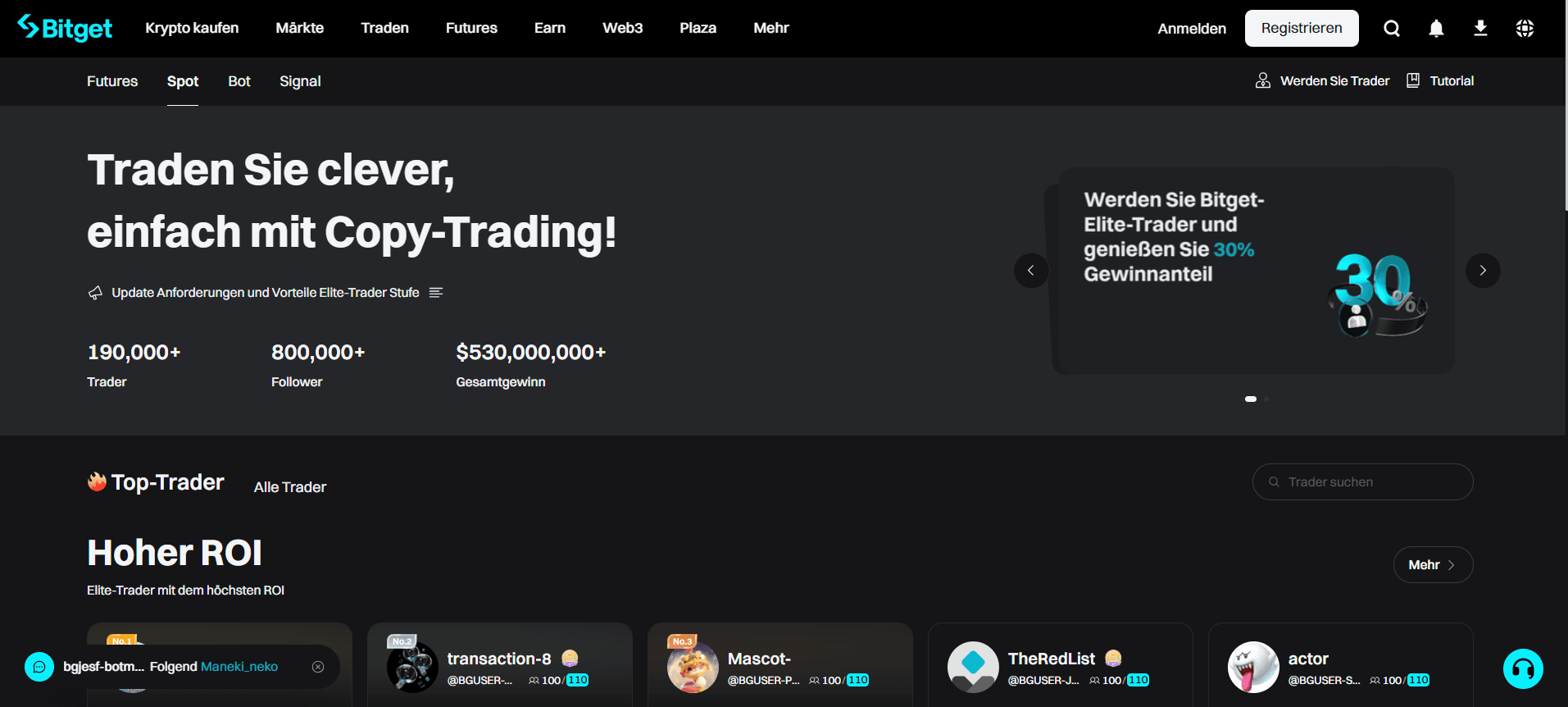
Copy trading mirrors the positions of other traders in your own account. Bitget describes itself as the largest crypto copy trading platform. The trader you follow passes on losses just as readily as gains, so set a maximum allocation and a stop-loss before you start. Our Bitget copy trading guide walks through the settings.
Trading Bots And Bitget Earn
Bots execute buy and sell orders by fixed rules, for example inside a preset price grid. Bitget Earn bundles savings and staking products whose yields change by coin and campaign. Neither a bot nor an Earn product removes market risk.
BGB Token
BGB is Bitget's own token. Paying spot fees in BGB cuts them by 20%. The token's price moves like any other coin, so a fee discount can easily be wiped out by a drop in BGB.
Bitget Wallet
Bitget Wallet is often confused with the exchange, but according to Bitget Wallet it is a self-custodial wallet, and the wallet and the exchange are separate businesses with separate ownership. You hold the keys yourself. The September attack hit the exchange's hot and warm wallets, not the wallet app. For larger amounts, a device from our hardware wallet comparison keeps the keys offline.
Bitget Fees In 2026: Spot, Futures And Withdrawals
Bitget charges trading fees as a percentage of the traded value. The standard rates apply to accounts without a VIP tier; higher trading volume, larger balances or BGB holdings lower them. The table uses the rates from Bitget's Trading Fees FAQ (updated 20 August 2026) and its spot trading rules.
| Item | Fee | Example on 1,000 USDT |
|---|---|---|
| Spot, maker and taker | 0.1% | 1.00 USDT |
| Spot, fee paid in BGB | 0.08% (20% discount) | 0.80 USDT |
| Futures, maker | 0.02% | 0.20 USDT |
| Futures, taker | 0.06% | 0.60 USDT |
| Funding on perpetuals | position value times funding rate, every 8 hours | depends on the market |
| Crypto deposit | no Bitget fee, network fee only | 0 USDT |
| Crypto withdrawal | varies by coin and network, shown before you confirm | varies |
Futures fees are charged on the position value, not on your margin. Open a 1,000 USDT position with 100 USDT of margin at 10x leverage, close it with a market order, and you pay 0.60 USDT twice. Those 1.20 USDT equal 1.2% of your margin before any funding is due. Frequent high-leverage trading therefore costs far more than the small percentages suggest. How network fees for withdrawals differ across coins is covered in our overview of crypto withdrawal fees.
Is Bitget Safe? The September 2026 Hack
What Happened
At 18:31 UTC on 24 September 2026, Bitget detected unauthorised transfers from part of its hot and warm wallet infrastructure. Cold wallets holding the majority of platform assets were not affected, the exchange says. In its incident overview Bitget puts the verified loss at about $388 million.
The attacker exploited a zero-day vulnerability in a third-party security product, used it to obtain administrator access and injected forged withdrawal commands straight into the wallet system. Mandiant and SlowMist are supporting the investigation. Chainalysis attributes the theft to North Korean actors: $387 million left the exchange in 23 transfers within three hours, 49.7% via Ethereum, 40.8% via XRP, 7.6% via Zcash and 1.8% via Tron. The details are in our reports on the attack path through third-party software and the North Korea attribution.
Can You Withdraw From Bitget? The Timeline
Trading and deposits kept running while withdrawals were paused. From 28 September Bitget reopened them in four stages at 08:00 UTC each, as set out in its Help Center notice. Bitget says every stage was completed on schedule.
| Date (08:00 UTC) | Reopened | Networks |
|---|---|---|
| 28 September 2026 | Bitcoin (BTC) | Bitcoin |
| 29 September 2026 | Ether (ETH) | Ethereum, BNB Smart Chain, Arbitrum, Base, Optimism |
| 30 September 2026 | Tether (USDT) | Ethereum, BNB Smart Chain, Solana, Tron |
| 2 October 2026 | all other tokens, fiat withdrawals, P2P | all |
If you still hold a balance, our articles on the withdrawal schedule and on what to check at your exchange list the steps.
Protection Fund And Proof Of Reserves
The Protection Fund covered the loss, and Bitget says account balances were left untouched. On 30 September the exchange reported that it had refilled the fund to more than $300 million, ahead of its own schedule. Customers pulled large sums in the same days, as our report on Bitget net outflows shows, and we also covered the restored Protection Fund. How exchange protection funds compare is explained in our protection fund check.
The Proof of Reserves report of 30 September (snapshot 29 September, 09:00 UTC) shows an overall reserve ratio of 131%, with all 19 covered assets above 100%: BTC 142%, ETH 110%, USDT 107% and USDC 154%. A Merkle tree lets each customer check that their balance is included. It is not an audit: the report names no external auditor, and it covers customer balances, not the company's other liabilities.
Protect Your Own Account
Turn on two-factor authentication before the first deposit, use a withdrawal address whitelist where it is offered, and keep only the amount on any exchange that you plan to trade. Everything else belongs in a wallet whose keys you control.
Who Can Use Bitget? Restricted Countries And Regulation
Bitget is not open to everyone. Its Terms of Use, last updated on 20 October 2026, name Austria, Belarus, Canada, Cuba, France, Germany, Hong Kong, Iran, Japan, Kazakhstan, Malaysia, North Korea, Russia, Singapore, Sudan, Thailand and the United States as prohibited countries, along with further sanctioned or high-risk jurisdictions and the Crimea, Donetsk, Luhansk, Kherson and Zaporizhzhia regions. The full, current list is in our Bitget review. Using a VPN to get around the restriction is expressly forbidden. US residents cannot open an account.
In the European Union, the Markets in Crypto-Assets Regulation (MiCA) requires every crypto service provider to hold an authorisation once the transitional periods have ended, on 1 July 2026 at the latest. Bitget EU applied to Austria's Financial Market Authority, according to an update of 2 July 2026. Bitget does not appear in the ESMA MiCA register as updated on 7 October 2026. New sign-ups from Germany and France stopped on 16 January 2026, and French customers lost all services on 31 March 2026. If you live in the EU, an exchange with MiCA authorisation from our list of the best regulated crypto exchanges is the safer route.
Getting Started With Bitget Using Our Referral Link
This walkthrough shows how to open an account on the web platform using this link. It only applies if you live outside the prohibited countries listed above.
Step 1: Create Your Account
Open your browser and visit Bitget. Sign up with email or phone, set a strong password and confirm the verification code. Before depositing, turn on two-factor authentication in the security settings.
Step 2: Complete Identity Verification
Bitget requires identity verification (KYC) before deposits and trading are unlocked. You submit a government-issued ID and complete a face check; further documents such as proof of address can follow.
Step 3: Fund Your Account
For a crypto deposit, choose the coin and the exact network, copy the deposit address and send a small test amount first. Networks are not interchangeable: coins sent over the wrong network can be lost.
Step 4: Place Your First Trade
Start on the spot market with a small order. If you move to futures, use low leverage, isolated margin and a stop-loss, and check the liquidation price before you confirm.
Bitget Pros And Cons
Pros
- low standard fees: 0.1% on spot, 0.02% and 0.06% on futures
- broad product range with USDT, USDC and coin-margined futures, copy trading and bots
- monthly Proof of Reserves, 131% in September 2026
- customer balances unaffected by the hack according to Bitget, all withdrawals open again after eight days
Cons
- no MiCA authorisation; prohibited in the US, Canada, Germany, France, Austria and other countries
- theft of about $388 million in September 2026
- Proof of Reserves without an external auditor
- leverage and copy trading can lead to fast, large losses
Bitget Alternatives With EU Authorisation
These well-known exchanges appear in the ESMA MiCA register as of 7 October 2026, with the authorised entity and the supervisor in charge.
| Exchange | Authorised entity | Supervisor | Authorised since |
|---|---|---|---|
| Bitpanda | Bitpanda GmbH | FMA, Austria | 9 April 2025 |
| Bitvavo | Bitvavo B.V. | AFM, Netherlands | 26 June 2025 |
| Bybit | Bybit EU GmbH | FMA, Austria | 28 May 2025 |
| Coinbase | Coinbase Luxembourg S.A. | CSSF, Luxembourg | 20 June 2025 |
| Kraken | Payward Europe Solutions Limited | Central Bank of Ireland | 25 June 2025 |
| OKX | OKX Europe Limited | MFSA, Malta | 27 January 2025 |
An authorisation says nothing about fees or coin selection; it governs custody, capital and supervision. Our exchange comparison sets the platforms side by side.
Bitget In October 2026: Strong Tools, A Higher Trust Bar
As a trading venue, Bitget offers low fees, deep futures markets and extensive copy trading. It absorbed the September hack through its Protection Fund and had all withdrawals running again after eight days. The open questions are about trust and regulation: a single flaw at a supplier was enough for a theft that, according to Chainalysis, pushed North Korea-linked crypto theft in 2026 past $1 billion; the reserve report is not audited; and without MiCA authorisation Bitget does not meet the licensing rule that applies across the EU. If you live outside the prohibited countries and want to trade actively, start small, secure your account and use this link to get started.
Frequently asked questions about Bitget
Related articles
- BGB Price Prediction: Bitget Token Price UP by more than 25%
- BGB News: Bitget Token Reaches New ATH Amid Market Momentum
- Top 5 Reasons Why Backpack Crypto Exchange is Crushing It
- BXB Market Review 2026: Platform, Pricing, and What Traders Should Know
- Inside Bitget: How COO Vugar Usi Zade Is Shaping the Future of Crypto Trading
Which topics should we dive deeper into?
Select what genuinely interests you. Your picks feed directly into our editorial planning.
Crypto news that's actually worth your time.
Weekly. 60 seconds. Carefully curated by our editors: no hype, no promo flood, no spam.

June 17, 2024 10:59 AM
TOP 3 DEX for June 2024
What are the best DEXs to use in 2024? Here are the top 3 for June 2024!

September 25, 2026 4:13 PM
Crypto Exchange Protection Funds Recalculated: What Really Covers Your Balance After the Bitget Hack
The $351.6 million attack on Bitget would eat up three quarters of the exchange's in-house protection fund. We retrieved the protection promises of several exchanges ourselves and measured them against deposit insurance and MiCA liability.
October 12, 2026 4:16 AM

Binance fees: 0.1 percent to trade, and one drawback compared with MiCA-licensed exchanges
Binance charges 0.1 percent in spot trading and 0.02 and 0.05 percent in derivatives. Since July 1, 2026 the exchange has lacked the MiCA authorisation for the EU, which leaves the fee table answering only half the question German investors are asking.
December 16, 2024 11:00 PM
Bitget Token (BGB) Surges to New All-Time High with $4 Price Target in Sight
Bitget Token (BGB) achieves a new all-time high (ATH) of $3.96, marking a 178.96% increase in a month. With bullish sentiment, market expansion, and key partnerships, BGB is set to target the $4 milestone.
October 29, 2023 2:38 PM
Crypto Exchange: How to use Bitget Exchange?
Bitget exchange stands as a strong option. In this article, we guide you step by step on how to start trading cryptos with the lowest fees.
July 19, 2026 1:59 PM
Top 5 Altcoins to Buy in July 2026 if the Crypto Recovery Holds
Bitcoin found support near its 21-month low around $58K. Here are 5 altcoins under $2B with real utility that could outperform if July's recovery holds.

April 15, 2026 8:44 PM

TradeEU Global Review 2026: What Traders Should Know Before Signing Up
Is TradeEU Global the right broker for you? We tested the platform, compared account tiers, and reviewed the full trading experience for 2026.

June 4, 2025 11:00 PM
Bitget Copy Trading: How to Follow Successful Crypto Traders Step-by-Step
Bitget copy trading automatically mirrors successful traders' strategies. Here's a guide showing you step-by-step the setup, benefits, risks, and tips for choosing the right traders to copy.
January 10, 2025 11:00 PM
Bitget Token Price Surge amid Market Downturn: New 2025 BGB ATH?
In this week's turbulent crypto market taken by downward pressure, BGB made it the top gainer with an impressive price surge. Will it end the week with a new ATH in 2025?
September 25, 2026 4:11 AM
Bitget Pauses Withdrawals: Where Existing Customers in Europe Stand
Bitget reports unauthorised outflows of around $351.6 million (later revised to $387.5 million) and has suspended withdrawals. For existing customers in Europe, that closes the one route MiCA had left them.
September 29, 2024 8:01 PM
Cheapest Way to Buy Bitcoin Today
With Bitcoin trading above $60K, the opportunity to invest is now. Why do experts predict it could still reach $100K and how can you easily buy Bitcoin?
May 20, 2024 10:19 AM

Will Dogwifhat (WIF) Price Still Go Up To Reach $5?
Dogwifhat (WIF), a meme coin based on a viral Shiba Inu meme, is making headlines with its skyrocketing value. What price to expect and what are the support levels now?

October 5, 2023 4:50 AM

Binance’s CZ Turns Down $40M Futures Exchange Proposal from Ex-FTX CEO SBF
In 2019, Binance's CZ made waves by declining a $40M futures exchange offer from ex-FTX CEO, SBF. Dive deep into their differing visions, the birth of FTT token, and the subsequent shifts in the crypto world.
September 10, 2026 1:21 AM

Crypto Exchanges Head to Head: Which Pairing Is Cheaper Where
Before opening an account, the question is rarely which exchange is best overall, but whether it should be this one or that one. This article sorts through the most searched head-to-heads, puts the cost per 1,000 euros side by side and explains the most expensive mix-up: one provider with two interfaces and a factor of seventeen between them.
September 16, 2026 1:28 PM
Crypto Withdrawal to Your Own Wallet: Ten Providers Checked, Three Will Not Let Your Coins Out
Seven of ten providers available in Germany offer a payout to a wallet address you control yourself; three do not. Our survey of September 16, 2026, shows how to spot the difference before you buy, and why the question matters right now.
September 30, 2026 5:03 PM
Bitget after the hack: withdrawals are back and the Protection Fund is above $300 million
Six days after the attack, Bitget is back with strong numbers: withdrawals for Bitcoin, Ether and USDT are running again, the Protection Fund was refilled two days ahead of its own deadline, and the proof of reserves shows 131 percent coverage.
October 6, 2026 7:35 PM

CFTC Opens a 60-Day Consultation on Leveraged Crypto Trading: “The American People Deserve Clarity, Reliability and Consumer Protection”
The US futures regulator CFTC published a 109-page paper on leveraged crypto trading on October 5, 2026. It is a consultation with a 60-day comment period, not a finished rule, and for investors in Germany MiCA and the BaFin general administrative act remain decisive.

February 18, 2024 11:00 PM
Bitget Token: How High Will the BGB Price Go?
This article is all about the BGB price analysis and What is BGB token. Let's take a look at this in more detail.
June 14, 2022 5:12 AM
BAD NEWS! Binance receives a Class Action Lawsuit, Sell BNB NOW?
Will BNB crash further because of the lawsuit? Is Binance safe as a crypto exchange? What happened to the Binance lawsuit? More info here.
June 17, 2026 9:41 AM

SpaceX vs Bitcoin: Which Was the Better Investment?
SpaceX stock vs Bitcoin: who actually won? See what investing at SpaceX's launch versus buying Bitcoin a year ago would be worth today.
August 21, 2026 1:13 AM

Proof of Reserves Explained: How to Check an Exchange Attestation Yourself
A proof of reserves shows that a crypto exchange controlled customer balances on a given reporting date. Here is how to recalculate your own holding in the Merkle tree, and why the attestation says nothing about solvency.
April 18, 2026 5:45 PM
RAVE Token Crash: 4,000% Rally Ends in Violent Dump – What Traders Got Right
RAVE token crashes after a 4,000% rally. Full chart analysis, key levels, and how traders can short or trade RAVE.
June 20, 2025 11:00 PM
Why OKX Might Be the Best Crypto Exchange in Europe – Hands-On Experience
Looking for a beginner-friendly, low-fee crypto platform? In this OKX review, we explore everything from sign-up to crypto trading, earning, and how to get €10 in Bitcoin with our exclusive CryptoTicker referral link.
February 18, 2024 11:00 PM

OKX Continues to Impress with its Transparent Growth
Dive into OKX's latest move in enhancing transparency with their 11th PoR report, showcasing a notable growth in their crypto assets. Discover how OKX is setting new standards in the crypto industry.
July 12, 2024 7:00 AM
Animoca Token Is LIVE: How To Buy MOCA On Bitget?
Here is how the new MOCA token, launched by Animoca Brands and Moca Network is set to revolutionize the Web3 landscape with its unique utilities.
More from CryptoTicker