
Crypto Virtual Portfolio: Track 50 Coins at Real Prices Without an Account
A virtual portfolio shows you how your selection would have developed without risking a single euro. Why crypto behaves differently from equities here, and how to start without registering.

Which topics should we dive deeper into?
Select what genuinely interests you. Your picks feed directly into our editorial planning.
Crypto news that's actually worth your time.
Weekly. 60 seconds. Carefully curated by our editors: no hype, no promo flood, no spam.
The information provided in this article is for informational purposes only and does not constitute financial advice. Investing in cryptocurrencies carries a high level of risk.
A virtual portfolio is a portfolio without money: you buy at real prices, the portfolio books quantity, price and fees, and after a few weeks you see what would have become of your selection. For equities and ETFs, many banks and financial portals offer this. For crypto the choice is narrower, and a crypto virtual portfolio works differently from a securities one in three respects: the market never sleeps, the swings are larger, and tax follows different rules. Here is what a virtual portfolio can do, where the line runs to a watchlist and a portfolio tracker, and how to set up a crypto virtual portfolio without registering.
Crypto virtual portfolio: the key points in brief
- A virtual portfolio is a simulated portfolio with real prices and play money. It books purchases and sales and shows the performance without any money moving.
- Virtual portfolios from banks and financial portals are built for securities: equities, ETFs, funds, bonds. Crypto mostly appears there only as a security, for instance as an ETN.
- A crypto virtual portfolio without registration is possible in CryptoTicker's trading simulator: 10,000 euros of play money, 50 coins, real prices, as of September 28, 2026.
- Crypto trades around the clock, 365 days a year. A virtual portfolio shows you on Monday what happened over the weekend.
- Watchlist, virtual portfolio and portfolio tracker are three different tools: observing, practising, managing real holdings.
- For tax purposes only real ownership counts: coins held privately are tax-free in Germany after a holding period of one year, and below that an exemption threshold of 1,000 euros a year applies (Section 23 of the Income Tax Act, as of 2026).
What is a virtual portfolio?
A virtual portfolio, also called a simulated or demo portfolio, replicates a real portfolio. You decide what you buy and how much of it, the virtual portfolio calculates at the current price, deducts the simulated fees and tracks the performance from then on. If you sell, the gain or loss is booked. There is no real money, no deposit and no withdrawal.
The benefit lies not in the result but in the process: you learn how an order feels, how fees change the outcome and how you react to a decline, without it costing anything. Anyone who later wants to open a real account will find providers, fees and licences for crypto in the exchange comparison.
How is a virtual portfolio structured?
A virtual portfolio looks like a bank's portfolio overview. Each line is a position, and the columns are almost everywhere the same:
- Quantity: how many shares, ETF units or coins you have bought. With crypto, fractions are usual, for instance 0.015 Bitcoin.
- Entry price: the price at which you bought, including the simulated fee.
- Current price: the price now. Some virtual portfolios show real-time prices, others prices delayed by 15 minutes; for practice either will do, for short-term trades it will not.
- Gain or loss: the difference between entry and current value, in euros and in percent.
- Share of the portfolio: what percentage of the total value this position accounts for. That column shows you when a single position has grown too large.
Added to that is the balance, the play money not yet invested. Anyone setting up a virtual portfolio should choose starting capital that matches their later stake, otherwise they practise with sums they will never move.
Watchlist, virtual portfolio, portfolio tracker, demo account: the difference
The four terms are often used interchangeably. They answer different questions:
| Tool | Question it answers | Real money | Books purchases with quantity and price |
|---|---|---|---|
| Watchlist | How are the prices I am interested in developing? | no | no |
| Virtual portfolio | How would my selection have developed? | no | yes |
| Demo account | How do I trade on a platform, including short-term and with leverage? | no | yes |
| Portfolio tracker | What are my real holdings worth, and what do I owe the tax office? | yes, it reads real holdings | yes, from real transactions |
The watchlist remembers prices, the virtual portfolio remembers decisions. A demo account is a virtual portfolio with the full toolkit of a trading account, that is, with stop loss, shorting and leverage; more on that in the guide to the trading demo account. A portfolio tracker, by contrast, is not a practice tool: it collects your real transactions from exchanges and wallets and calculates holdings and tax from them. Which trackers do that well is shown by the comparison of crypto tax tools and portfolio trackers.
Why a crypto virtual portfolio works differently
The market never sleeps
Equities are traded on weekdays during exchange hours. Bitcoin and the other large coins trade around the clock, including on public holidays. A crypto virtual portfolio therefore often only shows you on Monday that something happened on Saturday. For practice that means: decide in advance at which times you will look, and stick to it.
The swings are larger
Daily moves of ten percent are no exception among smaller coins. A virtual portfolio holding five small coins can halve or double within a week without your having done anything right or wrong. That is why the result of a single month serves poorly as evidence for a selection.
Security or coin
The virtual portfolios of banks and financial portals hold securities. Crypto appears there as a rule as an exchange-traded product, for instance as an ETN or ETP. That is not the same as the coin: an ETN is a debt instrument issued by an issuer, and it is treated differently for tax than a coin held privately. What you should check with such products is explained in the guide crypto ETNs in your portfolio. Anyone wanting to practise with the coin itself needs a virtual portfolio with coin prices.
Setting up a free crypto virtual portfolio: in three steps
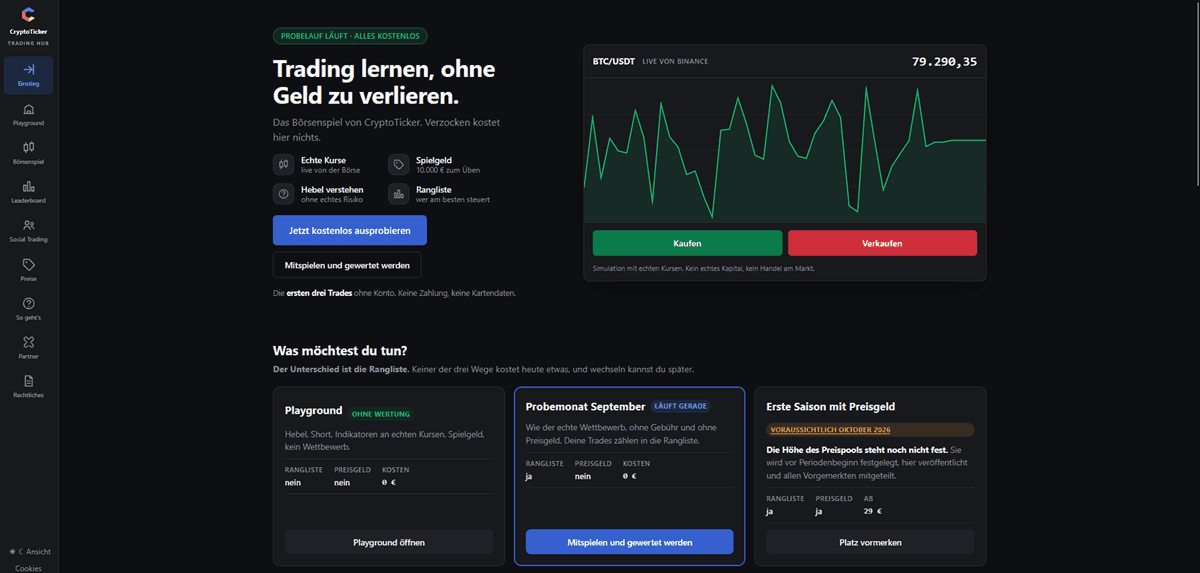
The trading simulator in CryptoTicker's Trading Hub works as a crypto virtual portfolio without registration, as of September 28, 2026:
- Open the page. No account, no email address, no credit card. 10,000 euros of play money are ready, and your state stays saved in the browser.
- Select coins and buy. The 50 largest coins with more than 50 million US dollars of daily volume are available, at real prices. For a classic virtual portfolio you buy without leverage and hold.
- Follow the performance. The portfolio shows the balance, open positions and result. You only need an account once you want to continue on a second device; you can reset at any time.
One exercise: two virtual portfolios, one question
A virtual portfolio becomes valuable when it answers a question. One suggestion, expressly as an exercise with play money and not as investment advice:
- Portfolio A weights three large coins by their market capitalisation.
- Portfolio B spreads the same amount equally across the same three coins.
- Rule for both: look once a week at the same time, reset to the original weighting once a month, and book every reallocation with a fee.
After four weeks you compare not only the result but also the largest drawdown along the way. The question is not which portfolio won, but which one you would have endured. Anyone wanting to do the same exercise with short-term trades will find the fundamentals in the Learn Trading pillar.
Where to find the best virtual portfolio?
That depends on what you want to practise:
- Equities, ETFs and funds: virtual portfolios from direct banks and financial portals. They are mostly free but require registration with an email address.
- Coins at real prices, without registration: a crypto simulator such as CryptoTicker's.
- Active trades with stops, shorts and leverage: a demo account or paper trading on a charting platform.
- Your real holdings: not a virtual portfolio but a portfolio tracker.
You recognise a good virtual portfolio by three things: real or only slightly delayed prices, calculated fees, and starting capital that matches your later stake. Anyone practising with 100,000 euros and later investing 2,000 euros has learned position sizes they will never need.
The way from the virtual portfolio to your first own trade runs through the Learn Trading pillar, with order types, position sizing and a practice plan. Anyone who already owns real coins and needs an overview for tax will find the right tools in the comparison of crypto tax tools and portfolio trackers.
Sources
- Income Tax Act, Section 23, private disposal transactions, as of 2026.
- CryptoTicker Trading Hub, trading simulator, as of September 28, 2026.
- Guide to crypto tax in Germany on CryptoTicker.
 Find a crypto exchange with an EU licence
Frequently asked questions about the crypto virtual portfolio
Transparency note: This article was produced with the assistance of artificial intelligence and reviewed by our editorial team before publication. All figures and claims were checked against the primary sources linked in the text. The feature image was generated with AI.
Related articles
- Germany's account lookup to cover crypto accounts: draft allows five-working-day freezes
- Swing trading crypto: in Germany every euro counts once annual gains reach €1,000
- Eurojust raid on fake trading platforms: more than 100 servers seized, seven arrests
- Margin trading explained: how trading with borrowed money works
- Russia Opens Crypto to Retail Investors on November 17: What Bitcoin, Ethereum and USDT Access Really Means
Which topics should we dive deeper into?
Select what genuinely interests you. Your picks feed directly into our editorial planning.
Crypto news that's actually worth your time.
Weekly. 60 seconds. Carefully curated by our editors: no hype, no promo flood, no spam.

November 6, 2026 1:40 AM
Crypto arbitrage: a €10 price edge loses out to trading fees
Bitcoin costs slightly different amounts on every exchange, and crypto arbitrage lives off exactly that. Our calculation using real order books from four euro exchanges shows why the price advantage disappears into fees for retail investors.
November 5, 2026 11:14 AM
What is KYC in crypto? The five details no exchange will let you trade without
KYC is the identity check without which no licensed crypto exchange in Germany will open an account. Here you learn which data you hand over, how long it is stored and what the Travel Rule, DAC8 and the AMLR from July 2027 change.
November 5, 2026 8:13 AM

Crédit Mutuel Arkéa hack: French bank confirms cyberattack as ZachXBT traces $133 million
French bank Crédit Mutuel Arkéa has confirmed a cyberattack involving fraudulent operations and says customer assets were not affected. Investigator ZachXBT is tracing more than $133 million that allegedly left via crypto exchanges and Monero.
November 3, 2026 1:30 PM
Raiffeisenbank crypto trading: four coins, no securities account, no deposit protection
Raiffeisenbank Schwaben Mitte has switched on crypto trading in the VR Banking app and, according to the Augsburger Allgemeine, is the seventh Bavarian cooperative bank with BaFin approval. Four crypto assets, a settlement account instead of a securities account, an external custodian and no statutory deposit protection: that is what applies at your bank once it switches on.
November 3, 2026 9:21 AM
Leverage trading in crypto: how margin and the liquidation price work
With leverage you move a larger crypto position than your stake would allow. We work through margin and liquidation price, show the leverage limits in the EU and which licensed providers offer leverage trading.
November 3, 2026 7:58 AM

Crypto futures trading: perpetual futures explained simply
Crypto futures and perpetual futures explained: how futures trading works, what the funding rate really costs and which exchanges are licensed for it in the EU.
October 29, 2026 12:28 AM
Bitget Wallet opens EUR accounts: incoming euros become USDT or USDC
Since October 27, 2026 Bitget Wallet gives its users their own account number in euros and US dollars, and the app converts incoming money automatically into USDT or USDC. What that means for SEPA transfers, the MiCA status of the two stablecoins and the holding period is set out here.
October 27, 2026 12:48 PM
Bloom trading bot: 9,408 SOL drained, what to watch now
The Telegram trading bot Bloom reports an outflow of 9,408 SOL from 49 addresses and points to a flaw in a third-party module. The provider promises reimbursement in full; the decisive question about the key remains open.
October 24, 2026 4:12 AM

Coinbase Ireland accepts a 3.25 million euro fine and admits the breaches: “We have no tolerance for weaknesses in safeguarding arrangements”
The Central Bank of Ireland has fined Coinbase Ireland Limited 3,252,618 euros because the e-money institution failed to safeguard client funds adequately and did not control the outsourcing to its US parent. European customers are tied to that very entity through the EU passport, and their euro balance is not a bank deposit.
October 22, 2026 4:17 PM
Railway hack hits crypto bots and wallets: what to check and replace now
US host Railway reports possible access to its customers' secrets. For crypto bots and wallets that is particularly dangerous: analysts already count outflows of around $371,000.

October 21, 2026 10:36 AM

LEO Token ranks 18th but moves just $150,000 a day: what that means for your exit
LEO Token is number 18 on the crypto market by market value, yet moves only around $150,000 a day, and 90 percent of that at a single venue. What this means for the route out, your provider's authorisation and the holding period.
October 21, 2026 7:16 AM

FinCEN crypto fraud report: what 33,904 filings and $12.7 billion actually show
FinCEN reviewed 33,904 suspicious activity filings covering $12.7 billion in activity. Why the data are a warning signal but not a confirmed loss statement.
October 20, 2026 10:27 PM
Ethereum from the Drift hack: the attacker moves up to $61 million into Tornado Cash
Wallets attributed to the Drift attacker forwarded between 13,400 and 25,700 ether to Tornado Cash on October 20 after two quiet months. Around 81,500 ether still sit with the attacker.
October 19, 2026 7:34 AM
Germany's savings banks start crypto trading: “When a savings bank starts is for it to decide”
The first German savings banks have switched on crypto trading in the App Sparkasse, with Bitcoin, Ethereum, XRP, Solana and Polygon tradable. There is no nationwide launch date, and the private keys stay in trust at DekaBank.
October 16, 2026 1:40 PM
Learning day trading for beginners: position size, fees and a practice plan with play money
Day trading can be learned in weeks, but almost nobody can live off it. How to calculate position size and fees, when Bitcoin is traded most and how to practise for four weeks with play money.
October 16, 2026 4:15 AM
241 scam sites taken offline, the recovery scam lives on: what to check now
The Brooklyn District Attorney and the FBI shut down a fraud network of 241 websites and 112 servers on 14 October 2026; the second stage of the scheme was a purported recovery service. Five days earlier, German regulator BaFin had warned about exactly this pattern at a purported bank.

October 15, 2026 1:34 PM

$489 million in liquidations in one hour: where your leverage breaks first
Forced closures wiped out around $489 million within one hour on 15 October 2026, more than half the daily total of $942 million. Our analysis of OKX futures market data shows why Ether was hit harder than Bitcoin.
October 14, 2026 4:17 PM

WhiteBIT Coin price at $78.68 after a 7.59 percent jump: what is behind it
WBT gains 7.59 percent within 24 hours to $78.68. Heavy trading volume and a positive month shape the move, while a specific trigger remains open.

October 12, 2026 6:50 PM
Kraken Lands Full Dubai Licence: Dirham Trading Goes Live for UAE Crypto Investors
Kraken has won full VARA approval in Dubai, clearing the way for dirham trading, margin, staking and tokenized stocks. Here is what UAE traders get.
October 12, 2026 1:17 AM

$25.09 billion market capitalisation, $106,017 of daily volume: how to proceed before you buy
Four of the 25 largest cryptocurrencies turn over less than 0.32 percent of their market capitalisation in a day, one of them without a single listed trading venue. What the ranking leaves out, and how to spot a thin market before you buy.
October 11, 2026 10:25 AM

Bitcoin holds up, Solana loses 8 percent: the crypto week in review to October 11, 2026
Bitcoin held up well in the week to Sunday, while Ether, XRP and Solana lost three times as much. What sits behind the setback, what it means for a typical portfolio and the three points to go through in your own holdings today.
October 4, 2026 1:33 AM
Building a crypto portfolio: the four largest coins move in step at 0.82 to 0.90
Bitcoin, Ethereum, Solana and XRP moved almost in parallel over twelve months, with drawdowns of 52 to 73 percent from their peaks. What that means for weighting a portfolio.
September 29, 2026 1:39 PM
Crypto Paper Trading: Practise Free Without Signing Up, and Where the Simulation Falls Short
Paper trading lets you trade crypto at real prices without real money. What the simulation reveals about your strategy, where it flatters you and how to start without an account.
September 22, 2026 4:33 PM

Three of the 25 Largest Coins Have No Euro Pair: How to Check Your Buying Route Before the Order
Our own survey of five trading venues active in the EU, taken on September 22, 2026, shows that three of the 25 largest cryptocurrencies have no euro pair there at all, and four more only one. What that means for your next order and what the detours cost.
September 22, 2026 4:26 PM
Trading Demo Account Without Signing Up: Practise Free With Real Prices (2026)
A demo account shows you whether your rule set holds before it costs money. What demo trading can do, where broker demo accounts are steering you, and how to practise at real prices without signing up.

More from CryptoTicker