
Pig butchering: FATF traces $100 million of victims' money into a single scam compound
Pig butchering combines romance fraud with crypto investment fraud: scammers build trust over weeks and then steer their victim onto a fake trading platform. A FATF report of November 5, 2026 traces more than $100 million of victims' money in a single case; this guide sets out the phases, the warning signs and where victims in Germany can turn.


Which topics should we dive deeper into?
Select what genuinely interests you. Your picks feed directly into our editorial planning.
Crypto news that's actually worth your time.
Weekly. 60 seconds. Carefully curated by our editors: no hype, no promo flood, no spam.
Pig butchering is a crypto fraud in which scammers fake a friendship or romance over several weeks and then steer their victim onto a fake trading platform until all their savings have been paid in. The name comes from Chinese and translates as “pig butchering”: the victim is first “fattened”, then “slaughtered”. On November 5, 2026 the Financial Action Task Force published a report finding that a single wallet cluster linked to one scam compound had taken in more than $100 million of victims' money.
For investors in Germany this is no distant problem. Payment is almost always made in crypto, usually stablecoins or bitcoin, because transfers on the blockchain cannot be reversed. Anyone who knows how the scheme unfolds will spot it long before the first euro lands on a stranger's platform. This guide explains the phases, the warning signs and the steps open to victims under German law.
What is pig butchering? The term and the scam behind it
Pig butchering combines two well-known types of fraud: romance fraud and investment fraud. In a classic romance scam, the fraudsters invent an emergency, such as an illness or luggage held at customs, and ask for money. In pig butchering they fake no money troubles. Instead they present themselves as successful, wealthy and generous, and offer to share their supposed knowledge of crypto investing.
Investigators in Germany usually speak of “trading scams” or cyber trading fraud. The Bavarian Ministry of Justice described the method in March 2024 as follows: the scammers first build an emotional bond, then persuade their victims to invest in crypto on fake trading platforms or apps. In the end both the money and the relationship are gone.
A wallet cluster is a group of crypto addresses that analysts attribute to the same person or organisation on the basis of shared transactions. Clusters of this kind are what make the flow of money in pig butchering visible, even when the perpetrators themselves remain anonymous.
FATF report of November 5, 2026: $100 million in a single wallet cluster
The FATF is the international body that sets global standards against money laundering; Germany is a member. Its new report, “Combating End-to-End Illicit Financial Flows Linked to Scam Compounds”, follows the plenary meeting of October 28 to 30, 2026 and traces the money from the victim's account to the point where it reappears as apparently clean wealth.
The key findings, as published by the FATF and consistently reported by specialist media:
- Blockchain analysis traced more than $100 million in victims' deposits into a single wallet cluster connected to a scam compound.
- The FATF estimates the annual losses caused by such scam compounds in the tens of billions of US dollars, with victims in more than 100 countries.
- The report treats crypto as a central channel for money laundering. A new element is the role of in-house OTC desks inside the compounds, through which stolen coins are exchanged without a regulated exchange.
- The FATF calls for faster cross-border action, better information sharing between authorities and an approach that puts victims first. This explicitly includes people trafficked into the compounds.
An OTC desk (“over the counter”) is a trading venue outside an exchange where large sums change hands directly between two parties. It appeals to criminals because identity checks often do not take place there.
The four phases of pig butchering: contact, trust, fattening, slaughter
Phase 1: the chance contact
Almost every case begins with a message that looks like a mistake: a misdirected text, a “Hi, is this still Anna's number?” on WhatsApp or a match on a dating app. Social media platforms, business networks and groups about sport or travel also serve as entry points. The profile shows an attractive person with a good job, plenty of travel and expensive hobbies.
Phase 2: building trust
For days and weeks the scammers write every day, ask about daily life and send photos of meals and workouts. The conversation quickly moves to an encrypted messenger. Money plays no part in this phase. That is exactly what makes the trust-building so effective: someone who is not asked for money does not feel threatened.
Phase 3: fattening
At some point the contact casually mentions their crypto gains, often citing an uncle or mentor with “insider knowledge”. The victim is encouraged to try it, starting with small amounts. The platform shows profits straight away, and a first small withdrawal actually works. That payout is part of the game, because it removes the last doubts.
Phase 4: slaughter
After that the deposits grow. The scammers push a “limited-time offer” or a minimum amount for a VIP account. When the victim finally wants to withdraw, the platform demands taxes, fees or a deposit to “release” the funds. Whoever pays receives new demands. In the end the profile disappears and the platform can no longer be reached.
Fake trading platforms: why the balance in the app is just a number
The platforms look professional, with price charts, an order book and customer support in a chat window. Technically, though, they are only a front end. The money you deposit does not land in a trading account but goes straight to wallet addresses controlled by the scammers. The balance in the app is a number in a database that the operator can change at will.
The scammers often use names that resemble real exchanges, or copy their design. A listing in an app store proves nothing either. The only reliable test is whether a provider holds a licence from a supervisor. Since MiCA, the EU's Markets in Crypto-Assets regulation, crypto service providers in the EU need authorisation. Which exchanges have it is shown in our comparison of regulated crypto exchanges, and the obligations attached to a licence are set out in the MiCA rules themselves.
A particular favourite with the scammers is the stablecoin Tether (USDT), because it holds steady against the dollar and moves quickly across low-fee networks. For victims, that means a USDT transfer to a stranger's address is effectively final.

Scam compounds in Southeast Asia: fraud factories built on human trafficking
In most cases the chat partner is a front for an organised crime operation, rarely a single person. The FATF describes scam compounds as sealed-off sites where gangs run the fraud with a division of labour: some write the messages, others build the platforms, others again launder the money. The compounds are concentrated in Southeast Asia, but the report also finds them in Africa, Europe and the Americas.
Many of the people typing messages there are victims themselves. A large share were lured with fake job offers and are forced to work. As early as 2024 the Bavarian Ministry of Justice cited an analysis by the United Nations Office on Drugs and Crime, according to which syndicates using this scheme took between $7.5 billion and $12.5 billion in a single country of the Mekong region alone.
For the criminals the effort is small. A script for the conversations, stolen photos for the profile and a copied trading interface are enough. AI tools increasingly help with translation, images and even video calls; how this changes fraud patterns is described in our article on AI-assisted crypto crime.
 Compare licensed crypto exchanges
Warning signs of crypto investment fraud in the chat and on the platform
None of these signs proves fraud on its own. If several come together, you should break off all further contact.
- The contact came out of nowhere: a stranger messages you, apparently by mistake, and keeps the conversation going anyway.
- No meeting, no spontaneous video call: there is always a reason why a meeting is not possible right now. Video calls are short, shaky or drop out.
- The conversation changes apps: from the dating app or social media it moves quickly to WhatsApp, Telegram or another messenger.
- Money comes up late, but it does come up: after weeks without any talk of money, success stories about crypto investments suddenly appear.
- An unknown platform: you are told to use a particular app or website you had never heard of and to send crypto there.
- Guaranteed profits: high returns without risk, “signals” from a mentor, a bonus for a larger deposit.
- Fees before a withdrawal: if you have to pay taxes or a deposit before you can access your own money, it is already lost. Reputable exchanges deduct fees from the balance.
- Pressure and secrecy: you are told not to tell anyone, because family or the bank “wouldn't understand”.
A simple cross-check almost always helps. Enter the platform's name in BaFin's company database and search for it in the MiCA register of the European Securities and Markets Authority, ESMA. If it does not appear there, it may not offer you crypto services in Germany.
Pig butchering in Germany: figures from the Bavarian cybercrime office and Operation Herakles
There are no nationwide figures for pig butchering alone, because the police record the cases as investment fraud or cyber trading fraud. Individual authorities have published data, however. According to the Bavarian Ministry of Justice in March 2024, the Central Office for Cybercrime Bavaria (ZCB) had received around 370 complaints since 2021, involving some 330 different platforms. The total reported loss was about €29 million, the average loss per case just under €80,000. The ministry noted that many victims do not file a complaint out of shame.
The heaviest blow against the infrastructure was struck by the authorities in Baden-Württemberg. According to a joint statement of September 25, 2026 by the Karlsruhe Public Prosecutor General's Office, the Baden-Württemberg State Criminal Police Office, BaFin and the Federal Network Agency, Operation Herakles switched off 9,304 German phone numbers used for cyber trading fraud within three months. Since the operation began, the total stands at 13,888 numbers, 13,397 of them German. As early as 2025 the investigators had taken more than 2,200 domains of fraudulent platforms offline.
In the same statement the authorities involved set out their advice: examine platforms closely before signing up, do not let yourself be pressured, never hand over login details or copies of your ID or bank cards, have offers checked by a consumer advice centre or an independent adviser, and report the crime if you have been defrauded. BaFin points out that providers of financial services in Germany generally need a licence.

Pig butchering victims: police report, evidence and the role of the crypto exchange
Anyone who realises they have been defrauded should act at once and not feel ashamed. The perpetrators are professionals working with tried and tested scripts. This order makes sense:
- No further payments: not even for supposed withdrawal fees, taxes or lawyers recommended by the platform.
- Secure the evidence: export the chat logs, take screenshots of the profile and the platform, note all transaction IDs and wallet addresses, and keep the bank's transfer receipts. Delete nothing, however painful it is.
- Inform your bank and exchange: if you paid by bank transfer to a crypto exchange, report the case there and to your bank. Exchanges can freeze accounts if coins still arrive there.
- File a criminal complaint: at any police station or through the online police services of the German states. The wallet addresses help investigators follow the money on the blockchain.
- Secure your access: if you installed remote-access software or shared data, change your passwords and have your device checked. With your identity, scammers can open further accounts.
The chances of getting money back are slim, but not zero. If coins land at a regulated exchange, investigators can have them frozen there. The sooner the complaint is filed, the more likely it is to reach that point in time. Because a fraud loss can also have tax consequences, keep all the records at least until your next tax return.
Recovery scams after pig butchering: the second wave after the first loss
Many victims face a second attack shortly after their loss. Supposed lawyers, investigators or “recovery firms” get in touch and promise to retrieve the money, in return for an upfront payment. The contacts often come from the same organisation that committed the first fraud, which is why they know names, amounts and the platform.
Reputable law firms and authorities do not charge fees in crypto, do not guarantee repayment and do not get in touch unprompted. How the scheme works in practice and how to spot it is shown in our guide to crypto recovery scams.
 Get the market briefing every morning
Protection against pig butchering: three checks before the first deposit
Pig butchering works because trust grows faster than suspicion. Three fixed rules take away the scammers' most important lever, however convincing the story sounds:
- Trade only with licensed providers: buy and sell crypto exclusively at exchanges with a MiCA licence or BaFin authorisation that you found yourself, never through a link from a chat. A selection is listed in our comparison of regulated crypto exchanges.
- Hold your coins yourself, check addresses yourself: anyone who keeps their coins in their own wallet will not casually send them to a stranger's platform. Which devices are suitable is shown in our hardware wallet comparison.
- Document every transaction: a portfolio tracker records deposits, withdrawals and wallet addresses. That helps with tax and, in the worst case, with the police report. Suitable tools are listed in our comparison of tax tools and portfolio trackers.
And the most important rule comes before all three: someone who gets to know you online and recommends an investment after a few weeks is, with very high probability, not a friend.
(As of November 10, 2026. This article is not investment advice. Prices and fee structures change; check the terms with the provider before you buy.)
Frequently asked questions about pig butchering
Transparency note: This article was produced with the assistance of artificial intelligence and reviewed by our editorial team before publication. All figures and claims were checked against the primary sources linked in the text. The feature image was generated with AI.
Related articles
- Eurojust raid on fake trading platforms: more than 100 servers seized, seven arrests
- Binance hack: the attack began with a fake job interview
- FinCEN crypto fraud report: what 33,904 filings and $12.7 billion actually show
- 241 scam sites taken offline, the recovery scam lives on: what to check now
- 23 websites, one blueprint: what to watch on an unlicensed crypto platform
Which topics should we dive deeper into?
Select what genuinely interests you. Your picks feed directly into our editorial planning.
Crypto news that's actually worth your time.
Weekly. 60 seconds. Carefully curated by our editors: no hype, no promo flood, no spam.

October 12, 2026 10:40 PM
Shiba Inu and the Fake Airdrop of October 12: “no such airdrop. this is a drainer”
An account on X advertised a supposed SHIB airdrop on October 12. An adviser to the project calls the page a wallet drainer. What is behind it and how to check and revoke your token approvals.
September 29, 2026 1:15 AM

BaFin warns over nova-c-solutions.com: What is behind a genuine registration number
The BaFin has warned about a website offering crypto-asset services without authorisation and speaks of a presumed identity theft at the expense of a real US company. The case shows why the advice to look a provider up in the register does not carry on its own.
September 26, 2026 4:21 AM
Operation Herakles disconnects 13,888 phone numbers: what to check on crypto investment calls
Six authorities have disconnected 13,888 phone numbers used by investment fraudsters to call their victims in Operation Herakles, 9,304 of them in the past three months alone. What the Federal Network Agency now requires of telecoms providers and which three checks protect you from the scheme.
September 25, 2026 10:31 AM
BaFin Warning: What Happens When You Enter Your Data on an AI Crypto Platform
On September 23, 2026 BaFin warned about 39 near-identical websites presenting themselves as AI-powered crypto trading platforms. On its findings these pages take no money but pass the data left in their contact form on to unauthorized trading platforms.
September 20, 2026 4:15 PM
Crypto Phishing After a Data Breach: The Warning Signs in a Fake Exchange Email
After every major data breach, the number of phishing emails sent in the name of crypto exchanges and wallet manufacturers rises. This article shows you how to recognise such a message, which data a reputable provider never requests by email, and what to do in the first hour after a click.
September 19, 2026 1:14 AM
Crypto investment fraud: when the tax office taxes phantom gains and what to check now
Between September 11 and 16, 2026, BaFin published thirteen consumer notices, seven of them on crypto-assets. Anyone who has paid into such a platform risks not only the loss but, in some circumstances, a tax demand on gains that never existed.

September 15, 2026 3:53 PM

Waltio Confirms Brevo Breach Touched Its User Emails: Here Is What To Do Now
Waltio has told users its Brevo account was accessed during the September breach that also hit Trezor and BitBox. Here is what was exposed.
September 14, 2026 1:27 PM
Bitcoin Lost to a Scam: What Counts as a Tax Loss in Austria
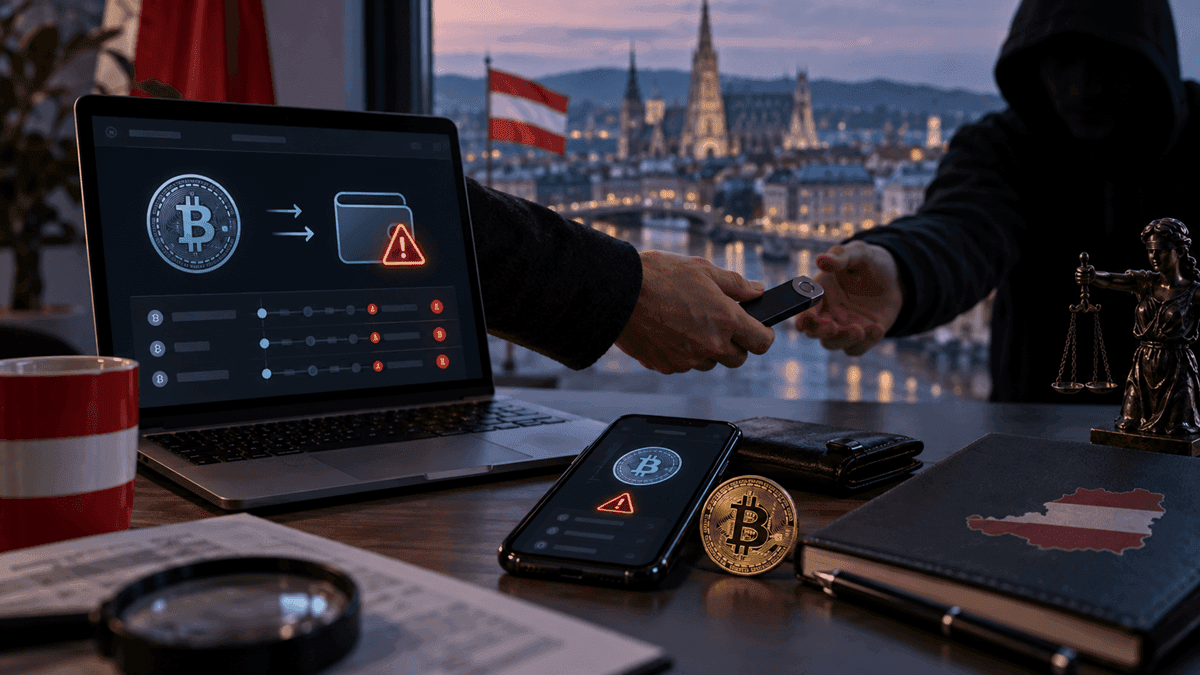
Lost bitcoin to a scam? Why Austria generally does not recognise the damage as a tax loss for privately held assets, and when compensation payments start to matter.
September 12, 2026 7:13 AM

BaFin Warnings in September: How to Check in Three Minutes Whether a Crypto Provider Holds Authorisation
Twelve consumer notices in ten days, five of them on crypto-asset services and two with the entry point in WhatsApp or Telegram. We evaluated all twelve notices ourselves and show the check that takes you three minutes.
September 5, 2026 10:24 PM

Fake German Finance Ministry Letters: Why Nobody May Demand 19 Percent VAT on Your Crypto Purchase
Since September 1, 2026, Germany's Federal Ministry of Finance has been warning about forged letters that demand 19 percent VAT on cryptocurrency purchases while citing real transactions. That tax does not exist, and this is how to spot the forgery.
August 31, 2026 10:12 AM
Fake AML Checks for Crypto Wallets: How to Spot the Scam Sites
Fraudulent websites pose as money-laundering screening services for crypto addresses and ask you to connect your wallet. A genuine check needs only the public address, and three of the domains named by Malwarebytes still respond twelve days later.
August 23, 2026 4:36 PM
Operation ASTERIX: How a Fake Support Call Delivers a Counterfeit Wallet App
Security researchers analysed an open server on which a phone system, phishing interfaces and cloned wallet programs all came together. The largest list of numbers was the German one.
August 23, 2026 1:16 PM
Address Poisoning: Why Seven of Forty Characters Were Enough to Divert $2 Million
A fake wallet address matched the real one in just seven of forty characters and still intercepted 2 million USDC. Our own count of the affected wallet shows that a third of all counterparties in its history belong to such look-alikes.
August 22, 2026 4:16 PM
Crypto Stolen or Scammed: What to Do Now and Where to Report It
Wallet drained or fooled by a fake platform? Which steps count in the first hours, where to file a report, when regulators, exchanges and stablecoin issuers can help, and why recovery services that want money upfront are the second trap.
August 18, 2026 10:19 AM

BaFin Warnings 2026: 24 Crypto Platform Series With 639 Domains, and How to Check Your Provider
In 2026 BaFin is increasingly warning about entire series of near-identical crypto websites rather than about single providers. Our own count of the complete stock of warnings shows how large the phenomenon has become and which two register checks reliably vet a provider.
August 11, 2026 9:18 AM

Your Crypto Exchange Is Telling You to Withdraw: How to Spot Phishing After the MiCA Deadline
Unauthorised crypto providers now have to tell their EU customers to withdraw, which leaves fraudsters an easy run with faked requests. Here is how to check in two minutes whether the message is genuine.

May 23, 2026 10:06 PM
ZachXBT Identity Revealed: Analyzing the Viral Allegations Against the Crypto Detective
On-chain sleuth ZachXBT faces intense scrutiny following a viral X thread tracking his identity and alleging conflicts of interest, selective exposure, and legal violations.
April 19, 2026 10:29 AM

RAVE Token Crash 95% in $6 Billion Wipeout: Insider Scam or Trader’s Paradise?
RAVE plummets 95% as allegations of insider manipulation surface. While retail investors suffer, professional traders eye a "Dead Cat Bounce" opportunity.
April 18, 2026 2:45 AM

Bitpanda Fusion Hits Paris: 100 Traders Take Over the Louvre for Paris Blockchain Week
Bitpanda Fusion takes over Paris with a massive trader flashmob at the Louvre during Paris Blockchain Week 2026. Discover the impact of this liquidity stunt.
April 1, 2026 4:21 PM
The End of Fake Volume? Why Crypto Could Become More Brutal After DOJ Charges
DOJ charges expose crypto manipulation. As fake volume disappears, markets may face lower liquidity and more brutal price swings.
June 3, 2025 7:00 PM

Top 3 Altcoins Under $1 with 10x Potential: Latest Altcoin News Analysis
With several promising altcoins trading under $1, investors are positioning themselves for potential 10x returns. Here are the top 5 that are shortlisted.

May 26, 2025 11:00 PM
Inside Bitget: How COO Vugar Usi Zade Is Shaping the Future of Crypto Trading
From Bitget Seed and AI-powered tools to regulatory strategy and mass adoption, COO Vugar Usi Zade reveals how Bitget is building the next era of crypto trading.
March 12, 2025 8:09 PM

Crypto News Today: Russia Announces Experimental Crypto Investment Regime
Russia's experimental crypto investment regime announcement is a major shift and boost for the cryptocurrency market. While still in its first step, the direction remains towards digital assets, but how will this impact the future of cryptos?
February 24, 2025 12:51 PM

Top 5 Reasons Why Backpack Crypto Exchange is Crushing It
Whether you're a beginner looking for a seamless entry into trading or an advanced user seeking innovative financial products, Backpack has something for everyone.

More from CryptoTicker